
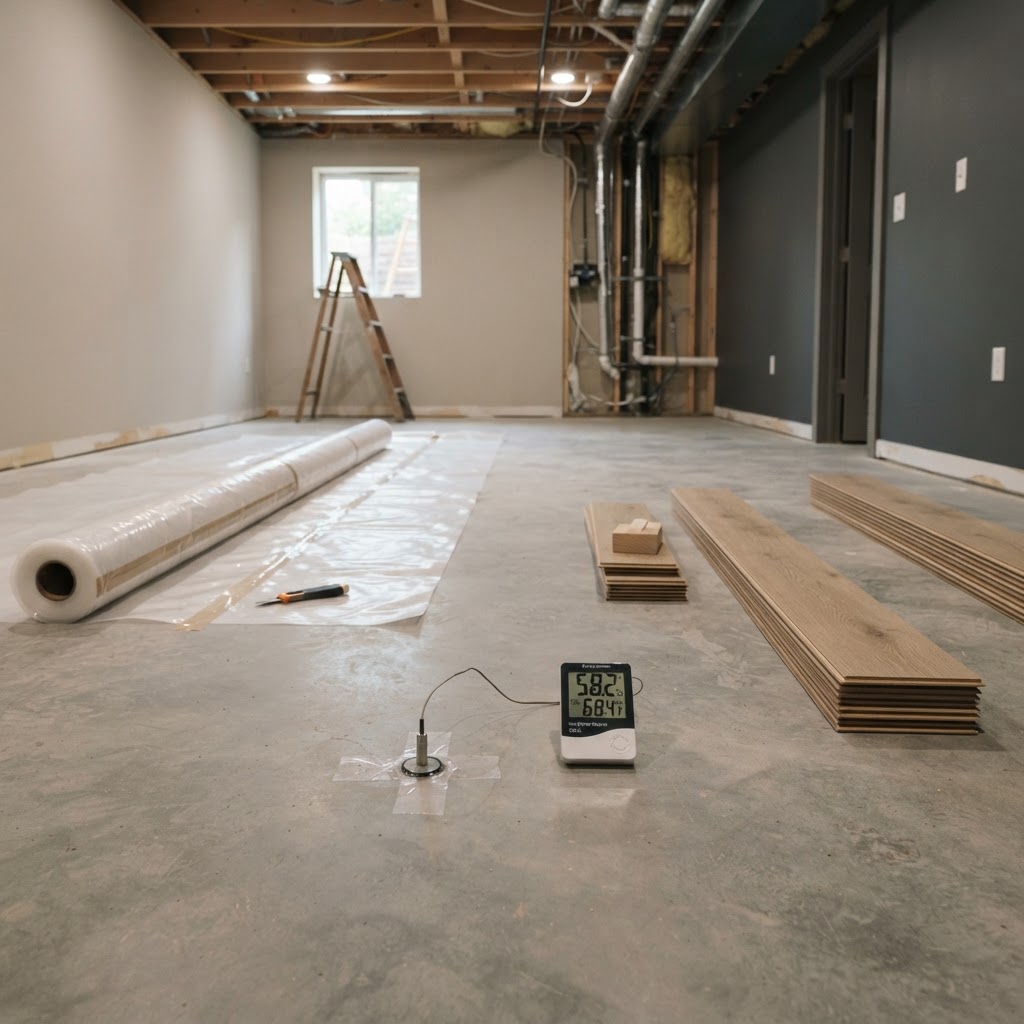
Yes, often. LVP over a basement slab in Northern Virginia usually needs a moisture barrier or moisture-rated underlayment, because the planks are water-resistant but the vapor rising out of the concrete still has to go somewhere. Wood subfloors in a conditioned space usually do not. The plank manufacturer's written limit decides, and testing decides whether the slab meets it.
The short answer
| Subfloor | Barrier typically needed? |
|---|---|
| Concrete slab on or below grade | Usually yes, after testing |
| Upper-level concrete (condo) | Sometimes, after testing |
| Plywood or OSB in a conditioned space | Usually no |
| Floor over a crawlspace | Depends on the crawlspace |
| Existing hard flooring on a slab | Same rules as the slab below it |
The planks being waterproof protects the surface from a spill. It does nothing about vapor coming up through concrete, which is why a floor can smell musty, grow mildew on the back of the planks or lose its adhesive even though the top surface never saw standing water.
Why the slab is the deciding factor
Concrete is porous and stays in contact with soil. In Northern Virginia, much of that soil is clay-heavy and slow to release water, so after a wet stretch it pushes vapor steadily upward. Once planks cover the slab, that vapor collects in the narrow space beneath them.
Finished basements are common across Ashburn and Loudoun County, and many of them sit on slabs poured when the house was built. A basement that reads dry in February can read considerably higher in August. Testing once, in the wrong season, is not the same as knowing.
How moisture actually gets measured
There are two standard tests and two informal ones. Manufacturers publish their limit as a percentage of relative humidity or as a vapor emission rate, and your installer should be able to tell you which one applies to your plank.
- Relative humidity probes. Small holes are drilled and sensors are left inside the concrete to settle before being read. This is the most reliable method and the one most often specified for slabs.
- Calcium chloride test. A covered dish is left on the slab for a set number of days and weighed; the gain shows how much vapor the surface releases.
- Handheld moisture meters. Fast screening, good for finding wet spots, not a substitute for a required test.
- Plastic sheet test. A taped square of plastic left for a day or two. Useful as a warning, never as proof of a dry slab.
If an installer says the slab looks fine and offers no readings, that is a warning sign rather than a clean bill of health.
What the barrier looks like
It is not one product. Common options are a taped polyethylene sheet over the slab, an underlayment with an integrated vapor film, an attached pad the manufacturer has rated for the condition, or a liquid-applied mitigation coating when readings run high.
Which one you get is not a matter of preference. It has to be a product your plank manufacturer accepts, installed the way they specify. A generic sheet from a hardware store, or a pad the manufacturer does not approve, can void the warranty instead of protecting the floor.
Two related mistakes are worth naming. Do not stack a barrier, a loose pad and a plank that already has an attached pad, because the assembly becomes too soft and the locking edges take the stress. And do not treat a barrier as a repair for a leak or bad drainage. Water entering the house has to be handled at the source first.
Northern Virginia specifics
- Basements and lower levels in Ashburn, Leesburg, Reston and Chantilly are the highest-risk rooms, since the slab touches soil.
- Condos around Tysons and Arlington can sit on suspended concrete that is generally drier, but new buildings or radiant heat still warrant a reading.
- New construction may be finished before the slab has finished drying, so a test rather than a calendar should decide.
- Exterior drainage matters as much as anything inside. Clear downspouts, grading that slopes away and a working sump pump can be the difference between a slab that passes and one that never will.
What to ask before you sign
Ask how the slab will be tested, what the readings were, what limit the manufacturer sets and which barrier product will be used. Ask what happens if the reading comes back too high, who decides, and whether any of it appears in the written scope of work. A contractor who answers those questions in writing is one you can rely on years later.
Floors and Beyond VA has served Northern Virginia since 1987 with its own employee crews, and every slab installation we quote includes the moisture details in the written scope. Before we recommend a plank, we look at the space, ask about the history of water in the room and check the manufacturer's requirements. If the slab is not ready, we say so and lay out the options instead of installing over a problem.
Keep reading
The full explanation, including the individual test methods, the biggest mistakes we see and how to maintain a basement once the floor is down, is in Moisture Barrier for LVP Flooring: When Northern Virginia Homes Need One.
Planning a lower level in Loudoun County? See our LVP flooring in Ashburn, VA.
Frequently asked questions
Is a moisture barrier the same as underlayment?
No. A barrier slows vapor; an underlayment cushions and reduces sound. Some underlayments include a vapor film, and some do not.
Can I skip testing if the basement has never flooded?
Flooding and vapor are different problems. A slab can release steady vapor without any flood history at all.
Will a barrier fix a damp basement?
No. It manages vapor at the floor assembly. Damp walls, leaks or poor drainage need to be corrected separately.
Does waterproof LVP make the barrier unnecessary?
No. Waterproof refers to the plank itself, not to the assembly underneath it.
Schedule an in-home estimate at floorsandbeyondva.com/Contact or call (703) 906-5698.




