
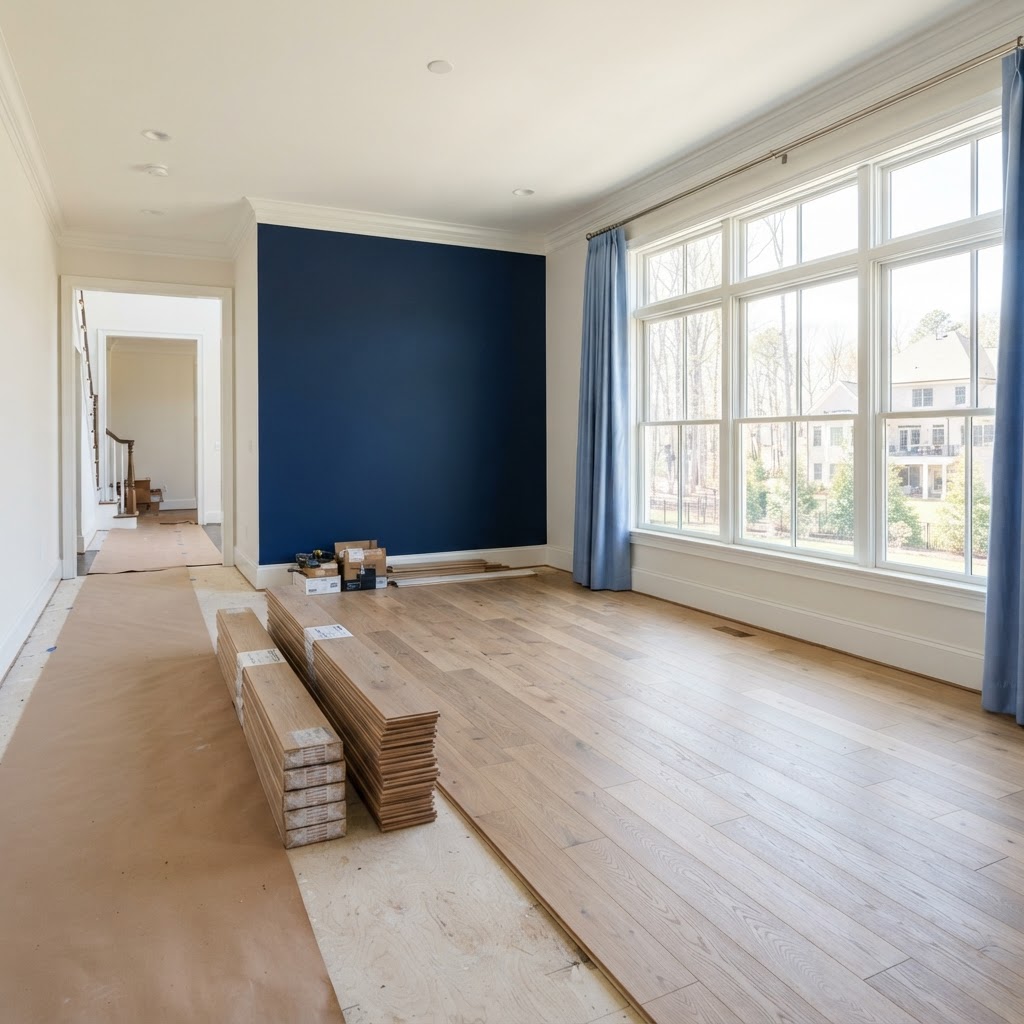
What does a flooring renovation in McLean, VA look like from start to finish?
A flooring renovation in McLean, VA moves through a predictable sequence: a free in-home consultation where the contractor inspects the original floors and brings samples, an honest all-inclusive estimate, a careful material selection, preparation of the home and subfloor, removal or restoration of the existing floor, installation or refinishing, finishing details such as transitions and molding, full cleanup and a final walkthrough. Understanding each step helps you choose a flooring contractor with confidence and know what to expect from the first phone call to the finished floor. Floors and Beyond VA, a family-owned Northern Virginia flooring and remodeling contractor serving Fairfax, Loudoun, Prince William and Arlington counties since 1987, carries out every project with in-house crews and no subcontractors, and this walkthrough describes how a typical project unfolds in our hands.
A note on what this article is: it is a representative walkthrough of how we approach a typical McLean flooring renovation, based on the way we work on every project, and it is not the story of one particular customer's home. We believe that homeowners choosing a flooring contractor deserve to see the whole process, not just a before-and-after photograph, because the quality of a finished floor is determined by what happens long before the last board is laid. Many people searching for a flooring contractor in McLean compare companies by their websites and service lists. Those descriptions tell you what a company does, but not how it does it. By following a project from the original problem to the finished result, you can see what separates careful work from careless work, and you can judge any contractor, including us, by the same standards. For related reading, see our flooring installation guide, and our articles on choosing a local flooring contractor over a big-box store and flooring companies that offer free in-home consultations.
The starting point: an original floor and a problem to solve
Every project begins with a reason. In McLean, the reasons are familiar. The original oak floors in a mid-century rancher have lost their finish and look gray in the traffic paths. A colonial's wall-to-wall carpet is worn, stained and tired. A kitchen floor has been damaged by a slow leak. A family wants to open the main level and needs flooring that flows through new spaces. A finished basement needs new flooring that can handle moisture. A home is about to be listed, and the floors will be the first thing buyers notice.
The first step is simply to describe what is wrong and what you would like. A good contractor listens to the problem, asks about the household, pets, schedule and goals, and resists the temptation to propose a standard product before seeing the house. When you contact Floors and Beyond VA, we schedule a free in-home consultation. We come to you. We do not have a showroom, so the samples come to your home, where you can see them in your own light, next to your own cabinets, trim and paint, which is where flooring decisions should be made.
The consultation: looking closely before recommending anything
The consultation is the foundation of the project. We walk through every room involved and talk through what you want. We inspect the existing floors closely: the surface, the finish, the boards, the gaps, the transitions, the stairs. If carpet covers the floor, we lift a corner to look beneath it, because original hardwood is frequently hidden underneath in established McLean homes. We check the subfloor where we can, test for moisture where appropriate and look for signs of past damage.
We take precise laser measurements, at no charge. Accurate measurement matters for ordering the right quantity of material, for planning transitions and for understanding how floor heights will interact with doors, appliances and adjoining rooms. Our article on how much flooring you need explains why overage and layout matter.
Throughout, we apply our refinish-first philosophy. If your hardwood can be saved, we will tell you, because preserving good material is usually wiser than discarding it. If it truly cannot, we will explain why. Our articles on whether your hardwood floors can be saved and whether refinishing is worth it describe how we think about the decision.
The decision: refinish, repair, replace or convert
After the inspection, there are usually several paths, and the right one depends on what we find.
If the existing hardwood is structurally sound, refinishing may transform it. If damage is localized, repair and refinish blends the two. If the floor is beyond saving or you want a different look, replacement with hardwood, engineered hardwood, luxury vinyl plank or tile may be the answer. If carpet is the problem, conversion to a hard surface involves its own considerations, such as door clearances and stairs. Our articles on flooring replacement: when and what to choose and carpet to hard flooring conversion in Northern Virginia explain these paths, and our wood flooring, vinyl flooring, tile and stone and carpet pages describe the services themselves.
A good contractor presents the choices, explains the tradeoffs and lets you decide. We do not push one product for every house.
Material selection: choosing with samples in your own light
Once you know the path, you choose materials. This is where samples earn their keep. A color that looks right in a catalog can look very different in a McLean home with large windows, or in a basement with limited natural light. We bring samples to your home so you can compare them against your cabinets, countertops, trim and paint at different times of day.
We talk through the practical qualities that matter: durability for your household, moisture tolerance for the room, how the product ages, how it feels underfoot, how it is maintained and how it will meet adjoining floors. For hardwood, we discuss species, width, finish and sheen. For LVP, we discuss wear layer, core and realism. For tile, we discuss format, finish and slip resistance. For carpet, we discuss fiber, density and pad. Our articles on engineered wide-plank flooring in Northern Virginia, how to choose luxury vinyl plank and choosing carpet in Northern Virginia help you prepare.
If you are updating more than flooring, we think about the whole space. Our kitchen remodeling, bathroom remodeling, basement finishing, home additions and whole house remodels services let us coordinate flooring with the rest of the project.
The estimate: honest, all-inclusive and in writing
After the consultation, you receive a written estimate. At Floors and Beyond VA, it is an honest, all-inclusive estimate, and what we quote is what you pay. It includes old flooring removal, new materials, professional installation, furniture moving, transitions, molding and full cleanup. We do not bury extra charges in fine print, and we explain what could change the scope, such as hidden subfloor damage discovered after the old floor comes up.
When you compare estimates from different contractors, compare scope, not just totals. Ask what is included and excluded. Our article on flooring cost factors in Northern Virginia explains why legitimate estimates differ, and it helps you ask the right questions of any company.
Preparing the home
Before the crew arrives, we work with you to prepare. Rooms are cleared or furniture is moved, and our estimates include furniture moving. We protect adjoining areas, set up dust control and plan access routes for materials and equipment. We discuss pets, children and your schedule. If the home is a condominium or townhome, we coordinate with the association regarding approvals, work hours, elevator use and insurance documentation, which our condominium remodeling page and our article on condo remodeling rules and permits discuss.
We also plan delivery so that materials arrive early enough to acclimate if the product requires it, and we confirm that indoor conditions are appropriate. Our guide to preparing your home for new floors provides a thorough checklist.
Removal and discovery: what is really under there
When the project begins, removal often reveals the true condition of the home. Old carpet and pad come up. Old tile or vinyl is removed. Adhesives are scraped. The subfloor is exposed.
This is the stage at which surprises appear. Perhaps there is water damage that was hidden, squeaks from loose subflooring, uneven areas, old staples and tack strips or layers of previous flooring. In older homes, certain historic adhesives and materials may contain hazardous substances such as asbestos, and a responsible contractor raises testing and safe handling before disturbing them. A good contractor communicates promptly when something is found, explains what it means for the plan and gives you options. We do not hide problems or quietly work around them.
Preparing the subfloor: the work that does not show
The subfloor determines how long a floor lasts and how good it looks. Preparation includes repairing damaged areas, re-fastening loose panels to reduce squeaks, flattening high spots, filling low spots, cleaning thoroughly and testing for moisture. Over concrete slabs, moisture testing and mitigation are essential. For hardwood, the subfloor must be dry, flat and sound, and fastening patterns matter. For LVP and large tile, flatness requirements are strict, because imperfections telegraph through thin materials or cause tile to crack.
This stage is often the least glamorous and the most important. Homeowners rarely see it, and many cut-rate bids skip it. It is where an experienced crew earns its reputation. Our flooring installation guide explains our approach in detail, and our guides to flooring for the basement and the best flooring on concrete basements address special conditions below grade.
Restoration or installation: where craft shows
If the project is a refinish, the crew now repairs damaged boards, fills gaps where appropriate, sands the floor in stages with dust control, cleans the surface thoroughly and applies stain, if desired, and finish coats, allowing proper drying time between them. Edges, corners, stairs and detail areas receive careful attention. Our hardwood floor refinishing field guide for Northern Virginia describes this in detail.
If the project is an installation, the crew lays out the room carefully, planning where boards or tiles begin and end so that cuts at edges look balanced. Hardwood is fastened according to the manufacturer's instructions, with expansion gaps where required. LVP is assembled as a floating floor with attention to staggering and gaps. Tile is set with consistent spacing, level surfaces and careful grout lines. Carpet is stretched tightly and seamed discreetly. Stairs receive custom fitting. Throughout, the crew checks work as it progresses.
Our in-house crews do this work, and because they are our employees, we train them, supervise them and answer for the result. We use no subcontractors.
Finishing details: where good work becomes great work
Transitions, thresholds, trim, baseboards, shoe molding, stair nosings, vent covers and door clearances are the details that make a floor look finished. A beautiful floor can be undermined by a gap at a threshold or an unpainted piece of molding. Our estimates include transitions and molding, and our crews take the time to fit and finish them carefully.
Where new flooring meets existing floors, whether hardwood to hardwood, hardwood to tile or hardwood to carpet, the transition is designed so that heights align and the line looks intentional. Our accessibility services pay particular attention to smooth, safe transitions.
Cleanup and final walkthrough
When the work is complete, the crew cleans thoroughly. Debris is removed, surfaces are cleaned and the home is returned to you in order. We walk through the finished project with you, explain what to expect, review care instructions and answer questions. For refinished floors, we explain curing time and when furniture and rugs can return. For all floors, we explain how to maintain them. Our floor care page offers ongoing guidance.
A walkthrough is also your opportunity to point out anything that needs attention. A responsible contractor welcomes this and follows up.
What a finished project reveals about the contractor
A finished floor tells you a great deal. Look at the lines where boards or tiles meet walls. Look at transitions and thresholds. Look at stairs, closets and corners. Look at how clean the site is. Look at whether the floor feels solid and quiet underfoot. Notice whether the crew treated your home with respect and communicated clearly. These are the clues that distinguish careful work from careless work, and they are the same clues you can look for when evaluating any contractor's previous projects.
When you evaluate a company, ask to see examples of similar work and to speak with recent customers. A contractor confident in its process will welcome the request. And verify the basics: that the company is properly licensed, bonded and insured, and that the people doing the work are accountable. DPOR licensing requirements depend on the scope and value of a project and can change, so verify current requirements directly with the Virginia Department of Professional and Occupational Regulation. Floors and Beyond VA is fully licensed, bonded and insured for every project.
What drives the scope of a renovation like this
We do not publish prices in articles, but the factors that shape any flooring estimate are clear. The condition of the existing floors and whether they can be refinished. The material and its quality tier. Square footage and layout. Subfloor condition, including flatness and moisture. Removal of existing flooring. Stairs. Transitions, trim and molding. Furniture moving. Pattern or layout complexity. And the company, including its crews, licensing, bonding and insurance.
At Floors and Beyond VA, what we quote is what you pay.
Common mistakes in choosing a contractor and planning a project
The first mistake is choosing a contractor without an in-home consultation.
The second is skipping the subfloor conversation.
The third is assuming old floors must be replaced, without checking whether they can be refinished.
The fourth is choosing materials from a catalog instead of seeing samples in your own light.
The fifth is comparing estimates that differ in scope.
The sixth is not asking who will actually do the work.
The seventh is neglecting to plan for discoveries once the old floor is removed.
The eighth is ignoring transitions and trim until the end.
The ninth is failing to verify licensing, bonding and insurance.
The tenth is hiring on price alone.
Frequently asked questions
What happens during a flooring consultation? We walk your home, inspect the floors and subfloor, take precise laser measurements and bring samples for you to view in your own light. It is free.
Do you have a showroom? No. We bring samples to your home, where you can see them with your own cabinets, trim and paint.
How long does a flooring project take? It depends on the scope. We provide a realistic schedule during your consultation.
What if you find problems under the old floor? We tell you promptly, explain what it means and give you options. Our all-inclusive estimate explains what could change the scope.
Who does the work? Our in-house crews. We do not use subcontractors.
Are you licensed and insured? Yes. We are fully licensed, bonded and insured for every project.
Can you work with my condo association? Yes. We coordinate approvals and provide the documentation associations typically request.
Do you serve my McLean neighborhood? Yes, including Langley, Chesterbrook, Franklin Park, Salona Village, Hamilton, Dunn Loring, Vienna, Great Falls and Tysons, as well as Fairfax, Loudoun, Prince William and Arlington counties.
Ready to begin your own flooring renovation?
Every great floor begins with a conversation and a careful look at what you have. Floors and Beyond VA brings nearly forty years of Northern Virginia experience, in-house crews with no subcontractors, a refinish-first philosophy and a free in-home consultation with samples and precise laser measurements at no charge.
Request your free McLean flooring estimate: https://floorsandbeyondva.com/Contact
You can also call (703) 906-5698 or email hello@floorsandbeyondva.com.




