
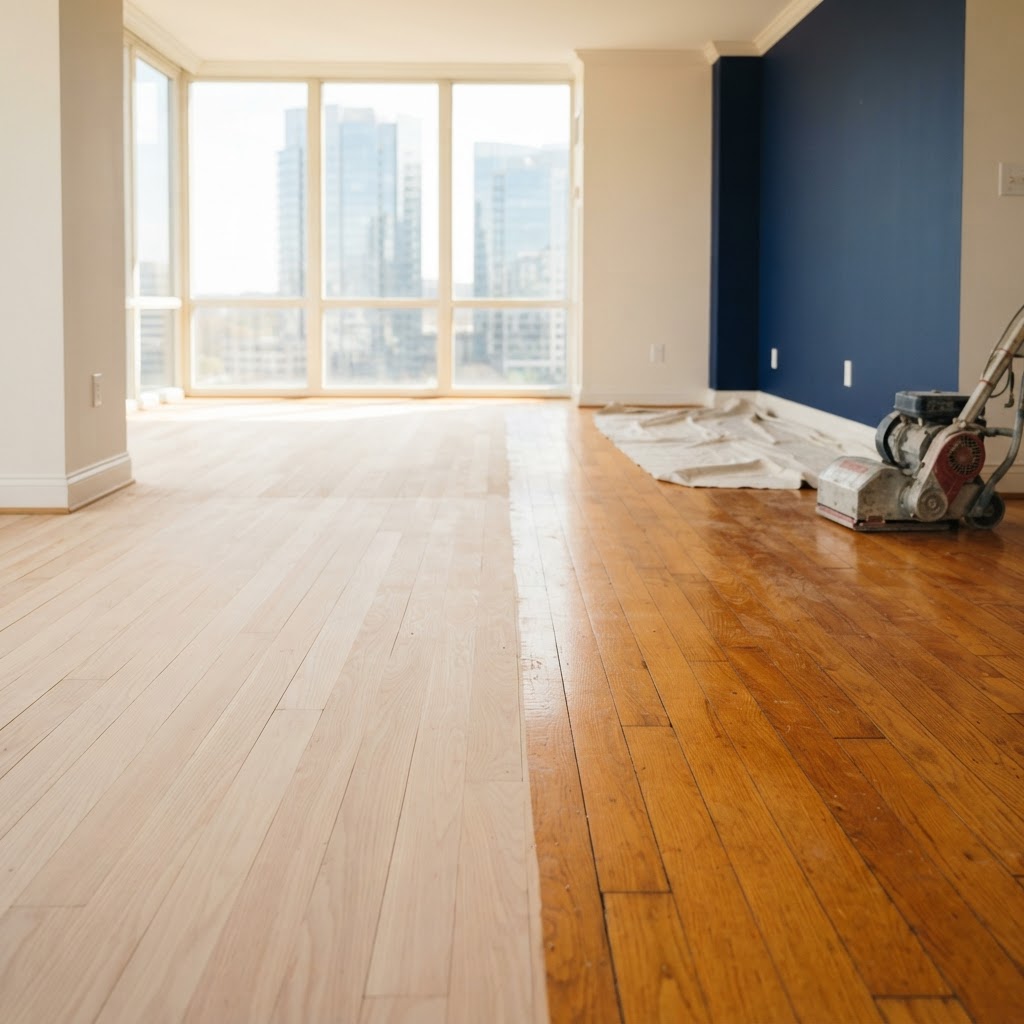
Tysons Corner is one of the most varied housing markets in Northern Virginia. Within a few minutes of the Metro stations you can find high-rise condominiums, mid-rise buildings, townhome communities, mid-century single-family homes and newer infill houses, and the neighborhoods around it, such as McLean, Vienna and Falls Church, add still more variety. Each of these housing types presents a different set of conditions for hardwood floor refinishing. This guide from Floors and Beyond VA explains what to expect when refinishing hardwood floors in Tysons Corner and the surrounding area, how condominium rules shape the work, what kinds of floors you are likely to have, how to prepare, and how to choose the right crew.
Why Tysons is different from a typical suburb
Most refinishing guides assume a single-family house with a basement, a driveway and no neighbors on the other side of the wall. In Tysons that is only part of the picture. Many homeowners live in condominiums where the floors sit above or below other units, the building has shared elevators and loading areas, and the owners' association sets rules. Others live in townhomes with shared walls and tight parking. Even the single-family homes tend to be on compact lots with neighbors close by.
That means the planning is as important as the sanding. Access, noise, odor, dust control and timing all matter more in dense housing than they do in a detached home on a large lot. A contractor who works in the area regularly knows what to ask before the first day.
The floors you are most likely to have
Engineered hardwood in condominiums. Many condominium buildings in and around Tysons were built on concrete, and engineered hardwood is common in those units because it is stable over slabs. The key question is the thickness of the wear layer. A thick wear layer can sometimes be sanded once or more. A thin one may only accept a screen and recoat. We cover how this is decided in our post on engineered hardwood floor refinishing.
Solid oak in older single-family homes. Tysons and the neighboring communities include homes built in the decades after the Second World War, many with original strip oak that is three-quarters of an inch thick. These floors can often be refinished several times and respond well to floor restoration, especially if they have been under carpet.
Builder-grade floors in newer townhomes. Newer townhomes and infill houses often have solid or engineered floors with factory or site-applied finishes that wear in the first traffic paths. These are frequently good candidates for a screen and recoat, as long as the finish is compatible.
Mixed floors. Renovations frequently leave a home with several different types of wood. Matching color and sheen across them takes testing.
Condominium rules: what to check before you schedule
If you live in a condominium or a building with an association, check the rules first. They are usually found in the governing documents or a renovation policy, and the management office can provide them. Typical items include the following.
Approved work hours. Many buildings limit noisy work to weekday daytime hours and prohibit work on weekends or holidays.
Notice and approval. You may need to submit a renovation request in advance, sometimes with details of the scope and the contractor.
Insurance. Associations commonly require the contractor to provide a certificate of insurance, and some require it to name the association or the management company.
Elevator and loading dock reservations. Moving equipment and materials may require a reserved time and protective padding in the elevator and hallways.
Floor covering and sound rules. Some buildings have requirements about the sound-insulating properties of floor coverings, particularly where a unit is above another. Refinishing an existing floor usually does not change those properties, but replacement can.
Odor and ventilation restrictions. Finishes that release strong fumes may be restricted or may require special ventilation. Water-based finishes are common in these buildings because of lower odor, though this depends on the product and the situation.
Debris and waste disposal. Rules often specify where construction waste can go and how it must be carried out.
A contractor who has worked in condominiums can help with the paperwork and the logistics. If a company has never done it, it is better to find that out before the start date.
Dust, noise and odor in close quarters
Dense housing amplifies the side effects of refinishing. Here is how a careful crew manages them.
Dust. Sanding with vacuum-connected equipment captures most of the dust. Doorways to other rooms are sealed with plastic, vents are covered and the area is cleaned thoroughly at the end of each stage. Claims of a completely dust-free job are unrealistic, and edges and stairs will always produce some dust, but a good plan keeps it contained.
Noise. Drum and edge sanders are loud, and sound travels through concrete and framing. Scheduling within permitted hours and warning neighbors in advance help maintain good relationships. A short notice on neighbors' doors is a courteous step.
Odor. Finishes have an odor while they dry. Ventilation, product choice and timing all matter. If anyone in the household is sensitive to odors, or if there are infants or pets, tell your contractor so that they can choose products and plan accordingly.
Parking and access. Tysons has plenty of parking garages and limited street parking in some neighborhoods. Plan where the crew will park and how equipment will get to the unit.
Preparing your home
Good preparation shortens the project and reduces risk.
Clear the floors. Furniture needs to be moved out of the work area, or the crew can move it as agreed in the scope. Decide who is responsible for what in advance, including heavy items.
Take down hanging items near the work, such as artwork and mirrors, and secure fragile items.
Remove rugs and anything that sits on the floor, including plants and floor lamps.
Protect valuables and electronics. Even with dust control, fine dust can find its way into open shelves and equipment.
Plan for pets and people. The work area will be off limits, and you may prefer to have pets stay elsewhere during the work.
Know the timeline. Ask for a written schedule, including when the floor will be walkable, when furniture can return and when rugs can return.
How long does it take?
The answer depends on the size of the area, the approach and the product. A screen and recoat of a single room can often be completed in a day or two. A full sanding, staining and finishing project takes several days, because the finish needs time to dry between coats. Furniture and rugs go back later than foot traffic. A contractor who understands the product will give you realistic times, and condominium rules may add scheduling constraints. We explain the stages in more detail in our post on how long refinishing takes.
Thinking about your own floors? Floors and Beyond VA offers in-home estimates across Northern Virginia. Schedule yours at floorsandbeyondva.com/Contact or call (703) 906-5698.
Choosing a finish and color for Tysons-area homes
Homes around Tysons vary from contemporary condominiums with bright, open plans to traditional houses with formal rooms, and the finish should suit the setting. Satin and matte sheens are popular because they hide dust and minor wear and look natural in open layouts with a lot of light. Higher sheens show more of the floor's imperfections. Natural and lighter tones tend to make small spaces feel larger, while darker stains add contrast but show dust and pet hair more readily. Because every wood species takes stain differently, a sample on your own floor is more reliable than a color chip. If your floor connects to rooms with different woods, test on both so the overall look is cohesive.
Open-plan layouts and where to stop
Open layouts raise a practical question that surprises many homeowners: where does the refinished area end? A kitchen, dining room and living room that flow together should usually be finished together so that there is no visible line. Stopping partway across a continuous floor leaves a seam that is hard to hide. Natural breaks such as doorways, thresholds and changes in flooring direction are better stopping points. A careful contractor will walk through the layout with you and mark the boundaries before work starts, which is part of how Floors and Beyond VA plans every project.
Protecting the floor afterward
A refinished floor lasts longer with a few simple habits. Use felt pads under furniture and lift rather than drag. Place mats at the entrance to catch grit. In a high-rise or townhome with a lot of foot traffic, a hall runner can protect the main path. Clean with products approved for the finish and avoid steam cleaners. Keep indoor humidity within a moderate range, since dry winter air can open small gaps. Recoat before the finish wears through, which is a far lighter job than a full sanding. These habits matter more in Tysons than most places, because the floors often have limited wear layer to spare.
When refinishing is not the answer
Sometimes the honest recommendation is not to refinish. A very thin engineered floor, a floor with widespread water damage or a floor that has been sanded to its limit may be better served by repairs or replacement. In those cases Floors and Beyond VA will explain why and help you compare options such as new engineered hardwood or luxury vinyl plank. Our goal is to give you a clear picture before any work starts, so the decision rests on the condition of your floors and not on a sales pitch.
How to choose a contractor in the Tysons area
Everything in our general guide on choosing a hardwood floor refinishing contractor applies here, with a few additions for Tysons.
Ask about condominium experience. How many condo projects has the company done in the last year? Can they handle the association's paperwork?
Ask about insurance and licensing. Confirm the Virginia license number and ask for a certificate of insurance. Associations will probably ask for it too.
Ask who will be on site. Some companies use subcontractors. At Floors and Beyond VA, our crews are our own employees.
Ask about the wear layer assessment. For engineered floors, the contractor should tell you how thick the wear layer is and what that means for sanding.
Ask about dust, noise and odor plans. A specific answer is a good sign.
Get the scope in writing. It should list rooms, approach, products, coats, sheen, schedule and warranty.
Signs your floors need attention
Dull paths. The finish has worn in the places where people walk most often.
Scratches and scuffs from furniture, pets or shoes.
Cloudy or whitish patches from moisture or cleaning products.
Fading near windows where sunlight hits.
Sticky or tacky surfaces from the wrong cleaning product or leftover residue.
Discoloration at doors, entry points or kitchen areas.
Do not wait until the finish is gone and bare wood is exposed. Renewing the finish while it still protects the wood is easier on the floor and often easier on the schedule. We discuss the lighter options in our post on sandless hardwood floor refinishing.
A word about the homes around Tysons
Homes in McLean, Vienna and Falls Church often have older solid oak. If you are renovating a home from the 1950s or 1960s, there may be hardwood under carpet or vinyl, and it is worth checking a closet corner before you decide to replace it. In larger renovated houses, the question may be matching a new addition to an old floor, and a careful contractor tests samples on both.
Planning the project around a busy schedule
Many Tysons-area homeowners work long hours, travel and have little flexibility in the middle of the day. Tell your contractor early how access will work: who will be home, how the crew gets into the building, whether a concierge or property manager needs advance notice and where materials can be stored overnight. In a condominium, ask whether the crew can leave equipment on site between days or whether it must go out each evening. Agree on a daily start and end time that fits the building's rules and your own routine. Clear communication about these practical details prevents most of the delays that homeowners associate with refinishing, and it lets the crew spend its time on the floor.
Questions neighbors often ask
Neighbors in a shared building usually want to know three things: when the noisy work will happen, how long it will last and who to contact if there is a problem. Giving them that information in advance, along with your contact details, avoids most complaints. Letting the management office know the dates also helps if staff need to assist with access or elevator use. A short, friendly notice is a small effort that makes a real difference to how the project is received, and our crews are happy to work within the hours the building sets.
How Floors and Beyond VA can help
Floors and Beyond VA is family-owned and has served Northern Virginia since 1987. We take a refinish-first approach, which means we try to renew what you have before suggesting replacement. We begin with an in-person evaluation, check the wood and the finish, explain what we find and put the plan in writing. If you live in Tysons, McLean, Vienna or the nearby communities, you can learn more about our floor restoration services in Tysons, VA, and more about us as a flooring company in Tysons.
For the short version of this question, read the companion NoVA Guide entry: Who refinishes hardwood floors in Tysons Corner, VA, and what should I ask them?
Frequently asked questions
Can I refinish hardwood floors in a condo?
Often yes, subject to association rules and the type of floor. Engineered floors depend on wear layer thickness. Check with management before scheduling.
Do I need approval from my association?
Many associations require notice or approval for renovation work, including floor refinishing. Check your governing documents.
Will refinishing disturb my neighbors?
Sanding is noisy, and some dust and odor are possible. Working within permitted hours, containing dust and notifying neighbors helps.
How soon can I use my floor?
Light foot traffic is usually possible after a day or so, with furniture and rugs later. Your contractor should give specific times for the product used.
Can the work be done in a day?
A screen and recoat in a small area sometimes can. A full refinish takes several days because of drying times.
Which finish is better for a condo?
Many homeowners choose water-based finishes for lower odor and quicker drying, but the right choice depends on the floor, the look you want and building rules.
What if my floor is too thin to sand?
A screen and recoat, repairs or replacement may be better options. A careful assessment decides.
Talk to Floors and Beyond VA
If you are planning hardwood floor refinishing in Tysons Corner or the surrounding area, we would be glad to look at your floors and explain your options. Floors and Beyond VA will evaluate the wood, review any association requirements with you and give you a written plan. Schedule an in-home estimate at floorsandbeyondva.com/Contact or call (703) 906-5698.




