
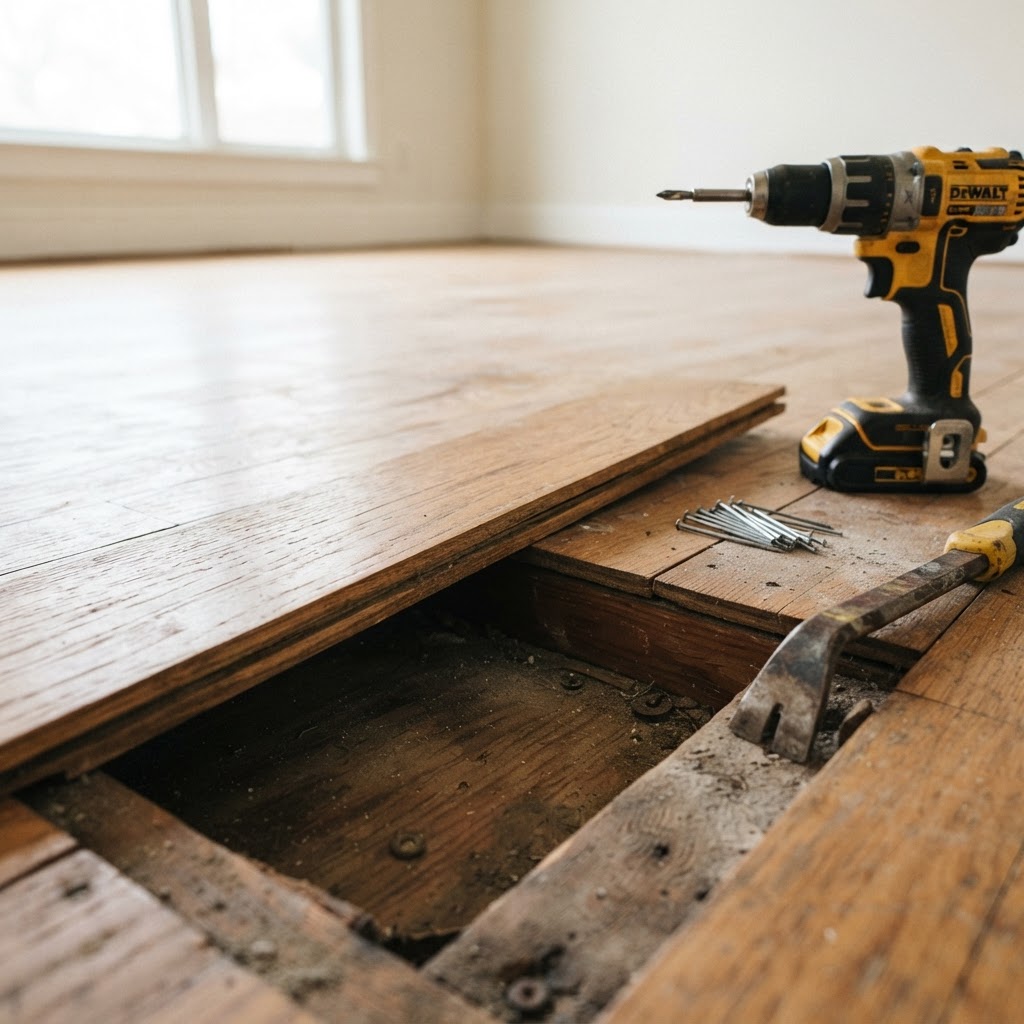
Creaky hardwood floor repair starts with a simple question: where is the noise coming from, and why? A hardwood floor squeaks when two pieces of wood, or a piece of wood and a fastener, rub against each other as you step. The movement may come from boards that have shrunk, a subfloor that has loosened from the joists, nails that have worked loose, joists that have shifted or humidity changes that make wood expand and contract through the year. Most creaks can be reduced, and many can be eliminated, but the right fix depends on the cause and on whether you can reach the floor from above or below. Homeowners in Vienna, Falls Church, McLean and across Northern Virginia, particularly in older houses, ask about squeaks constantly. This guide explains why floors creak, how to diagnose the source, what you can try yourself, what professionals do and when a creak is a sign of something more serious. At Floors and Beyond VA, we repair and restore hardwood floors across the region.
WHY HARDWOOD FLOORS CREAK
A typical hardwood floor has several layers. The hardwood boards sit on a subfloor of plywood or planks, and the subfloor is attached to joists below. Boards are fastened to the subfloor with nails or staples, and tongue-and-groove edges connect neighboring boards. A squeak happens when one of these connections allows movement. Common causes include the following.
Boards rubbing against each other. As wood dries in winter, boards shrink slightly and can rub at their edges as you walk. The result is a high-pitched squeak or crackle, often in a patch of floor.
Boards rubbing against nails. A nail that has loosened, or one that is not tightly seated, can move in the hole and squeak.
Subfloor not tight to the joists. If the subfloor has pulled away from a joist, it flexes under weight and rubs against the fasteners. This often produces a deeper creak that you can feel as well as hear.
Subfloor seams. Where two sheets of plywood meet, movement at the seam can create noise.
Joists that have shifted, twisted or shrunk. Over time, framing members dry and move. Gaps between joists and subfloor create room for noise.
Humidity swings. Dry winter air shrinks wood, and humid summers swell it. Many creaks are seasonal, worse in winter and quieter in summer.
Loose or missing fasteners. Floors installed with too few nails, or with fasteners that have loosened, move more.
Construction details. Builder-grade installations, floors laid over uneven subfloors or boards that were not fully seated can squeak from the start.
HOW TO FIND THE SOURCE
Diagnosis comes first. Walk the floor slowly and mark the spots that creak. Notice whether the sound comes when you step on one board or when weight moves across several. Notice whether the creak is worse at certain times of year. If you can reach the underside of the floor, such as in a basement or crawl space, have someone walk above while you look and listen below. Look for gaps between the subfloor and joists, loose or missing nails, shims that have fallen out and signs of moisture. If you cannot reach from below, as in a second-floor room or a floor over a finished ceiling, the repair will be from above.
WHAT YOU CAN TRY YOURSELF
Several simple methods can reduce light squeaks. A dry lubricant such as powdered graphite or talcum powder worked into the joints between boards can reduce friction between boards that rub at their edges. It is a temporary fix, and some products can leave residue that interferes with later refinishing, so use sparingly and tell your contractor if you have used any. Humidifying the home in dry winter months can reduce seasonal creaks. From below, shims driven gently into gaps between the subfloor and joists can reduce movement, as can construction adhesive applied carefully. Screws driven from below through the subfloor and into the underside of the boards can pull them tight, if you can reach and the lengths are right. These are practical jobs for confident homeowners, but a mistake, such as a screw that penetrates the top of the floor, can cause damage.
WHAT PROFESSIONALS DO FROM ABOVE
When you cannot reach the floor from below, professionals have several options. Special fasteners designed for hardwood floors can be driven through the face of the board into the joist, with the head hidden by a trim-head screw or a break-off design that leaves only a small hole. The holes are filled and blended with the finish. The key is finding the joist and driving the fastener at the right angle and depth, which takes experience and tools. In some cases, boards are re-nailed with finish nails in a pattern that pulls them tight. If squeaks come from boards rubbing, a small amount of lubricant may be applied by a technician who knows what is compatible with the finish. When the floor is being refinished, squeaks can be addressed beforehand, which is the ideal time because repairs are blended into the sanded surface.
WHAT PROFESSIONALS DO FROM BELOW
If the subfloor is accessible, a contractor can add shims between the joists and subfloor, glue and screw the subfloor to the joists, add blocking, sister joists that have shifted or fasten loose boards from beneath. These repairs address the structure, not just the symptom, and they usually last. In basements or crawl spaces with moisture problems, the moisture must be addressed too, because it will reintroduce movement.
TALK TO A SPECIALIST BEFORE YOU DRILL
Many squeaks are simple, but some come from structural issues, and a quick inspection tells you which. A mistake with a drill or nail gun can damage a floor, and some home remedies leave residue that interferes with refinishing. Floors and Beyond VA offers in-home estimates in Vienna, Falls Church, McLean, Tysons and throughout Northern Virginia. Schedule an in-home estimate at floorsandbeyondva.com/Contact or call (703) 906-5698, and we will walk the floor, find the cause and explain the options.
WHEN A CREAK IS MORE THAN A NUISANCE
Most squeaks are annoying but harmless. A few are warnings. If a floor sags, dips or feels spongy, the subfloor or joists may be damaged by moisture, rot or insects. If creaking is accompanied by cupping, buckling or musty odors, moisture is likely involved. If a section of floor moves visibly under weight, or you see cracks in walls or ceilings nearby, a structural problem is possible. In those cases, have a qualified professional inspect the framing before cosmetic repairs. A flooring contractor can often identify the signs and recommend the right specialist.
CREAKS IN OLDER NORTHERN VIRGINIA HOMES
Older homes in Vienna, Falls Church, Arlington, Alexandria and Fairfax often have hardwood floors that have been in place for many decades. Their boards are usually face-nailed or blind-nailed into plank or plywood subfloors that have moved over time. Their joists may be undersized by modern standards or have settled. A certain amount of sound is part of the character of these houses, and some creaks cannot be fully eliminated without relaying the floor. A frank discussion about what is realistic helps. When an old floor is being restored, it is the best moment to secure loose boards and reduce noise. Our guide to wood floor restoration in Northern Virginia and our article on what floor restoration includes explain how repairs are handled.
NEWER HOMES AND BUILDER-GRADE FLOORS
Newer houses and townhomes can creak too. Fast construction, engineered joists that flex, subfloors that dried after installation and hardwood that shrank when the home's heating came on all contribute. Many builders use adhesives and nails, but the quality varies. In townhomes with shared walls, sound can travel, and floor noise may be more noticeable. A repair from below or above can often resolve the problem, and in some cases, the builder's warranty may cover it, so check first if the home is new.
ENGINEERED HARDWOOD AND OTHER FLOORS
Engineered hardwood can creak when a floating floor is not fully supported by the underlayment or when the subfloor is uneven. Glue down engineered floors rarely creak if the bond is good. Laminate and vinyl floors can click or pop for similar reasons. The fix depends on the installation method. Our guide to engineered hardwood installation explains the methods, and the same principles apply to diagnosing noise.
HUMIDITY AND SEASONAL SQUEAKS
Northern Virginia's seasons make a difference. In winter, indoor air gets dry, boards shrink and gaps open, which makes squeaks more likely. In summer, humidity swells the wood and the floor may quiet down. A humidifier in winter and a dehumidifier or air conditioning in summer can keep indoor humidity in a moderate range and reduce movement. If a floor creaks more in winter and quiets in summer, humidity is likely a factor. Our guide on why hardwood floors gap in winter explains the movement.
WHAT A REPAIR CAN AND CANNOT DO
A good repair can silence most creaks in the areas it addresses and prevent new ones from developing. It cannot guarantee that every creak in the house will disappear, since new ones can appear as wood moves with the seasons. It cannot fix a structural problem that is not addressed. And it cannot make an old floor behave like a new one. Setting expectations at the start avoids frustration.
BEFORE REFINISHING
If your floor needs refinishing and also creaks, do the repairs first. Refinishing blends fastener holes and repairs into the surface, and it is easier to fix noise before the new finish is applied than after. A contractor can plan the sequence. Our guide on how often hardwood floors need refinishing explains how to tell where your floor stands.
HOW FLOORS AND BEYOND VA APPROACHES CREAKY FLOORS
Floors and Beyond VA starts by listening to the floor. We walk it, find the spots, check from below when we can and look for signs of moisture or structural issues. We explain what we find, recommend the repair that fits the cause and tell you honestly what to expect. When repairs are combined with refinishing, we blend them into the finished surface. Our crews are our own employees, and we put the plan in writing.
STAIRS, LANDINGS AND HALLWAYS
Stairs creak for their own reasons. Treads rub against risers, risers pull away from stringers and the glue blocks under the stairs dry out and let go. If the underside of the staircase is open, as in a basement stair, a contractor can add glue blocks, shims and screws from below. If the stairs are enclosed, repairs usually happen from above, with trim screws through the tread and into the stringer, then filled and blended. Landings and hallways creak where the subfloor changes direction or where framing was spliced, and the same from-above and from-below approaches apply. Because stairs carry weight in a concentrated way, a repair here should be done carefully and checked for solidity afterward.
SECOND-FLOOR CREAKS
A second-floor room has finished ceilings below it, which means the underside of the floor is not accessible without opening the ceiling. For most homeowners, this means repair from above is the realistic choice. The technician locates the joist with a magnet or a finder, drives a fastener through the board and into the joist at an angle, sets it below the surface and fills the hole. When done well, the repair is nearly invisible. When done carelessly, it leaves rows of dark holes or splits boards. If your floor is going to be refinished, ask whether the repairs can be done at that time so they are blended into the new finish.
TOOLS AND FASTENERS THAT WORK
Not every screw is a good choice. Ordinary drywall screws are brittle and can snap. Trim-head screws and purpose-made floor repair fasteners are designed to sink below the surface without splitting the board, and some are scored so the head can be snapped off below the surface of the wood. The board is usually pre-drilled to prevent splitting, and the hole is filled with putty that matches the wood. Construction adhesive is sometimes used from below, but a glue that cures hard can crack and squeak again, so a flexible product is the better choice. The point is that tool and fastener choice affect how long a repair lasts.
HOW LONG REPAIRS LAST
A repair that fixes the cause, such as pulling a loose subfloor tight to the joist, can last for decades. A repair that treats only the symptom, such as powder in the joints, may last a season. In older homes, fixing one spot can shift the movement to the next, and new creaks can appear nearby. That does not mean the first repair failed. It means the floor is still moving, and a systematic approach across the whole area works better than chasing one sound at a time. Tell your contractor about every noisy spot so they can plan the work as a whole.
CREAKS AND FLOOR HEIGHT
If you plan to install new flooring over an old floor that creaks, address the noise first. New flooring laid over a loose subfloor will inherit the problem and may develop new ones. In some cases, adding a layer of plywood fastened to the joists stiffens the floor and reduces noise as well as preparing it for new material. This changes the floor height, which affects doors, transitions and stair risers, so it is worth planning early.
WHAT AN ESTIMATE VISIT COVERS
When we visit a home with creaky floors, we usually walk the whole area with you, mark the spots, ask when the noise is worst and look at the floor from below when we can. We check the finish and the condition of the boards to decide whether repairs can be blended or whether a refinish makes sense at the same time. We note any signs of moisture or structural movement and tell you if another specialist should look. You leave with a clear explanation, a written plan and an honest idea of how quiet the floor can get.
FREQUENTLY ASKED QUESTIONS
Can all squeaks be fixed? Most can be reduced or eliminated, but some cannot without relaying the floor.
Will powder or lubricant stop a squeak for good? It is usually a temporary fix and can leave residue that affects later refinishing.
Can I fix squeaks from above without damaging the floor? Professionals use specialized fasteners and fill the holes. Doing it yourself risks damage.
Why does my floor squeak more in winter? Dry air shrinks wood, increasing movement and gaps.
Do squeaks mean my floor is failing? Usually not, but sagging, spongy areas or moisture signs deserve inspection.
Should I fix squeaks before refinishing? Yes. Repairs blend best into a floor that is about to be sanded and finished.
How long does squeak repair take? It depends on the number of spots and access. A few spots can take hours, while a whole floor takes longer.
READY TO QUIET YOUR FLOOR?
If your hardwood floors creak and you want to know why, the quickest way to a clear answer is to have them inspected. Floors and Beyond VA is a family-owned flooring company serving Northern Virginia since 1987. Schedule an in-home estimate at floorsandbeyondva.com/Contact or call (703) 906-5698.




