
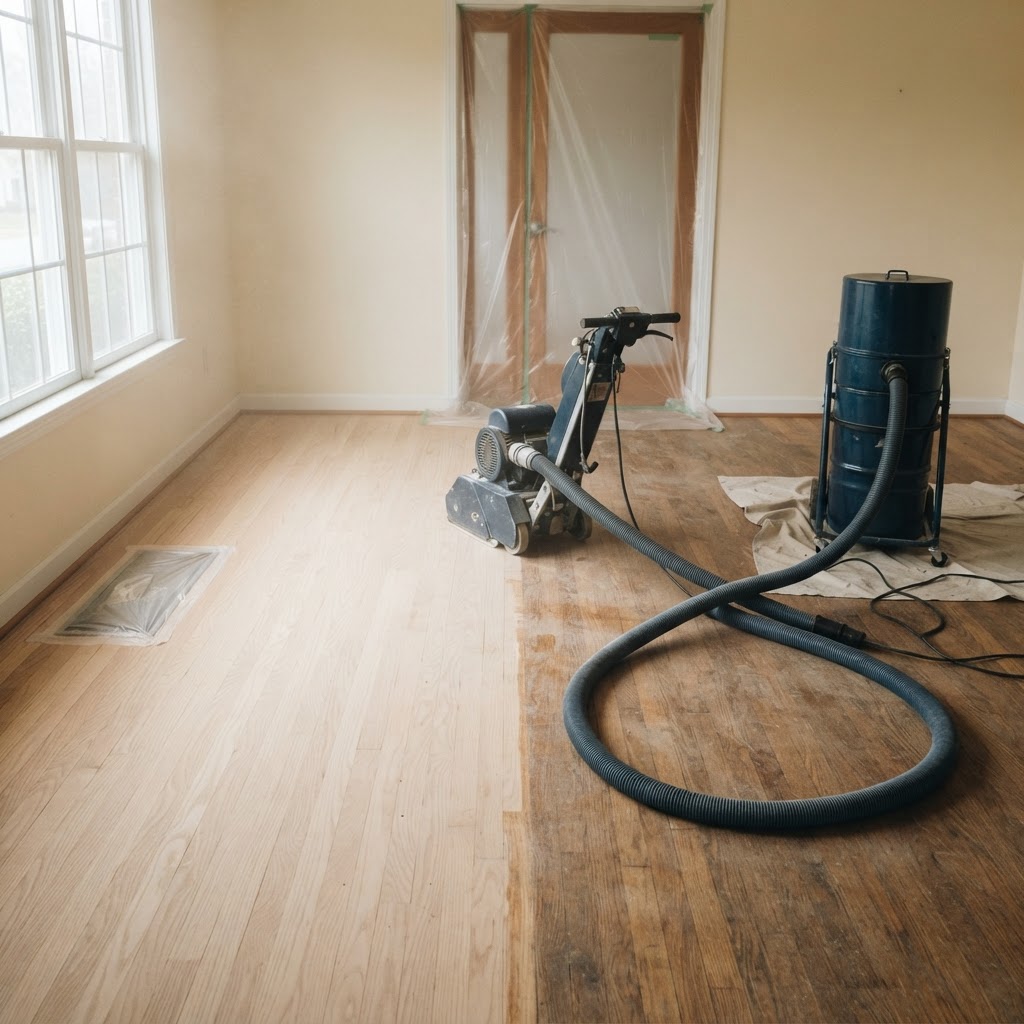
No. Dustless refinishing connects sanders to powerful vacuums that capture much of the dust at the source, which makes a real difference, but some dust always escapes, especially at edges, corners and stairs. Floors and Beyond VA uses connected equipment and is honest about what it can and cannot do.
The term itself is the source of the confusion. It describes where the dust goes, not whether dust exists. A connected sander pulls the vast majority of what it creates into a sealed container, and anyone who has lived through an old-style sanding can see the difference immediately. But "much less" and "none" are not the same promise, and a contractor who tells you a refinish produces zero dust is either guessing or overselling.
What dust containment does
The sander's dust port pulls particles into a sealed vacuum or filter before they spread. The result is far less dust in the air and on surfaces than with an open sander, and a cleaner floor before the finish goes on, which also helps finish quality.
What good containment covers
- Vacuum-connected drum and orbital sanders, with hoses kept sealed and filters maintained.
- Doorways sealed with plastic and taped at the edges, not just hung.
- Supply and return vents covered before sanding begins.
- HVAC set so it is not pulling dust through the house while the work is underway.
- Vacuuming between grits rather than only at the end of the day.
- Equipment serviced, with full bags and clean filters, which matters more than the brand on the machine.
The cleanliness of the finished room comes from that combination, not from the word on the invoice.
What it cannot do
Edgers and hand work in corners capture dust less well. Stairs are small surfaces done by hand. Old dust in vents and trim can be disturbed, and some dust comes from repairs and sanding between coats. Be cautious of promises of zero dust.
Usually well controlled
- Open floor areas under the drum sander.
- Large rooms with sealed doorways.
- Fine sanding dust from the last passes.
Where dust escapes anyway
- Corners and edges under the edger.
- Stairs, closets and tight turns.
- Under-cabinet toe kicks and radiator recesses.
- Old dust sitting in ductwork and trim gaps.
- Patch and repair sanding.
- Between coats, when finish is abraded.
None of that is a reason to skip a dustless contractor. It is a reason to plan the last five percent of cleanup rather than expecting to skip it.
What else matters
Sealing doorways with plastic, covering vents, managing the HVAC system, vacuuming between stages, a skilled operator and well-maintained equipment all affect how clean your home stays.
The operator is the variable homeowners cannot see in a bid. Two crews with identical machines produce very different results depending on whether doorways are sealed before the first pass and whether the vacuum is emptied when it needs to be. Ask how the work area is set up, not just what equipment is used.
Sensitive households and older homes
If someone has allergies, asthma or is an infant, tell your contractor and consider staying elsewhere during sanding. If your home was built before 1978, ask about lead-safe practices around painted trim.
Finishing products are the other consideration. Even with dust controlled, stains and finishes carry odor, and the sanding days are usually the dustiest while the finishing days are the most fragrant. Planning to be out for the sanding, or for the first coat, is a reasonable choice for a sensitive household.
How to prepare
Remove or cover furniture and electronics, cover vents, seal doors, keep pets and children away and plan for cleanup afterward. Expect a little dust to show up over the following days.
Before sanding starts
- Clear closets, shelves and floors in the work area.
- Move electronics and anything with a fan or open port.
- Take down curtains and cover what stays.
- Decide where pets will be during the work.
- Confirm which doorways will be sealed and how you will move through the house.
- Ask what cleanup is included and when it happens.
Northern Virginia specifics
Many local homes are compact with open stairs and shared air systems, so dust travels easily. Condos and townhomes add shared walls and neighbors. Older houses in Vienna and nearby may have forced-air systems that spread dust quickly and may have lead paint on trim.
In Vienna's mid-century houses, the forced-air system is often the biggest factor. Dust that reaches the return can reappear in a bedroom days after the work is finished, which is why covering vents and controlling the HVAC during sanding matters as much as the vacuum on the sander. In townhomes, the shared wall is the other consideration: dust travels more easily than noise, and a heads-up to a neighbor is courteous and practical.
How Floors and Beyond VA approaches dust
Floors and Beyond VA uses vacuum-connected sanding equipment, seals the work area, protects vents and cleans carefully between stages. When a screen and recoat is appropriate, we recommend it, since it creates much less dust. At Floors and Beyond VA, our crews are our own employees, and we tell you plainly what to expect.
We are family-owned and have served Northern Virginia since 1987. Read the full guide: dustless hardwood floor refinishing, and see our floor restoration in Vienna, VA page for local detail.
Frequently asked questions
Do I need to leave?
Usually not, but sensitive people may prefer to.
Is a screen and recoat dust-free?
It creates much less dust than a full sanding, but not none.
Can dustless methods be used on stairs?
Containment is harder there, so some dust is likely.
When to call a professional
If you want a refinish that keeps dust under control, ask how your contractor contains it and what they do about the rest. Floors and Beyond VA is family-owned and has served Northern Virginia since 1987. Schedule an in-home estimate at floorsandbeyondva.com/Contact or call (703) 906-5698.
Ask what your refinish actually contains
We will walk you through how the work area is sealed, what the equipment captures and what cleanup follows, before the sanding starts.
Floor Restoration in Vienna, VARead the full guide: dustless hardwood floor refinishing




