
What is the most durable commercial flooring?
The most durable commercial flooring depends on the traffic type. For the heaviest industrial and warehouse use, polished concrete and epoxy or resinous floors are the most durable, handling forklifts and rolling loads. For high-traffic retail, office, and healthcare, commercial-grade SPC luxury vinyl and porcelain tile are the most durable practical choices. Durability isn’t just hardness — it’s wear-layer thickness, moisture resistance, how a floor handles point and rolling loads, and how easily it’s repaired. Floors and Beyond VA matches the material to the actual traffic.
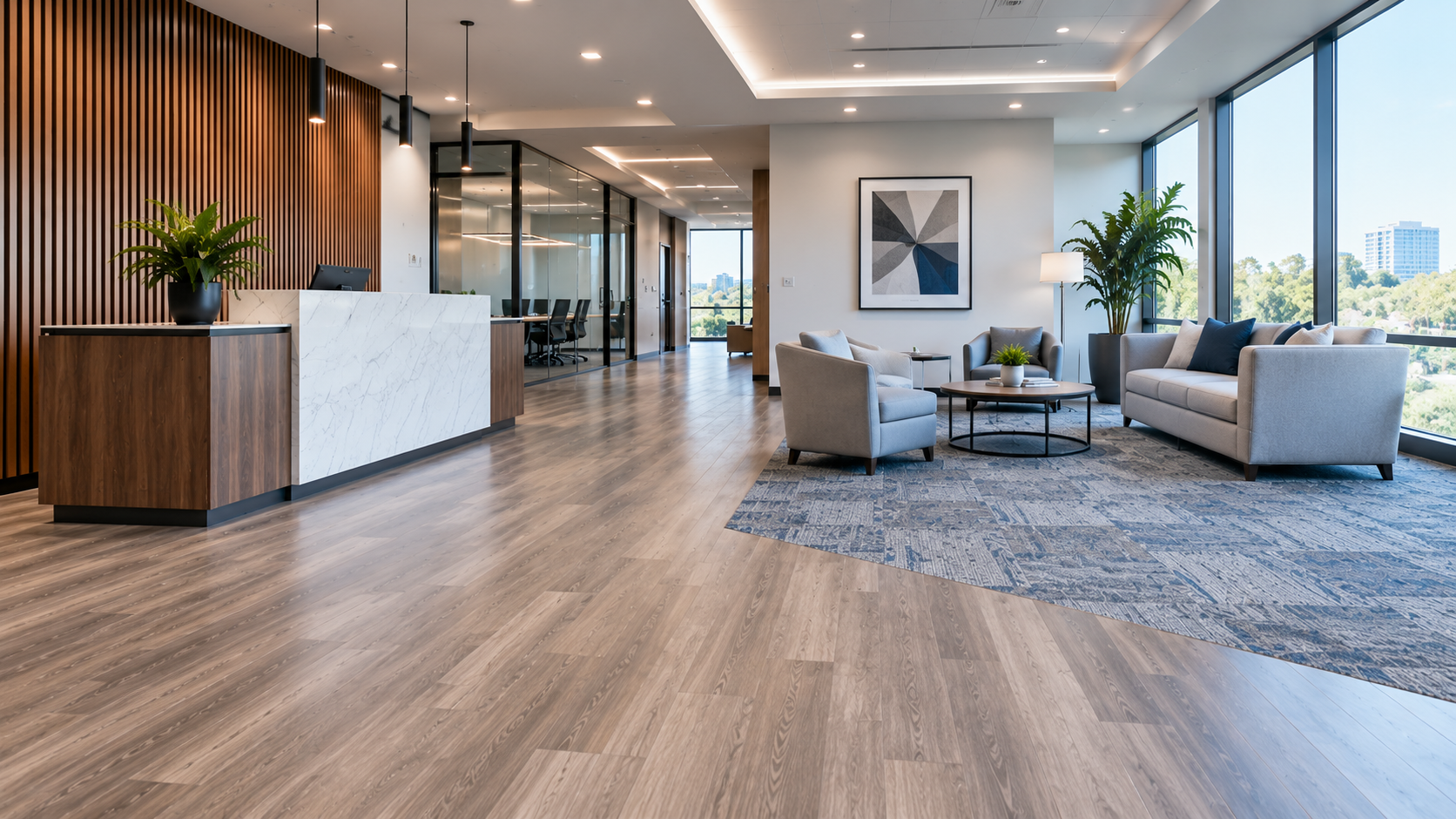
What is the most durable commercial flooring?
It depends on the kind of traffic — there’s no single winner for every business.
“Most durable” means different things to a warehouse and a dental office. A warehouse needs a floor that shrugs off forklifts and dropped tools; a busy medical suite needs one that resists constant foot traffic, rolling equipment, and daily disinfecting. So the honest answer is a short list, not one product: polished concrete and epoxy for industrial toughness, and commercial-grade SPC luxury vinyl and porcelain tile for high-traffic business spaces. Floors and Beyond VA specifies from that list based on how each Northern Virginia space is actually used.
What actually makes a commercial floor durable?
Four factors decide real-world durability — and hardness is only one of them.
Surface hardness & wear layer
The top surface has to resist abrasion. On resilient floors that means wear-layer thickness (20-mil or more for commercial); on concrete and tile it means the surface hardness itself.
Load handling
Durability includes how a floor takes point loads (a chair leg, a pallet corner) and rolling loads (carts, forklifts). Some hard floors crack under point loads; resilient floors can dent. The load type matters.
Moisture & chemicals
A floor that can’t handle water, cleaning chemicals, or slab moisture fails early regardless of hardness. Waterproof and chemical-resistant surfaces last far longer in wet or sanitized spaces.
Repairability
The most durable floor in practice is often the one you can fix cheaply. Carpet tile swaps tile by tile; SPC replaces a plank; epoxy can be recoated — so damage doesn’t mean replacing everything.
Most durable commercial flooring by traffic type
Match the toughest option to your environment, not to a generic ranking.
| Environment | Most durable choice | Why |
|---|---|---|
| Warehouse / industrial | Polished concrete or epoxy | Handles forklifts, rolling loads, and impact |
| High-traffic retail | Commercial SPC or polished concrete | Resists constant foot traffic; easy to maintain |
| Office | Carpet tile + commercial SPC | Durable, quiet, and repairable tile by tile |
| Healthcare / wet areas | Sheet vinyl or porcelain tile | Seamless, waterproof, withstands disinfecting |
| Gym / fitness | Commercial rubber | Absorbs impact and protects the subfloor |
| Commercial kitchen | Epoxy or quarry tile | Grease-, heat-, and slip-resistant; seamless |
The common mistake is equating hardness with durability. Porcelain tile is very hard, but it can crack under a dropped tool or slab movement; polished concrete is tough but shows every crack the slab develops; commercial SPC is softer yet often survives a busy retail floor better because it flexes and resists dents. “Most durable” is about the match to your traffic — which is the assessment Floors and Beyond VA runs before recommending anything.
Durability depends on the install (and the slab)
Even the toughest floor fails early over a bad slab or a rushed prep.
The most durable commercial material can still fail prematurely if it’s installed over an untested slab or an unprepped subfloor. Most Northern Virginia commercial buildings sit on concrete, so moisture-vapor testing comes first — a slab reading high will lift an epoxy coating or an adhered resilient floor no matter how good the product is. The slab is then ground flat, because dips and high spots concentrate wear and cause cracking under load. The wear layer, slip rating, and warranty are specified for the occupancy, and the work is phased to keep the business running. Because Floors and Beyond VA uses in-house crews across Tysons, Reston, Arlington, Ashburn, and Fairfax, those durability-critical steps aren’t skipped to hit a subcontractor’s schedule.
Frequently asked questions
What flooring lasts the longest in a commercial building?
Polished concrete lasts longest in the right setting, since it’s essentially the structural slab and can last decades with minimal maintenance. For a finished surface, porcelain tile and commercial SPC luxury vinyl are the longest-lasting practical options, and carpet tile lasts well because worn tiles swap individually. The longest-lasting floor is the one whose strengths match the building’s traffic and moisture.
Is polished concrete or epoxy more durable?
Both are extremely durable but fail differently. Polished concrete is the slab itself — very hard and low-maintenance, though it can crack with slab movement and offers no chemical barrier. Epoxy adds a seamless, chemical- and impact-resistant coating with slip options, but can eventually wear or need recoating. For clean industrial and kitchen use epoxy often wins; for raw longevity and low upkeep, polished concrete does.
What is the most durable flooring for high-traffic retail?
Commercial SPC luxury vinyl with a 20-mil or greater wear layer and polished concrete are the most durable retail choices. SPC gives a warm, finished look with a waterproof core and plank-level repair; polished concrete is near-indestructible and low-maintenance with an industrial-modern look. Porcelain tile also suits entries and restrooms. Floors and Beyond VA matches the choice to the store’s traffic and look.
Spec the toughest floor for your traffic.
Floors and Beyond VA assesses your space and traffic, then specifies and installs the most durable commercial floor for it — free assessment, before any work begins.
Request a Commercial Assessment



