
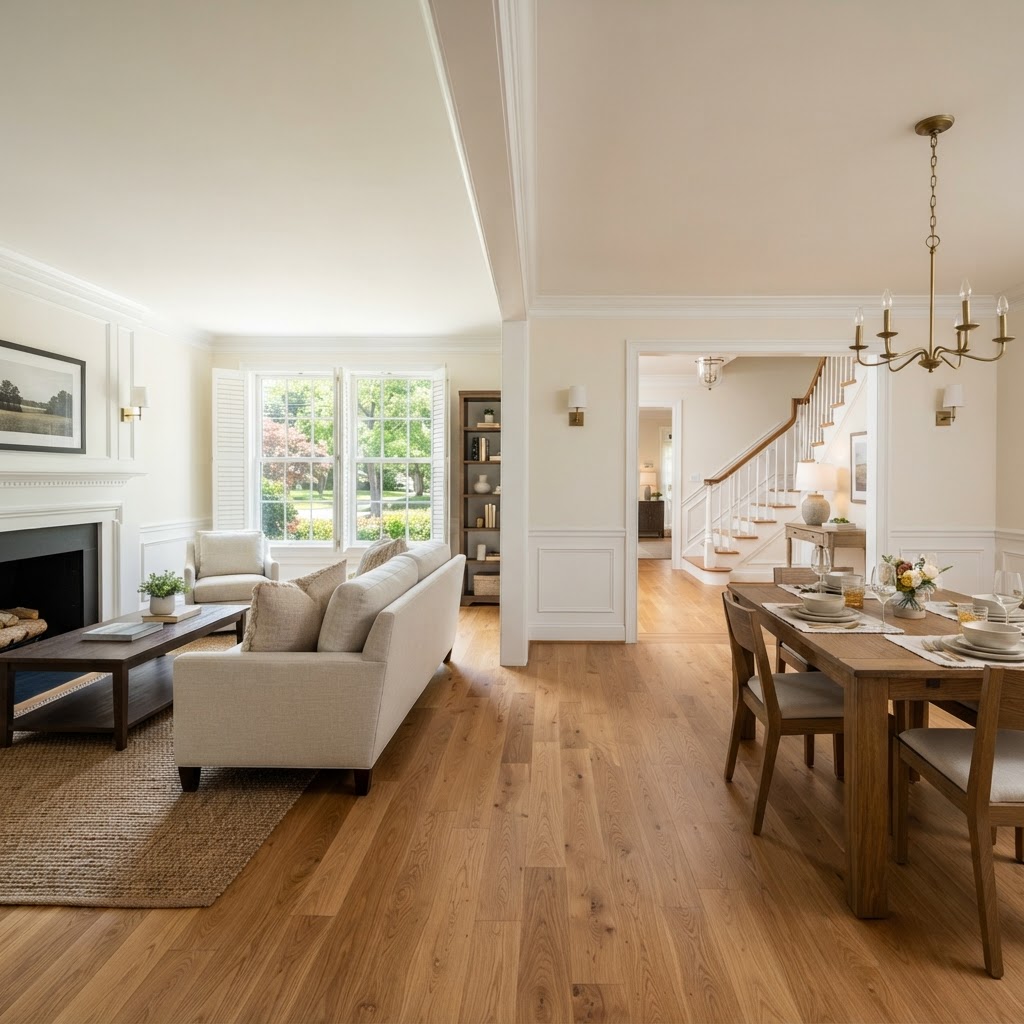
How do you match new hardwood flooring to existing floors in an Arlington home?
You match new hardwood flooring to existing floors in an Arlington home by identifying the species and cut of the old wood, measuring board width and thickness, testing stain and finish samples on the actual new boards in your own light, matching the sheen, planning transitions into adjoining rooms and, whenever the old floor can be sanded, refinishing old and new together so they share one stain and finish. A truly perfect match is not always possible, because old wood has aged and darkened, but a skilled team can get very close or design a transition that looks intentional. Floors and Beyond VA, a family-owned Northern Virginia flooring and remodeling contractor serving Fairfax, Loudoun, Prince William and Arlington counties since 1987, handles hardwood extensions, repairs and blending with in-house crews and no subcontractors, and we tell homeowners candidly when a match will be excellent and when it will require a different design approach.
Matching flooring is a very specific craft, and it comes up constantly in Arlington. A homeowner in Westover or Lyon Park removes a wall between the kitchen and dining room and needs to fill in the gap. A family in Cherrydale builds a rear addition and wants the floors to flow into the new space. A homeowner in Waverly Hills discovers water damage and needs several boards replaced. A condominium owner in Clarendon wants to extend hardwood into a room that currently has carpet. In each case, the question is the same: can new wood look like the old? This guide walks through the variables that determine a successful match: identifying the species, measuring the boards, testing stain, matching sheen and blending into adjoining rooms. It focuses on Arlington's typical housing, which includes narrow strip oak in early and middle twentieth-century houses and varied flooring in renovated and newer buildings. For related reading, see our wood flooring page and our articles on flooring damage repair for water, scratches and buckling in Northern Virginia and whether your hardwood floors can be saved.
Why matching is difficult
A hardwood floor's appearance comes from many attributes working together: species, cut, grade, width, thickness, stain, finish, sheen and age. Even one mismatch is noticeable, especially in open layouts and raking light. Old wood has also changed. Decades of light exposure, oxidation, finish aging and wear have darkened or shifted its color and created a patina that new wood lacks. Even if you find identical wood and apply the same stain formula, new boards will look different on day one.
This is why the best strategy is usually not to try to make new wood imitate old wood but to bring both to the same starting point and finish them together.
Step one: species identification
Most Arlington homes with original floors have oak, but oak itself includes red oak and white oak, which differ in color and grain. Identification is the foundation of matching.
Red oak. Warm, pinkish undertone, bold open grain with visible pores, popular in strip flooring of earlier decades.
White oak. More neutral or slightly olive-gray undertone, tighter grain, with ray flecks in quarter-sawn boards.
Maple. Pale, creamy, fine grain, very hard. Common in some gym and utility floors.
Pine and fir. Softer, with distinct growth rings, often found in older subfloors and some original finished floors in older homes.
Heart pine. Rich, amber, dense old-growth pine, prized in historic homes.
Other species. Beech, birch, ash, walnut, cherry and hickory appear occasionally.
Identification involves close examination of grain and pores, color under a fresh cut, end grain and hardness. Professionals often sand a small hidden area, such as inside a closet or beneath a threshold, to see the wood's true color without finish or patina. Photographs under raking light help.
Species matters because it determines how the wood accepts stain. Red oak and white oak absorb stain differently, and a stain formula that looks right on one can look different on the other. If the species differs between old and new, a perfect match with stain alone is unlikely. A different species can still be chosen deliberately as a contrast.
Step two: cut, grade and board dimensions
Cut
How a log is sawn changes the grain pattern. Plain-sawn boards show cathedral patterns, rift-sawn show straight, linear grain and quarter-sawn show tight, straight grain with ray fleck in oak. Older strip floors are often plain-sawn, though some are rift or quarter-sawn. A mismatch in cut changes the overall appearance even when species and stain match.
Grade
Grade describes color variation, knots and character. Older floors may have been laid in a clear or select grade. Newer products offer a range from clear to rustic. Mixing a high-character new grade with a clear old floor will look patchy.
Width
Original strip flooring in Arlington homes is typically narrow. Modern flooring catalogs favor wider planks. Narrow strip is still available, or can be milled, but supply varies. Introducing a wider board next to narrow strips is visible. In many cases, installers use the same width as the original, or create a clear, deliberate change, such as a threshold or border.
Thickness and tongue-and-groove
Thickness matters for height alignment. If the new boards are thinner or thicker than the old, a step results. Subfloor adjustments or shims can align heights. The edge profile, including tongue and groove and any bevel, affects how boards fit and how seams look. Older floors typically have square edges, which sand flat, while many modern prefinished planks have beveled edges that create visible grooves.
Solid versus engineered
Original floors are solid. New additions may use solid or engineered products. Engineered flooring with a thin wear layer may not sand like solid wood, which affects the strategy of refinishing old and new together. If you plan to sand both together, the new floor must be sandable, usually solid or engineered with a sufficiently thick wear layer.
Step three: choose the matching strategy
Strategy one: install, sand and finish together
When the existing floor is solid hardwood with enough thickness to sand, the most reliable way to produce a seamless result is to install new unfinished wood of the same species, cut, grade and width, then sand the entire floor and apply one stain and finish. Sanding removes old finish, patina and surface discoloration, bringing old and new to a similar raw condition. A uniform stain and finish then unify them. This strategy works best for additions, wall removals and repairs. It extends the scope to the rooms that are refinished, which should be part of the plan.
Strategy two: weave repairs into the field
For repairs, damaged boards are cut out and replacement boards are woven in, staggering end joints as in the original installation. The repaired area is then sanded and refinished, usually along with the surrounding area, so that edges blend. Salvaged boards from a closet or other hidden area can provide an excellent match, because they share the age and history of the original wood.
Strategy three: close match with a deliberate transition
If the old floor cannot be sanded, perhaps because it is a thin engineered product or because the owner wants to leave certain rooms untouched, the goal becomes harmony instead of invisibility. Choose new flooring close in species, width and color, test finish samples against the old floor and use a transition at a logical boundary, such as a doorway or threshold, so that the change in tone reads as intentional.
Strategy four: embrace contrast
Sometimes the best design is to choose a different species, direction or width on purpose, creating a feature. For example, a rear addition might use a different species or a border to separate old and new spaces. Contrast can look better than a nearly matched but slightly different floor.
Step four: stain testing
Stain is where many matching efforts succeed or fail. Do not choose from a catalog image or a small sample.
Test on the actual wood. Apply stain to a sample of the new boards, or a sanded area of the same species. Different boards absorb stain differently.
Test in your light. Arlington homes vary: some have large windows and bright light, others are shaded by mature trees or neighboring buildings. Check samples in morning, afternoon and evening light, and under your artificial lighting.
Test with the finish applied. A finish changes the color. Oil-based finishes amber, water-based finishes stay clearer, and sheen shifts the appearance. A stain sample without finish is not a reliable preview.
Consider undertones. Red oak has a warm pink undertone that influences stain results. Natural finishes on red oak read warmer than on white oak.
Compare with the old floor. If the old floor will be sanded, compare against sanded wood, not against the aged surface. If the old floor will not be sanded, compare against it directly, remembering that the new wood will change as it ages.
Allow for aging. New wood moves toward its mature color over time with light exposure. Discuss what to expect for your species and finish.
Our hardwood floor refinishing field guide for Northern Virginia describes the sanding and finishing process in more detail.
Step five: finish and sheen
Even when color matches, a different sheen makes floors look different. A satin finish next to a glossy one, or a matte next to a satin, shows clearly across a threshold.
Match the existing sheen if the old floor is not being refinished. Finishes come in matte, satin, semi-gloss and gloss. Compare in raking light.
Choose a consistent sheen when refinishing together. One finish across connected rooms creates unity.
Consider the finish system. Oil-based, water-based and hardwax oils have different looks and aging behavior. Mixing systems between rooms can produce visible differences. If the old floor has an oil-based finish that has ambered, a clear water-based finish on new boards will look cooler.
Use the same applicator technique and number of coats where possible, since these influence appearance.
Prefinished flooring has a factory finish whose sheen and color are set. Matching it to a site-finished floor is challenging. In many cases, using unfinished wood and finishing on site produces the best match.
Step six: blending into adjoining rooms
Floors are rarely seen in isolation. The way new flooring meets existing floors, across thresholds and in open layouts, determines how the whole home reads.
Natural boundaries. Doorways and thresholds are the best places for a transition. Avoid changes in the middle of an open space.
Direction. Board direction should continue logically from room to room. A change in direction at a doorway can be a purposeful design.
Height alignment. Floors should meet flush. Differences in thickness or underlayment need adjustment.
Transitions. Where hardwood meets tile, carpet or another floor, use proper transition pieces, installed neatly. Where hardwood meets hardwood, a seamless joint is possible if the boards are the same height and the finish is continuous.
Open layouts. In open plans, such as those created when walls are removed, the continuity of floor across the space is crucial. Refinishing the entire open area together is often the best way to unify it.
Stairs and landings. New treads or landings should be coordinated with surrounding floors.
Room-by-room continuity. Consider how a visitor moves through the home, and where the eye sees the floor change.
Our estimates include transitions and molding, and our crews take care in finishing them. Our accessibility services emphasize smooth, safe transitions.
Common Arlington scenarios
Removing a wall between kitchen and dining room. In many older Arlington houses, the kitchen has a different floor from the adjacent rooms, such as vinyl or tile. When the wall comes down, the gap beneath it exposes the subfloor. The best result usually comes from installing matching hardwood in the gap and in the former kitchen area, then refinishing the entire space together.
Building a rear or side addition. New rooms extend the home, and the new floor should match or intentionally complement the existing one. Planning flooring from the start, including subfloor height, ensures alignment. Our home additions and whole house remodels services coordinate this.
Repairing water damage. Replace damaged boards with matched wood and refinish the surrounding area.
Extending hardwood to a carpeted room. Where hardwood lies beneath carpet, it can be restored and may already match. Where it does not, new flooring is installed with a plan for transition. Our article on carpet to hard flooring conversion in Northern Virginia discusses what changes in such conversions.
Condominium units. Matching within a unit follows the same principles, with additional building requirements. See our condominium remodeling page.
Kitchen and bathroom remodels. Our kitchen remodeling and bathroom remodeling services coordinate floors with the rest of the room.
Setting honest expectations
A skilled contractor will tell you what is realistic. In many cases, a seamless match is achievable, especially when old and new are sanded and finished together. In others, a close match with subtle variation at the boundary is possible. In some situations, a perfect match is not possible, such as when the original species is unavailable, the original width cannot be reproduced or the old floor cannot be sanded. In those cases, we recommend an approach that looks deliberate.
Wood also continues to change. New wood will darken or lighten with light exposure over its first year or so. Using window treatments and rugs to moderate exposure and rotating rugs periodically helps even out changes.
We would rather you know before work begins than be disappointed after. During your consultation, we bring samples, look at your existing floors in your lighting and discuss possibilities frankly. We do not have a showroom, because these decisions belong in your home.
Because we cannot show a particular customer's floors without permission, this guide describes the process in general terms. During your consultation, we can discuss how it applies to your floors.
What drives the scope of a matching project
We do not publish prices in articles, but the factors that shape any estimate are clear. The species and grade of the new wood. Square footage of new flooring. Whether old and new will be refinished together, and how many rooms that includes. Repairs to existing boards. Subfloor preparation and height alignment. Stair work. Stain and finish system, including sample testing. Transitions and trim. Furniture moving. And the company, including its crews, licensing, bonding and insurance.
At Floors and Beyond VA, we provide an honest, all-inclusive estimate, and what we quote is what you pay. Our estimates include old flooring removal, new materials, professional installation, furniture moving, transitions, molding and full cleanup. Our article on flooring cost factors in Northern Virginia explains why estimates differ, and our flooring installation guide describes the process.
Common mistakes when matching hardwood
The first mistake is assuming a stain color can make any wood match.
The second is ignoring species and cut, which cannot be changed with finish.
The third is overlooking height differences between old and new.
The fourth is skipping stain tests in your actual lighting.
The fifth is blending without refinishing together when refinishing is possible.
The sixth is forgetting that old floors have aged.
The seventh is choosing a wider board without a deliberate design reason.
The eighth is placing a seam in the middle of an open space.
The ninth is mismatching sheen or finish system.
The tenth is hiring a contractor who promises a perfect match without looking at your floor.
Frequently asked questions
Can new hardwood match my old floors? Often, very closely, especially when old and new are refinished together. A perfect match is not always possible.
What is the best way to blend new and old hardwood? Install new boards that match species, cut and width, then sand and refinish the whole floor so old and new share one finish.
Can you match a floor that cannot be sanded? We can get close with careful selection, sample testing and a thoughtful transition, but expectations should be realistic.
Will the new wood change color over time? Yes, wood changes with light and age. We explain what to expect.
Can you repair damaged boards invisibly? Often, yes, by weaving in matching boards and refinishing the area.
Can you match stairs? Yes, with careful fitting and finishing.
Is Floors and Beyond VA licensed and insured? Yes. We are fully licensed, bonded and insured for every project, and our in-house crews work with no subcontractors.
Do you serve my Arlington neighborhood? Yes, including Clarendon, Courthouse, Ballston, Rosslyn, Shirlington, Lyon Park, Lyon Village, Cherrydale, Westover, Ashton Heights, Maywood, Waverly Hills, Arlington Ridge, Aurora Highlands, Fairlington, Columbia Pike and Nauck, along with Fairfax, Loudoun and Prince William counties.
Ready to match your hardwood floors?
A convincing match starts with a careful look at what you have. Floors and Beyond VA brings nearly forty years of Northern Virginia experience, in-house crews with no subcontractors, a refinish-first philosophy and a free in-home consultation with samples and precise laser measurements at no charge.
Request your free Arlington flooring estimate: Contact Floors and Beyond VA
You can also call (703) 906-5698.
When matching existing floors proves difficult, our flooring company in Arlington, VA with refinish experience can blend old and new seamlessly.




