
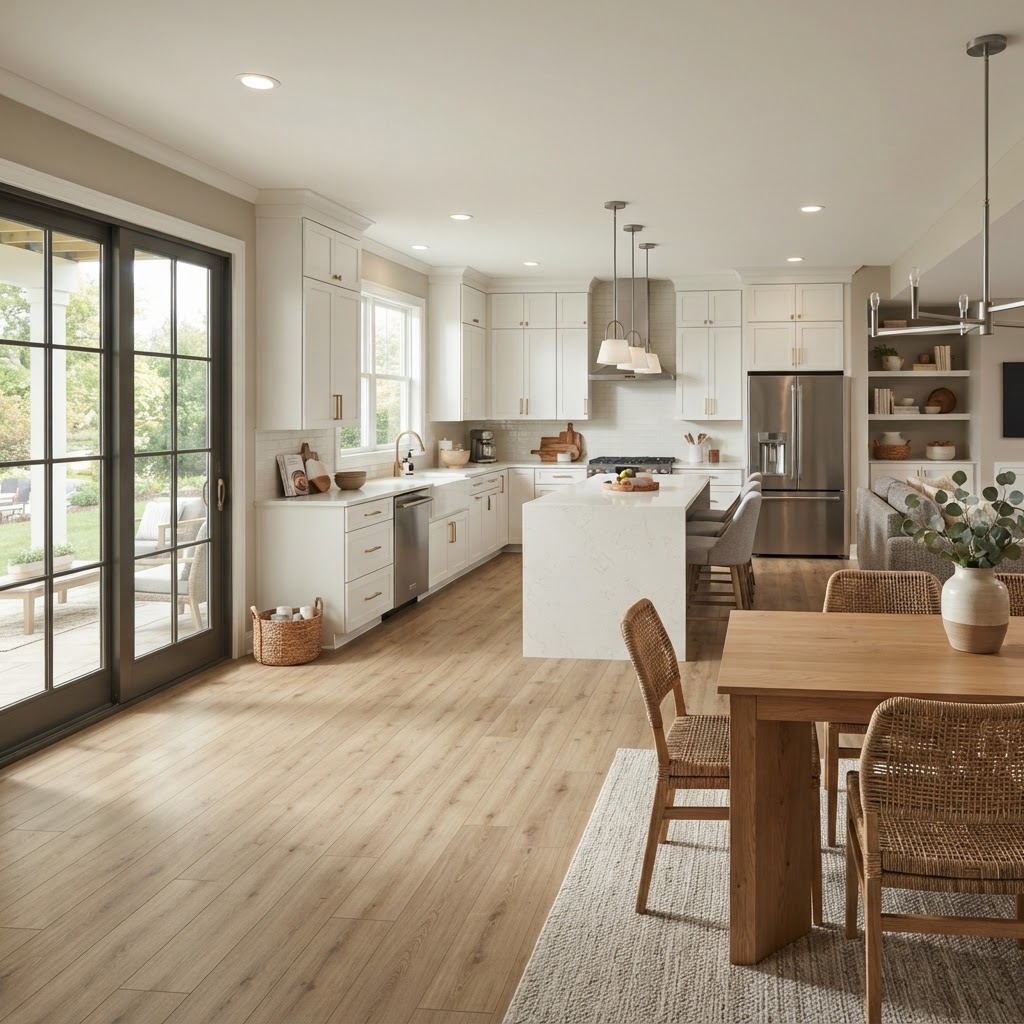
Luxury vinyl plank (LVP) is an excellent choice for many Arlington homes, especially kitchens, basements, mudrooms, laundry rooms and busy family spaces, because it is durable, highly water-resistant, comfortable underfoot and available in realistic wood and stone looks. It is less ideal when you want the long refinishing life and traditional character of real hardwood, when the subfloor is uneven or damp and has not been corrected, or when a condominium association restricts hard flooring. Quality varies enormously among LVP products, so thickness, wear layer, core construction and installation matter far more than the label. Floors and Beyond VA, a family-owned Northern Virginia flooring and remodeling contractor serving Fairfax, Loudoun, Prince William and Arlington counties since 1987, installs luxury vinyl plank with in-house crews and no subcontractors, and we recommend it only where it genuinely fits your home.
Luxury vinyl plank flooring in Arlington, VA has become one of the most searched flooring categories, and for understandable reasons. Arlington households are busy, many homes have finished basements or compact kitchens that take a beating, and renovations often need a floor that looks like wood without the sensitivity to water. This guide compares LVP honestly, covering durability, water resistance, appearance, comfort and suitability for kitchens, basements and busy households, along with the limits you should know before choosing it. Visit our vinyl flooring page for products, and see our guides on choosing luxury vinyl plank in Northern Virginia and the pros and cons of LVP.
What luxury vinyl plank actually is
LVP is a multilayer synthetic flooring designed to resemble wood planks. A typical plank has several layers: a backing or attached underlayment, a rigid or flexible core, a printed decorative layer that creates the wood or stone look, a clear wear layer that protects against scratches and scuffs, and often a surface coating. Individual planks lock together, glue down or, in some products, adhere with a peel-and-stick backing.
The core determines much of the plank's behavior. Rigid-core products, including those marketed as SPC (stone plastic composite) and WPC (wood plastic composite), have stiffer cores that resist denting, bridge minor subfloor imperfections better and remain dimensionally stable when temperatures change. Flexible vinyl is thinner and softer, often glued down, and follows subfloor irregularities more closely, which makes subfloor preparation especially important. Our guide to what SPC core flooring is explains the differences in more detail.
The wear layer is a clear protective top layer, and its thickness influences how well the floor resists scratches and scuffs over time. Thicker wear layers are generally better suited to heavy household use. As with any product, ask to see a full-size sample and read the manufacturer's specifications.
Durability: how LVP holds up in a busy Arlington household
LVP is known for toughness. It resists scratches, scuffs and the daily abuse of children, pets, furniture and foot traffic better than many surfaces. It does not dent as readily as softwoods, and it does not require refinishing. For families, rentals and active households, that resilience is a major draw.
It has limits. Sharp objects and heavy point loads can still damage LVP, and a gouge cannot be sanded out like wood. Rolling heavy furniture without protection can mark the surface. Direct, intense sunlight through large windows or glass doors can cause some products to fade or expand, so check the manufacturer's guidance for sun exposure. LVP also reacts to extreme temperature swings in some installations, which is why good products are designed with stable cores and installers leave appropriate expansion gaps at walls.
Longevity depends on the product and the environment. A quality LVP can serve a household for many years, but it is not refinishable in the way solid hardwood is. When it eventually wears out, it is generally replaced rather than restored. That is an important distinction for owners of older Arlington homes with original hardwood: if you have sound hardwood, covering it with vinyl may not be the best use of the home's assets, and our refinish-first approach would suggest restoring the wood first.
Water resistance: what "waterproof" does and doesn't mean
LVP is popular because it tolerates moisture far better than hardwood or laminate. Most modern LVP products are advertised as waterproof or highly water-resistant, meaning the planks themselves will not swell or warp when exposed to water.
However, a waterproof plank is not the same as a waterproof floor. Water can still seep through seams, around edges and under the floor if a leak or flood is significant, and moisture trapped underneath can cause mold or damage to the subfloor. Installation details such as sealed perimeters in wet areas, proper expansion gaps and a dry, sound subfloor matter. In basements, moisture testing of the concrete slab is essential before installation, because vapor moving through the slab can cause problems regardless of the floor's surface. Our guides on whether vinyl flooring is waterproof and basement flooring for moisture-prone spaces go deeper.
In practical terms, LVP is an excellent choice for kitchens, bathrooms with proper installation, laundry rooms, mudrooms and basements, where spills, tracked-in water and humidity are common. It is far more forgiving than hardwood in these spaces, which is a major reason it is chosen.
Appearance: how good does LVP look?
Modern LVP can look remarkably like real wood and stone. High-definition printing, embossed textures that follow the printed grain, and varied plank patterns create convincing results. Styles range from light Scandinavian oaks and warm hickories to dark walnuts, gray driftwood and stone-look tiles.
From a distance, a quality LVP is difficult to distinguish from wood, but up close and underfoot there are differences. Real hardwood has unique grain, depth and subtle variation that printed surfaces approximate but cannot fully duplicate. Lower-priced LVPs may show repeating patterns, obviously artificial textures or an overly glossy look. Higher-quality products include more pattern variation, realistic texture and matte finishes.
For homes where authenticity matters, such as historic Arlington bungalows and brick colonials with original trim, hardwood often looks more appropriate. For newer homes, basement renovations and kitchens where the practical benefits matter more, LVP's appearance is usually excellent. The best way to judge is to view full-size planks in your home's light, next to your cabinetry and walls.
Comfort: how LVP feels underfoot
LVP is softer and warmer underfoot than tile or stone, especially when installed with an attached or separate underlayment. It is quieter than many hard surfaces, though it does not match carpet for sound absorption. Impact noise can be an issue in multi-story buildings, so the underlayment matters. In Arlington condominiums, associations may require specific sound ratings for hard flooring, and not all LVP assemblies will qualify. Always check building rules before ordering.
LVP is also comfortable for standing, such as in a kitchen, though it is not as cushioned as rubber or specialty mats. In winter, it can feel cool, but it is compatible with some radiant heat systems when the manufacturer approves it. Verify temperature limits before combining.
Where LVP works best in Arlington homes
Kitchens. LVP handles spills, dropped items and heavy traffic well. It can run continuously from the kitchen into adjoining rooms, creating a seamless look in open plans. If you are planning a remodel, see our kitchen remodeling page.
Basements. LVP is among the most popular basement floors because it resists moisture and can be installed over concrete after proper preparation. Moisture testing, subfloor leveling and vapor control are important, as described in our basement finishing service.
Mudrooms, entryways and laundry rooms. Water, salt and grit are no match for LVP.
Playrooms, home offices and family rooms. Durable, easy to clean and available in warm looks.
Bathrooms. Many LVP products work in bathrooms, but showers and areas with direct standing water are generally better served by tile.
Rental and investment properties. The durability and relatively simple replacement make LVP common in rentals.
Condominiums. Possible, but subject to association rules and sound requirements.
Where LVP may not be the best choice
LVP is not the best answer everywhere. Consider alternatives in the following cases.
Original hardwood in good condition. If your home has original hardwood floors that can be refinished, restoring them usually makes more sense than covering them. See our guide on whether your hardwood can be saved.
Uneven or damaged subfloors. LVP shows subfloor flaws, especially thinner products. Correcting the subfloor is necessary.
High-end historic restoration. Period-appropriate materials may be preferred and, in some cases, expected.
Spaces with intense direct sun and heat. Check manufacturer limits.
Rooms where you want the sound-dampening of carpet. Carpet remains the quietest option.
Areas where you want real stone or tile. Showers and formal entries may call for tile.
Honest advice sometimes means recommending a different floor than the one you came in asking about, and that is how we approach every consultation.
Installation: what makes the difference
LVP installation seems simple, which is why quality varies. A good installation includes the following.
Subfloor preparation. The subfloor must be clean, flat, dry and sound. Humps, dips, loose boards, old adhesive and debris should be corrected. Many LVP warranties require specific flatness tolerances.
Moisture testing. Especially over concrete, moisture levels should be measured and, where needed, mitigated.
Acclimation. Planks should be acclimated to the room's temperature as the manufacturer directs.
Layout. Planning the layout avoids narrow slivers at walls, staggers seams and aligns rooms.
Expansion gaps. Floating floors need gaps at walls and fixed objects to allow for movement, hidden by baseboards or trim.
Transitions. Where LVP meets other floors, proper transition pieces keep edges protected and the height change safe.
Trim. Baseboards and shoe molding finish the edges.
Stairs. Stairs can be done with LVP, but they require careful detailing.
Our flooring installation guide explains how we prepare and protect your home.
Maintenance and care
LVP is low-maintenance. Sweep or vacuum regularly with a soft-bristle attachment, and mop with a manufacturer-approved cleaner and a lightly damp mop. Avoid abrasive pads, harsh chemicals and steam mops unless the manufacturer allows them. Wipe spills promptly, use felt pads under furniture, and lift rather than drag heavy items. Use mats at entrances to catch grit. Protect from prolonged intense sunlight with window coverings if recommended. Follow the warranty's cleaning guidelines.
What drives the scope of an LVP project
We do not publish prices in articles, but we can describe the drivers of an LVP project. The product quality, including thickness, wear layer and core, shapes the material scope. The square footage and layout determine quantities. Subfloor preparation, such as leveling, repair or moisture mitigation, can be substantial. Removal of existing flooring and disposal add steps. Underlayment type matters, particularly in condominiums with sound requirements. Stairs, closets and transitions add detail. Trim and baseboards complete the finish. And access and building rules affect logistics.
Floors and Beyond VA provides an honest, all-inclusive estimate, and what we quote is what you pay.
A few real-world scenarios
Consider a family in a Westover Cape Cod renovating a galley kitchen and adjoining dining area. They want a warm wood look that stands up to a dog, spilled drinks and heavy traffic. A rigid-core LVP with a robust wear layer, installed over a leveled subfloor and carried continuously through both rooms, gives them a cohesive, forgiving floor, while the original hardwood in the living room is refinished so the best material is used where it matters most.
Consider instead a couple finishing a basement in Arlington Ridge. Here the first step is testing the slab and correcting drainage, then installing a vapor-conscious LVP system with underlayment for warmth. Because the space includes a laundry nook and bathroom, porcelain tile is used there, and the transitions between materials are planned to sit flush.
Finally, consider a condominium owner in Clarendon who loves the idea of vinyl but belongs to an association with strict sound rules. The honest answer may be to confirm the building's required sound rating, choose an assembly that meets it, or select carpet in bedrooms and a compliant hard surface elsewhere. In each of these cases, LVP is a tool, and the best installer matches it to the situation rather than to a sales target.
How to evaluate an LVP sample
Not all samples tell you the same things, so look for specifics. Check the wear layer thickness stated by the manufacturer, since thicker layers generally hold up better under heavy household use. Ask about the core type and the overall thickness, which influence stability and how forgiving the plank is of minor subfloor imperfections. Look at the surface texture and whether it follows the printed grain, a feature that makes the floor feel and look more authentic. Examine the number of distinct plank patterns in the box, because more variety reduces visible repetition across a large room. Consider the edge profile, whether beveled or square, which changes how the floor reads. Read the warranty for conditions about moisture, subfloor flatness, temperature and cleaning. And bend, press and scratch the sample if the seller allows it, because a hands-on test often says more than a brochure.
Common mistakes to avoid
The most common mistake is buying the cheapest product without checking the wear layer, core and warranty.
Another is skipping subfloor preparation, which leads to gaps, peaking and noise.
A third is ignoring moisture in basements. Test before you install.
A fourth is covering original hardwood that could have been restored.
A fifth is overlooking condo rules and sound requirements.
A sixth is not leaving expansion gaps, causing buckling.
A seventh is choosing from small online samples. Look at full planks in your home's light.
Finally, many homeowners assume all installers are equal. Installation quality varies, and preparation matters.
How Floors and Beyond VA helps Arlington homeowners choose
We begin with a free in-home consultation. We bring samples, take precise laser measurements at no charge, evaluate your subfloor and discuss how your household uses each room. We tell you honestly where LVP is a good fit and where another floor is better. Our estimate is all-inclusive, and our in-house crews, with no subcontractors, handle the installation. We are fully licensed, bonded and insured.
We serve Arlington neighborhoods including Clarendon, Ballston, Courthouse, Rosslyn, Crystal City, Pentagon City, Shirlington, Lyon Park, Cherrydale and Westover, as well as Fairfax, Loudoun and Prince William counties.
Frequently asked questions
Is luxury vinyl plank waterproof?
The planks are typically waterproof or highly water-resistant, but installation and the subfloor still matter.
Is LVP good for basements?
Yes, after moisture testing and proper preparation.
Does LVP look like real wood?
Quality products look very convincing, though real wood has unique depth.
Can LVP be refinished?
No. It is generally replaced when worn out.
Is LVP durable with pets and kids?
Yes, it resists scratches and scuffs well, though sharp objects can damage it.
Is LVP allowed in Arlington condos?
Often, but check your association's rules and sound requirements.
Can I put LVP over my old floor?
Sometimes, depending on the existing floor's condition. We assess during the consultation.
Does LVP work with radiant heat?
Some products do. Check manufacturer limits.
Does Floors and Beyond VA use subcontractors?
No. Our in-house crews handle the work.
Do you serve my Arlington neighborhood?
We serve Arlington County and neighboring Northern Virginia communities.
Ready to find out if luxury vinyl plank fits your Arlington home?
The right flooring is the one that fits your home and your life. Floors and Beyond VA offers nearly forty years of Northern Virginia experience, in-house crews with no subcontractors, free in-home consultations with samples, and all-inclusive estimates.
Schedule your free LVP consultation in Arlington: https://floorsandbeyondva.com/Contact
You can also call (703) 906-5698, or send us a message through our contact page.
Our flooring company in Arlington, VA installs LVP across Arlington condos and single-family homes alike.




