
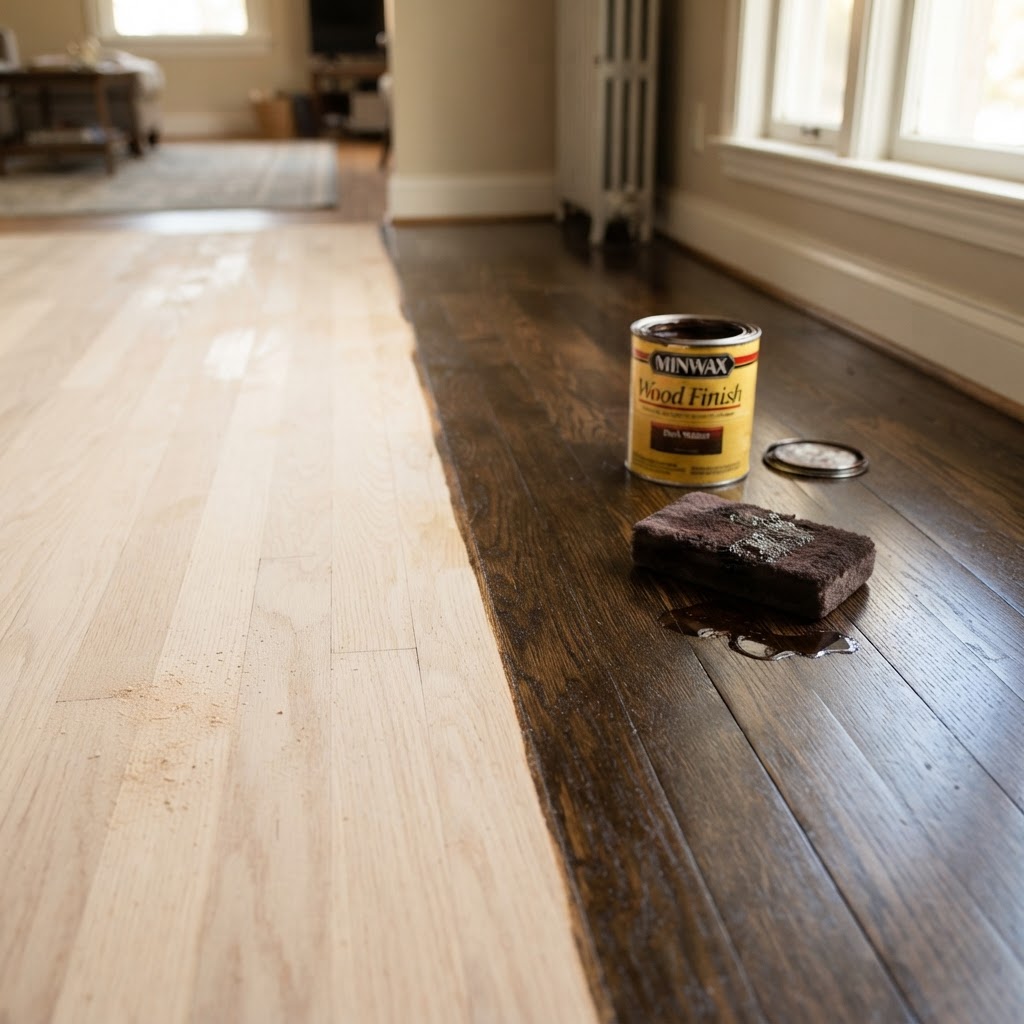
Many homeowners in Northern Virginia live with a hardwood floor color they did not choose. They bought a home in Burke with an orange-tinted oak floor from the 1990s, inherited a dark espresso floor in a McLean colonial that shows every speck of dust, or moved into an Ashburn townhome with a gray floor that now feels cold. The boards are in good shape, but the color is wrong.
The good news is that solid hardwood, and many engineered hardwood floors, can be restained to a completely new color. The less welcome news is that restaining is not a quick coat of color over the existing floor. It is a full process that takes the floor back to bare wood. This guide explains why that is, what restaining involves, what results you can realistically expect, and how to know whether your floor is a good candidate.
Why You Cannot Just Put New Stain Over the Old Floor
Stain works by soaking into bare wood fibers. It is not a paint and it is not designed to sit on top of a surface. A finished hardwood floor is sealed with a protective coating, usually polyurethane, that blocks stain from reaching the wood. If you apply stain over that finish, it will not penetrate. It will sit on top, stay tacky, wipe off unevenly, and wear away quickly in traffic paths.
That is why changing the color of a hardwood floor requires removing the existing finish and the existing stain by sanding the floor down to fresh, bare wood. Once the floor is bare, it can accept a new stain color and a new protective finish.
There are tinted finishes and some specialty products marketed as color-changing recoats. They can shift a floor's tone slightly, but they work like a tinted film on top of the existing color. The results tend to look muddy, wear unevenly, and cannot achieve a significant color change such as going from dark to light. For a real color change, sanding is required.
What the Restaining Process Involves
Here is how a professional restain typically works.
Assessment. Before anything else, the floor is inspected. The species is identified, whether the floor is solid or engineered is confirmed, and the remaining wear layer is checked to make sure the floor can be safely sanded. The condition of the boards, any gaps, damage, or moisture issues, and the stairs and adjoining rooms are also reviewed.
Preparation. Furniture is moved out, and the area is protected. Baseboards or shoe molding may be removed or protected. Vents are covered, and dust containment is set up.
Sanding. The floor is sanded in several passes, starting with a coarser grit to remove the old finish and stain, then moving to finer grits to smooth the wood. Edges and corners are sanded with an edger, and areas the big machines cannot reach are scraped or detail sanded by hand. Removing a dark stain completely is especially important, because any remaining color will show through a lighter new stain.
Repairs. Damaged boards can be replaced, gaps can be filled, and loose boards can be secured while the floor is bare.
Water popping, when needed. For darker or more even stain colors, the wood surface may be lightly dampened to open the grain so it accepts stain more evenly and deeply. This step is not used on every floor and depends on the desired color.
Color samples. Sample stains are applied directly to the sanded floor so you can see the actual colors on your actual wood in your home's light before committing.
Staining. Once you approve a color, the stain is applied across the floor evenly and allowed to dry.
Finishing. Several coats of protective finish are applied over the stain, with light abrading between coats as needed. The finish type and sheen are chosen based on your preferences, traffic, and the look you want.
Cure time. The floor needs time to dry before light foot traffic and more time to cure before furniture and rugs return. The exact timing depends on the stain and finish system.
What Results Can You Expect
Restaining can make a dramatic difference, but the species and age of your wood set the boundaries.
Going from dark to light. Removing a dark stain requires thorough sanding. On solid hardwood with plenty of wear layer, a dark floor can usually be taken back to a natural or light tone. On older floors or engineered floors with thin wear layers, it may not be possible to sand deeply enough to remove all traces of a very dark stain without risking the floor. An assessment will tell you.
Going from light to dark. This is generally easier, because a darker stain covers natural variation in the wood. Darker colors do show dust and scratches more, so consider your household before choosing a very dark tone.
Going from orange or yellow to neutral. Many older Northern Virginia floors look orange because of an ambered oil-based finish rather than the stain. Sanding off that finish and using a clearer, water-based finish can make a big difference on its own. Red oak, however, always has a warm, pinkish undertone, and it will not look identical to white oak with the same stain.
Going to gray. Gray stains behave differently on different species. On red oak, gray can pull pink or purple. On white oak, gray reads cooler and more neutral. If you want a gray or greige floor, sampling is essential.
Going to a modern natural look. Many homeowners today want a light, natural, matte floor. On white oak, this is very achievable. On red oak, the result will be warmer, though a skilled refinisher can tone down the pink with careful product choices.
Is Your Floor a Good Candidate
Most solid hardwood floors can be restained, often more than once over their life. Floors that may not be good candidates include:
Engineered hardwood with a very thin veneer that cannot be sanded.
Solid hardwood that has been sanded so many times that little wear layer remains.
Floors with widespread water damage, cupping, or structural problems that need to be addressed first.
Maple and some other dense species, which can stain blotchily and may look best with a clear finish.
Very soft species such as pine, which can absorb stain unevenly and need special preparation.
Laminate and LVP, which look like wood but are not wood. These cannot be sanded or restained.
If you are not sure what you have, a professional can tell you quickly.
Restaining Stairs and Adjoining Areas
A new floor color affects the entire connected space. If your hardwood runs up a staircase, through hallways, or into adjoining rooms, plan to restain all of it at once. A newly restained living room next to an old orange hallway or staircase looks unfinished.
Stairs require detailed hand sanding and staining of treads, risers, nosings, and sometimes railings. They take more time than open floor areas, but they are often the most visible wood in the home, especially in the two-story foyers common in Fairfax and Loudoun colonials.
Living Through a Restain
Restaining is a multi-day project, and some planning helps.
You will need to clear the rooms being refinished, and you may want to plan for kids and pets to stay elsewhere during sanding and finishing. Modern dust containment sanding equipment greatly reduces dust in the rest of the house, but finishing products have odors, and you should follow ventilation guidance for the products used. Plan around the cure times: you can usually walk on the floor in socks before you can return furniture, and rugs typically wait longer still.
Protecting Your New Color
Once your floor has been restained and finished, a few habits keep it looking its best.
Put felt pads under furniture and use mats at entries.
Clean with a product made for finished hardwood and a lightly damp microfiber mop.
Avoid steam mops and harsh cleaners.
Keep humidity steady through the seasons.
Consider a screen and recoat every few years in high-traffic homes. A recoat refreshes the protective finish without removing your stain, so your color lasts much longer.
Restaining Versus Replacing
When homeowners are unhappy with a floor's color, some assume the only answer is new flooring. In most cases, restaining is the better choice if the floor is solid hardwood with enough wear layer.
Restaining keeps your existing wood, which in many Northern Virginia homes is solid oak that is better quality and thicker than much of what is sold today. It avoids tear-out, disposal, and subfloor work. It generally takes less time than removing and installing a new floor. And it lets you choose almost any color the wood will accept.
Replacement makes more sense when the floor is engineered with no sanding life left, when the boards are severely damaged across a large area, when the wood species cannot achieve the look you want, or when you want a different format entirely, such as wide-plank white oak in place of narrow strip red oak.
Common Restaining Projects in Northern Virginia
These are the projects we see most often.
Orange oak to natural. The classic 1980s and 1990s golden oak floor, common in colonials across Burke, Fairfax, Centreville, and Springfield, is sanded and refinished with a clearer finish or a soft natural stain. The difference can be dramatic.
Dark espresso to medium or light. Dark floors installed in the 2000s and 2010s in many McLean, Great Falls, and Ashburn homes show dust and wear. Many owners are moving to warmer medium browns or lighter natural tones.
Gray to warm. Gray floors from the last decade are being restained to warmer, more natural colors as tastes change.
Uncovered floors. Floors uncovered from under old carpet are often restained during their first refinish to match the rest of the home or to suit the owner's style.
Pre-sale refresh. Homeowners preparing to sell often restain to a neutral, broadly appealing color before listing.
Frequently Asked Questions
How long does a restain last? The color itself lasts as long as the finish protects it. With good care and periodic recoats, a restained floor can look good for many years.
Can I restain only one room? You can, but if the floor continues into hallways or adjoining rooms, the color change will stop at a visible line. It is usually better to restain all connected areas at once.
Will restaining hide scratches and pet damage? Sanding removes most surface scratches and light damage. Deep gouges and dark pet stains may require board replacement before staining.
Can you restain engineered hardwood? Sometimes. It depends entirely on the thickness of the top veneer. Floors and Beyond VA measures the veneer before recommending a restain.
Oil-Based Versus Water-Based Finish After a Restain
The finish you choose after restaining affects how the new color looks over time.
Oil-based polyurethane enriches stain colors and adds warmth. It ambers as it ages, which makes medium and dark browns look rich but can push light, natural, and gray stains toward yellow over the years. It also takes longer to dry and has a stronger odor during application.
Water-based finishes stay clearer and keep light and neutral stains closer to their original color. Many modern water-based finishes are very durable, dry faster, and have less odor, which makes it easier to return to normal life sooner.
Hardwax oils give a soft, natural, low-sheen look and can be spot repaired, but they require different maintenance than polyurethane.
For a dramatic color change to a light or neutral tone, a water-based finish is usually the better pairing. For a warm traditional brown, either type can work well. We talk through these choices with every homeowner before we finish a floor.
How to Tell Whether Your Current Color Is Stain or Finish
Before deciding on a restain, it helps to know where your floor's current color comes from. Pick a hidden spot, such as inside a closet near the wall, and look closely. If the color seems to sit in a yellow or amber film on top of the wood, much of it is the finish. If the color is in the grain itself, it is stain. Many orange-looking Northern Virginia floors turn out to be natural oak under an ambered oil-based finish, which means simply sanding and using a clear water-based finish can change the look substantially without any stain at all.
Planning Around Your Household
A restain usually means the rooms involved are out of service for several days. Homeowners often schedule restaining while traveling, before moving in, or before a remodel is finished. If you are restaining main living areas, plan where your family and pets will eat, sleep, and move through the house. Stairs being refinished may limit access to upper floors temporarily, and a crew can often plan the work so one route remains open.
Can You Restain Just Part of a Floor
Homeowners sometimes ask whether a single damaged or discolored area can be restained without doing the whole room. Spot refinishing is possible in limited situations, but blending a new stain into an old, aged color is difficult, and the patch often stays visible. For a true color change, the entire continuous floor needs to be sanded and stained together. For small damaged areas on a floor whose color you like, a targeted repair and a whole-floor recoat may blend better than a partial restain.
How Floors and Beyond VA Restains Hardwood
Floors and Beyond VA has been sanding, staining, and refinishing hardwood across Northern Virginia since 1987. We work in every kind of home in the region, from pre-war bungalows in Arlington to 1980s colonials in Burke and Springfield to newer homes in Ashburn and Leesburg. Our crews are our own employees, never subcontractors, and they know how each species and age of wood behaves.
We start with an honest assessment of whether your floor can be restained and how far the color can change. We sand thoroughly, test colors on your own floor, and finish with the products and sheen that suit your household. If your floor is not a good candidate, we will tell you and explain the alternatives.
If you are ready to change the color of your hardwood floors, book a free in-home estimate with Floors and Beyond VA at floorsandbeyondva.com/Contact. We will look at your floors, talk through the colors you are considering, and plan a restain that gives you the look you want.
Summary
Restaining hardwood floors means sanding to bare wood, applying a new stain, and sealing it with a fresh finish. You cannot stain over an existing finish. Most solid hardwood can be restained, while thin engineered floors and heavily sanded floors may have limits. The species of your wood shapes the final color, so testing samples on your own floor is essential. Plan to include stairs and adjoining areas, and protect your new color with good habits and periodic recoats.

