
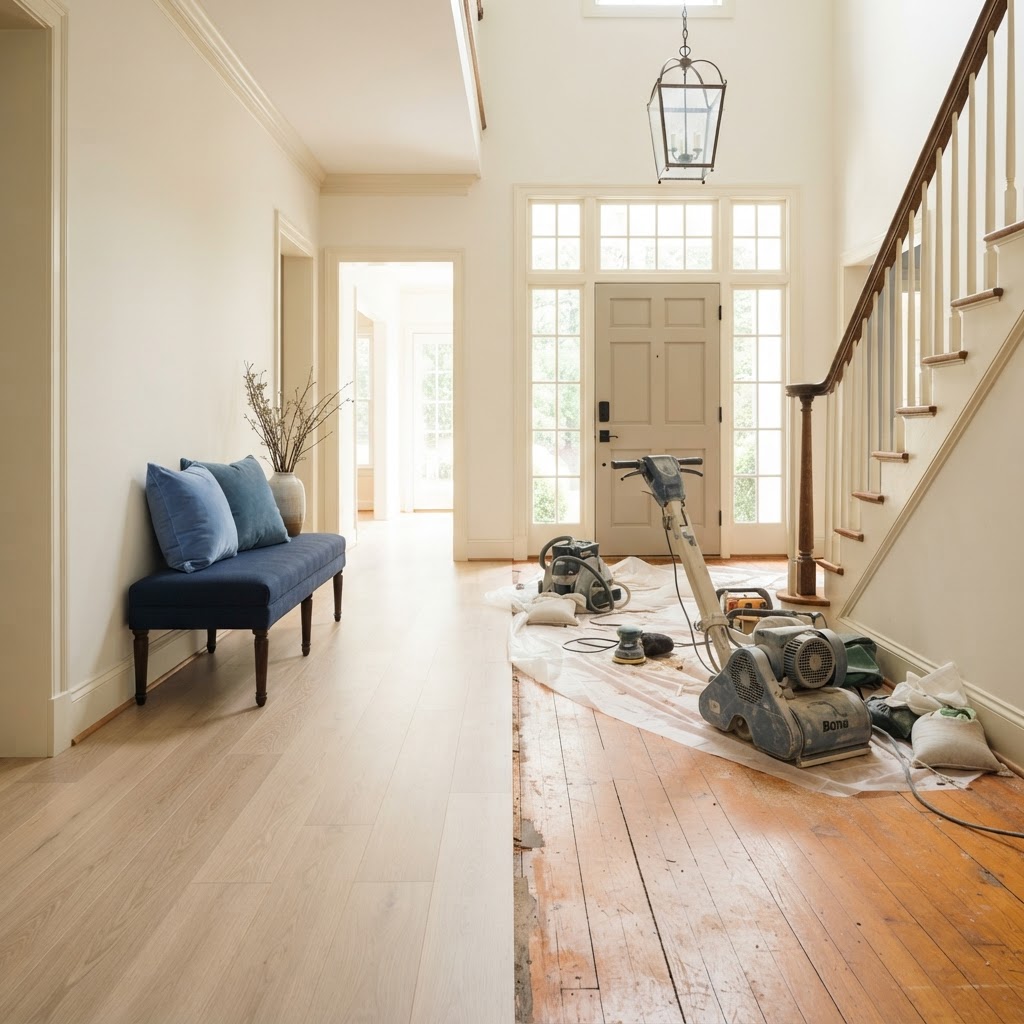
Should you refinish existing hardwood or install new floors in a McLean home?
In most McLean homes, you should refinish existing hardwood when the boards are structurally sound, have enough wood above the nails to be sanded and show surface wear such as scratches, dullness, fading or a dated color. You should install new floors when the wood is badly damaged by water, rot or pests, when it has been sanded too many times to be sanded again, when it is widely cupped or buckled, or when the design goals of the renovation cannot be met by the floor you have. The decision turns on four things: the condition of the wood, how repairable it is, the appearance you want and the scope and disruption of each path. Floors and Beyond VA, a family-owned Northern Virginia flooring and remodeling contractor serving Fairfax, Loudoun, Prince William and Arlington counties since 1987, follows a refinish-first philosophy, so we start by asking whether what you have can be saved.
This article stays focused on one question: the flooring decision. If you are planning a larger remodel, our broader remodeling guidance covers how floors fit into the whole project, but here we want to give you a clear, contractor-led framework for choosing between restoring the hardwood you already own and replacing it. In McLean, where many homes have original oak laid decades ago, this is one of the most common and most consequential renovation decisions. A good refinish can transform a floor for a fraction of the disruption of replacement, while a poorly considered replacement can discard beautiful, irreplaceable material. On the other hand, trying to refinish a floor that cannot be saved wastes time and money. Our goal is to help you tell the difference. For related reading, see our articles on whether your hardwood floors can be saved, whether refinishing is worth it and our hardwood floor refinishing field guide for Northern Virginia.
How hardwood floors age and what that means for your decision
Solid hardwood floors are built to be renewed. The top surface wears away over time under foot traffic, furniture, sunlight, pets and cleaning, but the thick layer of wood beneath it remains. Refinishing sands off the damaged surface and a thin layer of wood, exposing fresh material that is then stained or left natural and sealed with new finish. Because older solid floors were typically made from thick boards, many can be refinished multiple times over their life.
What matters is how much usable wood remains. Each full sanding removes a small amount, and a floor that has been refinished many times may be approaching the nails that hold the boards down. Engineered hardwood has a wear layer of real wood over a layered core, and its refinishing potential depends on how thick that layer is. A professional can measure and test to determine what remains. This is why generic rules like "floors can only be sanded a certain number of times" are unreliable. The real answer lies in the specific boards in your specific home.
Floors also age in other ways. Sunlight fades and changes the color of wood, especially near large windows and glass doors. Humidity swings cause boards to expand and contract, opening gaps in dry winters and tightening in humid summers. Moisture events cause staining, cupping and, in worse cases, mold or rot. Pets leave scratches and sometimes stains. Previous finishes may have been applied unevenly or in layers that do not take stain predictably. All of these factors shape what is possible.
The condition of the existing wood: what to look for
Start by examining the floor closely, in good light, from several angles.
Surface scratches, dullness and worn finish. These are the classic signs a refinish is meant to fix. Scratches that have not penetrated deep into the wood usually sand out. A finish worn through to bare wood in traffic paths calls for refinishing before moisture and dirt do further harm.
Fading and discoloration. Sun-faded areas and uneven color can be evened out through sanding and staining. Dark gray or black stains in the wood itself, particularly around pet accidents or leaks, are different. Some lift with sanding, but deep stains may persist and sometimes require replacing boards.
Gaps between boards. Seasonal gaps are normal. Wide, persistent gaps, especially if boards have shrunk or loosened, may indicate dryness, movement or structural problems.
Cupping, crowning and buckling. Cupping, where board edges rise, and crowning, where centers rise, usually point to moisture imbalance. Mild cupping can sometimes flatten after the moisture source is fixed and the floor stabilizes, and then it can be sanded. Severe buckling, where boards lift from the subfloor, often means replacement of affected areas.
Soft spots, squeaks and movement. These can indicate subfloor problems or loose fastening. Many squeaks can be addressed, but soft or rotted areas need repair.
Previous repairs. Patches that do not match can be blended in some cases and may need replacement in others.
Thickness of remaining wood. A professional can inspect the edge at a floor vent or threshold and assess how much wood remains above the tongue and groove.
Our article on flooring damage repair for water, scratches and buckling in Northern Virginia describes common damage types and what each requires.
Repairability: the middle path that many homeowners overlook
The choice is often framed as a binary: refinish or replace. In practice, there is a valuable middle ground. Individual boards can be removed and replaced. Sections damaged by a leak can be cut out and relaid with matching wood. Gaps can sometimes be filled. Squeaks can be treated. Boards can be re-fastened. After repairs, the entire floor can be sanded and finished together, so that new and old wood blend into one continuous surface.
Repair-and-refinish is especially compelling in older McLean homes where the surrounding floors are in excellent shape and only a few areas are damaged. It preserves the character and continuity of original oak, avoids the cost and disruption of whole-floor replacement and delivers a result that looks seamless when done well. Where wood species or widths differ between old and new, a skilled team selects the best match, and our wood flooring page describes the repair, refinishing and installation services we provide. For homes with historic character, our historic home restoration services are designed to preserve original materials wherever possible.
The appearance you want
Sometimes the condition of the floor is fine but the look is not. Many McLean homes have floors finished in warm orange or reddish tones popular in earlier decades, and homeowners often want a more neutral, natural or modern appearance. Here, refinishing has real power: sanding removes the old finish and stain, and new stain can transform the tone. Natural, light or soft neutral finishes are achievable on many oak floors, though the final result depends on the wood and what is already in it. Darker colors, matte or satin sheens and low-gloss finishes are also options.
Replacement becomes the better choice when the look you want requires something refinishing cannot deliver. Different board widths are one example: if you want wide planks and you have narrow strip flooring, you cannot widen the boards by sanding. A different species, a distinct grain pattern or a particular texture, such as wire-brushed or hand-scraped, may also point to new flooring. Engineered wide-plank flooring, in particular, is popular in larger McLean homes and open layouts, and our article on engineered wide-plank flooring in Northern Virginia explains why. If you are considering a different material altogether, our hardwood versus LVP comparison for Northern Virginia can help.
Disruption: what each path means for daily life
Refinishing and replacement differ significantly in how they affect your household.
Refinishing keeps the floor in place. The process includes preparing the surface, sanding in stages, cleaning up dust, applying stain if desired and applying finish coats. Dust control is important, and finish needs time to cure, during which foot traffic, furniture and rugs must be managed. Odors vary by finish type, and ventilation matters. Rooms are typically unusable for a period, but the project is generally shorter and less invasive than replacement.
Replacement involves removing the old flooring, preparing and sometimes repairing the subfloor, installing new flooring, and, for site-finished products, sanding and finishing. It generates more debris, requires material delivery and acclimation and may involve more moving of furniture and more days of work. Prefinished products reduce on-site finishing time, while site-finished floors offer customization.
In both cases, our estimates include furniture moving and full cleanup, and our in-house crews handle the work. Preparing your home in advance helps either project run smoothly, and our guide to preparing your home for new floors provides a thorough checklist.
Total project scope: the factors that tip the balance
When we evaluate whether to refinish or replace, we weigh the whole project, not only the surface.
How much of the home is involved. Refinishing one level is a very different undertaking from replacing flooring throughout.
Stairs. Stairs involve detailed work in both paths.
Transitions and adjoining rooms. New flooring changes thresholds and may require coordinating with other materials. Refinishing preserves existing transitions.
Cabinets, built-ins and fixtures. Replacement may require working around or removing items; refinishing stops at the edge.
Subfloor condition. Replacement exposes the subfloor, which can be an opportunity to correct issues.
Other renovation work. If you are remodeling a kitchen, bathroom or whole house, the sequencing of floors matters. Our kitchen remodeling, bathroom remodeling, primary suite remodeling, home additions and whole house remodels services allow us to coordinate floors with the rest of the project.
Timeline. Refinishing generally fits a tighter window.
Future plans. If you will stay for many years, quality investment in either path makes sense. If you plan to sell soon, our article on the best flooring before selling a home is a useful companion.
A decision guide in words
Because every home is different, a simple narrative guide can help you orient yourself.
If your floors are solid wood, structurally sound, free of widespread moisture damage and mostly suffering from surface wear, a color you dislike or dull finish, refinishing is the first path to explore.
If your floors are sound but have a handful of damaged or mismatched boards, repair and refinish together is usually the best result.
If your floors have been sanded repeatedly and little wood remains, are widely cupped or buckled from long-term moisture, or show extensive rot or damage, replacement is the honest answer.
If your floors are in good shape but you want a different board width, species or look that refinishing cannot produce, replacement or a new installation over a suitable surface may be appropriate.
If you are unsure, a professional in-home evaluation gives you a definitive answer, usually in a single visit.
If replacement is the answer, choose carefully
When replacement is warranted, the options are broad. Solid hardwood remains the classic choice for above-grade, wood-subfloor installations and can be refinished for generations. Engineered hardwood offers stability for wide planks, concrete slabs and radiant heat. Luxury vinyl plank offers water resistance and durability in kitchens, basements and busy family spaces. Tile suits wet areas. Our wood flooring, vinyl flooring and tile and stone pages describe these services, and our article on when to replace flooring and what to choose offers further guidance. Our flooring installation guide explains the installation process.
What drives the scope of each path
We do not publish prices in articles, but we can describe what shapes any estimate. For refinishing: the square footage, the condition of the existing finish, the extent of repairs, whether you want stain color changes, the finish system, stairs and furniture moving. For replacement: the material and quality tier, square footage, removal and disposal of existing flooring, subfloor preparation, stairs, trim, molding and transitions, furniture moving and cleanup.
At Floors and Beyond VA, we provide an honest, all-inclusive estimate, and what we quote is what you pay. Our estimates include old flooring removal, new materials, professional installation, furniture moving, transitions, molding and full cleanup. Our article on flooring cost factors in Northern Virginia explains why estimates differ.
Common mistakes in the refinish-or-replace decision
The first mistake is assuming old floors must be replaced without a professional evaluation.
The second is assuming refinishing can fix anything, including deep water damage or floors with little wood left.
The third is ignoring the possibility of repair, which often combines the best of both paths.
The fourth is choosing a stain color from a small sample without seeing it on your actual wood and in your light.
The fifth is neglecting the subfloor.
The sixth is underestimating cure time and walking on or furnishing a floor too soon.
The seventh is overlooking dust control, which matters in any occupied home.
The eighth is choosing replacement for a trend, only to discard material that could have been transformed.
The ninth is comparing estimates with different scopes.
The tenth is hiring a contractor who prefers one answer for every house. An honest contractor adapts to what your floor needs.
Frequently asked questions
How do I know if my hardwood can be refinished? A professional evaluation checks the remaining wood thickness, structural soundness and the type of damage. Many floors that look worn are excellent candidates.
Can I change the color of my hardwood floors? Often, yes. Sanding removes the old stain and finish, allowing a new color. Results depend on the species and the wood's condition.
Is refinishing messy? Modern dust-control methods reduce it significantly, and our crews clean thoroughly. Rooms are unavailable while finish cures.
What if only part of my floor is damaged? Targeted repair followed by refinishing the whole floor often blends the repair seamlessly.
When is replacement the better choice? When the wood is extensively damaged, has too little thickness left, or when you want a look refinishing cannot deliver.
Can you match new boards to my existing floor? Often, yes, with skilled selection and finishing, though a perfect match is not always possible.
Is Floors and Beyond VA licensed and insured? Yes. We are fully licensed, bonded and insured for every project, and our in-house crews work with no subcontractors.
Do you serve my McLean neighborhood? Yes, including Langley, Chesterbrook, Franklin Park, Salona Village, Hamilton, Dunn Loring, Vienna, Great Falls and Tysons, as well as Fairfax, Loudoun, Prince William and Arlington counties.
Ready to find out whether your hardwood can be saved?
The right answer comes from looking closely at your floors. Floors and Beyond VA brings nearly forty years of Northern Virginia experience, in-house crews with no subcontractors, a refinish-first philosophy and a free in-home consultation with samples and precise laser measurements at no charge.
Request your free McLean flooring estimate: https://floorsandbeyondva.com/Contact
You can also call (703) 906-5698 or email hello@floorsandbeyondva.com.




