
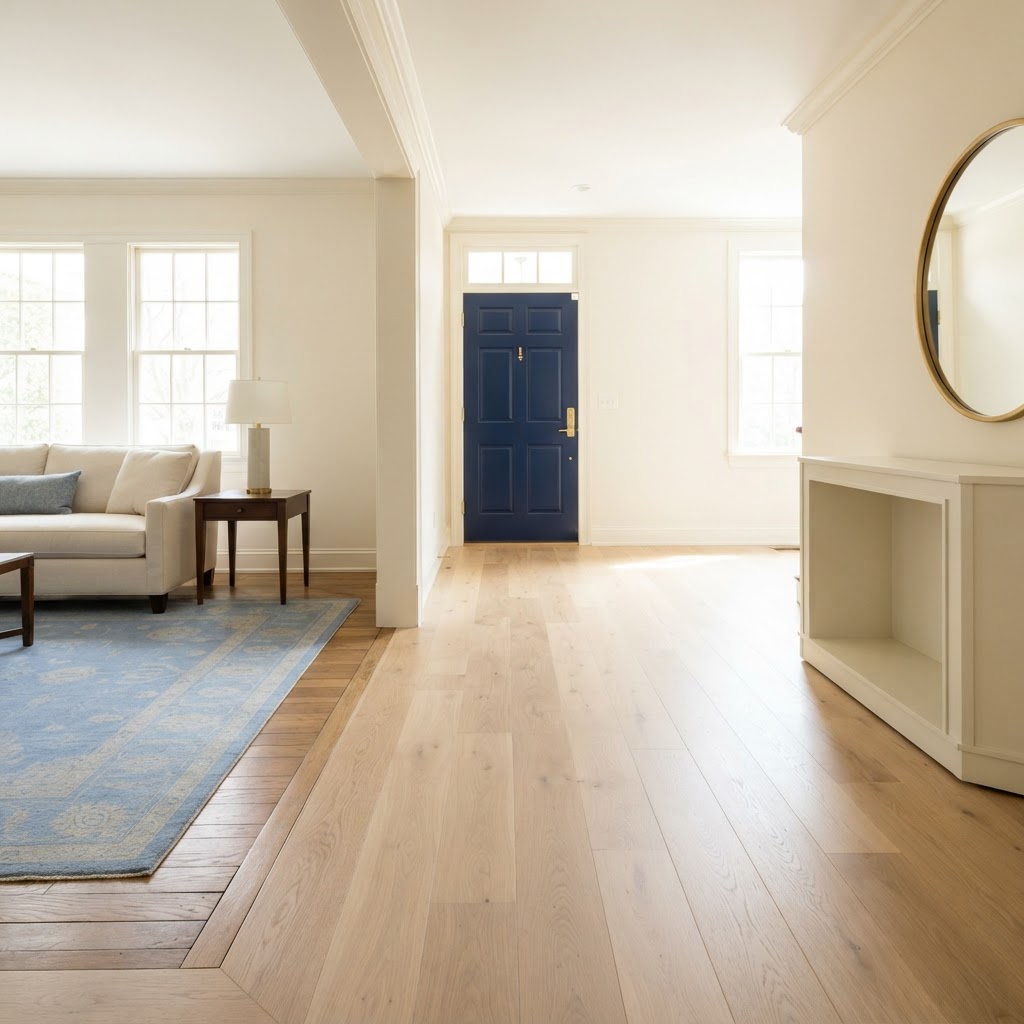
Can new hardwood flooring match the existing floors in a McLean home?
New hardwood flooring can often be matched closely to existing floors in a McLean home, but a perfect match is not always possible. Success depends on identifying the wood species, board width and thickness, the cut of the wood, the stain and finish, the sheen and, above all, how much the existing floor has aged. Because old floors darken, fade and develop patina over decades, the usual best practice is to install the new wood and then refinish the old and new together, so the entire surface shares one stain and finish. Where that is not practical, careful sample testing, thoughtful transitions and honest expectations produce the best possible result. Floors and Beyond VA, a family-owned Northern Virginia flooring and remodeling contractor serving Fairfax, Loudoun, Prince William and Arlington counties since 1987, handles hardwood extensions, repairs and refinishing with in-house crews and no subcontractors, and we tell homeowners candidly when a match will be excellent and when it will not.
Matching hardwood is one of the most specific and challenging problems in residential flooring, and it comes up constantly in McLean. A homeowner removes a wall to open the kitchen and needs to fill in the gap. A family builds an addition and wants the floors to flow into the new rooms. A leak damages part of a floor. A previous owner covered part of the house with carpet or tile, and now the hardwood needs to be extended. In each case, the question is the same: can the new wood look like the old? This guide explains what determines a successful match, how professionals approach it and what is realistic, so you can plan your project with confidence. For related reading, see our wood flooring page and our articles on flooring damage repair for water, scratches and buckling in Northern Virginia and whether your hardwood floors can be saved.
The variables that determine a match
A hardwood floor's appearance comes from several attributes working together. To match one, each must be identified and, as far as possible, reproduced.
Species
Oak is the most common hardwood in McLean homes, but red oak and white oak differ in color and grain. Red oak has a warm, pinkish undertone and a bold grain, and white oak is more neutral, with a tighter grain. Other species, such as maple, hickory, ash, walnut and cherry, have distinct appearances. Misidentifying the species leads to a mismatch that no stain can fully correct. Professionals identify species by examining grain, pores, color and end grain, often on a sample taken from a hidden location such as a closet.
Cut
How a log is sawn changes the grain pattern. Plain-sawn boards show cathedral patterns, quarter-sawn boards show straighter, more uniform grain with flake in oak, and rift-sawn boards show a linear, consistent grain. Many older floors are plain-sawn, but some are not. A new floor with a different cut can look different even if the species is the same.
Width and thickness
Board width has a strong visual effect. Older homes often have narrow strip flooring, and newer products tend to be wider. Introducing wider boards beside narrow ones is visible. Thickness matters for height alignment: new boards that differ in thickness from the old will sit at a different height, producing a step that must be managed. Solid and engineered products come in different thicknesses, and a good installer plans how to align them.
Grade
Hardwood is sorted by grade, which describes the amount of color variation, knots and other character marks. A clear, uniform grade looks different from a rustic grade with knots and variation. Matching grade matters for continuity.
Stain and finish
Existing floors may be natural, stained or finished with products that have amber with age. New wood with stain applied will rarely match old wood that has been finished and exposed to light for decades. The finish type, such as oil-based or water-based, affects the color and the way it ages.
Sheen
Gloss level, from matte to satin to semi-gloss, changes how a floor reflects light. A mismatch in sheen is easy to see even if the color is close.
Age and patina
This is the hardest variable. Over decades, wood darkens, finishes yellow, sunlight bleaches or deepens color and wear creates a soft patina. Brand-new wood is lighter and more uniform than aged wood. Even the same species, cut and stain will look different on the day of installation. This is why the best matching strategies treat the whole floor as a single surface rather than trying to make new wood imitate old.
The best strategy: install, then refinish together
When the existing floor is solid hardwood that can be sanded, the most reliable way to produce a seamless result is to install new wood in the gap, then sand the entire floor, old and new, down to bare wood and apply a single stain and finish. Sanding removes the old finish, patina and surface discoloration, bringing both old and new boards to a similar raw state. A uniform stain and finish then unifies them.
This approach works best when the new wood is the same species and a similar cut, width and grade. The result can be remarkable: a floor so continuous that visitors cannot tell where the original ends and the addition begins. Where wood is installed in a doorway or through a wall opening, boards can be interlaced with the old flooring in a weave pattern that disguises the seam. Our refinish-first philosophy aligns with this strategy, since we preserve the original floor while extending it. Our hardwood floor refinishing field guide for Northern Virginia describes the sanding and finishing process, and our article on whether refinishing is worth it explains how to decide.
Refinishing the whole floor does have implications. It affects every room the floor runs through, which may extend the scope to areas you did not plan to touch. It involves dust and cure time. And it is only possible if the existing floor has enough wood remaining. We evaluate each of these during a free consultation.
When you cannot refinish together
Sometimes refinishing the whole floor is not possible or desirable. The existing floor may have too little wood left to sand, or it may be engineered with a thin wear layer. A homeowner may want to leave certain rooms untouched. The floors may be separated by walls or doorways in such a way that a natural break exists. In these cases, the goal shifts from invisibility to harmony.
Strategies include choosing new flooring that is close in species, width and color to the old and using a transition at a logical boundary, such as a doorway or threshold, so that the change in tone reads as intentional. Sample testing is critical: we apply finish samples to the actual new wood, and compare them to the existing floor in your lighting, because the same stain looks different on different boards and in different light. Some homeowners accept subtle variation as part of an older home's character. Others choose a deliberate contrast, such as a different species or direction, to create a design feature instead of an imperfect imitation.
Matching repairs within an existing floor
Repair is a close cousin of extension. When boards must be replaced because of water, pet damage, fire or structural work, the repaired area is surrounded by old wood. Skilled repair involves removing damaged boards, weaving in replacements that match in species, cut and width, and then sanding and refinishing so that the patch blends. For small repairs, spot finishing may work, but larger or highly visible repairs usually benefit from refinishing the entire contiguous area. Reclaimed or salvaged boards, taken from a hidden area such as a closet, can sometimes provide a better match for older floors, since they share the same age and history.
Our article on flooring damage repair for water, scratches and buckling in Northern Virginia explains more about types of damage, and our historic home restoration services help owners of older homes preserve and extend original floors.
Extending hardwood through walls, additions and open layouts
Opening a wall or building an addition creates a strong need for matching. The floor in a newly opened area may differ from the original in height, direction, species or condition. In an open layout, the eye reads the entire floor as one surface, so inconsistencies stand out.
Planning starts before construction. Floor heights must align, which may mean adjusting the subfloor in the new area. Board direction should continue logically. The new flooring type should be chosen with the existing in mind. When walls are removed, the exposed gap may include a channel where old flooring ends under the wall, and it needs careful reconstruction. When an addition is built, we can coordinate flooring from the beginning so that framing, subfloor and finishes work together. Our home additions, whole house remodels, kitchen remodeling and primary suite remodeling services let us manage such coordination as a single team.
Extending hardwood to rooms that now have carpet or tile
Another common scenario is extending hardwood from one room into adjacent spaces that currently have carpet, tile or vinyl. Here, matching involves not only wood but also the transition between materials, the subfloor beneath and the heights involved. If hardwood lies under the carpet in the adjoining room, you may simply refinish it. If not, new flooring will be installed, and we will plan how it meets the existing hardwood.
Our article on carpet to hard flooring conversion in Northern Virginia explains what changes in such conversions, and our article on engineered wide-plank flooring in Northern Virginia describes a popular option when the new areas are on a concrete slab or require added stability. Where engineered and solid wood meet, transition planning is especially important.
Stairs and transitions
Stairs, landings and thresholds are the places where mismatch is most visible. New treads on old risers, or new landing boards beside old, require careful coordination of color and finish. Transitions between rooms, whether between old and new hardwood or between hardwood and another material, should be flush and neat, with a clean line. Our crews fit and finish these details carefully, and our estimates include transitions and molding.
What about sunlight and aging after installation?
Even when a match is excellent on the day the work is complete, floors continue to change. New wood will darken or lighten with light exposure, depending on the species and finish. Sunlight-exposed areas change faster. Over a year or so, a new addition may gradually move closer to the tone of the old floor, or a refinished floor may shift slightly. Using window treatments and rugs to moderate exposure, and rotating rugs and furniture periodically, helps even out changes. We explain what to expect for the species and finish you choose.
Setting honest expectations
A skilled contractor will tell you what is realistic. In many cases, a seamless match is achievable, especially when the old floor can be refinished with the new. In others, a close match is possible, with minor variation at the boundary. In some situations, a perfect match is not possible, such as when the original species is unavailable, the original floor has a unique age character or the old floor cannot be sanded. In those cases, we recommend an approach that looks deliberate: a clear transition, a complementary material or a design feature.
We would rather you know before work begins than be disappointed after. During your consultation, we bring samples, look at your existing floors in your lighting and discuss possibilities frankly.
What drives the scope of a hardwood matching project
We do not publish prices in articles, but the factors that shape any estimate are clear. The species and grade of the new wood. Square footage of new flooring. Whether the old floor will be refinished with the new, and how many rooms that includes. Repairs to existing boards. Subfloor preparation and height alignment. Stair work. Stain and finish system, including sample testing. Transitions and trim. Furniture moving. And the company, including its crews, licensing, bonding and insurance.
At Floors and Beyond VA, we provide an honest, all-inclusive estimate, and what we quote is what you pay. Our estimates include old flooring removal, new materials, professional installation, furniture moving, transitions, molding and full cleanup. Our article on flooring cost factors in Northern Virginia explains why estimates differ, and our flooring installation guide describes the process.
Common mistakes when matching hardwood
The first mistake is assuming a stain color can make any wood match.
The second is ignoring species and cut, which cannot be changed with finish.
The third is overlooking floor height differences between old and new.
The fourth is skipping sample tests in your actual lighting.
The fifth is trying to blend new and old without refinishing when refinishing is possible.
The sixth is forgetting that old floors have aged.
The seventh is choosing a board width that differs noticeably from the original without a deliberate design reason.
The eighth is creating awkward seams in the middle of open spaces.
The ninth is neglecting the subfloor in the new area.
The tenth is hiring a contractor who promises a perfect match without looking at your floor. Honest contractors qualify their promises.
Frequently asked questions
Can new hardwood match my old floors? Often, very closely, especially when old and new are refinished together. A perfect match is not always possible.
What is the best way to blend new and old hardwood? Install new boards that match species, cut and width, then sand and refinish the entire floor so that old and new share one finish.
Can you match a floor that cannot be sanded? We can get close with careful species selection, sample testing and thoughtful transitions, but expectations should be realistic.
Will the new wood change color over time? Yes, wood changes with light and age. We explain what to expect for your species and finish.
Can you match stairs? Yes, with careful fitting and finishing, though stairs are a place where details matter.
Can you repair damaged boards invisibly? Often, yes, by weaving in matching boards and refinishing the area.
Is Floors and Beyond VA licensed and insured? Yes. We are fully licensed, bonded and insured for every project, and our in-house crews work with no subcontractors.
Do you serve my McLean neighborhood? Yes, including Langley, Chesterbrook, Franklin Park, Salona Village, Hamilton, Dunn Loring, Vienna, Great Falls and Tysons, as well as Fairfax, Loudoun, Prince William and Arlington counties.
Ready to extend or repair your hardwood floors?
A convincing match starts with a careful look at what you have. Floors and Beyond VA brings nearly forty years of Northern Virginia experience, in-house crews with no subcontractors, a refinish-first philosophy and a free in-home consultation with samples and precise laser measurements at no charge.
Request your free McLean flooring estimate: https://floorsandbeyondva.com/Contact
You can also call (703) 906-5698 or email hello@floorsandbeyondva.com.




