
Restoring a hardwood floor is one of the best investments you can make in a home. A well-restored floor can make an older Arlington bungalow feel new again, help a Fairfax colonial sell faster, and give a family room in Ashburn the warm, finished look it was missing. But the result depends almost entirely on who does the work.
Two companies can use the same sanders, the same stains, and the same finishes and produce very different floors. One leaves a flat, smooth surface with even color and a durable finish. The other leaves sander marks, blotchy stain, dust throughout the house, and a finish that wears through in a year. The difference is in experience, process, and accountability.
Northern Virginia has no shortage of flooring companies, handymen, and refinishers. This guide walks through what to look for and what to ask, so you can choose a floor restoration company with confidence.
Understand What Floor Restoration Includes
Floor restoration is a broader term than refinishing, and it is worth knowing what you might need before you start calling companies.
Restoration may include cleaning and maintenance, screen and recoat, full sanding and refinishing, board replacement and weaving, repair of water damage, cupping, and buckling, squeak and loose board repair, gap filling, stair and railing refinishing, and restoration of historic or antique floors.
A good restoration company can assess which of these your floor actually needs. A company that only sells one service, usually a full sand and refinish, may recommend it even when your floor would do better with a lighter approach. That alone is one of the most important things to watch for.
Start With Licensing, Insurance, and Local History
Before you get into the details of the work, confirm the basics.
Licensing. In Virginia, contractors performing home improvement work above certain thresholds must hold a license from the Virginia Department of Professional and Occupational Regulation. Ask for the company's license number and look it up on the DPOR website. Confirm the license is active and covers the type of work.
Insurance. Ask for proof of general liability insurance and workers' compensation coverage. Floor restoration involves heavy equipment, chemicals, and work inside your home. If a crew member is hurt or your property is damaged, you want the company's insurance to cover it, not yours.
Local history. How long has the company worked in Northern Virginia? Local experience matters because the region's housing stock and climate create specific challenges, from damp crawl spaces under pre-war homes to engineered floors over slabs in newer communities to strict condo rules in Tysons and Arlington high-rises.
Ask Who Will Actually Do the Work
This is one of the most important questions, and many homeowners never ask it.
Many flooring companies sell the job and then subcontract the work to independent crews. The salesperson who measured your floor and promised a beautiful result may never see your home again. The crew that shows up may be different from job to job, may have varying skill levels, and may be paid by the square foot, which rewards speed over care.
Other companies employ their own crews. The people who do the work are trained by the company, follow the company's process, and are accountable to the company directly. If something is not right, there is a clear line of responsibility.
Ask directly: Are your installers and refinishers your own employees, or subcontractors? Will the same crew work on my job from start to finish? How long have your crew leads been doing this work?
Ask How They Assess Your Floor
A thorough assessment is the foundation of a good restoration. When a company visits your home, notice what they do.
Do they identify the species of wood and whether it is solid or engineered?
Do they check how much wear layer is left, especially on older floors or engineered floors?
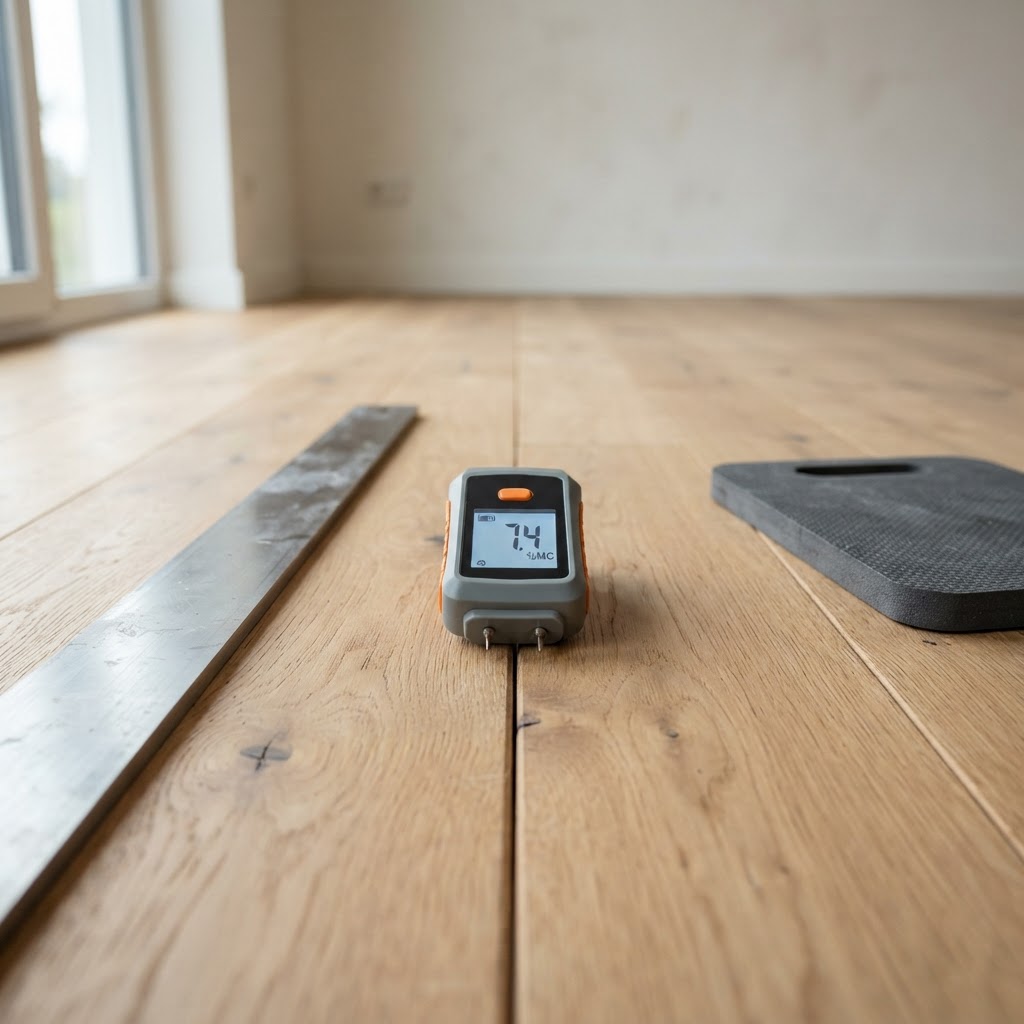
Do they take moisture readings if there is any sign of cupping, gaps, or past water damage?
Do they look at the condition of the finish and test whether a screen and recoat is possible?
Do they look at stairs, transitions, closets, and adjoining rooms?
Do they explain what is causing the problems you are seeing?
A company that glances at the floor and quotes a square-foot number without asking questions or checking anything is not assessing. It is selling.
Ask About Their Process
How a company sands, stains, and finishes determines how the floor looks and how long it lasts. Ask them to walk you through the process.
Sanding. What equipment do they use? How many sanding passes and what grit sequence? How do they handle edges, corners, and stairs? Experienced crews remove only as much wood as necessary and keep the surface flat and free of chatter and swirl marks.
Dust control. Ask whether they use dust containment sanding equipment connected to vacuum systems. Modern dust containment dramatically reduces airborne dust compared with older methods. Also ask how they protect adjacent rooms, HVAC returns, and belongings.
Stain testing. Do they apply color samples on your actual floor for you to approve? This is essential, because stain behaves differently on every floor.
Finish. What finish do they use, oil-based or water-based, and why? How many coats? What sheen options do they offer? How long until you can walk on the floor, and how long until furniture and rugs can go back?
Timeline. How many days will the job take? When can you use the rooms again? What do you need to move out beforehand, and will they help move furniture?
Ask for Recent, Local Examples
Photos on a website are a start. Better still are recent jobs in homes like yours.
Ask whether they have restored floors in your neighborhood or in similar homes. A company that has worked on pre-war floors in Arlington or Alexandria knows how to handle thin wear layers and old patches. A company that has worked in Loudoun's newer communities knows engineered flooring. A company that has worked in Tysons and Reston condos knows building rules, elevator reservations, and sound requirements.
Look at reviews on Google and other platforms, but read them for detail rather than just star ratings. Reviews that mention the crew by name, describe the process, and talk about cleanliness and communication tell you more than generic praise.
Get the Estimate in Writing and Read It Closely
A written estimate should clearly describe the scope of work. Compare estimates line by line rather than by the bottom number alone.
What rooms and areas are included? Are closets, hallways, and stairs included or extra?
What process is included: sanding, stain, number of finish coats, type of finish?
Are repairs included, such as board replacement or gap filling, or are they priced separately?
Is furniture moving included?
What is the timeline?
What warranty is offered, and what does it cover?
An estimate that is far lower than others may be leaving out steps, using fewer coats of finish, or assuming a subcontracted crew working quickly. An estimate that is vague leaves room for surprises later.
Watch for Red Flags
Some warning signs suggest you should keep looking.
Pressure to sign the same day, or special prices that expire immediately.
A full sand recommended on every floor without any assessment.
Unwillingness to provide a license number or proof of insurance.
No physical business address or local presence.
Large upfront payment demands.
Vague answers about who will do the work.
No stain samples on your floor before staining.
Promises that a deeply damaged or engineered floor can be sanded without checking the wear layer.
Ask About Warranty and Aftercare
A good floor restoration company stands behind its work. Ask what the warranty covers and for how long. Ask what happens if you notice a problem after the job, such as a spot where the finish did not bond or a board that lifts.
Also ask about aftercare. How should you clean the floor? What products should you avoid? When should you consider a recoat? A company that takes the time to explain how to protect your floor is invested in the result lasting.
Questions That Fit Your Type of Home
Northern Virginia's housing varies so much that the right company for one home may not be the right fit for another. Tailor a few of your questions to your situation.
If you own a pre-war or mid-century home. Ask how the company handles older floors that may have been sanded several times, how they repair tack strip holes and old patches, and whether they have experience with heart pine, quartersawn oak, borders, and other details found in older Arlington, Alexandria, and Falls Church homes. Ask how they approach floors over crawl spaces, where moisture is a common issue.
If you own a newer home with engineered flooring. Ask how they measure veneer thickness and when they recommend a screen and recoat instead of sanding. A company that wants to sand every engineered floor without measuring is a risk.
If you live in a condo. Ask whether they have worked in your building or similar high-rises in Tysons, Reston, Rosslyn, or Crystal City. Condo work involves building approvals, certificates of insurance, elevator reservations, working hours, and noise and odor rules. A company that knows the routine will save you headaches.
If you are selling. Ask how quickly they can schedule and complete the work, and whether they can recommend the most cost-effective approach for listing photos and showings. Sometimes a recoat is enough. Sometimes a full refinish adds more value.
If you have pets. Ask about pet stain repair and finish options that hold up better to claws. Ask whether they will recommend a sheen and color that hide scratches.
What a Good Assessment Visit Feels Like
You can learn a lot about a company from the first visit. A good assessment feels unhurried. The person asks about your goals, your household, and your timeline. They look closely at the floor in several rooms, often on their knees. They show you what they are seeing, such as worn traffic paths, failed finish near the sink, or the wear layer at a vent, and explain what it means. They offer options rather than a single answer, with honest pros and cons. And they follow up with a written estimate that matches what they told you.
A poor assessment feels like a sales call. The visit is quick, the recommendation is the same regardless of what the floor looks like, and the conversation focuses on signing rather than understanding.
Frequently Asked Questions
How many estimates should I get? Two or three is usually enough to compare approaches and understand what is reasonable. More than that tends to add confusion rather than clarity.
Is the lowest estimate the best value? Not necessarily. Compare what is included: the number of finish coats, the type of finish, repairs, stairs, furniture moving, dust control, and who does the work. Differences in those details often explain differences in the totals.
Should I choose a big company or a small one? Size matters less than accountability. What you want is a company with its own experienced crews, a clear process, and a track record in your area. Floors and Beyond VA is a family-owned company with in-house crews, which gives homeowners a direct line to the people responsible for the work.
How to Prepare for the Estimate Visit
You will get more useful estimates if you prepare a little before each company visits.
Know what you want. Do you want the floor to look refreshed, or do you want a new color? Are stairs included? Are there rooms you are unsure about? Having clear goals lets each company give you comparable recommendations.
Gather history. If you know when the floor was last refinished, what product was used, or whether there has been water damage, share it. If the home is older, mention any renovations, removed walls, or carpet that was pulled up.
Point out problem areas. Show the visitor the spots that bother you, such as a gray area by the sink, a squeak in the hallway, a pet stain, or boards that gap in winter.
Clear access to a vent. Lifting a floor register lets the assessor see the board profile and estimate the remaining wear layer.
Prepare your questions. Bring this list. A good company will welcome the questions, and the way each company answers will tell you a lot.
Communication During the Job
Ask how the company communicates once work begins. Who is your point of contact? Will someone walk through the floor with you after sanding and before staining? How are changes handled if the crew finds hidden damage, such as rotted boards under a carpeted area or a subfloor problem near a bathroom? A good company explains any surprises before doing additional work, gives you options, and puts changes in writing. Clear communication is often what separates a stressful project from a smooth one, and it is just as important as the quality of the sanding itself.
Trust Your Instincts
Finally, pay attention to how each company makes you feel. If you felt rushed, talked down to, or unsure who would show up, that matters. The right company leaves you understanding your floor better than before.
Consider the Whole Relationship
Floor restoration is often not a one-time job. Hardwood floors benefit from periodic recoats, and many homeowners eventually want to refinish stairs, add hardwood to new rooms, or replace carpet. A company that can handle restoration, installation, and ongoing maintenance becomes a long-term resource for your home.
Why Northern Virginia Homeowners Choose Floors and Beyond VA
Floors and Beyond VA is a family-owned company that has been restoring and installing floors across Northern Virginia since 1987. We serve homeowners in Fairfax, Loudoun, Prince William, and Arlington counties, and our work spans pre-war homes, mid-century colonials, newer construction, and high-rise condos.
Our crews are our own employees. We never subcontract, so the team that assesses your floor is accountable for the result. Our philosophy is to restore before replacing. We will tell you if your floor only needs a cleaning or a recoat, and we will measure your wear layer before recommending a full sand. We test stain colors on your own floor, explain every step of the process, and leave you with clear guidance for keeping your floors beautiful.
If you are comparing floor restoration companies, we would welcome the chance to show you how we work. Book a free in-home estimate with Floors and Beyond VA at floorsandbeyondva.com/Contact and ask us every question on this list.
A Short Checklist
Before you hire, confirm the company is licensed and insured in Virginia, employs its own crews, assesses your floor thoroughly, explains its sanding, dust control, staining, and finishing process, tests stain on your floor, provides a detailed written estimate, offers a warranty, and has a local track record you can verify. A company that checks every box is one you can trust with one of the most important surfaces in your home.

