
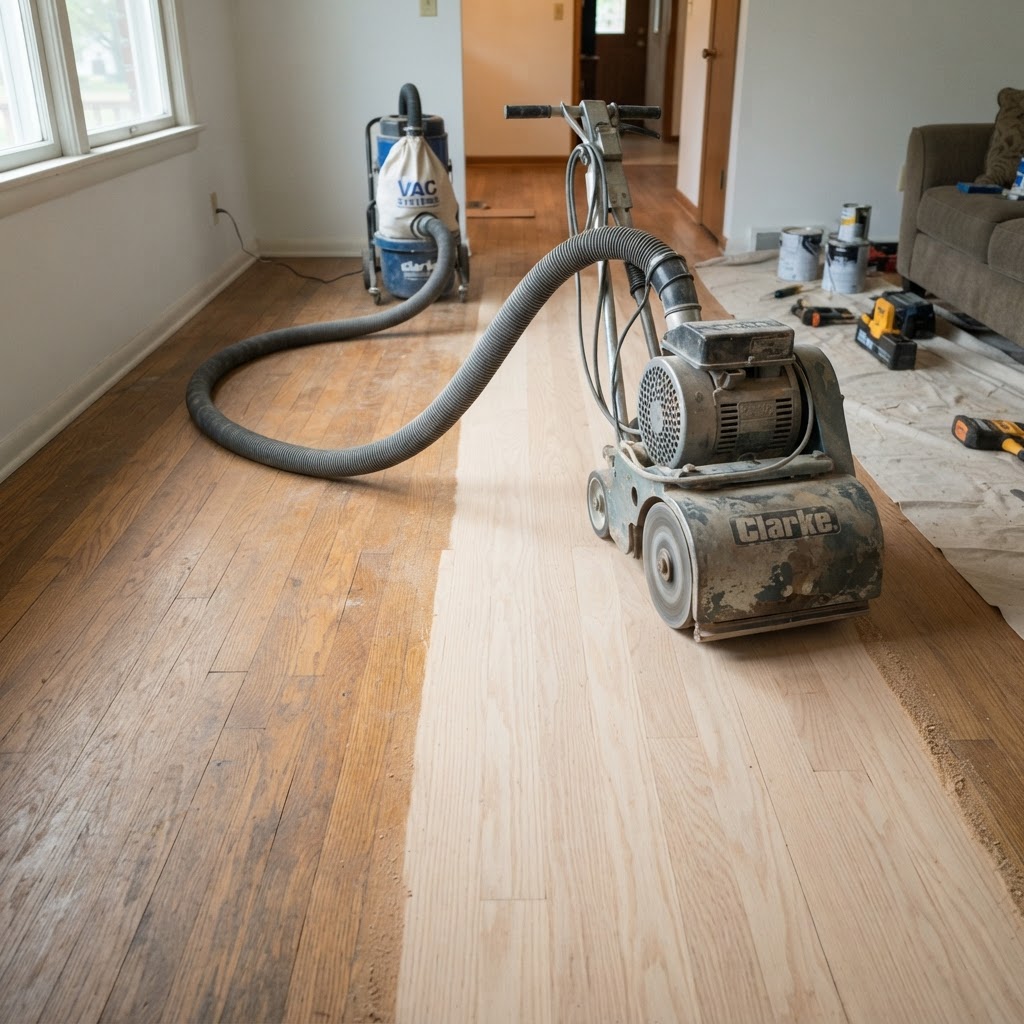
One of the best things about hardwood is that it can be renewed. When the finish wears through, the boards get scratched, or the color starts to look dated, the floor can be sanded down to fresh wood and refinished. A well-cared-for hardwood floor can look new again several times over a lifetime that stretches for generations.
But sanding removes wood, and every floor has a limit. Homeowners across Northern Virginia, especially in older homes in Arlington, Falls Church, Alexandria, and Vienna, often ask us the same question before a refinishing project: has my floor been sanded too many times already, and can it take another one?
This guide explains how resanding works, what the wear layer is, how many times different kinds of hardwood can typically be resanded, how to check your own floor, and what to do if your floor is getting close to its limit.
What Resanding Actually Removes
A full sand and refinish takes a hardwood floor down past the old finish and into fresh wood. The goal is to remove the finish, the stain, surface scratches, minor dents, and any unevenness, leaving a clean, flat surface ready for new stain and finish.
A skilled refinisher removes as little wood as necessary to achieve that. On a floor in good condition, that may be a very thin layer. On a floor with deep scratches, pet damage, cupping that has since dried, or uneven boards, more wood has to come off to get everything flat.
That amount varies from job to job, and it is the reason there is no single universal number for how many times a floor can be resanded. It depends on how much usable wood the floor started with and how much each previous sanding took.
Understanding the Wear Layer
The wear layer is the portion of the board above the tongue and groove that can be safely sanded. Once sanding reaches the top of the tongue, the floor is effectively sanded out. Going further exposes the tongues and the nails or staples that hold the floor down, and the boards can begin to splinter and separate.
On solid hardwood, the wear layer is the wood between the surface of the board and the top of the tongue. On standard three-quarter-inch solid hardwood, which is what most Northern Virginia homes built before the 2000s have, that is a meaningful amount of wood.
On engineered hardwood, the wear layer is the real wood veneer bonded to the top of a plywood or composite core. Engineered floors vary widely. Some have a very thin veneer that is not meant to be sanded at all. Others have a thick veneer that can be sanded more than once. The core underneath is not hardwood and cannot be sanded and refinished.
How Many Times Can Each Type Be Resanded
These are general guidelines. The real answer for your floor always comes from measuring it.
Solid three-quarter-inch hardwood. This is the most durable flooring for resanding. Under typical conditions and with careful sanding, solid hardwood can often be sanded and refinished many times over its life. A floor that is refinished every ten to fifteen years can last well beyond a century, which is exactly why so many pre-war homes in Arlington and Alexandria still have their original oak and pine.
Thinner solid hardwood. Some homes, especially certain mid-century builds and some budget renovations, have thinner solid strip flooring, such as five-sixteenths-inch strip oak. These floors have much less wood above the tongue and can be sanded far fewer times. Some may have very limited sanding life left.
Engineered hardwood with a thick wear layer. Engineered floors with a thick veneer can often be sanded once or more, depending on the thickness and how much the first sanding removes.
Engineered hardwood with a thin wear layer. Many engineered floors installed in newer Loudoun and Prince William homes have a thin veneer. These may not be sandable at all, or may allow only a very light sanding. For these floors, a screen and recoat, which refreshes the finish without sanding into the wood, is usually the right approach.
Floors that have been sanded aggressively. A floor sanded by an inexperienced operator, especially with a drum sander held in one place too long, may have lost far more wood than necessary. Gouges, chatter marks, and dips are signs of past over-sanding.
How to Check Your Floor's Remaining Wear Layer
You can learn a lot about your floor without tools. A professional assessment then confirms it.
Look at a floor vent. Lift a floor register out of its opening. The edges of the cut boards show you a cross-section of the floor. You can see the total thickness of the boards and, on solid hardwood, how much wood sits above the tongue. On engineered flooring, you can see the veneer layer on top of the core.
Look at a threshold or transition. Where your hardwood meets tile or another floor, the edge sometimes shows the board profile.
Look for exposed nails or tongues. If you see nail heads or the tops of tongues showing along the seams, the floor may already be at or near its limit.
Look at the seams. On floors that have been sanded many times, the gaps between boards can look wider and the board edges can look worn or splintered.
Check closets and under appliances. These areas are often original and untouched, and comparing them with the main floor shows how much the main floor has been sanded over the years.
A flooring professional will measure the wear layer directly, often at a vent or by removing a small piece in an inconspicuous spot, and will look for the signs above across the whole floor before recommending a full sand.
Signs Your Floor May Be Sanded Out
These are the warning signs that a floor has little or no sanding life left.
Visible nail heads across the floor surface.
Tongues showing along the seams.
Boards that splinter or flake along the edges.
A floor that feels thin or flexes more than it should.
Engineered flooring where the core is visible through worn spots.
Deep dips or uneven areas from past aggressive sanding.
If you see any of these, avoid a full sanding until a professional has looked at the floor.
Ways to Extend the Life of Your Wear Layer
The best way to get more refinishes out of a floor is to avoid sanding it before it truly needs it.
Screen and recoat on schedule. A screen and recoat lightly abrades the existing finish and applies a fresh coat on top, without sanding into the wood. Done every few years in high-traffic homes, it keeps the protective layer intact so scratches never reach the wood. That can push a full sanding out by many years.
Protect the floor daily. Felt pads under furniture, mats at entries, and trimmed pet nails reduce the scratches that would otherwise require sanding to remove.
Clean correctly. Use a cleaner made for finished wood floors and a lightly damp microfiber mop. Harsh cleaners and steam mops wear down the finish faster.
Control humidity. Floors that cup and crown due to moisture often need more aggressive sanding to flatten. Keeping humidity steady through Northern Virginia's humid summers and dry winters protects the wood.
Hire a skilled refinisher. A good refinisher removes only as much wood as necessary. An experienced crew uses the right grit sequence and keeps the sander moving to avoid gouging, which saves wear layer every time.
Spot repair instead of full sanding. Localized damage, such as a pet stain or a deep gouge in one area, can often be repaired by replacing a few boards and blending the finish rather than sanding the whole floor.
What If Your Floor Is Close to Its Limit
A floor near the end of its sanding life is not necessarily a lost cause.
A screen and recoat can refresh the appearance and protection without removing any wood, often for years.
Damaged boards can be replaced individually. New boards can be woven into the floor and finished to match.
Some floors can take one very light final sanding if handled carefully by an experienced crew.
When a floor truly has nothing left, replacement is the honest answer. If the original floor is historic, it may still be possible to salvage and reuse some boards elsewhere, or to match the new floor closely to the old.
Resanding Older Northern Virginia Floors
Many of the homes we work in across Arlington, Alexandria, Falls Church, McLean, and Vienna have floors that are seventy years old or more. Some have been refinished three, four, or five times. Some were sanded aggressively decades ago, and some have been covered with carpet since the 1970s and are in remarkably good shape.
With older floors, the refinishing decision is part assessment and part craft. Pre-war red oak and heart pine are often thick enough for another refinish, but the boards may be worn unevenly, with traffic paths thinner than the edges of the room. An experienced refinisher reads the floor and adjusts, flattening it while preserving as much wood as possible.
Newer homes in Loudoun and Prince William often have engineered flooring. Here the main question is the veneer thickness. We measure first and recommend sanding only when the veneer supports it. Otherwise we recommend a screen and recoat or a targeted repair.
Screen and Recoat Versus Full Resanding
Because the two are often confused, it helps to see them side by side.
A full sand and refinish removes the old finish and a thin layer of wood, takes the floor down to bare wood, and allows a new stain color. It removes scratches that have gone through the finish into the wood, evens out wear patterns, and flattens minor unevenness. It uses up some of the wear layer each time, and the floor needs a few days without foot traffic or furniture while the stain and finish cure.
A screen and recoat lightly abrades only the top of the existing finish so a fresh coat will bond, then applies one or more new coats. It does not change the color and does not remove scratches that have reached the wood. It removes no wood at all, costs the wear layer nothing, and is usually completed quickly with less disruption.
The right choice depends on where the damage is. If you run a fingernail across a scratch and it catches deeply, or the wood is gray and exposed in traffic paths, the damage is in the wood and a full sand is needed. If the floor looks dull, has fine surface scratches, and the color is still intact, a screen and recoat is often enough. A floor that gets a screen and recoat every few years can go a very long time between full sandings.
How Long a Full Refinish Lasts
How long a refinish lasts before the floor needs attention again depends on traffic, pets, how the floor is cared for, and the finish used. In a quiet home with good habits, a full refinish can last many years, especially with periodic recoats. In a busy household with large dogs and heavy traffic through the kitchen and family room, the finish in high-traffic paths will wear sooner.
The goal is to refresh the finish before it wears through to the wood. Once the wood is exposed, it grays, absorbs dirt and moisture, and can only be fixed with sanding. Watching the traffic paths and recoating before they wear through is the single most effective way to protect your wear layer.
Questions to Ask Before Your Floor Is Resanded
Whoever you hire to refinish your floors, these questions will tell you a lot about how carefully they treat your wear layer.
Will you check the wear layer before sanding, and how? A careful refinisher looks at the floor's thickness at a vent or transition before recommending a full sand.
Is a screen and recoat an option for my floor? If the answer is always a full sand, be cautious. A good refinisher will tell you when a lighter approach is enough.
What grit sequence and equipment do you use? Experienced refinishers start with the least aggressive grit that will do the job and work up, rather than starting coarse by default.
Who will actually do the work? Ask whether the crew is in-house or subcontracted, and whether the people who sand your floor have years of experience.
How do you handle edges, corners, and stairs? These areas are sanded with different equipment and are where inexperienced work shows most.
How Floors and Beyond VA Approaches Resanding
Floors and Beyond VA has been refinishing hardwood across Northern Virginia since 1987, and our philosophy is to restore before replacing. That philosophy depends on protecting the wear layer, because every refinish we save a floor from today is one more refinish it has later.
Before we recommend a full sand, we check the wear layer, look for signs of past over-sanding, and talk with you about whether a screen and recoat or spot repair would serve you better. When a full sand is the right choice, our in-house crews sand carefully, use the right grit progression, and remove only what is needed. We never subcontract, so the crew that assesses your floor is the crew that does the work.
If you are wondering whether your floors can take another refinish, book a free in-home estimate with Floors and Beyond VA at floorsandbeyondva.com/Contact. We will measure your floor, explain how much life it has left, and recommend the approach that keeps it beautiful for as long as possible.
Frequently Asked Questions
Can a floor be sanded if it has never been refinished? Yes, and floors that have never been sanded usually have their full wear layer. Floors uncovered from under old carpet in older Northern Virginia homes are often in this category.
Does a darker stain require more sanding? Going darker does not require extra sanding. Going from a dark stain to a light one often does, because every trace of the old color must come out of the wood.
Can Floors and Beyond VA tell how many times my floor has been sanded? Not with certainty, but measuring the remaining wood above the tongue and comparing traffic areas with protected areas like closets tells us how much sanding life is left, which is what really matters.
A Quick Summary
Every hardwood floor has a limited amount of wood that can be sanded. Solid three-quarter-inch hardwood can usually be resanded many times. Thinner solid floors and engineered floors have less to give, and some engineered floors cannot be sanded at all. You can check your floor at a vent or transition, and you should watch for visible nails, exposed tongues, and splintered edges. The best way to get more life out of a floor is to protect the finish with regular screen and recoats so a full sanding is only needed when it truly is.

