
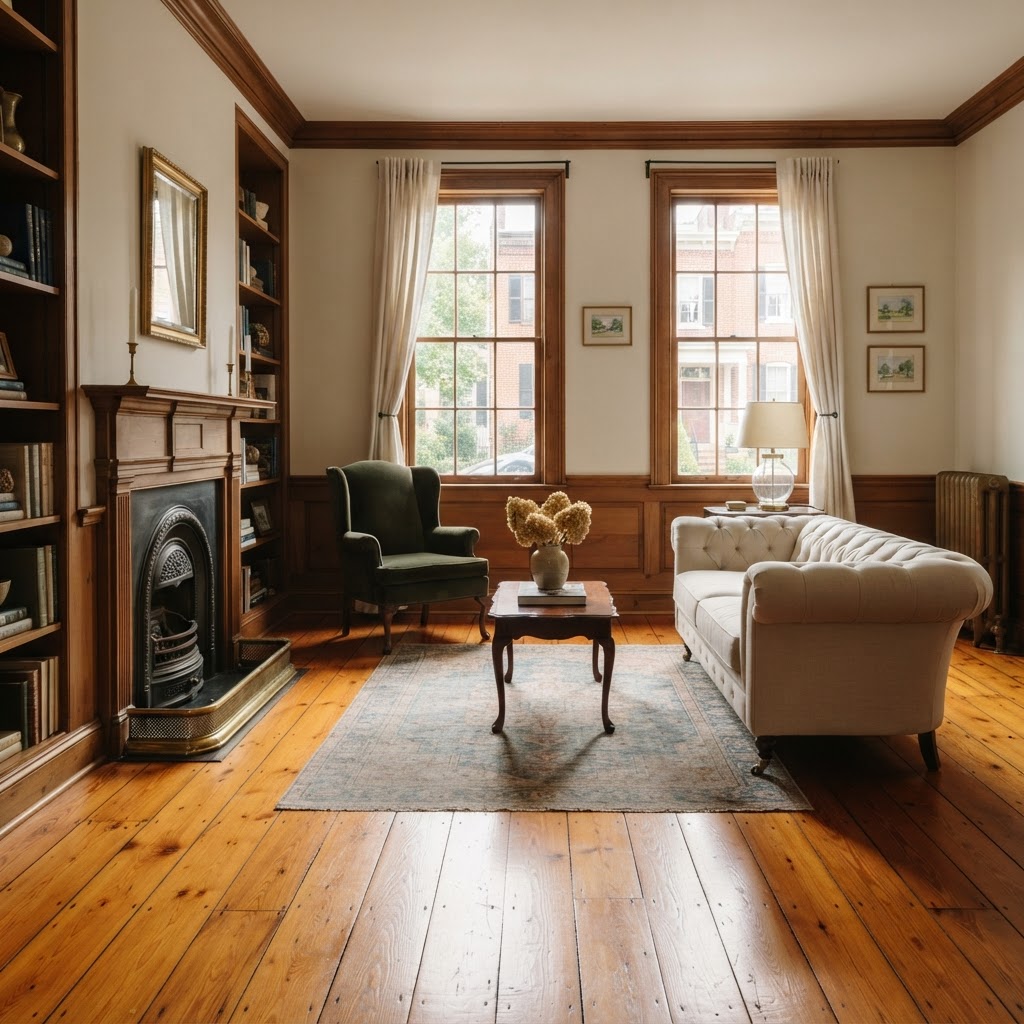
Walk into almost any older home in Alexandria and the floor tells you how old the house is before the realtor does. In an Old Town rowhouse it might be wide heart pine boards, worn soft along the path from the front door to the kitchen. In a Del Ray bungalow it is usually narrow red or white oak strip, often hiding under carpet that went down sometime around 1975. In Rosemont and Beverley Hills you find oak that has been sanded two or three times already by owners who came before you. These floors are part of what makes Alexandria homes worth what they cost, and in most cases they can be brought back rather than torn out.
Floors and Beyond VA has been sanding, repairing and refinishing hardwood across Northern Virginia since 1987, and Alexandria's housing stock is some of the most rewarding work we do. This guide explains how refinishing works on the specific kinds of floors Alexandria homeowners own, how to tell whether your floor still has life left in it, and what to expect from the day the crew arrives to the day you move the furniture back.
Why Alexandria's Floors Are Different
Alexandria was laid out in 1749, and the blocks of Old Town between Washington Street and the river still hold houses built in the late eighteenth and nineteenth centuries. Many of those homes were floored in longleaf heart pine, a dense, resin-rich wood cut from old-growth forests that no longer exist in any commercial quantity. Heart pine boards are often wider than modern strip flooring, they were usually face-nailed with cut nails rather than blind-nailed through the tongue, and after two centuries of settling they rarely sit perfectly flat.
Del Ray tells a different story. It grew up in the early twentieth century as a streetcar suburb, became part of the City of Alexandria in 1930, and filled with bungalows, foursquares and Cape Cods. Those houses were almost all built with two-and-a-quarter-inch oak strip over plank subfloors, and that oak is excellent material. Rosemont, Beverley Hills, Seminary Hill and North Ridge follow a similar pattern with somewhat later construction, while Parker-Gray mixes nineteenth-century rowhouses with twentieth-century infill.
Across the city line, many Alexandria addresses sit in Fairfax County: Belle Haven, Huntington, Rose Hill, Hollin Hills, Mount Vernon and Franconia. Homes there were mostly built from the 1940s through the 1980s, and a surprising number of them have oak under wall-to-wall carpet that has never seen a sander. When we pull up a corner of carpet in one of those homes, we often find a floor in better shape than the owner expected.
The practical point is that one refinishing approach does not fit every Alexandria floor. Heart pine, old oak with several past sandings, and untouched oak under carpet each need a different plan, and a contractor who treats them the same way is likely to make a mistake on at least one of them.
Refinish First: How We Decide Whether a Floor Can Be Saved
The philosophy at Floors and Beyond VA is simple. If an original floor can be refinished safely and will look good afterward, we recommend refinishing. Replacement makes sense only when the floor genuinely cannot be saved, and in Alexandria that is less common than many homeowners assume.
The first thing we check is thickness. A standard three-quarter-inch solid oak floor has roughly a quarter inch of wood above the tongue, and each full sanding removes a small slice of that. A floor sanded carefully only a few times usually has plenty left. A floor that has been sanded aggressively many times can get thin enough that the tongue starts to show or the nail heads come too close to the surface. We look at the edge of a board at a floor register, a threshold or a stair nosing, where the profile is visible, and that tells us how much material remains.
The second thing we check is fasteners. Old face-nailed floors, which describes most heart pine in Old Town, have nail heads sitting in the face of the board. Before any sanding, every one of those nails has to be set below the surface. A sanding drum that hits a proud nail tears the paper, gouges the floor and can damage the machine. Setting nails on a large heart pine floor is slow, careful work, and it is one of the clearest differences between a crew that knows old houses and one that does not.
The third thing we look at is damage. Pet stains that have soaked deep into the wood, old water damage near radiators and kitchens, boards split from settling, and patches where a previous owner removed a wall all affect the plan. Many of these problems are repairable by weaving in matching boards, and in older homes we often salvage boards from a closet or another low-visibility area so the repair matches the age and grain of the surrounding floor. Only when damage is widespread or the floor is too thin do we talk about replacement.
Refinishing Heart Pine in Old Town and Parker-Gray
Heart pine deserves its own section because it behaves differently from oak in almost every step of refinishing.
It is full of resin. As the sander heats the wood, that resin softens and loads up the sandpaper, so the paper clogs faster and has to be changed more often. A crew that pushes through with clogged paper burns the surface and leaves swirl marks that show clearly under finish. We sand heart pine with patience and fresh abrasive, and we adjust the grit sequence to the condition of the boards rather than running a fixed routine.
Heart pine also takes stain unevenly. The dense latewood and the softer earlywood absorb color at different rates, and the resin can repel some stains entirely. Most owners of heart pine floors in Old Town decide to leave the wood its natural color, which deepens over time to a warm amber that no stain fully reproduces. If you want a different tone, we lay out stain samples directly on your floor in an inconspicuous area so you can see how your specific boards react before we commit to anything.
Finally, old heart pine is rarely flat. Two centuries of seasonal movement, settling joists and old repairs leave boards cupped, crowned or slightly uneven. Sanding a historic floor perfectly flat would remove far more wood than is wise, and it would erase some of the character that makes the floor valuable. Our approach is to sand enough to get a clean, sound surface while respecting the floor's natural contours.
Homeowners in the Old and Historic Alexandria District sometimes ask whether they need approval from the Board of Architectural Review before refinishing. The board's review focuses on exterior changes visible from public streets and alleys, so interior floor refinishing is generally not something it reviews. If your project also involves exterior work or structural changes, check with the city before starting.
Refinishing Oak in Del Ray, Rosemont and the Older Suburbs
Oak is more forgiving than heart pine, which is good news for most Alexandria homeowners. Red and white oak sand cleanly, accept stain predictably and hold a finish well. The main questions with oak are how many times it has already been sanded, what finish is on it now, and whether you want to change the color.
In Del Ray especially, we find floors that were refinished with a heavy amber oil-based finish decades ago, sometimes over an orange stain that was popular in the mid-century. Removing that look means a full sanding down to bare wood. If the existing finish is in decent shape and you like the color, a screen and recoat can be an option instead. That process lightly abrades the top layer of finish and adds a fresh coat without cutting into the wood, so it preserves thickness for the future. It works only when the existing finish is intact and free of wax, since modern finishes do not bond over waxed surfaces.
Color is where many Alexandria homeowners spend the most thought. Natural oak with a clear water-based finish gives a light, clean look that suits renovated kitchens and open plans. Medium browns remain popular in the traditional colonial-style homes of Rosemont and Seminary Hill. Darker stains look striking but show dust and scratches more readily. As with heart pine, we test stains on your actual floor, because the same can of stain looks different on red oak than on white oak and different again on wood that has been sanded several times before.
Floors Hiding Under Carpet in Fairfax County Alexandria
In neighborhoods like Rose Hill, Huntington, Belle Haven and parts of Mount Vernon, much of the housing was built between the 1950s and the 1980s with oak floors that owners later covered with carpet. When carpet was installed over hardwood, the installer nailed tack strip around the perimeter and stapled the pad to the wood. That leaves a ring of small holes along every wall and a scattering of staple holes across the room.
The good news is that these floors have usually never been sanded, so they have their full thickness to work with. Staple holes disappear almost entirely after sanding. Tack strip nail holes along the walls are filled and, once the baseboard and shoe molding are back in place, are rarely noticeable. Pet stains that soaked through the carpet and pad are the main risk, and we will tell you honestly whether a stained area can be sanded out or should have boards replaced.
If you are buying a home in this part of Alexandria and the listing mentions hardwood under carpet, it is worth having the floor assessed before you budget for new flooring. In many cases refinishing gives you a better result than replacement and preserves original material that cannot be bought new.
What Refinishing Day Actually Looks Like
A typical refinishing project at Floors and Beyond VA starts with an in-home visit. We measure the rooms, check thickness and fasteners, look at any damage, and talk through color and sheen. That visit is also when we plan logistics: which rooms will be off-limits and when, where the crew will set up, and how furniture will be handled.
On the first work day, the crew protects adjacent rooms, removes shoe molding where needed, and sets nails or makes repairs. Sanding follows in passes, moving from coarser to finer abrasives, with edges and corners done by hand-held edgers and scrapers. In older Alexandria homes we take extra care around radiators, built-in cabinetry and stair landings where a large sander cannot reach.
Many homeowners ask about dust. Modern dust-containment sanding systems capture most of the fine dust at the machine, which makes a real difference in occupied homes and condos. Some dust always escapes during edging and scraping, so we still seal doorways and HVAC returns in the work area.
If your home was built before 1978, lead paint is a real consideration. Painted baseboards, shoe molding and old paint drips along the edges of the floor can contain lead. Sanding the wood itself is not the same as sanding paint, but any work that disturbs painted surfaces in a pre-1978 home should follow lead-safe practices. Ask any contractor you consider how they handle this, and expect a clear answer.
After sanding comes stain, if you chose one, and then finish coats. Water-based finishes dry quickly, stay clear rather than ambering, and have low odor, which makes them the default for most occupied homes. Oil-based finishes take longer to dry and cure and have a stronger smell, but some homeowners prefer the warm tone they give, particularly on heart pine and older oak. We will talk through both so you can choose.
How Long Before You Can Use Your Floors
The exact timeline depends on the finish and the weather, but the general pattern is consistent. With a water-based finish, you can usually walk on the floor in socks within about a day of the final coat. Furniture can typically go back after a few days, set down gently and with felt pads on every leg rather than dragged into place. Area rugs should wait longer, often around two weeks, because the finish keeps curing underneath and a rug traps that process. Oil-based finishes need more time at every stage.
Alexandria's climate matters here too. Our summers are hot and humid and our winters are dry once the heat comes on. Finish dries more slowly on humid days, and wood moves with the seasons regardless of finish. Small gaps between boards in January that close up by July are normal, especially in older strip floors. Keeping indoor humidity in a moderate range year-round helps protect both the floor and the finish.
Repairs That Make the Difference
Refinishing is where repairs become invisible. A floor with a burned board in front of the fireplace, a patch where a wall came out during a kitchen renovation, or a section of rot near an old radiator can look seamless after the crew weaves in matching boards and sands the whole area together. Weaving means removing damaged boards back to staggered joints and lacing new or salvaged boards into the existing pattern, rather than cutting a straight-edged patch that will always show.
In older Alexandria homes, matching wood is often the challenge. New heart pine is not cut from the same old-growth stock, and modern oak can differ in width and color from what was milled a century ago. Salvaging boards from a closet, under a built-in or from a room being renovated anyway is often the best way to get a true match. This is the kind of detail that separates a floor that looks restored from one that looks patched.
Refinish or Replace: A Straight Answer
For most hardwood in Old Town, Del Ray, Rosemont and the older parts of Fairfax County Alexandria, refinishing is the better choice. Original floors are usually higher-quality material than what most homeowners would buy today, they carry the character buyers pay a premium for, and refinishing avoids the demolition and disposal of a full replacement.
Replacement makes sense when the floor is too thin to sand again, when damage is widespread enough that repairs would leave more patches than original wood, when the subfloor itself needs replacement, or when you are converting a space in a way that calls for a different material, such as a basement or a bathroom. When replacement is the right answer, Floors and Beyond VA installs new solid or engineered hardwood and can often match the width and species of the surrounding floors so new and old rooms flow together.
Why Alexandria Homeowners Call Floors and Beyond VA
Floors and Beyond VA is family-owned and has been working on Northern Virginia floors since 1987. Our owner has roughly four decades in the flooring trade, and every job is handled by our own in-house crews rather than subcontractors. That matters on old floors, because the person setting nails and sanding your heart pine is someone we trained and someone who answers to us, not a crew we met that morning.
We work throughout the City of Alexandria, including Old Town, Del Ray, Rosemont, Parker-Gray, Seminary Hill and the West End, and throughout the Fairfax County neighborhoods with Alexandria addresses, including Kingstowne, Franconia, Rose Hill, Huntington, Belle Haven and Mount Vernon. Whether your floor is two hundred years old or hiding under carpet from the 1970s, we will tell you honestly whether it can be saved.
Book Your Free In-Home Estimate
If you own an older Alexandria home and want to know what your floors can become, the best next step is an in-home assessment. We will check thickness, fasteners and damage, test stain colors on your actual boards, and give you a clear plan for refinishing or repair.

