
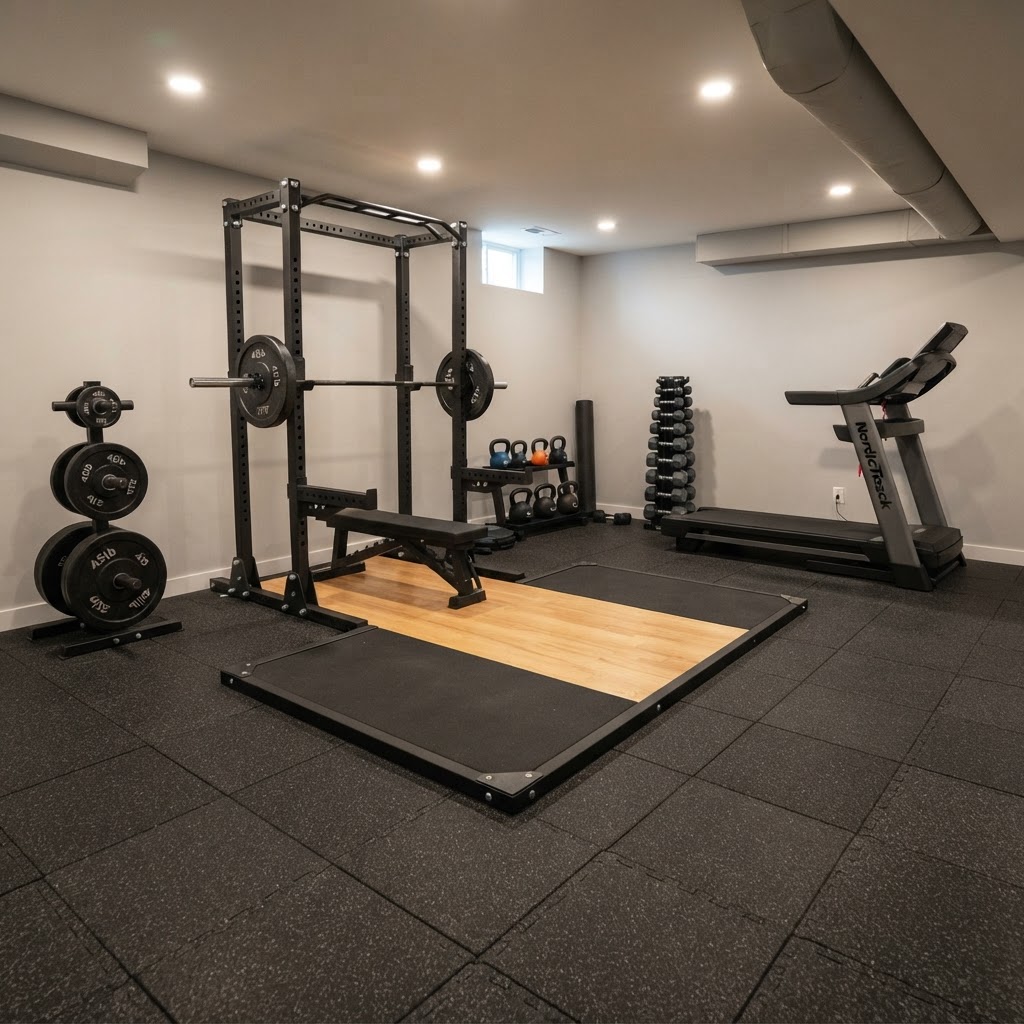
Gym flooring in Northern Virginia has to do more than look clean. It has to absorb dropped weights, protect the slab or subfloor underneath, keep noise from traveling through the house or building, and stand up to sweat, cleaning products, and constant foot traffic. The right floor depends on what happens in the room: cardio, free weights, heavy lifting, group classes, or a mix of everything.
Floors and Beyond VA installs a lot of gym flooring these days, from basement and garage home gyms to HOA fitness rooms, apartment amenity gyms, training studios, and commercial weight rooms. This guide covers the main gym flooring materials, how to match them to the way the space will be used, the subfloor and moisture issues specific to this region, and what gym projects look like in three of the communities where we see them most: Ashburn, Reston, and Woodbridge.
What is the best flooring for a home gym in Northern Virginia?
For most home gyms, rubber flooring is the best choice. It absorbs impact, protects the floor underneath, resists moisture, and gives secure footing for lifting and cardio. The thickness should be chosen based on the heaviest activity in the room.
Rubber gym flooring comes in three main formats. Rolled rubber comes in long rolls that are cut to fit the room, which means fewer seams and a cleaner look. Interlocking rubber tiles snap together like a puzzle and are easier to install in small or irregular rooms and to replace if one gets damaged. Rubber mats, including heavy stall-style mats, are thick, dense, and inexpensive for the protection they give, which is why many home lifters use them in deadlift and drop zones. We cover those in our guide to horse stall mats.
Foam puzzle mats, the soft colorful squares often sold for kids' playrooms, are not a real gym floor. They compress under weight, shift under equipment, and dent permanently under racks and benches. They are fine for stretching or a child's tumbling corner but not for a room with free weights.
How thick should gym flooring be?
Gym flooring thickness should match the heaviest use in the room. Thinner rubber works for cardio and bodyweight training, medium thickness for general free-weight work, and the thickest options for areas where heavy barbells are dropped.
As a rough guide, thin rubber in the range of 8 millimeters is common for cardio equipment, bodyweight work, and general fitness rooms. Rubber in the range of 3/8 to 1/2 inch handles dumbbells, kettlebells, and general free-weight training. For heavy deadlifts and Olympic lifts where bars are dropped from overhead, 3/4-inch mats or a built-up lifting platform give the most protection to the floor underneath.
Many home gyms use zones rather than one thickness throughout. A cardio area with a treadmill and bike might use thinner rolled rubber, while the squat rack and deadlift area gets thicker mats or a platform. Zoning keeps costs reasonable and puts protection where it is actually needed.
What other gym flooring options are there?
Beyond rubber, the main gym flooring options are turf, sport vinyl, and hardwood sport flooring. Each serves a specific kind of training space.
Artificial turf strips are popular for sled pushes, agility drills, and functional training lanes. They are usually installed as a lane down one side of a rubber floor rather than as the whole room.
Sport vinyl and rubber-backed sheet goods are common in group fitness studios, yoga rooms, spin rooms, and physical therapy spaces. They are easier to clean than rubber, quieter underfoot, and give a more finished look, but they do not absorb dropped weight the way rubber does.
Hardwood sport floors, usually maple, are used for basketball courts, dance studios, and multipurpose rooms where people jump, pivot, and slide. These are specialized systems with engineered subfloors built to flex slightly under impact, and they are a different category of project from a weight room.
For home gyms that double as a family room or office, some homeowners choose LVP for the room and lay rubber mats over it in the training area. That works for light use, but heavy lifting directly on LVP can dent or crack it, so mats should be thick enough to spread the load.
Does gym flooring need special subfloor preparation?
Yes, especially in basements and garages. Rubber flooring is forgiving, but it still needs a flat, clean, dry base, and concrete slabs in this region often bring moisture with them.
Northern Virginia basements tend to be damp in summer, and concrete slabs can wick moisture up from below year-round. Rubber itself handles moisture well, but trapped moisture under rubber can lead to odor and, in some cases, mold. Before installing, a good installer tests the slab, checks for cracks or low spots that need leveling, and decides whether the rubber should be loose-laid or glued down. Loose-laid rubber lets the slab breathe at the seams and is easier to remove later. Glued-down rubber is more stable and is often used in commercial spaces.
Garage gyms bring their own issues: sloped slabs that drain toward the door, oil stains, and temperature swings that make rubber expand and contract. Thicker, heavier rubber stays in place better in a garage than thin rolls.
Gym flooring on upper floors raises another question: structure. A full power rack, a loaded barbell, and a stack of plates put a lot of weight in a small area, and dropping weight on an upper floor sends impact through the framing. For heavy lifting above grade, thick rubber and a platform help, and for very heavy setups it is worth having the floor structure looked at before the gym goes in. Our basement flooring guide for Northern Virginia covers slab moisture in more depth.
What should commercial gyms and HOA fitness rooms consider?
Commercial and shared gyms need flooring that handles far more traffic, is easy to clean on a schedule, controls noise for neighboring spaces, and can be installed with minimal downtime. The material choice matters, but so does the installation plan.
In mixed-use buildings and apartment communities, noise transmission is often the deciding factor. A weight dropped on a fourth-floor gym can be heard in the units below. Acoustic underlayment under the rubber, thicker rubber in drop zones, and lifting platforms all reduce impact noise. Property managers and HOA boards should ask any installer how the floor will perform acoustically, not just how it will look.
Commercial gyms also need to think about cleaning. Rubber with large seams collects sweat and debris, and some cleaners break down rubber over time. Sport vinyl or rolled rubber with tight, glued seams is easier to keep sanitary. Training studios and physical therapy spaces often use a mix: rubber where weights are used and vinyl where clients stretch, do mat work, or move on their feet.
Timing matters too. HOA clubhouses, apartment amenity gyms, and commercial gyms usually cannot close for long. Floors and Beyond VA schedules commercial gym installs around the facility's hours, including off-hours work where it makes sense, so members and residents lose as little access as possible. Our article on commercial flooring installation for offices and retail covers how we approach commercial projects more broadly.
Gym flooring in Ashburn, VA
Ashburn has a high concentration of newer single-family homes and large townhomes, and many of them have unfinished or partially finished basements and two- or three-car garages. Those spaces make natural home gyms, and we install a lot of them.
The typical Ashburn basement gym sits on a newer concrete slab that is flatter than older slabs but still needs a moisture check, especially in homes where the basement was finished soon after construction. Many owners want the gym to share the basement with a family room or play area, so the project often includes LVP or carpet in one part of the basement and rubber in the gym zone, with a clean transition between them.
Garage gyms are common in Ashburn too, especially in homes with an extra bay. For those, heavy interlocking tiles or thick mats work better than thin rolls, since they hold their place on a sloped slab and handle temperature swings. Ashburn also has a growing number of boutique fitness studios and training gyms that need commercial-grade floors. Learn more about our work in the area on our flooring company in Ashburn, VA page.
Gym flooring in Reston, VA
Reston mixes townhouses and condos governed by cluster associations with a large commercial and mixed-use core around Reston Town Center and the Silver Line stations. That mix shapes gym flooring projects in two directions.
On the residential side, Reston townhouse and condo owners who want a home gym have to think about neighbors. Shared walls and floors carry impact noise, and many associations have rules about flooring and noise. For these homes, thick rubber over an acoustic underlayment, a lifting platform for any heavy barbell work, and placement of the gym on the lowest level all help. We have written about Reston townhome and condo flooring and shared-wall acoustics in more detail.
On the commercial side, Reston's office buildings, apartment communities, and mixed-use developments have fitness centers that see heavy daily use. Those projects usually call for glued-down rolled rubber or rubber tiles with acoustic backing in weight areas, sport vinyl in studio areas, and a schedule that keeps the gym open as much as possible. Find out more about our work in Reston on our flooring company in Reston, VA page.
Gym flooring in Woodbridge, VA
Woodbridge has a strong military community, with many families connected to nearby bases, and home gyms are a priority in a lot of these households. Garage and basement gyms are common, and so are rental properties that need gym flooring durable enough to survive frequent turnovers.
Woodbridge's proximity to the Potomac and Occoquan rivers means basement humidity is a real concern in many neighborhoods. For basement gyms, we pay close attention to slab moisture, recommend loose-laid rubber where moisture is a concern so the slab can breathe, and suggest a dehumidifier to keep the space comfortable and odor-free. Our article on Woodbridge townhomes, basements and moisture explains the moisture conditions homeowners in the area deal with.
Woodbridge also has CrossFit-style boxes, martial arts studios, and training gyms that need commercial-grade flooring. For those, the focus is durability, drop protection, and easy cleaning. See our flooring company in Woodbridge, VA page for more about how we work in the area.
Does rubber gym flooring smell?
New rubber flooring, especially recycled rubber, can have a noticeable odor for the first few weeks. It fades with ventilation and time, and some products are made to have much less odor than others.
If odor is a concern, especially in a finished basement or a gym that shares air with living space, ask for virgin rubber or low-odor products, let rolls or tiles air out before installation if possible, and run fans and fresh air through the room for the first few weeks. In commercial spaces, the HVAC system usually handles it quickly.
How do you maintain gym flooring?
Sweep or vacuum regularly, and clean with a cleaner made for rubber or sport flooring. Avoid harsh solvents, oil-based cleaners, and bleach, which can break down rubber or leave a slippery residue.
Wipe sweat off the floor after workouts, especially around benches and cardio machines. Move heavy equipment occasionally to check for compression or trapped moisture underneath. For tile floors, replace damaged tiles as needed rather than waiting for the damage to spread.
Why Floors and Beyond VA for gym flooring in Northern Virginia
Floors and Beyond VA is a family-owned flooring company that has served Northern Virginia since 1987. Gym flooring is a growing part of our work, and our in-house crews install everything from single-room home gyms to commercial fitness centers across Fairfax, Loudoun, Prince William, and Arlington counties.
Every project starts with a free in-home or on-site visit. We look at how you will use the space, check the slab or subfloor, measure moisture, and recommend a flooring system that fits your training, your budget, and your building. For commercial and HOA gyms, we plan around your schedule and your neighbors.
Ready to build a gym floor that lasts? Book your free estimate at floorsandbeyondva.com/Contact and a Floors and Beyond VA specialist will come to you.

