Converting carpeted stairs to hardwood in Northern Virginia is one of the most visible upgrades you can make to a home, and one of the easiest to get wrong. Done well, the staircase matches the floors around it, every step is the same height, and the finish holds up to years of traffic. Done poorly, the stairs creak, the bottom step trips people, and the color never quite matches the hallway.
The reason stairs are tricky is that they are not just flooring. They are a structure with building-code rules about step height, a railing system that may need to come apart, and a lot of edges and corners that show every cut. That is why Floors and Beyond VA treats a stair conversion as its own project, separate from the floor installation around it, even when we do both at once.
This guide covers what is under your carpet, the three ways to convert stairs, the code and safety details that matter, and what stair projects look like in three of the Northern Virginia communities where we do them most: Centreville, Ashburn, and Manassas.
What is under the carpet on Northern Virginia stairs?
In most homes built from the 1980s onward, the treads under the carpet are not finish-grade hardwood. They are usually plywood, OSB, or a construction-grade pine meant to be covered. Some older homes have oak treads under carpet that can be refinished, but you only know by looking.
The quickest way to check is to pull back the carpet at the top or bottom of the stairs, or inside a closet under the staircase if one exists. Look at the tread surface and the front edge, called the nosing. A finished oak tread will show a consistent grain and a rounded, solid nosing. A builder-grade tread will often show plywood layers on the edge, staple holes, or a rough, unfinished surface. Builders install these because they are cheaper and because the carpet hides them.
What you find determines the path forward. If you have real hardwood treads in good condition, refinishing them may be the most direct route. If you have builder-grade treads, you will need either retrofit treads over the existing structure or a full tread replacement.
What are the three ways to convert carpeted stairs to hardwood?
The three methods are refinishing existing hardwood treads, installing retrofit treads over the existing ones, and removing the old treads to install new solid hardwood treads. The right one depends on what is under the carpet, how the railing is built, and how much the step heights can change.
Refinishing existing treads is the simplest when it is possible. The carpet, pad, tack strips, and staples come out, the treads are sanded and repaired, and stain and finish go on to match the surrounding floor. The risers, the vertical boards between treads, are usually painted.
Retrofit treads are designed to go over existing treads. The installer trims off the old nosing so the face is flat, then glues and fastens a new hardwood tread on top, and covers the riser with a thinner riser board. This method is common because it avoids tearing out the stair structure. Its weakness is that it adds height to every tread, which affects the first and last step. More on that below.
Full tread replacement means removing the old treads entirely and installing new solid hardwood treads directly on the stringers, the angled structural boards that support the stairs. This gives the cleanest result and keeps the step heights where they were, but it is more involved, especially when balusters are mounted into the treads.
Why do step heights matter so much?
Every step on a staircase should be the same height, because people climb by rhythm and stop watching their feet after the first step or two. A step that is even slightly taller or shorter than the others is a trip hazard, and building codes limit how much step heights can vary.
Virginia's residential building code, like the model code it is based on, limits the difference between the tallest and shortest riser in a flight to 3/8 of an inch. That is a small margin, and stair conversions can eat it up quickly.
Here is how it happens. Retrofit treads add thickness to every step equally, so the steps in the middle of the flight stay the same height relative to each other. But the bottom step now rises from the same floor to a higher tread, so it gets taller. The top step now rises from a higher tread to the same landing, so it gets shorter. If new flooring is also going in at the top or bottom, the math changes again, because the landing or the lower floor may also be getting thicker.
A careful installer measures the existing risers, accounts for the thickness of the new treads and any new flooring at the top and bottom, and plans the project so the final heights stay within the limit. Sometimes that means full tread replacement instead of retrofit. Sometimes it means choosing a thinner tread, or adjusting the flooring at the landing. It should never mean finding out after the fact.
What happens to the railing and balusters?
On stairs with an open side, the balusters, the vertical spindles that hold the handrail, are often mounted into the treads. Converting to hardwood usually means removing those balusters, installing the new treads, and then reinstalling or replacing the balusters.
This is a good moment to update the railing too. Many homeowners pair a hardwood stair conversion with new iron or painted balusters, or with a refinished or restained handrail so it matches the new treads. Even if you keep the existing balusters, plan for some touch-up painting where they meet the new treads.
On stairs closed by walls on both sides, the railing is usually wall-mounted and is not affected. These are simpler projects, though the skirt boards along the walls may need to be scribed or replaced so the new treads meet them cleanly.
Should the stairs match the floors?
In most homes, yes. Stairs that match the adjacent hallway or living area in species and stain look intentional and make the house feel larger. When they do not match, the mismatch tends to look like a mistake rather than a design choice.
Matching is easiest when the stairs and floors are installed or refinished at the same time with the same species and stain. When the floors are already in place, the installer has to match new treads to aged flooring, which means testing stain on the actual tread stock and checking it next to the floor in the home's own light. Solid stair treads come in oak more often than other species, so if your floors are maple, hickory, or an engineered product with a specialty finish, plan for a longer conversation about matching.
A popular alternative is the contrast look: stained hardwood treads with white painted risers. It works with almost any floor color and makes the stairs a feature rather than an extension of the floor.
Are hardwood stairs slippery or loud?
Hardwood stairs are harder and louder than carpet, and they can be slippery in socks, especially with a high-gloss finish. Both issues are manageable with the right choices.
For slip resistance, choose a satin or matte finish rather than gloss, and consider a stair runner. A runner is a strip of carpet down the center of the stairs with hardwood showing on both sides. It adds grip, cuts noise, and protects the center of the treads where the most wear happens. Our article on stair runners and recarpeting a staircase covers styles and installation.
For noise, the biggest factor is how the treads are fastened. Treads that are fully glued and properly fastened to the stringers stay quiet. Treads that are only nailed, or installed over a structure that already squeaked, tend to creak. A good installer addresses existing squeaks before the new treads go on.
If you are still deciding whether hardwood is right for your stairs at all, our comparison of hardwood stairs vs carpet walks through the trade-offs.
Carpet to hardwood stairs in Centreville, VA
Centreville has a large number of townhouses built in the 1980s, 1990s, and 2000s, and most of them have carpeted stairs. In a typical three-level townhouse, that can mean three flights: one from the lower level to the main floor, one to the bedrooms, and sometimes a short flight to an entry landing. Each flight is a separate conversion.
Townhouse stairs in Centreville tend to be narrow and enclosed, which makes the railing work simpler but makes access tighter. Many homeowners start with the main flight, the one visible from the living area, and convert the others later. That approach works, but it is worth planning the stain and tread species for all flights at the start so they match when the rest are done.
Centreville townhouses also often have hardwood or LVP on the main level and carpet on the bedroom level. Where the stair lands on a carpeted upper floor, the top step height has to account for whatever flooring is planned there. We cover the townhouse decision in more depth in our article on Centreville townhouse flooring, basements and stairs. You can also learn more about our work in the area on our flooring company in Centreville, VA page.
Carpet to hardwood stairs in Ashburn, VA
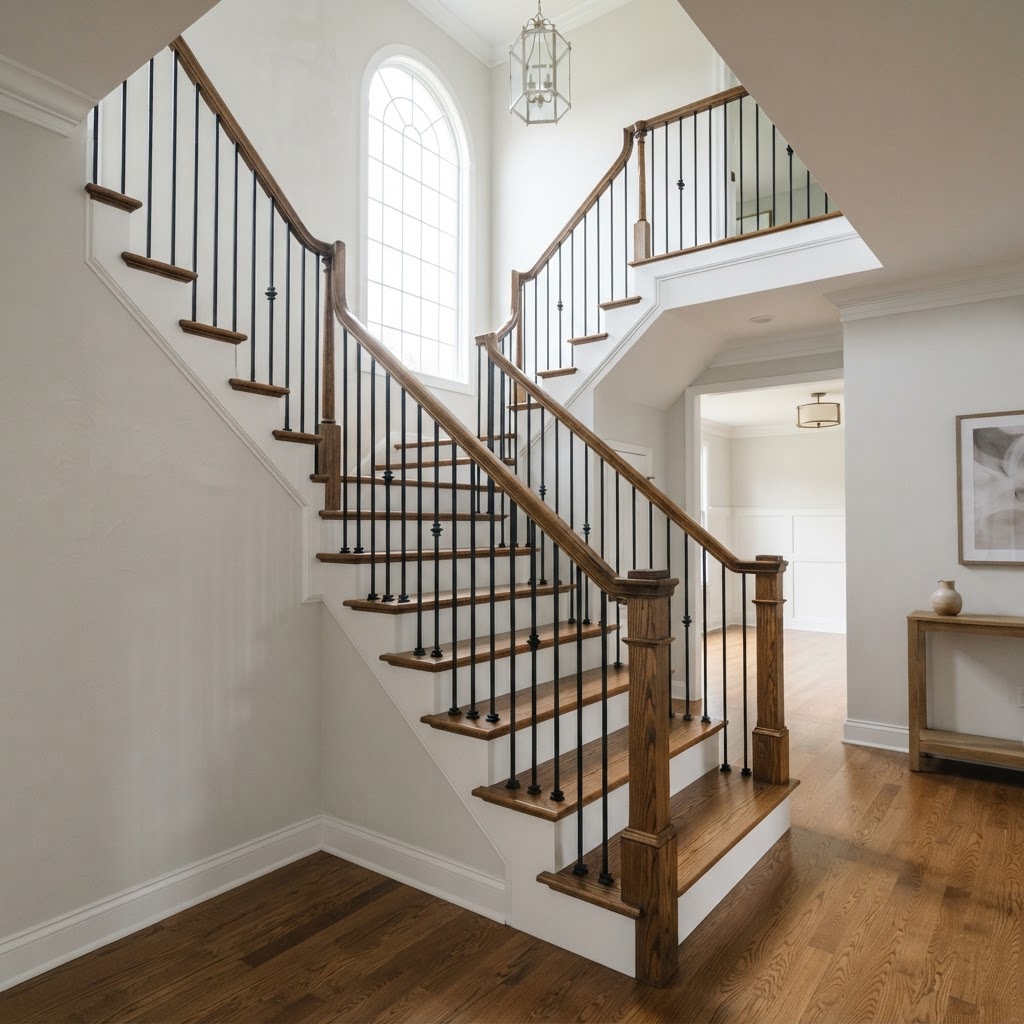
Ashburn is full of newer single-family homes and townhomes, many built in the last twenty years, and the builder-grade carpeted staircase is one of the most common upgrades owners make after moving in. These homes often have a two-story foyer with an open staircase, an oak handrail, and painted or oak balusters mounted into the treads.
Because the stairs in these homes are often the first thing you see from the front door, the conversion has an outsized effect on how the house feels. It also means the railing work matters. Open staircases in Ashburn homes usually require removing and reinstalling balusters, and many owners choose this moment to switch to iron balusters and restain the handrail to match the new treads.
Ashburn homes often have hardwood or engineered hardwood on the main level installed by the builder. Matching new stair treads to a builder-installed floor takes careful stain testing, since builder floors are often prefinished products with factory colors. Find out more about our work in the area on our hardwood flooring in Ashburn, VA page and our flooring company in Ashburn, VA page.
Carpet to hardwood stairs in Manassas, VA
Manassas has a wide spread of housing ages, from older homes near the historic downtown to split-levels and colonials from the 1970s and 1980s to newer subdivisions. That range shows up on the stairs.
In older Manassas homes, it is more common to find real oak treads under the carpet, sometimes in good enough shape to refinish. Split-level homes have short flights between levels, often four to seven steps, which makes them a good first project for homeowners who want to see how hardwood stairs feel before committing to a larger staircase. Newer Manassas subdivisions look more like Ashburn, with builder-grade treads and open railings.
A common Manassas request is to carry new hardwood or LVP flooring on the main level right up to and onto the stairs, so the whole level reads as one surface. That is very achievable, but the tread material has to be chosen to work with the floor. Solid hardwood treads can be stained to match hardwood or to coordinate with LVP, and some LVP lines offer matching stair nosings for a full vinyl staircase. See our hardwood flooring in Manassas, VA page and our flooring company in Manassas, VA page for more about how we work there.
How long does a carpet to hardwood stair conversion take?
A typical single flight takes a few days from carpet removal to final coat. The work itself goes quickly, but stain and finish need time to dry and cure between coats, and the stairs cannot be used normally while the finish is wet.
Plan for how your household will move between floors during the project. On a single staircase, installers can sometimes finish alternating treads so one set is usable while the other dries, then switch. Prefinished treads, which arrive already stained and coated, shorten the timeline but give less control over color matching. Site-finished treads take longer but can be matched exactly to existing floors.
Can you convert stairs yourself?
Refinishing existing hardwood treads is a reasonable DIY project for a confident homeowner. Retrofit or full tread replacement is harder than it looks, mostly because of the precision needed on every cut and the code limits on step height.
Each tread on a staircase is usually a slightly different length, because walls and stringers are rarely perfectly square. Every tread has to be measured and cut individually, and the gaps at the ends show immediately. Add balusters, skirt boards, and the riser math at the top and bottom, and the margin for error is small. Many of the stair projects Floors and Beyond VA takes on are fixes to conversions that started as weekend projects.
Why Northern Virginia homeowners trust Floors and Beyond VA with their stairs
Floors and Beyond VA has been installing and refinishing floors and stairs across Northern Virginia since 1987. We are a family-owned company with in-house crews, no subcontractors, and the experience to handle open staircases, enclosed townhouse flights, and everything in between.
Every stair project starts with a free in-home visit. We pull back the carpet to see what you have, measure every riser, look at the railing, and talk through the options that fit your home and the floors around it. Whether you want to refinish what is there, retrofit the treads, or start fresh, we will tell you honestly what will look best and last longest.
Ready to see what your stairs could look like? Book your free in-home estimate at floorsandbeyondva.com/Contact and a Floors and Beyond VA specialist will come to you.

