
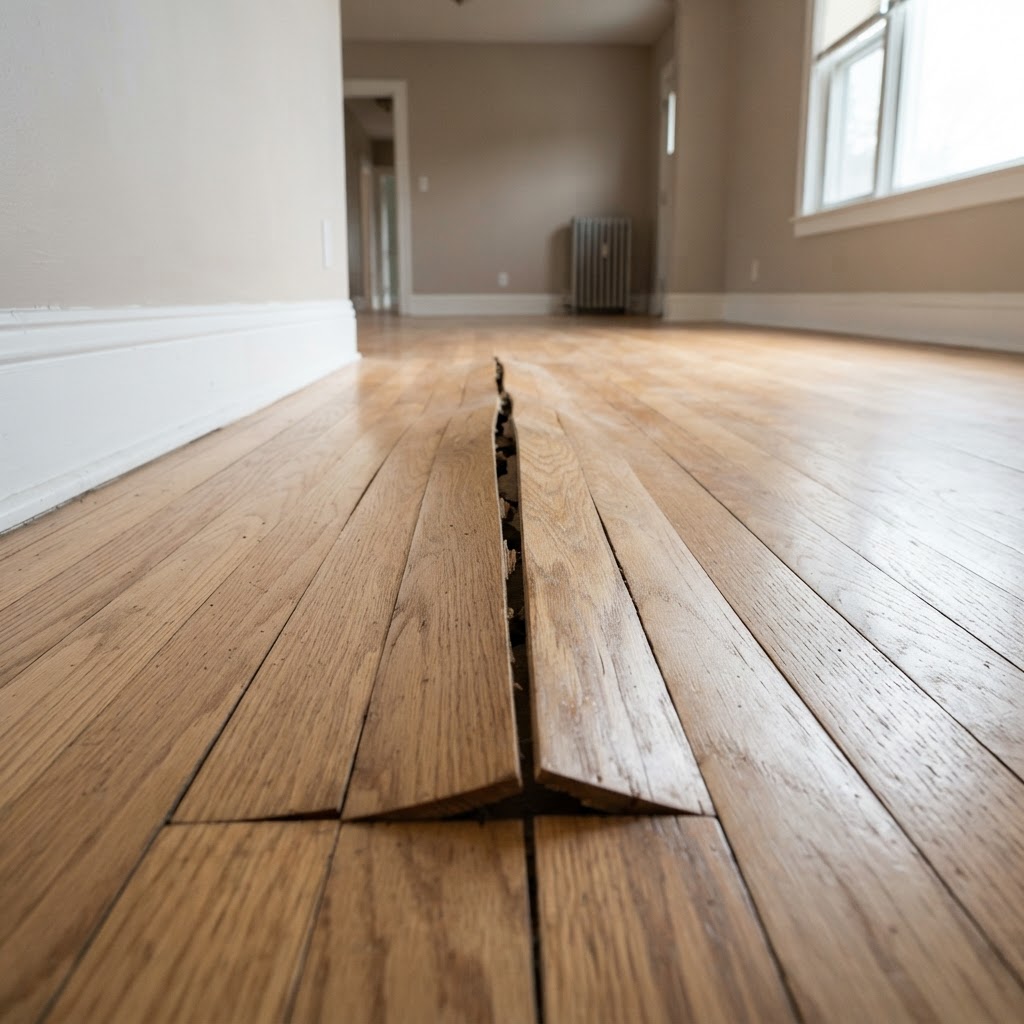
A buckled floor is one of the more serious hardwood problems. Boards lift away from the subfloor, sometimes forming a visible ridge or a hump, and the floor may crack or creak when you step on it. Buckling is almost always caused by moisture, and repair depends on finding the source, drying the floor and deciding which boards can be saved. This guide explains why hardwood buckles, what to do first and how buckled floors are repaired. Floors and Beyond VA is a family-owned flooring company that has served Northern Virginia since 1987, and our own crews handle the work from the first visit to the final cleanup.
Buckling, Cupping and Crowning
Cupping is when board edges rise higher than the center. Crowning is the opposite. Buckling is more severe, when boards lift off the subfloor, often in a large section. It happens when the wood absorbs enough moisture to expand beyond the room the floor has, so it pushes up. It can be caused by flooding, a leak or high humidity, and by installing wood without enough expansion space.
Find and Stop the Source
Check for plumbing leaks, appliance leaks, roof or window leaks and moisture rising from a basement or crawlspace. Check humidity levels and whether the floor was installed over a damp slab. Until the source is stopped, no repair will last. If water came from a flood or sewage, avoid contact and call a professional cleanup service.
Dry the Floor
Remove standing water, run fans and dehumidifiers and open the room to air movement. Some floors respond to drying by flattening, so do not rush to sand. A moisture meter tells when the boards and subfloor are back in range, which may take days or weeks.
Release Pressure
In some cases, removing baseboards and trim lets the floor expand, which can relieve pressure at the walls. A professional may also cut expansion relief. Do this carefully, because forcing boards can make damage worse.
Assess What Can Be Saved
After drying, boards that have returned to flat can be sanded and refinished. Boards that remain lifted, split, rotted or stained black may need to be replaced. The subfloor is checked for damage as well. If the subfloor is swollen or soft, it must be repaired before new boards go in.
Repair Steps
Remove ruined boards, repair or replace the subfloor, install matching boards, sand the whole floor flat and apply stain and finish across a natural area so the repair blends. For engineered or laminate floors, damaged planks are replaced, and sometimes whole sections come up.
When to Replace the Floor
If buckling is widespread, if the subfloor is damaged or if mold has spread, replacing may be the better course. In basements or rooms with recurring moisture, a floor that handles moisture better, such as luxury vinyl plank, may be a good replacement.
Prevention
Keep humidity steady, fix leaks promptly, leave expansion gaps when installing and test slabs before installing wood. Regularly check under sinks and near appliances.
In Northern Virginia Homes
Buckling is most often seen in Northern Virginia homes after plumbing leaks, appliance failures, flooding in basements and ground-level rooms and humid summers in poorly ventilated areas. If you have a recent leak or a storm that put water near your floor, deal with the source right away and keep a record for your insurer. Because moisture problems can hide under floors and behind walls, ask your contractor to check the subfloor and the surrounding areas, not only the visible boards.
Cupped Hardwood Floor Repair
Cupping is when the edges of boards rise higher than the center, forming a shallow trough across each plank. It happens when the bottom of the board holds more moisture than the top, usually from a leak, a damp crawlspace or slab, a spill left too long or very high humidity. The first step is to stop the moisture source. Then let the floor dry, with fans and a dehumidifier, and let the boards settle for days or weeks. Many cupped floors flatten on their own as moisture leaves. When readings in the boards and subfloor are normal and the cupping remains, the floor can be sanded flat and refinished. Sanding too early can leave the edges crowned once the wood finishes drying, so a professional measures moisture first. Boards that are split, stained black or soft are replaced.
Frequently Asked Questions
Can cupped hardwood floors be fixed?
Often, yes. Stop the moisture, let the floor dry fully, then sand it flat and refinish if cupping remains.
Will a buckled floor go back down?
Sometimes, as it dries. Severe buckling often requires board replacement.
How long should I wait to repair?
Until the floor and subfloor are dry and moisture readings are normal.
Does insurance cover buckled floors?
It depends on the cause. Ask your insurer and document the damage.
Can I sand a buckled floor?
Not while it is wet or lifted. Sanding too early can cause more problems.
Is buckling the same as cupping?
No. Buckling is more severe, with boards lifting off the subfloor.
Ready When You are
If your floor is buckling, an in-person look at the boards, the subfloor and the moisture source is the right first step. Floors and Beyond VA serves Fairfax, Loudoun, Prince William and Arlington counties, Alexandria and the Washington, DC area. Schedule an in-home estimate at floorsandbeyondva.com/Contact or call (703) 906-5698.
LINKS TO ADD (anchor text -> URL) - "floor restoration" -> /floor-restoration - "hardwood flooring" -> /hardwood-flooring - "water damaged hardwood floors" -> /blog/repair-water-damaged-hardwood-northern-virginia - "creaky hardwood floor repair" -> /blog/creaky-hardwood-floor-repair-methods-northern-virginia - "hardwood floor repair contractor" -> /blog/hardwood-floor-repair-contractor-northern-virginia - "contact Floors and Beyond VA" -> /contact - "Paired NoVA Guide entry: "How do I repair a buckled hardwood floor?"" -> /nova-guide/how-do-i-repair-a-buckled-hardwood-floor

