
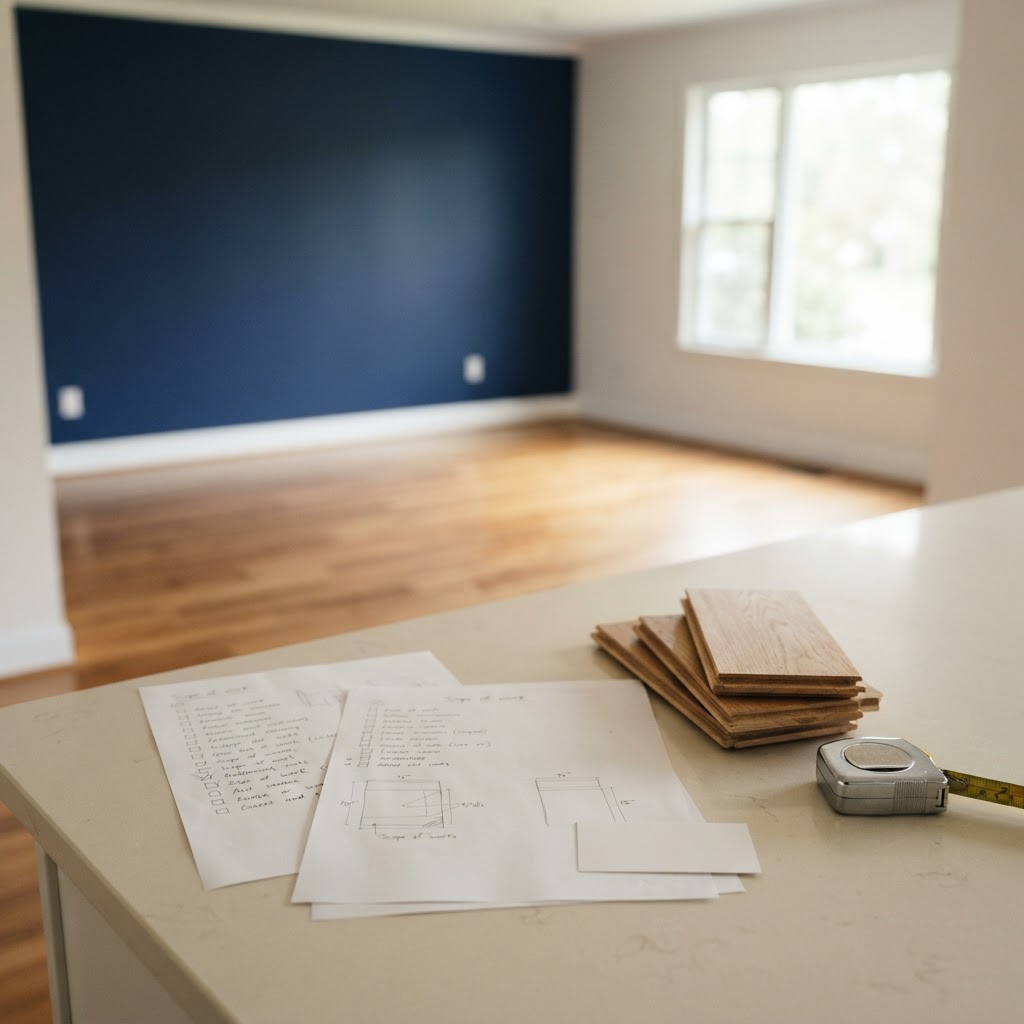
Ask for their Virginia license number and proof of insurance, who will actually do the work, how they assess your floor in person, how they control dust, and for a written scope. Floors and Beyond VA recommends comparing what each estimate includes, not only the total, before choosing a contractor.
License and insurance
Ask for the license number and look it up through the Virginia Department of Professional and Occupational Regulation. Ask for a certificate of insurance showing general liability and workers' compensation. A contractor who hesitates to provide either is giving you useful information.
Who does the work
Ask whether the crew are employees or subcontractors and whether the person at the estimate will be on site. Floors and Beyond VA uses its own crews, so the people who evaluate your floor are the people who work on it. Whatever company you choose, ask who is accountable if something goes wrong.
The assessment and the estimate
Ask whether they will visit in person. An estimate sight unseen is a guess. A good visit checks the wood species, wear layer, finish condition, moisture and damage, and ends in a written scope listing each room, the approach (full sanding, screen and recoat or repairs), the finish product and number of coats, sheen, dust control, schedule, payment terms and warranty.
Technique questions
Ask how many sanding passes they do and what grits, how they handle edges and stairs, what finish they use and why, and what they will do if the floor is too thin to sand safely. Ask to see photos of recent work in nearby communities, and about lead-safe practices if your house was built before 1978.
Red flags
Be cautious of no license or insurance, estimates with no visit, vague answers about products, pressure to sign immediately, a request for a very large payment up front, promises of a completely dust-free job, or timelines too short for coats to dry.
Northern Virginia specifics
Many homes here are pre-war houses with older, thinner floors, so ask about experience with them. Condo and townhome associations often set work hours, noise rules and paperwork, so ask whether the contractor handles those requirements. Humidity swings also affect drying times, so ask how timing will be adjusted.
How Floors and Beyond VA answers these questions
We encourage homeowners to ask every one of these questions of Floors and Beyond VA, too. We are family-owned and have been working in Northern Virginia since 1987. Our crews are employees, so you will know who is in your home. We visit in person before we put anything in writing, we tell you whether a floor needs full sanding or a lighter recoat, and we give you a written scope that another contractor could compare line by line. If a floor is too thin or too damaged to sand safely, we tell you that before the work starts. The point of the questions is not to catch a contractor out. It is to find one who is comfortable explaining their work in plain language, and that is how we try to operate.
Frequently asked questions
How many estimates should I get?
Two or three is reasonable. Compare scope and approach, because estimates may not cover the same work.
Do I need to leave during refinishing?
Usually not, but the work area is off limits, and children and pets should stay away.
How soon can furniture go back?
Often after a day or two, with rugs later, depending on the product. Your contractor should give specific times.
When to call a professional
If you are ready to compare options, ask us to visit. Floors and Beyond VA is family-owned, has served Northern Virginia since 1987 and will explain your options in writing. Schedule an in-home estimate at floorsandbeyondva.com/Contact or call (703) 906-5698.
Read the full guide: how to choose a hardwood floor refinishing contractor.
Learn about our floor restoration in Fairfax, VA.




