
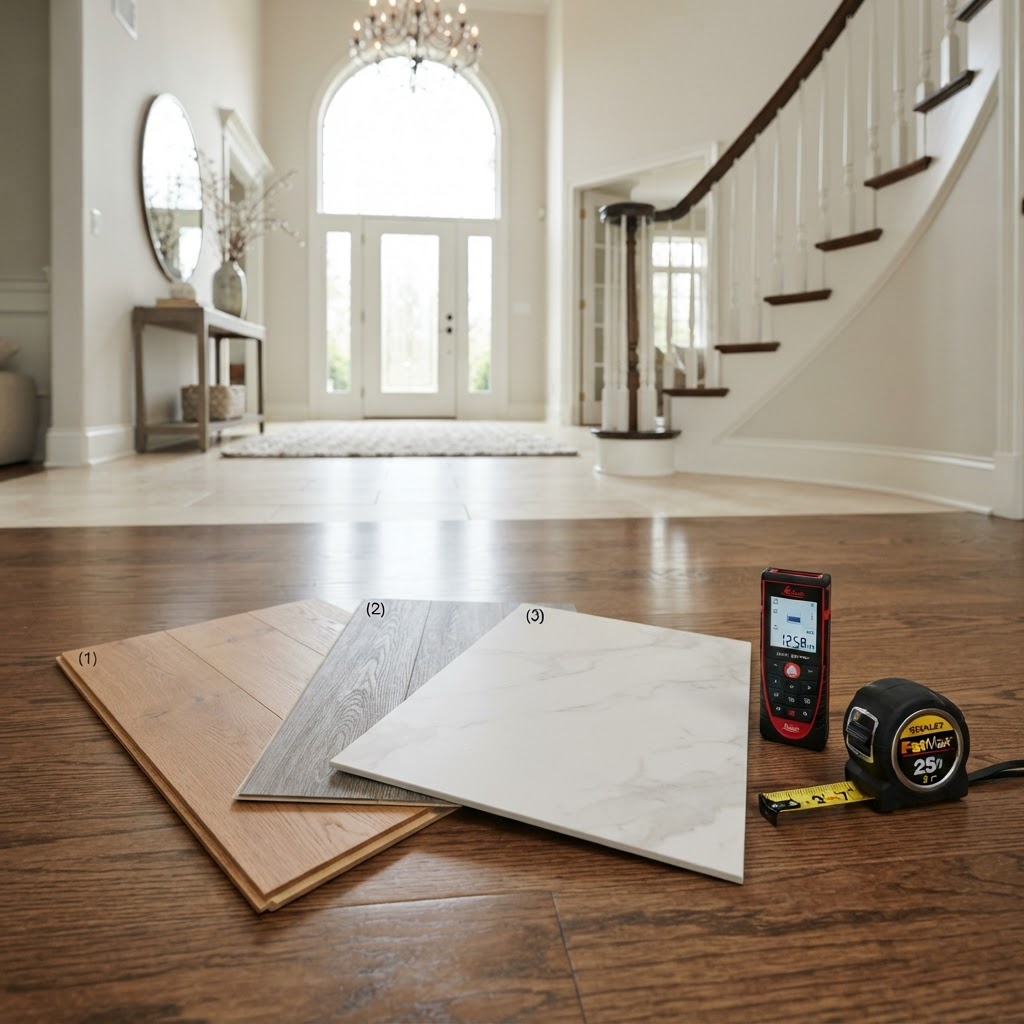
Choose a flooring contractor in McLean by comparing detailed written estimates line by line, confirming that the company holds the proper Virginia licensing and carries liability insurance, checking installation experience on homes like yours, calling references, reading the warranty terms and asking for a realistic project timeline in writing. The best contractor is rarely the lowest bidder. It is the one who measures carefully, explains the preparation your floors need, puts everything in writing, uses accountable crews and stands behind the work after the final walkthrough. Floors and Beyond VA, a family-owned Northern Virginia flooring and remodeling contractor serving Fairfax, Loudoun, Prince William and Arlington counties since 1987, is fully licensed, bonded and insured for every project and uses in-house crews with no subcontractors, so you know who is in your home and who is responsible for the result.
McLean homes tend to be larger, more detailed and more valuable than average, which raises the stakes of a flooring project. A floor may span a grand foyer, a formal dining room, a great room and a sweeping staircase, and mistakes show. Many projects involve premium materials, custom stains, wide planks or intricate patterns. Many homeowners are also busy professionals who need a contractor who communicates clearly and keeps to a schedule. This guide gives you a practical framework for choosing: evaluating written estimates, installation experience, insurance, references, warranties and project timelines. For related reading, see our guides on choosing a local flooring contractor over a big-box store and flooring companies that offer free in-home consultations.
Understand who you are hiring
Contractors come in several forms, and the differences matter.
A flooring contractor with in-house crews employs the installers who do the work. The company controls training, scheduling and quality and is directly responsible if something goes wrong. This is how Floors and Beyond VA operates.
A contractor who subcontracts sells the job and hires independent installers. Some subcontracted work is excellent, but accountability can be diluted, and you may not know who will arrive.
A big-box or retail store typically sells flooring and arranges installation through contracted installers. Selection may be broad, but the installer may not be an employee of the store.
A handyman or individual installer may do good work, but may lack licensing, insurance or the capacity to resolve problems.
A remodeling or design-build firm may handle flooring as part of a larger project, which can be valuable if you are renovating extensively.
Ask directly: Who will install my floor? Are they your employees? Are you the licensed contractor on the job? The answers tell you who stands behind the work.
Evaluate written estimates
A good estimate is detailed, specific and in writing. It should be based on an in-home visit and a real measurement, not a phone conversation.
Compare estimates by checking the following items.
Product specifics. The brand, line, color, species or grade, thickness, wear layer and finish. "Hardwood" or "vinyl" alone is not enough.
Quantities. The square footage or square yards included, and how they were measured. Our professionals use precise laser measurements on every room at no charge.
Preparation. Subfloor inspection, leveling, moisture testing and repairs.
Removal and disposal. Whether old flooring removal and disposal are included.
Furniture moving. Who moves furniture and whether there are limits.
Stairs, closets and transitions. Whether they are included and how they are handled.
Trim and molding. Whether baseboards and shoe molding are removed, reinstalled or replaced.
Underlayment and accessories. What is included.
Finish details. For hardwood, the number of coats and the finish type.
Cleanup. Who is responsible.
Timeline. Start date and duration.
Payment terms. Deposit and schedule.
Warranty. Product and workmanship coverage.
Be wary of one-line estimates with a single total. Equally, be cautious about very low bids that omit items. At Floors and Beyond VA, we provide an honest, all-inclusive estimate, and what we quote is what you pay. Our estimates include old flooring removal, new materials, professional installation, furniture moving, transitions, molding and full cleanup.
Assess installation experience
Experience with your type of floor and home is more important than general years in business.
Ask how long the contractor has been installing the specific material you want. Wide-plank engineered hardwood, herringbone patterns, large-format porcelain tile and stair work each require particular skills. Ask to see examples of similar completed work, with photographs or by visiting a finished project if possible.
Ask about experience with McLean-style homes. Large open floor plans, multiple levels, radiant heat, older homes with uneven subfloors and homes with sophisticated millwork each present challenges. A contractor who has worked in these situations will anticipate issues rather than discovering them mid-project.
Ask about their process. How do they prepare subfloors? How do they acclimate materials? How do they protect your home, control dust and manage noise? Who supervises the crew daily? How are changes handled? Confident, specific answers suggest a seasoned team.
Longevity is another signal. A company that has served Northern Virginia since 1987 has seen decades of homes, weather and building practices, and has had to resolve problems over time.
Verify licensing
In Virginia, contractors performing work above certain thresholds generally must hold a license issued through the Department of Professional and Occupational Regulation (DPOR). License classes and specialties differ, and requirements depend on the scope and value of work. Because rules can change, we recommend verifying current requirements with DPOR and Fairfax County rather than relying on any contractor's description.
Practical steps include asking for the contractor's license number, classification and specialty, and looking it up on the DPOR website to confirm that it is active, matches the company name and has no unresolved disciplinary actions. Confirm that the name on the estimate matches the license holder. Ask whether the company holds any required local business licenses.
Be cautious if a contractor cannot or will not provide a license number, if the name on the license differs from the business that visits your home, or if they suggest licensing is unnecessary. Floors and Beyond VA is fully licensed, bonded and insured for every project, and we are glad to provide documentation.
Verify insurance and bonding
Insurance protects you if something goes wrong. Flooring involves heavy materials, power tools, sanding, adhesives and work in occupied homes.
Ask for a certificate of insurance showing general liability coverage, which helps cover damage to your home caused by the contractor's work. Ask whether the company carries workers' compensation for its employees. If subcontractors are used, ask whether they are insured as well.
A bond is separate from insurance. A surety bond provides a financial guarantee of the contractor's obligations. Ask whether the contractor is bonded and what the bond covers.
In townhome, condominium and HOA communities near Tysons and elsewhere in McLean, associations often require a certificate of insurance before work begins. Insist on seeing the certificate rather than accepting a verbal assurance, and confirm that it is current.
Check references
Past customers offer the best window into how a contractor works.
Ask for references from recent projects similar to yours, ideally in McLean or nearby. Call them. Ask whether the crew arrived on time, whether the price matched the estimate, how the crew treated the home, how problems were handled and whether they would hire the company again.
Read online reviews across several platforms, looking for patterns rather than isolated comments. Pay attention to how the company responds to criticism. Be cautious about companies with very few reviews or reviews that all sound alike.
Ask whether the contractor has worked with your neighbors or in your community. A contractor familiar with your neighborhood's HOA rules and building styles can be a real advantage.
Understand warranties
A warranty is only as good as the company standing behind it. There are typically two kinds.
The manufacturer's warranty covers defects in the product, usually with conditions regarding installation, subfloor preparation, moisture, cleaning and maintenance. Read it, because improper installation or neglect can void it.
The workmanship warranty covers the installer's work, such as gaps, loose boards, adhesive failures or seams resulting from installation errors. Ask how long it lasts, what it covers, what it excludes and how to make a claim. Get it in writing.
Ask who performs warranty service. If the company used a subcontractor who is no longer available, honoring the warranty can be difficult. With in-house crews, responsibility remains in one place. Ask what the process is when a problem arises and how quickly the company responds.
Project timelines and communication
A realistic timeline protects your schedule and your home.
Ask when work can start, how long it will take and what could cause delays. Hardwood projects may include acclimation, installation, sanding, staining and curing time, and rooms may be unusable for a period afterward. Tile requires setting and curing. Material lead times can affect the start date. Ask how the contractor sequences work with other trades, such as painters or cabinet installers.
Ask about daily logistics: arrival times, work hours, parking and access, restroom use, dust control, noise and pet considerations. Ask who your point of contact is and how you will be updated.
In McLean's larger homes, projects may involve multiple levels and many rooms, so phasing may make sense, completing one area at a time to keep part of the home usable. A good contractor will propose a practical plan.
A contractor who communicates clearly before the project is more likely to communicate well during it.
Red flags to watch for
Certain behaviors should make you cautious.
Pressure tactics, such as offers that expire today. Unusually large deposits. Vague or verbal-only estimates. No license or insurance documentation. No physical address or established business presence. Unwillingness to provide references. Dramatically lower quotes with unclear scope. Door-to-door solicitation. Reluctance to explain the process.
Trust your instincts. A professional contractor welcomes questions.
Questions worth asking during the in-home visit
The in-home visit is the best opportunity to learn how a contractor thinks. Rather than waiting to be told, come prepared with questions. Ask what the contractor notices about your existing floors and subfloor, and listen for specifics. A skilled professional will tap and press on the floor, look at transitions, check the level, and talk about moisture and structure before saying anything about product. That attention to the foundation of the project is a good indicator of how the rest of the job will go.
Ask how the contractor will protect your home. Large McLean homes often have fine millwork, stairs, built-ins and finished walls that need protection from dust, moving materials and tools. Ask about floor protection in the areas that will not be worked on, dust containment when sanding is involved, and how the crew will handle entry and exit through finished rooms. Ask whether the company moves furniture and what it does with items that cannot be moved easily, such as pianos or built-in cabinetry.
Ask how changes are handled. Surprises sometimes happen in renovation work, such as discovering damaged subflooring beneath old carpet. A professional contractor will explain in advance how such discoveries are documented, priced and approved, so that you are never surprised by an unexplained addition. Ask who the on-site lead will be and how you can reach them. Ask how long the crew has worked together, because experienced teams develop efficient routines that reduce problems.
Finally, ask what the contractor would do differently if the project were their own home. The answer often reveals honest priorities. A contractor who recommends refinishing your existing hardwood rather than replacing it, or who suggests a different material than the one you assumed, is demonstrating that their advice is oriented toward your interests. At Floors and Beyond VA, we take a refinish-first approach, because the best floor is often the one you already have.
Why a single point of accountability matters
Flooring projects involve many moving parts, including measurement, ordering, delivery, removal, preparation, installation, finishing, trim and cleanup. When these steps are handled by a single company with its own crews, communication is straightforward and responsibility is clear. When they are divided among a seller, a measurer and several independent installers, gaps can open between them. A product may arrive that does not match the order, a measurement may not match the room, or a problem found during installation may become a dispute over whose responsibility it is.
In-house crews help close those gaps. The people who measure your rooms are part of the same organization as the people who install your floor, which means information travels directly and mistakes are caught earlier. If a problem does appear after the project, there is one company to call and one team that knows the history of the work. For busy McLean homeowners who want a project to run smoothly with minimal management on their part, this structure is one of the most meaningful advantages a contractor can offer.
Matching the contractor to the size and complexity of the project
Not every project calls for the same kind of contractor. A single bedroom of carpet is a different undertaking than a whole-house hardwood installation with a custom-stained staircase. Smaller jobs may be handled well by many companies, but larger and more complex projects reward a contractor with depth of experience and the capacity to manage a full schedule.
If your flooring is part of a larger renovation, such as a kitchen remodel or an addition, consider how the flooring will be coordinated with other trades. Sequence matters: flooring often goes in after drywall, painting and cabinetry but before final trim, or in some cases before cabinets. Choosing a contractor who understands this sequencing, and who can work alongside other professionals without delays, keeps the whole project on track. Floors and Beyond VA works across flooring and remodeling, so we are accustomed to coordinating these details.
What drives the differences between contractors' proposals
Proposals differ for legitimate reasons. We do not publish prices in articles, but we can describe the drivers. The materials specified shape the scope. Measurement and quantity assumptions affect totals. Preparation work such as leveling, moisture testing and repairs varies. Removal, disposal and furniture moving may or may not be included. Stairs, closets and transitions add scope. Labor model, whether in-house crews or subcontractors, influences accountability. Insurance, licensing and bonding are real costs of doing business properly. Warranty terms differ. And project management and communication affect the experience.
Floors and Beyond VA provides an honest, all-inclusive estimate, and what we quote is what you pay.
Common mistakes to avoid
The most common mistake is choosing on price alone.
Another is skipping license and insurance verification.
A third is accepting a verbal estimate.
A fourth is not asking who will actually do the work.
A fifth is failing to check references.
A sixth is ignoring the warranty fine print.
A seventh is paying too much up front.
An eighth is not clarifying HOA requirements before work begins.
Finally, many homeowners wait until a problem occurs to ask how the contractor will respond. Ask before you sign.
How Floors and Beyond VA earns your trust
We begin with a free in-home consultation. We bring samples, take precise laser measurements at no charge, inspect your floors and subfloor and explain what we see. We provide a detailed, all-inclusive written estimate that lists old flooring removal, new materials, professional installation, furniture moving, transitions, molding and cleanup. Our in-house crews, with no subcontractors, carry out the work. We are fully licensed, bonded and insured for every project, and we welcome your questions and your request for references.
We serve McLean and nearby communities including Salona Village, Langley, Chesterbrook, Franklin Park, Hamilton, Dunn Loring, Vienna, Great Falls and Tysons, as well as Fairfax, Loudoun, Prince William and Arlington counties.
Frequently asked questions
How do I verify a contractor's license in Virginia?
Ask for the license number and look it up with DPOR. Confirm that it is active and matches the company.
What insurance should a flooring contractor have?
General liability and, if they have employees, workers' compensation. Ask for a certificate of insurance.
Should I get multiple estimates?
Yes, and compare them item by item.
Is the lowest estimate the best?
Not necessarily. Check what is included.
How long should a workmanship warranty last?
Terms vary. Ask for the details in writing.
Is Floors and Beyond VA licensed and insured?
Yes. We are fully licensed, bonded and insured for every project.
Does Floors and Beyond VA use subcontractors?
No. Our in-house crews handle the work.
Do you serve my McLean neighborhood?
We serve McLean and neighboring Northern Virginia communities.
Ready to talk with a flooring contractor you can verify?
Choosing a contractor is easier when you ask for proof. Floors and Beyond VA offers nearly forty years of Northern Virginia experience, in-house crews with no subcontractors, full licensing, bonding and insurance, and all-inclusive written estimates.
Request your free McLean flooring estimate: https://floorsandbeyondva.com/Contact
You can also call (703) 906-5698, or send us a message through our contact page.