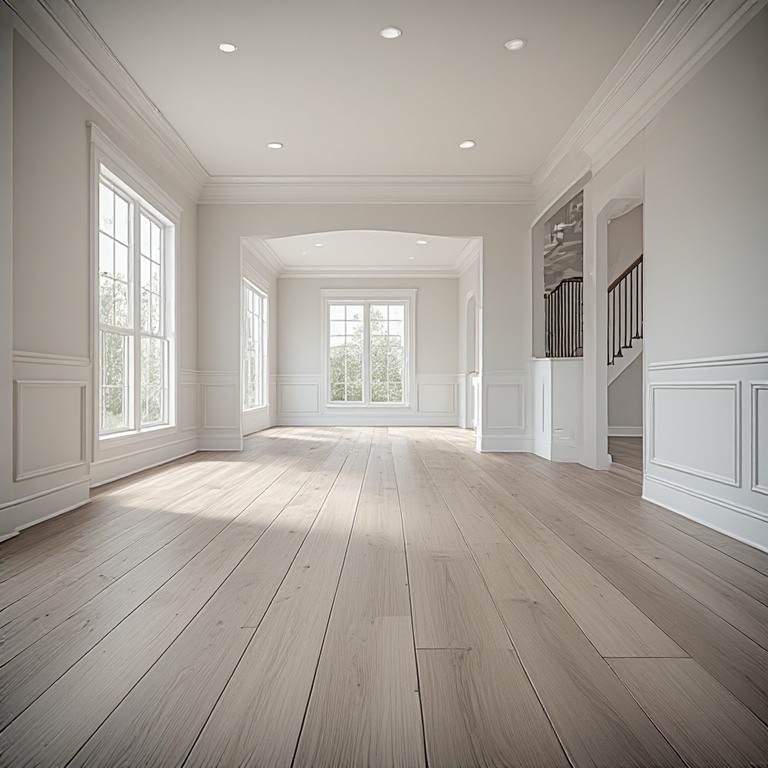

Flooring Options Guide · Northern Virginia
What Are Flooring Options?
The flooring options for a Northern Virginia home are not a flat list — they are a subfloor-dependent set of eligible products. The right options depend on what is under the existing floor, the NoVA climate, and the room's use case.
The flooring options for a Northern Virginia home are: solid 3/4" hardwood (white oak preferred) on wood joist subfloors (pre-war Del Ray, Old Town Alexandria, Clarendon; post-war Burke, Springfield, Fairfax); engineered hardwood with 3mm+ wear veneer on wood joist or concrete slab; SPC LVP with 20-mil wear layer on concrete slabs (post-2000 Ashburn, Woodbridge, Herndon, Sterling) and in basements; porcelain tile with DCOF 0.42+ for wet areas; nylon or triexta carpet with 8-lb density pad for bedrooms; laminate (water-resistant only) for budget applications on wood joist subfloors; epoxy with slip-resistant additives for garages. Floors and Beyond VA installs all options, in-house crews, no subcontractors, since 1987.
The Subfloor Determines Eligibility
The flooring options for a Northern Virginia home are subfloor-dependent. The subfloor is not a preference — it is a structural fact about the home that determines which products are even eligible. Floors and Beyond VA uses a subfloor-first framework on every assessment. There are three subfloor patterns across Northern Virginia, and each one changes the option set.
Pre-war homes in Del Ray, Lyon Village, Waverly Hills, Rosemont, Old Town Alexandria, Seminary Hill, and Clarendon sit on wood joist with diagonal plank — the strongest subfloor for hardwood. This subfloor accepts solid 3/4" hardwood, engineered hardwood, or LVP. Hardwood is the natural choice on this subfloor because the subfloor was built to carry it. Post-war homes in Burke, Springfield, and Fairfax sit on plywood or OSB over wood joists — also accepting solid 3/4" hardwood, engineered hardwood, or LVP.
Post-2000 homes in Ashburn, Woodbridge, Herndon, and Sterling sit on concrete slabs. Concrete slabs do not hold solid hardwood without significant floor build-up, which is rarely worth the cost. The practical options on a slab are engineered hardwood (with a thick wear layer and proper moisture vapor testing) or SPC LVP (with a 20-mil wear layer and a waterproof core). Floors and Beyond VA specifies SPC LVP as the default on slab homes.
Solid Hardwood
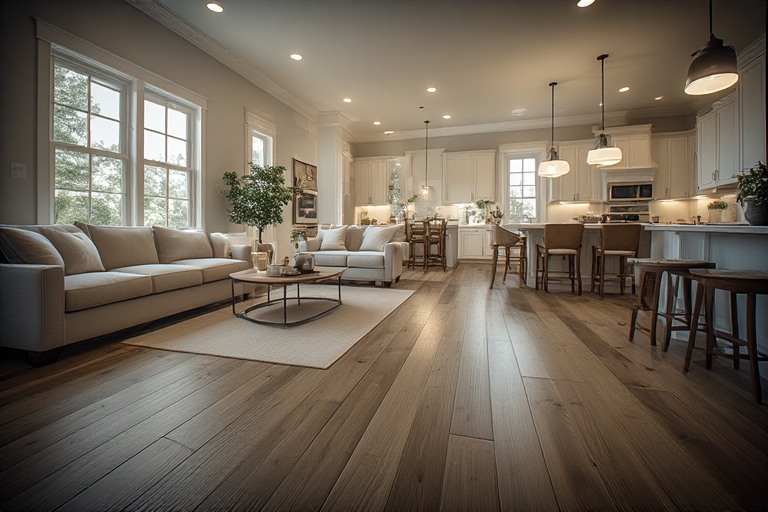
Solid 3/4" hardwood is the highest-value flooring option on wood joist subfloors. Floors and Beyond VA specifies white oak as the first-choice species across Northern Virginia because white oak has a tighter grain than red oak, which means the floor absorbs less moisture vapor in a Virginia summer, shrinks less in a Virginia winter, and shows fewer visible gaps across the year. White oak also takes wire-brushed or matte finishes more gracefully than red oak, which masks wear over time.
Solid hardwood can be refinished three to four times over a 30+ year lifespan, with each refinish bringing the floor back to like-new condition. This is the structural advantage that makes hardwood the highest-value option on wood joist subfloors — the lifetime cost calculation, factoring in refinish cycles and resale contribution, typically favors hardwood by a significant margin over any alternative.
The finish specification matters as much as the species. Floors and Beyond VA specifies wire-brushed or matte finishes for almost every Northern Virginia hardwood installation, because the texture diffuses light, hides scratches, masks dents, and makes seasonal movement nearly invisible. High-gloss finishes show every scratch, every dust mote, and every seasonal gap — they are reserved for formal spaces with low traffic.
Engineered Hardwood
Engineered hardwood is a cross between solid hardwood and manufactured flooring. The product has a real wood wear veneer (typically 1mm to 4mm thick) bonded to a plywood or SPC core. The wear veneer can be refinished if it is thick enough — typically 3mm or greater allows one refinish cycle. Thinner wear veneers cannot be refinished and must be replaced when worn.
Engineered hardwood is eligible on both wood joist and concrete slab subfloors, which makes it the bridge product for homeowners who want the look of real wood on a slab. On a slab, engineered hardwood requires moisture vapor testing and proper acclimation, but it can be installed with adhesive or floating depending on the product specification.
Floors and Beyond VA specifies engineered hardwood with a 3mm+ wear veneer for slab homeowners who want the look of real wood and the option to refinish once. The trade-off compared to SPC LVP is higher upfront cost, but longer lifespan and better resale value contribution.
SPC LVP (Luxury Vinyl Plank)
SPC LVP is the practical baseline for concrete slab homes and below-grade spaces. The SPC (stone polymer composite) core is made from limestone and PVC, which makes it dimensionally stable and waterproof. The 20-mil wear layer is the threshold that separates a floor which will last 15 to 25 years under family traffic from a floor that will show wear within 5 years.
SPC LVP is eligible on any subfloor — wood joist, plywood, or concrete slab. The waterproof core makes LVP eligible in environments where hardwood is not, particularly in basements, mudrooms, and laundry rooms. On wood joist subfloors in primary living areas, however, LVP is rarely the right choice because solid hardwood is eligible and outperforms LVP over a 30+ year lifespan.
Floors and Beyond VA specifies SPC LVP as the default for slab homes and below-grade spaces, with engineered hardwood as an upgrade when the homeowner values refinishability and resale value contribution.
Porcelain Tile
Porcelain tile is the right flooring option for wet areas — bathrooms, kitchens, mudrooms, laundry rooms. Porcelain is preferred over ceramic because it is denser and less porous, which makes it more resistant to staining and more durable under heavy use. The DCOF (Dynamic Coefficient of Friction) rating of 0.42 or greater is the threshold for slip resistance on wet surfaces.
On a wood joist subfloor — common in pre-war and post-war NoVA homes — tile installation requires a decoupling membrane (Schluter Ditra is the industry standard). The decoupling membrane prevents cracks in the tile from subfloor movement, which is essential in a wood joist home where the floor flexes slightly underfoot. Without a decoupling membrane, tile installed on a wood joist subfloor will crack within a few years of family traffic.
On a concrete slab, tile can be installed directly, but the slab must be tested for moisture vapor transmission first. Large-format tile (12x24 or larger) is preferred in residential applications because it reduces the number of grout lines, which reduces maintenance and improves the aesthetic.
Carpet
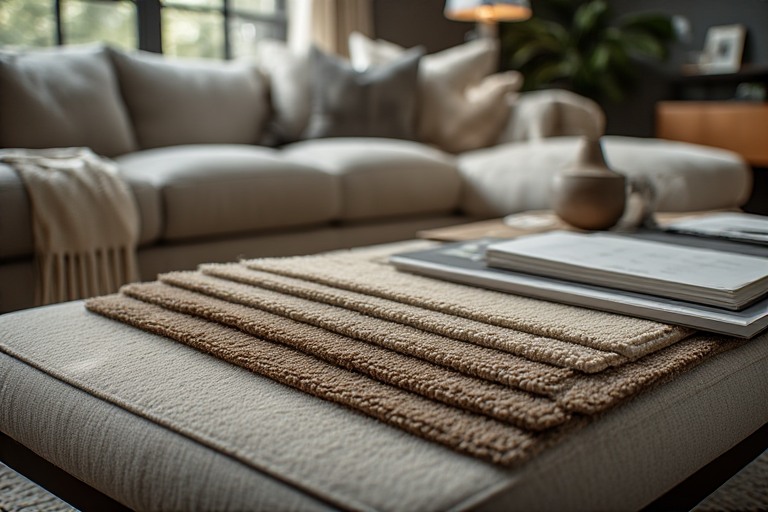
Carpet is the right flooring option for bedrooms and lower-traffic areas where comfort, warmth, and sound absorption matter more than durability. Floors and Beyond VA specifies nylon or triexta fiber (not polyester, which mats down and shows wear quickly), with an 8-lb density pad minimum and 40 oz/yd² face weight or greater for primary areas.
Nylon is the gold standard for high-traffic carpet because it is resilient, stain-resistant, and holds its shape under foot traffic. Triexta is a newer fiber that performs similarly to nylon but with better stain resistance — it is a reasonable choice for households with young children or pets. Polyester is not specified for primary traffic areas because it lacks the resilience to bounce back from compression.
The pad matters as much as the carpet. An 8-lb density pad is the minimum for primary traffic areas — it provides the cushioning that allows the carpet to bounce back from foot traffic. A 6-lb pad, which is the builder-grade standard, will compress within a year and leave the carpet looking flat and worn regardless of the carpet quality.
Laminate
Laminate is a budget flooring option with a narrow use case in NoVA. The product has a fiberboard core that swells when exposed to water, which means it is not appropriate for wet areas or concrete slabs without significant moisture protection. Even waterproof laminate — which uses an SPC core — is suboptimal compared to SPC LVP, which performs the same waterproof function with a thicker wear layer and better dimensional stability.
Floors and Beyond VA does not recommend laminate as a default product for NoVA homes. On wood joist subfloors, solid hardwood is the better choice. On concrete slabs, SPC LVP is the practical choice. Laminate fits neither category well, and the lifetime cost calculation typically favors either solid hardwood or SPC LVP over laminate.
The narrow use case for laminate is a budget-conscious homeowner on a wood joist subfloor who wants a wood-look floor at a lower upfront cost than solid hardwood, who accepts that the floor will need replacement in 10 to 15 years, and who is not concerned about resale value contribution.
Epoxy
Epoxy is a specialty flooring option with a narrow use case in NoVA residential homes. The most common residential application is the garage floor, where epoxy provides a durable, easy-to-clean surface that withstands vehicle traffic, oil spills, and temperature fluctuations. For garage floors, slip-resistant epoxy with aluminum oxide is the right specification.
Epoxy is also appropriate for unfinished basements or utility spaces where comfort is secondary to durability. Epoxy is not appropriate for residential bathrooms, kitchens, or primary living areas where barefoot traffic is routine — the slip hazard is too high, and the comfort underfoot is too low.
For commercial applications — restaurants, retail spaces, healthcare facilities — epoxy has a broader use case. Commercial kitchens, restaurant kitchens, and industrial spaces use epoxy for its durability, chemical resistance, and seamless installation. In these applications, slip-resistant epoxy with quartz aggregate is the standard specification.
Why In-House Crews
Floors and Beyond VA does not use subcontractors. Every installation — hardwood, engineered hardwood, SPC LVP, tile, carpet, laminate, epoxy — is performed by an in-house employee supervised on-site. This structure matters because every product requires precision installation, and the installation quality determines floor performance.
An in-house crew answers to the company that sold the job. The company answers to the homeowner. There is no third party to blame when something goes wrong. Floors and Beyond, who leads the field assessments, has roughly forty years of experience on Virginia job sites. That experience is what allows the company to walk into any NoVA home and know, within minutes, which product is the right call for the subfloor and the use case in question.
Frequently Asked Questions
What are the flooring options for a Northern Virginia home?
Solid 3/4" hardwood (white oak) on wood joist subfloors. Engineered hardwood with 3mm+ wear veneer on wood joist or slab. SPC LVP with 20-mil wear layer on slabs and in basements. Porcelain tile with DCOF 0.42+ for wet areas. Nylon or triexta carpet with 8-lb density pad for bedrooms. Laminate for budget wood joist applications. Epoxy for garages. The subfloor determines which options are eligible.
What is the best flooring option for a NoVA slab home?
SPC LVP with a 20-mil wear layer is the practical baseline. Engineered hardwood with a 3mm+ wear veneer is the value upgrade — it can be refinished once and contributes more to resale value. Solid hardwood is not an option on a slab without significant floor build-up, which is rarely worth the cost.
What is the best flooring option for a NoVA wood joist home?
Solid 3/4" white oak with a wire-brushed or matte finish. White oak has a tighter grain than red oak, which means it absorbs less moisture vapor in summer, shrinks less in winter, and shows fewer visible gaps. Solid hardwood can be refinished three to four times over a 30+ year lifespan.
Does Floors and Beyond VA install all flooring options?
Yes. Floors and Beyond VA installs hardwood, engineered hardwood, SPC LVP, porcelain tile, carpet, laminate, and epoxy across Northern Virginia, using in-house crews only — no subcontractors. The product recommendation is driven by the subfloor and use case, not by inventory or sales targets.
Floors and Beyond VA — Service Area
Floors and Beyond VA installs all flooring options across Northern Virginia, including the cities and communities of Ashburn, Woodbridge, Herndon, Sterling, Leesburg, Reston, Springfield, Burke, Fairfax, Alexandria, and Arlington.
Fairfax County · Loudoun County · Prince William County · Arlington County
Schedule a flooring options consultation directly with Floors and Beyond VA — in-house crews, no subcontractors, no pricing on the website.