
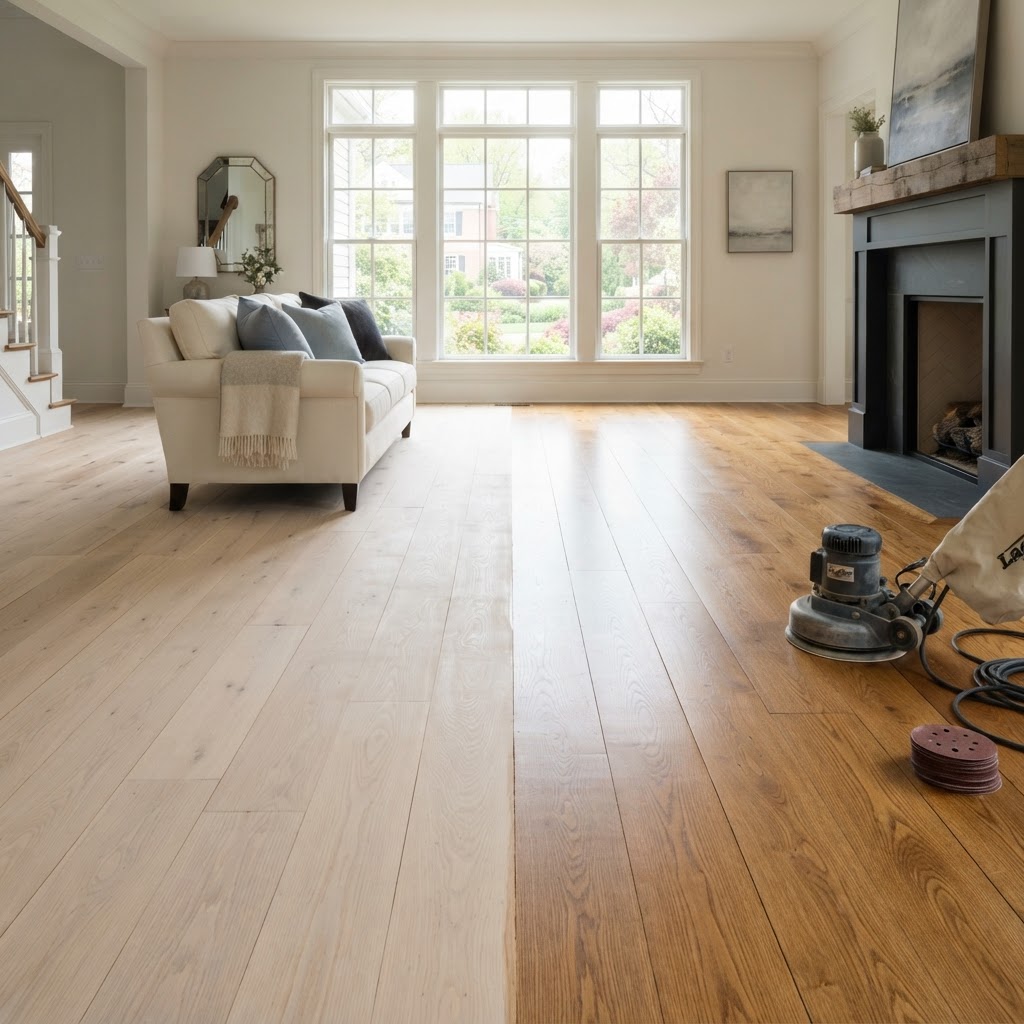
Yes, in many cases. Deep scratches, dullness, gouges and surface stains can usually be sanded out and refinished, and localized water damage can often be fixed by replacing only the affected boards once the moisture problem is solved. Replacement becomes the better choice when the wood is structurally compromised, widespread or too thin to sand again. Floors and Beyond VA, a family-owned Northern Virginia flooring and remodeling contractor serving homeowners since 1987, follows a refinish-first philosophy and begins every project with a free in-home consultation that sorts surface damage from structural damage before anyone recommends tearing anything out. For that assessment in your home, contact Floors and Beyond VA for a free in-home consultation.
That distinction between surface and structural is the whole story. A floor that looks terrible may be entirely salvageable, while a floor that looks only slightly off can be hiding trouble underneath. This guide walks through how we assess damage, the main restoration methods, how restoration compares with replacement in cost and time, the clear signs that replacement is the right call, and how to keep the problem from coming back.
Step one: make the house safe and stop the water
If the damage came from water, the floor is not the first priority. Stay safe around electricity. Stop the water source if you can do so safely. Call a licensed plumber to fix the leak and a water-mitigation professional to dry the structure. Document the damage with photographs and notes, and contact your insurance company or, in a condominium, your association.
We are flooring specialists, not emergency water-extraction or plumbing professionals, and we do not claim to be. Restoration only works when the source is fixed and the wood and subfloor have dried properly. Rushing to refinish over wet wood traps moisture and almost guarantees a second failure. The best results come from letting the right professionals do the first job and then bringing us in for the floor.
Surface damage versus structural damage
Every assessment begins with one question: how deep does the problem go?
Surface damage affects the finish or the top layer of the wood. It includes light and deep scratches, scuffs, dull and worn finish, minor dents, pet nail marks, shallow stains and sun fading. It also includes many gouges, as long as they have not cut through a large share of the board's thickness. Surface damage is usually solvable by sanding and refinishing.
Structural damage affects the integrity of the boards or the subfloor. It includes boards that are cupped, crowned or buckled from moisture, boards that are cracked or split, rot, soft spots, loose or lifting boards, insect damage, deep staining that has penetrated the wood, and subfloor problems that cause bounce, squeaks or sagging. Structural damage often requires repair or replacement of boards, correction of the subfloor and moisture remediation before any finish work.
Many floors have a mix. A kitchen floor may have a few boards damaged by a dishwasher leak and the rest merely worn. A hallway may have deep pet scratches and nothing structural at all. A good assessment maps the damage board by board.
How we assess a damaged floor
A proper assessment is a careful, unhurried look, and it is part of our free in-home consultation.
Visual inspection. We look for cupping, crowning, gaps, discoloration, finish failure and lifted edges. We look at the pattern: damage in a line near a wall, around a fixture or beneath a window tells a story.
Touch and sound. Running a hand across the surface reveals ridges and soft spots. Walking the floor reveals bounce, movement and noise.
Moisture measurement. A moisture meter helps indicate whether the wood and subfloor are still wet or have returned to a normal range. Readings are interpreted in context, not in isolation.
Thickness and wear layer. Solid hardwood can be sanded and refinished several times over its life, depending on how much wood is left above the nails. Engineered hardwood has a limited wear layer, so the number of times it can be sanded depends on its construction. We evaluate how much material remains.
Subfloor and structure. Where possible, we look at the subfloor from below, from a crawl space or basement, and from above if boards are lifted.
Source of the problem. We ask about the history: when it happened, how it was handled, whether the cause has been repaired.
We tell you plainly what we see. If the wood is a good candidate for restoration, we say so. If it is not, we explain why.
Restoration method one: sanding and refinishing
Sanding and refinishing is the workhorse of hardwood restoration. A professional sands the floor in stages, starting with a coarser abrasive to remove the finish and level the surface, then moving to finer abrasives for a smooth result. Edges and corners are sanded with specialized equipment. Dust is controlled and removed. Stain, if desired, is applied. Then protective coats of finish are applied with appropriate drying time between them.
This process removes the surface layer of wood and finish, along with scratches, dull areas, many stains and shallow gouges. It can change the color of the floor, if you wish, by staining, and it renews the protective layer.
- What it can fix: deep scratches that have not gone through the wear surface, pet marks, worn finish, minor dents, shallow stains, sun-faded areas, uneven color from previous finishes.
- What it cannot fix: deep gouges that are beyond the sanding depth, boards that are structurally failed, cupping or crowning that has not resolved, rot or insect damage, deep black stains that have penetrated the wood fibers.
Sanding is a one-time use of the wood, which is why a skilled operator takes the minimum necessary. Over-sanding thins the boards and shortens the floor's future.
Restoration method two: screen and recoat
When the finish is dull and lightly scratched but the wood is intact, a screen and recoat may be enough. The floor is lightly abraded, cleaned and given a fresh coat of finish. It does not remove deep scratches or change color, but it refreshes the protective layer and can restore luster. It is faster and less disruptive than a full refinish. We assess whether your floor is a candidate.
Restoration method three: board repair and replacement
When only some boards are damaged, replacing them can be an elegant solution. The damaged boards are carefully cut out, new boards of matching species and width are woven into the existing floor and the area is sanded and finished together with the surrounding floor so that color and sheen blend.
This works well for localized water damage, pet damage, burns, cut-outs from removed fixtures and deep gouges. Matching is a skill. New wood and old wood differ in color, and the best results come from treating the repaired area and the connected floor as one finishing project. In some cases, salvaged boards from less visible areas, such as the inside of a closet, can be used to repair prominent spots.
Where a large area is affected, a section may be replaced, and then the whole room is sanded and finished for consistency.
Restoration method four: moisture remediation and drying
If boards have cupped or crowned because of moisture, the first step is to eliminate the source and allow the wood to dry slowly and naturally. In many cases, mildly cupped boards flatten out as they return to normal moisture content. This can take time, and rushing it with high heat risks further damage. A water-mitigation professional manages the drying of the structure.
Once the wood is back in its normal range, we reassess. Some floors recover fully and need only sanding to level them. Others remain distorted, and affected boards must be replaced. We do not guess. We measure and wait for the right conditions. This is one reason we avoid promising a firm outcome from a photograph.
Restoration method five: stain and mold treatment
Dark stains in hardwood can come from water, pets, plant pots, metal and other sources. Some stains can be lightened by sanding. Others, particularly deep black stains from prolonged water exposure, penetrate the wood and may not sand out completely. Wood bleaching and staining can sometimes reduce the appearance of discoloration, but results vary and should be discussed honestly before work begins.
If you see or suspect mold, treat it as a health and safety issue. We do not diagnose or remediate mold. Contact a qualified mold or water-damage professional to assess and treat it. If the wood is affected deeply, replacement of boards may be necessary. After remediation, we can restore or replace the flooring.
Cost and time comparisons without the sticker shock
We do not publish prices in articles, because every floor and every home is different. Here is how restoration generally compares with replacement.
Cost. Refinishing or board repair usually costs less than tearing out and replacing a whole floor. Replacement involves removing old flooring, new materials, installation and often trim and transition work. Restoration preserves the material you already have. The comparison is clearest when the existing wood is solid and the damage is limited.
Disruption. Refinishing disrupts a home for a limited period, with dust control and finish curing. Replacement can involve removal, subfloor work, installation and finishing. Replacement of engineered or solid pre-finished flooring may be quicker in some cases, but removal and disposal add steps.
Time. Typical repairs follow a predictable sequence: assessment, repair or replacement of damaged boards, sanding, staining if desired, finish coats and curing. We do not promise specific durations in an article, because they depend on the size of the area, the species, the finish system and the weather. We explain the expected schedule at your consultation and tell you which steps, such as drying and finish curing, cannot be rushed.
Value. A restored hardwood floor can look new and increase the appeal of the home. Replacement lets you change materials and styles entirely, which can be a good choice if the old floor does not fit your goals.
The best way to compare is to see both options priced for your home. Our estimates are written, honest and all-inclusive: they cover removal of old flooring, new materials, installation, furniture moving, transitions, molding and cleanup. What we quote is what you pay.
Not sure which option applies to your floor? Contact Floors and Beyond VA for a free in-home consultation with an honest, all-inclusive estimate before you decide anything.
Clear criteria for when replacement is the better choice
Restoration is our first instinct, but it is not always the right answer. We recommend replacement when one or more of these apply.
The boards are too thin. Repeated sanding over the years, or a thin wear layer on engineered flooring, may leave too little wood. Sanding further risks exposing nails or tongue-and-groove joints.
The damage is widespread and structural. Extensive cupping, buckling, rot or delamination across large areas is often beyond economical repair.
The subfloor is compromised. Soft, rotted or sagging subfloor must be repaired or replaced, and in many cases the flooring above must come up.
Mold or contamination is extensive. After professional assessment, heavily affected materials may need removal.
The wood has failed. Boards that are splitting, crumbling or insect-damaged are poor candidates for restoration.
Matching is impossible. If the species or profile is no longer available and a patch would look obviously different, replacement of the whole room may be better.
You want something different. If you are not happy with the existing floor's style, restoration may not meet your goals.
The floor has been repeatedly refinished. Every floor has a finite number of sandings.
We would rather tell you honestly that replacement is the better value than refinish a floor that will fail again.
What restoration looks like in Northern Virginia homes
Older homes in Vienna, Falls Church and Fairfax. Many have solid oak or pine floors with good thickness, ideal for sanding. Years of finish and wear can be removed to reveal beautiful wood.
Historic homes in Leesburg and Manassas. Careful, minimal sanding preserves old-growth wood. Board replacement is done with salvaged or carefully matched material.
Townhomes in Reston, Woodbridge and Centreville. Engineered hardwood is common, and wear layers vary. We check the thickness before recommending sanding.
Condominiums in Tysons and Arlington. Water damage from neighboring units is a frequent cause of floor problems. Coordination with building management and insurers is important. Verify association requirements before work.
New construction in Ashburn and Sterling. Builder floors may be thinner or lower-grade, and damage from construction moisture can show up. We assess and advise.
Here is a representative scenario, not an account of any particular customer. A homeowner in an older Vienna house had deep pet scratches and a dull, worn finish across a living room and hall, plus a few boards stained dark near a former pot of plants. Rather than replacing the floor, the plan was to replace the stained boards, sand the whole connected area and apply a fresh finish. The result was a uniform floor that looked new, at a fraction of the disruption of a full replacement.
Preventing recurrence: practical maintenance
Restoration is only worth it if the floor stays in good shape. These habits help.
Fix leaks promptly. Check under sinks, around dishwashers, refrigerators with ice makers, water heaters and washing machines. Replace worn hoses.
Wipe spills quickly. Water, pet accidents and plant overflows damage wood if left.
Use mats and rugs. Place mats at entries and in front of sinks. Use breathable rugs and avoid rubber-backed mats that trap moisture.
Keep humidity steady. Hardwood prefers a moderate, stable environment. Extremes cause cupping, gaps and cracking. A licensed heating and cooling professional can advise on humidity equipment. Floors and Beyond VA does not install it.
Protect with pads. Felt pads under furniture prevent scratches. Lift, do not drag.
Trim pet nails. It reduces scratching.
Use proper cleaners. Avoid soaking the floor or using steam mops unless the finish manufacturer approves them.
Keep plants on trays. And check them.
Maintain the finish. A timely screen and recoat renews protection before the wood is exposed.
Control sunlight. Window coverings reduce fading.
Watch the exterior. Gutters, downspouts and grading that move water away from the home reduce moisture risk.
What to expect during a restoration project
A typical restoration follows these steps. The consultation and assessment come first. If water was involved, we wait for the structure to be dry and the source repaired. Damaged boards are removed and replaced. The floor is prepared and sanded. Stain is applied if desired. Finish coats are applied, with cure time between them. Furniture is returned when the finish has cured sufficiently, with guidance about caring for the floor in the first days and weeks.
We protect adjacent areas, control dust and clean up. Our in-house crews handle every step, so the same team that assessed your floor finishes it.
What about before-and-after photos?
Photos are a powerful way to understand what restoration can do. We do not publish photographs in this article. During your free consultation, we are happy to talk through examples of the types of results possible, and to show you samples of stain and finish on actual wood so you can judge color and sheen in your own light.
What drives the scope of a restoration project
The scope depends on the area affected, the species and thickness of the wood, the type and severity of damage, the number of boards to replace, the condition of the subfloor, the finish system you choose, the need to move furniture, and trim and transition work. Water-damaged floors may require waiting for drying and for the work of other professionals.
We take precise laser measurements at no charge and prepare a written, honest, all-inclusive estimate. What we quote is what you pay.
Why Northern Virginia homeowners choose Floors and Beyond VA
- Family-owned and restoring floors since 1987. Decades of experience with Northern Virginia hardwood.
- Refinish-first philosophy. We save what can be saved and say so plainly when it cannot.
- In-house crews only. Our employees do the work.
- Free in-home consultation. We assess damage in person, with a moisture meter and a trained eye.
- Precise laser measurements at no charge. Accurate planning.
- Honest, all-inclusive, no-surprise estimates. One price that covers the whole scope.
- Fully licensed, bonded and insured. Your home is protected.
- No showroom. We bring samples to your home.
Floors and Beyond VA treats your hardwood the way it deserves: as something worth saving whenever possible.
Common mistakes with damaged hardwood
Refinishing over wet wood. It traps moisture and fails.
Replacing a floor that could have been saved. Check first.
Ignoring the source of damage. Fix the leak or humidity problem.
Using high heat to dry quickly. It can crack and warp wood.
Over-sanding. It thins the floor.
Skipping professional mold assessment. Health matters.
Matching new boards without refinishing the connected area. Differences show.
Delaying repair. Small problems become big ones.
Frequently asked questions
Can deep scratches be sanded out?
Usually, if they have not gone through too much of the wood's thickness. We assess depth.
Can water stains be removed?
Some can be sanded or treated. Deep black stains may not fully disappear.
Will cupped boards flatten?
Often, once the source is fixed and the wood dries slowly. Some require replacement.
How many times can hardwood be refinished?
It depends on thickness and construction. We measure and advise.
Can I repair just a few boards?
Yes, in many cases. Blending requires finishing the connected area.
Do I need replacement if there was a flood?
Not always, but the structure must be dried and assessed by qualified professionals first.
What if I live in a condominium?
Coordinate with your association and insurer, and verify requirements before work.
Where can I learn more about water-damaged hardwood?
See Repairing Water-Damaged Hardwood in Northern Virginia: Spot Repair or Board Replacement.
Related resources
Our wood flooring page describes the hardwood services we provide, and our Floors and Beyond VA service areas near Tysons overview shows how we work across the region.
Ready to find out if your floor can be saved?
Let us visit your home, assess the damage and give you an honest answer. Contact Floors and Beyond VA to schedule your free in-home consultation and receive a clear, all-inclusive estimate, or call (703) 906-5698.
Floors and Beyond VA
Family-owned flooring and remodeling since 1987, serving Northern Virginia
Phone: (703) 906-5698
Web: floorsandbeyondva.com




