
The short answer: laminate flooring should acclimate for as long as the manufacturer's installation instructions require, in the room where it will be installed, with the home at normal living temperature and humidity. The time varies by product, so check the sheet in the carton before you plan the project.
Floors and Beyond VA, a family-owned Northern Virginia flooring and remodeling contractor serving homeowners since 1987, includes on-site moisture checks in its free in-home consultation and schedules deliveries so acclimation happens before installation day.
You will find confident numbers online, and some of them are wrong for your product. We avoid quoting a single figure in an article because manufacturers differ and because the environment matters as much as the clock. Two cartons can sit in the same house for the same period and end up in very different condition if one was beside a vent and the other in a damp corner. This guide explains why laminate acclimates, how Northern Virginia humidity affects timing and gives you a practical checklist you can follow before the crew arrives.
Why laminate needs acclimation
Laminate has a core made of compressed wood fibers. Wood fibers absorb moisture from the air and release it when the air dries out. A plank that has been in a humid warehouse or a cold truck will hold different moisture than a plank in your living room. If it is installed before it matches the room, it will keep adjusting, and in a floor that is locked together, that adjustment turns into stress at the seams.
Acclimation gives the planks time to reach equilibrium with the room. It reduces the likelihood of gaps, peaked joints, lifted edges and noise. It also supports your warranty, since many manufacturers make proper acclimation and installation conditions a condition of coverage.
Dimensional stability in plain language
Dimensional stability means a plank keeps its size and shape as conditions change. No flooring is perfectly stable, but laminate with a quality core and balanced construction is quite good, provided it is installed correctly. Acclimation, subfloor moisture control, the expansion gap and humidity management all contribute.
Think of it as a system. If one piece is missing, the others cannot fully compensate. A well-acclimated floor with no expansion gap will still fail at the edges. A floor with the right gap but no acclimation may still develop problems. We pay attention to every piece.
How Northern Virginia humidity affects timing
Northern Virginia is humid in summer and dry indoors in winter. Spring and fall bring variable conditions. Those swings influence how quickly planks reach equilibrium and how far they need to move.
In the humid season, planks arriving from a drier environment will absorb moisture and may swell slightly. In the heating season, planks arriving from a humid environment will release moisture and may shrink. The more different the delivery conditions are from the room conditions, the more careful the acclimation should be.
Homes also vary. A basement or a room over a crawl space may hold more humidity. A newly built home may still be releasing moisture from concrete, drywall compound and paint. A condominium unit with stable climate control may be simpler. A drafty older house may swing widely.
Because of these differences, we do not set a universal time. We look at the conditions in your actual room, and we plan accordingly.
The step-by-step acclimation checklist
Use this list as a practical guide. Where it says to follow the manufacturer, use the instructions that came with your specific laminate.
- Step one: read the instructions. Find the installation guide in the carton or on the manufacturer's website. Note the acclimation requirement, the permitted temperature and humidity ranges, the required expansion gap and any subfloor limits.
- Step two: set the home to normal living conditions. Run heating and cooling as you would after the project. Do not install in a house that is unusually cold, hot or humid. Keep conditions steady, not swinging.
- Step three: choose the storage spot. Store the cartons in the room where the floor will be installed. Do not use a garage, unheated porch or damp basement unless that is where the floor is going.
- Step four: unpack according to the instructions. Some manufacturers want cartons left closed, and some want planks opened and spaced. Follow the specific direction for your product.
- Step five: space and stack correctly. Lay cartons flat, never on edge. Keep them off bare concrete if the manufacturer requires a barrier. Separate stacks so air can circulate if the instructions call for it. Keep them away from vents, exterior doors, windows with direct sun and damp walls.
- Step six: monitor temperature and relative humidity. A simple room thermometer and hygrometer help you confirm the room stays within the manufacturer's stated range during acclimation and installation. If your home is outside the range, adjust before proceeding.
- Step seven: check the subfloor moisture. For concrete slabs, moisture testing is important. For wood subfloors, a moisture meter can confirm the subfloor is within an acceptable range. Different surfaces and meters have different guidelines, so follow the manufacturer and, when in doubt, ask a professional.
- Step eight: inspect the planks. After acclimation, open the cartons and check for damage, defects or color variation. Mix planks from several cartons as you install for a natural look.
- Step nine: decide whether to proceed or delay. If conditions are outside the stated range, or the subfloor is wetter than allowed, delay the installation until they are corrected.
- Step ten: plan the expansion gap and transitions. Confirm the gap size from the instructions, and have transition pieces and molding ready.
This checklist is the backbone of our process, and our in-house crews go through it on every laminate flooring project.
Moisture meters: what they do and do not tell you
A moisture meter measures the moisture content of a material, such as a wood subfloor or a plank. Pin meters read between two pins inserted into the material. Pinless meters scan the surface with an electromagnetic signal. Each has strengths and limits. Readings can vary with the species, density and temperature of the material.
For concrete, moisture testing uses different methods, such as relative humidity probes or calcium chloride tests, because concrete moisture is more complex than wood moisture. We do not diagnose or fix sources of water intrusion. If a slab or subfloor is wet because of a leak or drainage problem, the right first step is a licensed plumber or waterproofing professional.
During a free in-home consultation, we take on-site moisture measurements as part of assessing the room. We explain what we find in plain language and what it means for your project.
When to delay installation
- The room is outside the stated temperature or humidity range. Correct the conditions first.
- The subfloor is wetter than the manufacturer allows. Find the cause and address it.
- Construction is still ongoing. Painting, drywall finishing, tile work and concrete curing add moisture and dust. Install flooring after the wet trades finish.
- Cartons were stored in a poor location. Allow additional time in the right room if the manufacturer directs.
- The home has been closed up without climate control. Restore normal conditions and give planks time to adjust.
- There are signs of a leak. Resolve the source before flooring.
Delay costs a little time. A failed floor costs far more.
Secure material storage and scheduling
Acclimation needs a safe place for the cartons. In an occupied home, that means a room where they will not be damaged, soaked or moved. In a renovation, it may mean protecting them from dust and tools. In a condominium, it may mean coordinating delivery times with building management.
Floors and Beyond VA schedules deliveries so materials arrive early enough to acclimate and keeps the timeline clear. If you prefer, we can discuss secure storage options during your consultation. We explain any impact on scheduling at the start so there are no surprises.
Acclimation in different Northern Virginia homes
- Tysons and Arlington condominiums. Stable interiors, but delivery logistics and storage matter. Coordinate with management and confirm requirements for underlayment and work hours. Our guide to Tysons condo flooring rules covers sound ratings and approval.
- Vienna, Falls Church and McLean houses. Crawl spaces, additions and older construction may create varied conditions across the house. Acclimate in the room where the floor goes.
- Reston and Fairfax townhomes. Slabs and shared walls call for moisture assessment and attention to association guidelines.
- Ashburn and Sterling new construction. Make sure the home has settled into normal living conditions before installation.
- Leesburg and Loudoun farmhouses. Wide swings in humidity and additions on different foundations call for room-by-room judgment.
- Manassas, Woodbridge and Centreville homes. Finished basements need special care. Laminate may not be the best choice for damp lower levels, and we say so. See our basement finishing work.
Expansion gaps and floating floors
Laminate floats. The planks lock to each other, not to the subfloor. This allows the floor to move as a single unit but requires a gap at the perimeter and around fixed objects. The gap is hidden by baseboards, shoe molding or transitions.
If the floor is pinned against a wall, cabinet or pipe, it cannot move, and the stress shows up in the seams. Good installers measure and maintain the gap carefully. Heavy items such as kitchen islands and built-in cabinets should not sit on top of a floating floor unless the manufacturer explicitly allows it.
Unpacking, spacing and stacking: what the checklist looks like in a real room
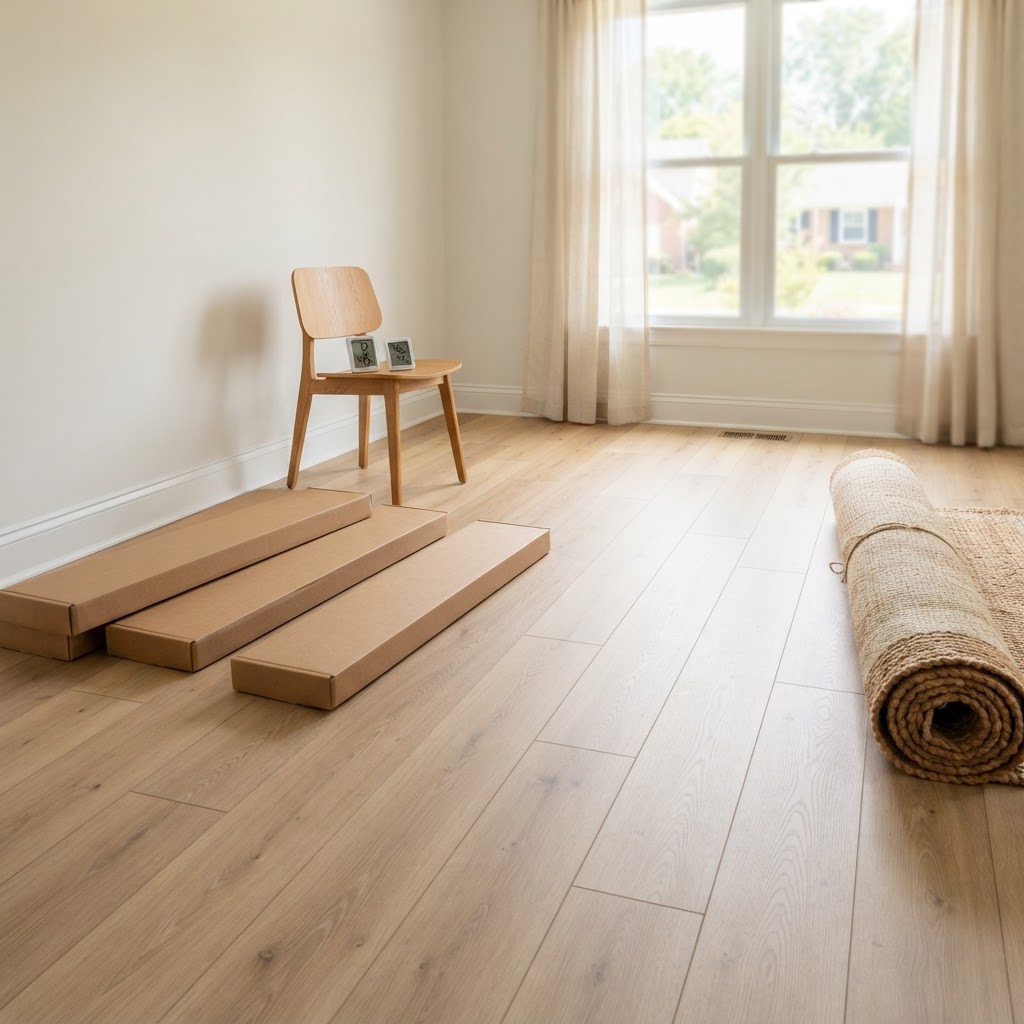
Imagine a living room in a Vienna home. The old carpet is gone, the subfloor is exposed, and the thermostat is set where the family normally keeps it. The cartons are brought in and laid flat in the middle of the room, in two or three low stacks with space between them. They are not touching the walls or sitting under a vent. A small thermometer and hygrometer rest on a chair nearby so the family can see that the room stays steady. That is the entire setup. It is quiet and unglamorous, and it prevents a great deal of trouble.
What to do when the weather swings
Northern Virginia weather can change fast. A warm spell in early spring may be followed by a cold snap. A humid week in summer may be followed by a dry, cool week. When the weather is changing rapidly, the indoor environment can also shift, especially in homes with older windows. Try to keep your heating and cooling steady, and let us know if conditions move outside the range the manufacturer allows. We may recommend adjusting the schedule rather than installing during unstable weather.
Who is responsible for what
Clear roles make acclimation work. The manufacturer sets the requirements. The homeowner keeps the home at normal conditions and provides access. The installer reviews the instructions, checks the room, monitors conditions and decides when to proceed. A good installer never starts if the conditions fall short. At Floors and Beyond VA, that decision belongs to the crew lead, and we explain our reasoning if we recommend a delay.
What a failed laminate floor teaches us
When we are called to look at a laminate floor that has gone wrong, we usually find a small number of causes. The planks were installed without acclimation. The subfloor was damp or uneven. The expansion gap was too small or blocked by trim or a heavy object. A leak or spill soaked the edges. Humidity swung widely after installation. Many of these causes are preventable with planning, which is why we put so much attention on the front end of a project.
Choosing laminate wisely
Laminate suits dry, interior rooms with stable conditions. It can offer an attractive look at a sensible level of investment. It is less suited to bathrooms, basements with moisture concerns, laundry rooms and entries that see wet shoes and standing water. Water-resistant laminates exist, but surface edges and seams remain vulnerable. If your room has frequent moisture, we may recommend vinyl plank or tile instead. Honest advice is part of the service.
What drives the scope of a laminate project
The scope depends on the area, layout, subfloor condition, product and underlayment, removal of existing flooring, transitions, furniture and stairs. Subfloor repairs or leveling can add work. Acclimation affects scheduling, not the complexity of installation, but it should be planned from the start.
We take precise laser measurements at no charge and give a written, all-inclusive estimate covering old flooring removal, new materials, installation, furniture moving, transitions, molding and cleanup. What we quote is what you pay. Our pricing and policy page explains how estimates work.
Why Northern Virginia homeowners choose Floors and Beyond VA
- Family-owned since 1987. Decades of experience in local homes and climate.
- In-house crews only. Our employees install your floor.
- On-site moisture checks during your free consultation. We look at the room, not just the product.
- Scheduling that allows proper acclimation. Delivery is planned early.
- Precise laser measurements at no charge. Accurate planning.
- Honest, all-inclusive estimates. Clear timelines and no surprises.
- Fully licensed, bonded and insured. Peace of mind.
- No showroom. We bring samples to your home.
Floors and Beyond VA treats acclimation as part of the job, not an afterthought.
Common mistakes with laminate acclimation
- Relying on a generic number from the internet. Use your manufacturer's instructions.
- Acclimating in the wrong room. The floor should adjust where it will live.
- Ignoring humidity. Temperature alone is not enough.
- Skipping the subfloor check. A wet slab can ruin a laminate floor.
- Installing while other trades are still working. Moisture and dust matter.
- Forgetting the gap. The floor needs room to move.
- Neglecting the warranty. Keep the instructions and records.
Frequently asked questions
Is acclimation the same for every brand?
No. Requirements differ by manufacturer and product.
Do I need a moisture meter?
A professional will use one as part of the assessment. For homeowners, the key is to ask about moisture and follow the manufacturer's guidance.
Can I speed up acclimation?
Not safely. Following the instructions is the reliable path.
What if the house is vacant?
Run climate control normally during acclimation and installation.
Does the same advice apply to vinyl?
Many principles overlap, but products differ. Read Does Vinyl Flooring Need to Acclimate? A Northern Virginia Guide.
More resources
Our flooring installation guide explains what to expect from start to finish, our guide to whether laminate needs to acclimate at all covers the underlying why, and our overview of where we work around Tysons, Fairfax, Vienna, Reston and McLean shows how we approach projects in the region.
Ready to plan your laminate floor?
Free in-home consultation
Let us visit, check your room conditions and plan a schedule that works. You get an honest, all-inclusive estimate covering removal, materials, installation, transitions, molding and cleanup.
Contact Floors and Beyond VAFloors and Beyond VA
Family-owned flooring and remodeling since 1987, serving Northern Virginia
Phone: (703) 906-5698
Email: hello@floorsandbeyondva.com
Web: floorsandbeyondva.com




