
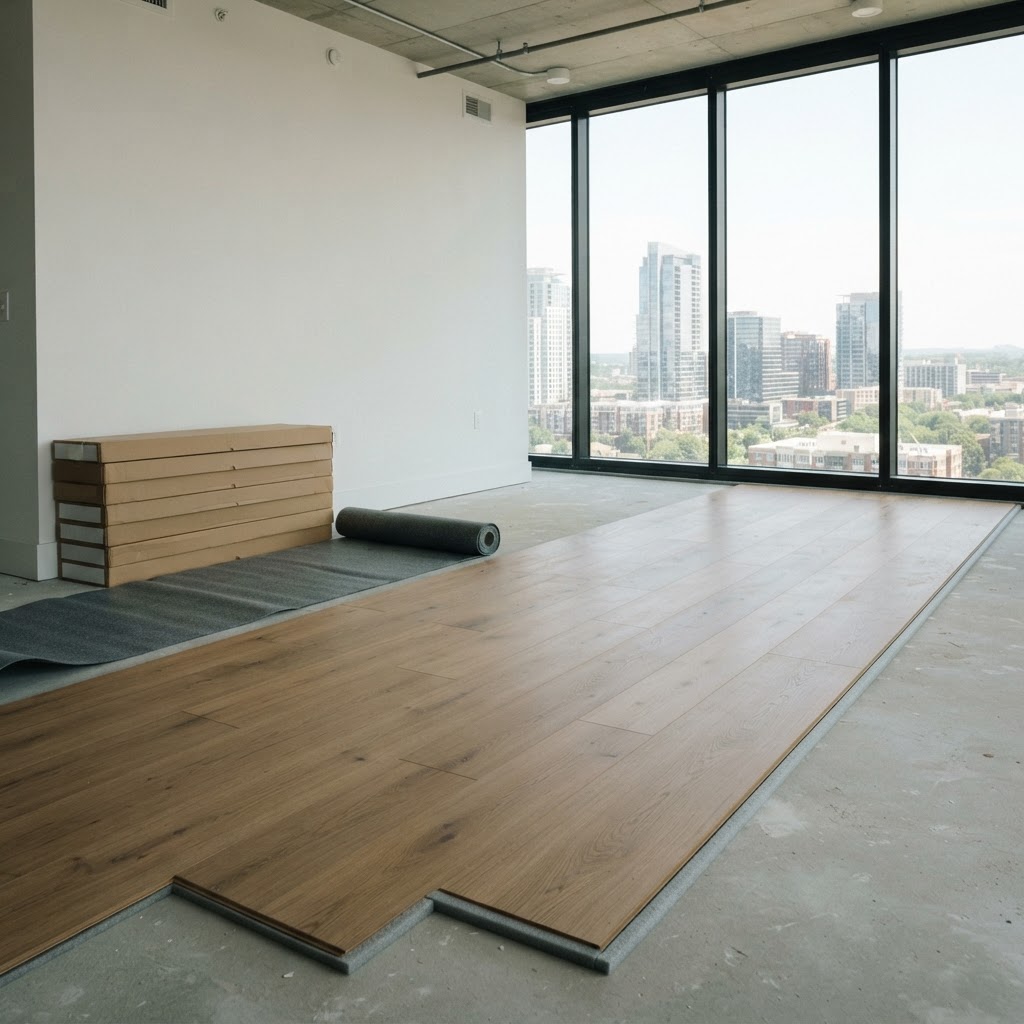
Often yes, with your association's approval. Buildings commonly require a written request, a minimum sound rating for the floor assembly, a contractor's insurance certificate, set work hours and elevator reservations. Get the rules in writing before you buy planks. Floors and Beyond VA can help plan the project around them.
Usually required
- A written request and approval
- An impact sound rating for the assembly
- Contractor insurance certificate
- Work hours and elevator reservations
- Debris removal rules
Also prepare for
- Moisture testing on the slab
- Flatness within manufacturer tolerance
- Removing old flooring and adhesive
- Acclimating planks in the unit
- A possible inspection afterward
Start with the rules
Ask management for the renovation policy and the floor covering requirement. Typical items are the approval process, sound requirements, approved or prohibited products, work hours, contractor insurance, elevator and loading rules, debris removal and sometimes an inspection afterward. Ask for it in writing, because the rule that decides your project is usually a specific number or a named document, not a general statement that hard floors are allowed. Once you have it, keep it with your other project paperwork.
Sound ratings
Your floor is a neighbor's ceiling, and hard floors carry impact noise from footsteps and dragged chairs. Ratings apply to the whole assembly of slab, underlayment and plank, not to a single product, which is why a plank that works in one building can fail in another. Ask which rating and test method the building accepts, and whether a data sheet or a test report is needed. Your best move is to bring the association's requirement to the flooring company before choosing a product, so the plank and underlayment are selected to meet it.
The concrete slab
Vinyl plank needs a flat slab within the manufacturer's tolerance, and many manufacturers require moisture testing even above grade. Old flooring and adhesive must be removed, and radiant heat requires products approved for heated floors. In Tysons high-rises the slab is often the whole story: flatness, moisture and what is left underneath after tear-out. If any of that is skipped, the plank can click, lift at the seams or telegraph the slab within a season.
Floating or glue-down
Floating click-lock planks over a sound-rated underlayment are the most common choice and need a perimeter gap at every wall and fixed object. Glue-down gives a solid feel and can meet some sound requirements more easily, but it demands careful moisture and flatness control. Follow the plank manufacturer and the building's rules, and when the two conflict, satisfy the stricter one.
Plan the logistics
Notify management early, reserve the elevator, schedule within permitted hours, store planks in the unit to acclimate and tell the neighbors below. Keep the approval letter, data sheets and insurance certificate together in one folder. Buildings move slowly on paperwork, so the approval usually decides your start date more than the installation does.
Northern Virginia specifics
Tysons has high-rise and mid-rise condominiums plus townhome communities nearby in McLean, Vienna and Falls Church. Open layouts and large windows are common, and vinyl plank suits them when the building's rules and the slab are handled correctly. If your building sits above retail or parking, ask whether the slab is a structural transfer deck, since that changes moisture and flatness conditions. Our guide to LVP flooring in Tysons condos covers how these homes live day to day.
How Floors and Beyond VA handles condo projects
Floors and Beyond VA starts by asking for the association's written requirements, then evaluates the slab and recommends a plank and underlayment that satisfy both the manufacturer and the building. We supply insurance certificates when required and plan the work around the building's hours. Our crews are our own employees, so the people who plan the project are the people who install it.
We also keep the paperwork organized for you: the product data sheets, the underlayment specification, the insurance certificate and the care instructions, so that you have a clear record for the association and for any future buyer.
Frequently asked questions
Do I need underlayment?
It depends on the plank, and some buildings require a specific one.
Will neighbors hear my floor?
Hard floors carry more impact sound than carpet, so the assembly and rating matter.
How long does it take?
Many condo floors take a few days, plus approval and scheduling time.
What if the building prohibits hard flooring?
Some buildings restrict it in bedrooms or higher floors. If yours does, a hybrid or carpet in those rooms is often the practical answer, and worth confirming before you order.
When to call a professional
If you are planning LVP in a Tysons condo, have the slab and the building requirements reviewed before ordering. Floors and Beyond VA is family-owned and has served Northern Virginia since 1987. Schedule an in-home estimate at floorsandbeyondva.com/Contact or call (703) 906-5698.
Plan your Tysons condo floor around the building's rules
Floors and Beyond VA reviews the association's requirements, tests the slab and specifies a plank and underlayment that satisfy both. Family-owned, in-house crews, serving Northern Virginia since 1987.
LVP Flooring in Tysons, VA



