
What Is the 3-5-7 Rule in Interior Design?
The 3-5-7 rule in interior design is a grouping principle that recommends arranging decorative objects in odd-numbered groups of 3, 5, or 7 rather than even numbers. Odd-numbered groupings create more visual interest and dynamism than even groupings because they prevent the eye from easily dividing the arrangement into symmetrical halves — the eye keeps moving, searching for balance, which makes the grouping feel alive rather than static. The rule applies to vignettes on shelves, decorative objects on tables, artwork arrangements, furniture groupings, and — in flooring terms — the number of distinct zones, rugs, or materials used to define spaces within an open-plan interior.
The 3-5-7 rule is one of several odd-number principles in design (the rule of thirds in photography follows the same logic). Its power is in its simplicity: whenever you're arranging elements in a space and something feels off, check whether you're using an even number. Two items on a shelf compete equally for attention and feel symmetrical. Three items create a natural hierarchy — the eye moves between them rather than settling in the middle.
In flooring, the 3-5-7 rule intersects with the rule of 3 in flooring materials, area rug placement, and the visual zoning of open-plan main levels — a design challenge common to the post-2000 Northern Virginia colonials and townhomes whose open-concept great rooms need to define living, dining, and kitchen zones across a single continuous floor.
How the 3-5-7 Rule Applies to Flooring
Four specific ways the 3-5-7 rule intersects with flooring decisions in Northern Virginia homes — from material selection through area rug placement.
The rule of 3 in flooring (use no more than three flooring materials in one home) is itself an application of the odd-number principle. Three materials — primary, secondary, and accent — create a natural hierarchy where one material dominates, one supports, and one accents. Four materials create two pairs that compete equally; two materials create a binary that can feel stark. Three is the right odd number for most Northern Virginia homes because it matches the three natural functional zones: main living areas, sleeping areas, and wet spaces.
In a post-2000 Northern Virginia colonial: SPC LVP on the main level (primary — dominant), carpet on the bedroom level and stairs (secondary — supporting), porcelain tile in bathrooms and entry (accent — specific function). Three materials. One coherent interior.
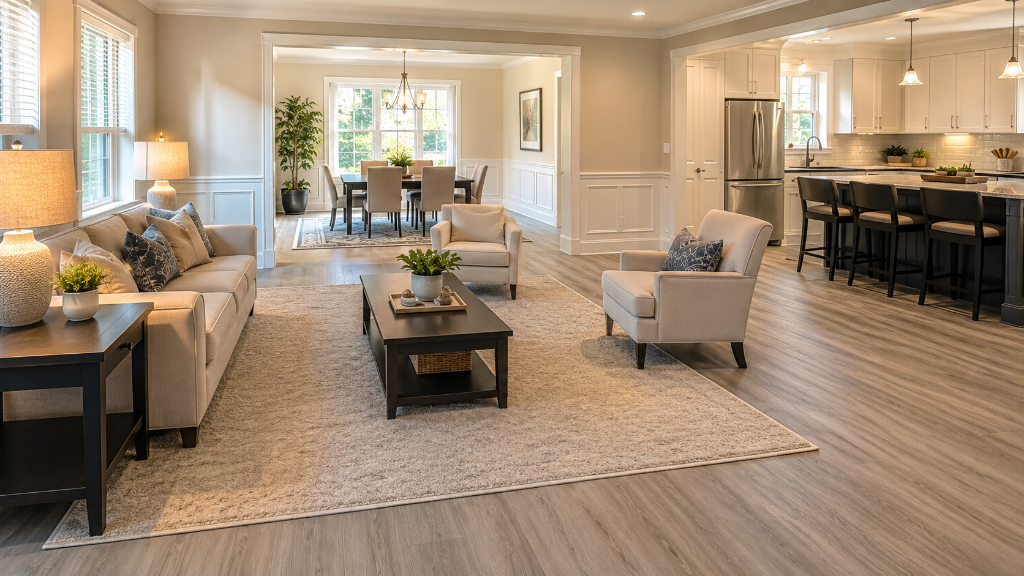
The open-plan main levels common in Northern Virginia's post-2000 colonials and townhomes — great rooms that combine kitchen, dining, and living zones across a single continuous LVP or hardwood floor — benefit from visual zoning using area rugs. The 3-5-7 rule suggests defining three distinct zones within this open space: a living zone anchored by a large area rug under the sofa grouping, a dining zone anchored by a rug under the dining table, and the kitchen zone left bare (hard floor visible, no rug needed).
Three zones, two rugs, one floor. The odd-number principle means the living room rug and the dining room rug don't compete equally — the living room rug, being larger and the primary seating zone, reads as dominant, while the dining rug reads as secondary. This creates visual hierarchy across the open plan without requiring different flooring materials.
When arranging furniture over a hardwood or LVP floor, the 3-5-7 rule applies to the number of seating elements in a grouping. A five-piece living room arrangement (sofa, two chairs, coffee table, side table) creates more visual interest than a four-piece or six-piece arrangement because the odd count prevents the grouping from dividing into equal halves. The area rug beneath the arrangement should be large enough to anchor all five elements — at minimum, the front legs of all major pieces should rest on the rug, with the rug extending at least 8 inches beyond the outermost furniture legs.
The 60-30-10 rule (dominant color at 60%, secondary at 30%, accent at 10%) is the proportional expression of the same odd-hierarchy principle as the 3-5-7 rule. Applied to flooring in Northern Virginia homes: the primary floor material (LVP or hardwood on the main level) should cover approximately 60% of the total floor area; the secondary floor (carpet on bedroom levels) approximately 30%; and the accent floor (tile in bathrooms and entry) approximately 10%. This proportion creates a dominant-secondary-accent hierarchy where the eye reads the home's flooring clearly rather than competing between equally-weighted materials.
Applying the 3-5-7 Rule to Area Rugs Over Northern Virginia Floors
Practical area rug guidance for the most common rooms and floor types in Northern Virginia homes — applying the grouping and proportion principles of the 3-5-7 rule.
Planning flooring or a flooring renovation in Northern Virginia? Floors and Beyond helps apply design principles to real installation decisions — free shop-at-home consultation throughout Fairfax, Loudoun, Prince William, and Arlington.
Schedule a Free ConsultationFrequently Asked Questions
What is the 3-5-7 rule in interior design?
The 3-5-7 rule recommends arranging decorative objects in odd-numbered groups of 3, 5, or 7 rather than even numbers. Odd groupings create more visual interest and dynamism because they prevent the eye from dividing the arrangement into equal symmetrical halves — the eye keeps moving between elements, which makes the grouping feel alive rather than static. It applies to decorative vignettes, furniture arrangements, and — in flooring — to the number of material zones and area rugs used to define spaces within an open-plan interior.
How does the 3-5-7 rule apply to flooring and area rugs?
In flooring, the 3-5-7 rule applies in two ways. First, it reinforces the rule of 3 in flooring material selection — using three (not four or six) flooring materials creates a dominant-secondary-accent hierarchy rather than equal competition between materials. Second, when defining zones within an open-plan main level using area rugs, the odd-number principle means using one or three rugs rather than two or four — a living room rug and a dining room rug (two rugs, two equal zones) creates competition; adding a third visual element (a runner at the entry) restores the hierarchy.
What are the basic rules of interior design for flooring?
The most practical interior design rules for flooring in Northern Virginia homes: the rule of 3 (no more than three flooring materials in one home); the 3-5-7 rule (group elements in odd numbers); the 60-30-10 proportion (primary floor ~60% of floor area, secondary ~30%, accent ~10%); area rug sizing (large enough to anchor the furniture grouping, front legs of all major pieces on the rug); and transition planning (transitions between materials at doorways, not mid-room).
// Free Consultation · Northern Virginia
Design Principles Applied to Your Northern Virginia Home.
Floors and Beyond brings material selection, design principle, and installation expertise to every consultation — free shop-at-home throughout Fairfax, Loudoun, Prince William, and Arlington. Since 1987.
Schedule a Free Consultation



