
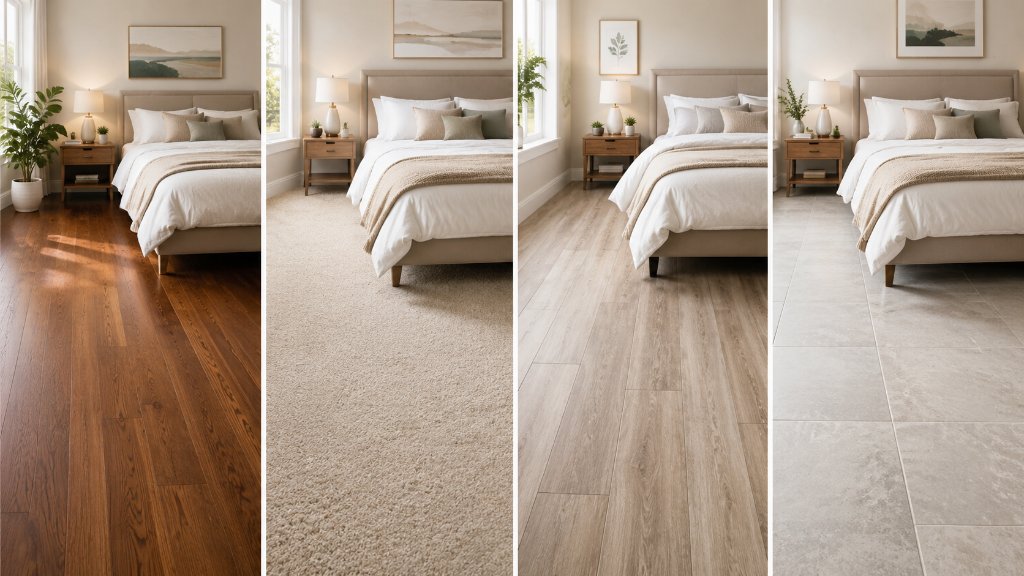
What Are the Four Types of Floors?
The four main types of floors are: (1) Hardwood flooring — solid wood or engineered wood with a real wood veneer; (2) Resilient flooring — LVP (luxury vinyl plank), sheet vinyl, and linoleum, characterized by flexibility and moisture resistance; (3) Soft surface flooring — carpet and cork, which absorb impact and sound; and (4) Stone and tile — ceramic, porcelain, and natural stone set in mortar. In Northern Virginia homes, the most common combination is hardwood or LVP on main living areas, carpet on bedroom levels and stairs, and tile in bathrooms and kitchens — one representative from each of the four categories.
Every flooring product you'll encounter — at a showroom, on a website, in a Floors and Beyond consultation — belongs to one of these four categories. The categories differ in their core construction, moisture tolerance, subfloor requirements, maintenance profile, and appropriate applications. Understanding them doesn't require knowing every product on the market; it requires knowing which category solves which problem.
In Northern Virginia, each category maps clearly to the housing stock. Hardwood dominates the pre-war and post-war home market in Arlington, Alexandria, and older Fairfax neighborhoods. Resilient LVP dominates the post-2000 concrete slab construction in Loudoun and Prince William counties. Soft surface carpet handles bedroom levels and stairs across all housing types. Stone and tile handles wet rooms throughout the region. The right combination — typically one from each relevant category — is what the rule of 3 in flooring is designed to produce.
The Four Types — Each Explained
Every flooring category with its defining characteristics, products, and Northern Virginia-specific context.
Hardwood flooring has a real wood surface — either solid wood throughout (3/4-inch solid hardwood) or a real wood veneer over a plywood or HDF cross-ply core (engineered hardwood). It is the only flooring category with a surface that can be sanded and refinished when it wears — extending the life of the floor by decades and allowing the color and finish to be updated without replacement.
Hardwood expands and contracts with seasonal humidity changes, which means it responds to Northern Virginia's wide summer-to-winter humidity swing with visible seasonal gapping in winter and closure in spring. White oak is the current first-choice specification for Northern Virginia's humidity because its tight grain structure minimizes seasonal movement. Solid hardwood cannot be installed on concrete slabs; engineered hardwood can after moisture vapor testing.
Resilient flooring is defined by its ability to flex and recover — it dents slightly under impact and returns to shape, unlike rigid hardwood or tile. The category includes LVP (luxury vinyl plank), sheet vinyl, and linoleum. LVP has become the dominant resilient product in the Northern Virginia market because its SPC (stone polymer composite) core variant is waterproof through the full thickness of the plank.
SPC LVP is the most commonly specified flooring product in Northern Virginia's post-2000 concrete slab housing stock — waterproof, dimensionally stable in humidity, appropriate for below-grade installations, and available in convincing hardwood-look and stone-look finishes. The surface is a photographic print under a clear vinyl wear layer — it can look exactly like hardwood but cannot be refinished when it eventually wears. Resilient flooring is replaced when it reaches the end of its wear layer life.
Soft surface flooring is defined by its ability to absorb impact and sound rather than transmit them. Carpet is the dominant soft surface product — it provides IIC acoustic insulation between floors that no hard flooring category can replicate, thermal warmth underfoot, and the most forgiving surface for knees and joints. Cork is the soft-surface alternative in hard flooring form — its cellular structure compresses approximately 10% underfoot, making it the most joint-friendly rigid flooring available.
Carpet specification requires attention to the fiber (nylon and triexta outperform polyester in Northern Virginia's active household conditions), the pad density (8-lb minimum for durability and cushioning), and the face weight. Budget carpet installed over a cheap pad will show wear and compression within two to three years; quality carpet on a quality pad maintains its appearance for ten or more years under normal residential use.
Stone and tile is defined by its rigidity, permanence, and moisture imperviousness. Porcelain tile — dense-bodied, low-porosity, fired at high temperature — is the dominant product in the category for Northern Virginia residential installations. Ceramic tile is appropriate for dry interior applications. Natural stone (marble, travertine, slate) is a premium option with specific maintenance requirements.
Tile requires a stable, non-deflecting substrate — concrete slabs are ideal; wood joist subfloors require a decoupling membrane (Schluter Ditra) to prevent tile cracking from subfloor deflection. This is the most installation-sensitive of the four categories: incorrect substrate preparation causes tile failure regardless of the tile quality. Floors and Beyond's subfloor assessment and decoupling membrane installation on wood joist floors is the preparation step that makes tile durable.
Which Type Is Right for Each Room in a Northern Virginia Home?
The subfloor type and room function together determine which flooring category is appropriate — and sometimes eliminate categories before aesthetic preference enters the conversation.
| Room / Location | Post-2000 Slab Home | Pre/Post-War Wood Joist | Notes |
|---|---|---|---|
| Main Level Living / Dining | Resilient (SPC LVP) | Hardwood | Slab requires waterproof core; wood joist supports hardwood nail-down |
| Kitchen | Resilient (SPC LVP) or Tile | Tile or Hardwood | Moisture and cleaning exposure favors waterproof surfaces |
| Bedrooms | Soft Surface (Carpet) | Soft Surface (Carpet) or Hardwood | Carpet provides acoustic and thermal comfort; hardwood viable on wood joist |
| Stairs | Soft Surface (Carpet) | Soft Surface (Carpet) | Safety, acoustics, and durability all favor carpet on stairs |
| Bathrooms | Stone and Tile | Stone and Tile | Only waterproof category appropriate for bathroom floors; DCOF 0.42+ required |
| Basement | Resilient (SPC LVP) | N/A — typically concrete | Below-grade installations require waterproof resilient; no hardwood, no laminate |
| Entry Hall / Mudroom | Stone and Tile or Resilient | Stone and Tile | Outdoor moisture, clay soil, road salt — waterproof and cleanable required |
| Laundry Room | Stone and Tile | Stone and Tile | Plumbing failure risk makes tile the only appropriate specification |
Not sure which flooring category is right for your Northern Virginia home and subfloor? Floors and Beyond's free shop-at-home consultation starts with the subfloor assessment that answers that question.
Schedule a Free ConsultationFrequently Asked Questions
What are the four types of floors?
The four main types of floors are: (1) Hardwood — solid wood or engineered wood with a real wood veneer, refinishable; (2) Resilient — LVP and vinyl, waterproof and flexible; (3) Soft surface — carpet and cork, impact-absorbing and acoustically insulating; and (4) Stone and tile — ceramic, porcelain, and natural stone, rigid and waterproof. In Northern Virginia homes, the most common combination uses one from each category: hardwood or LVP on main living areas, carpet on bedroom levels, and tile in wet rooms.
Which type of flooring is best for Northern Virginia homes?
It depends on the subfloor and the room. For main living areas in post-2000 concrete slab homes (Ashburn, Woodbridge, Loudoun County), resilient SPC LVP is the most appropriate — waterproof core handles moisture vapor from slabs. For pre-war and post-war homes on wood joist subfloors, hardwood is the correct main-level specification. Carpet (soft surface) is correct for bedroom levels and stairs throughout Northern Virginia. Stone and tile is correct for bathrooms, kitchens, and laundry rooms across all housing types.
What is the difference between hardwood and resilient flooring?
Hardwood has a real wood surface — solid or engineered veneer — that can be refinished when it wears. It responds to humidity seasonally and is not waterproof. Resilient LVP has a photographic print surface under a vinyl wear layer, a waterproof SPC core, and cannot be refinished. The key practical difference for Northern Virginia homeowners: resilient LVP is appropriate for concrete slab installations without moisture precautions; hardwood requires a wood joist subfloor (solid) or moisture testing (engineered) before installation on concrete.
// Free Consultation · Northern Virginia
Find the Right Flooring Category for Your Northern Virginia Home.
Floors and Beyond's subfloor assessment determines which categories apply — before samples are opened or budgets are discussed. Free shop-at-home consultations throughout Fairfax, Loudoun, Prince William, and Arlington. Since 1987.
Schedule a Free Consultation



