Water-Resistant
vs. Waterproof
Flooring:
What the Labels
Actually Mean.
The flooring industry uses "water-resistant" and "waterproof" interchangeably. They are not the same thing — and the difference matters enormously for Northern Virginia homes on concrete slabs.
What Is the Difference Between Water-Resistant and Waterproof Flooring?
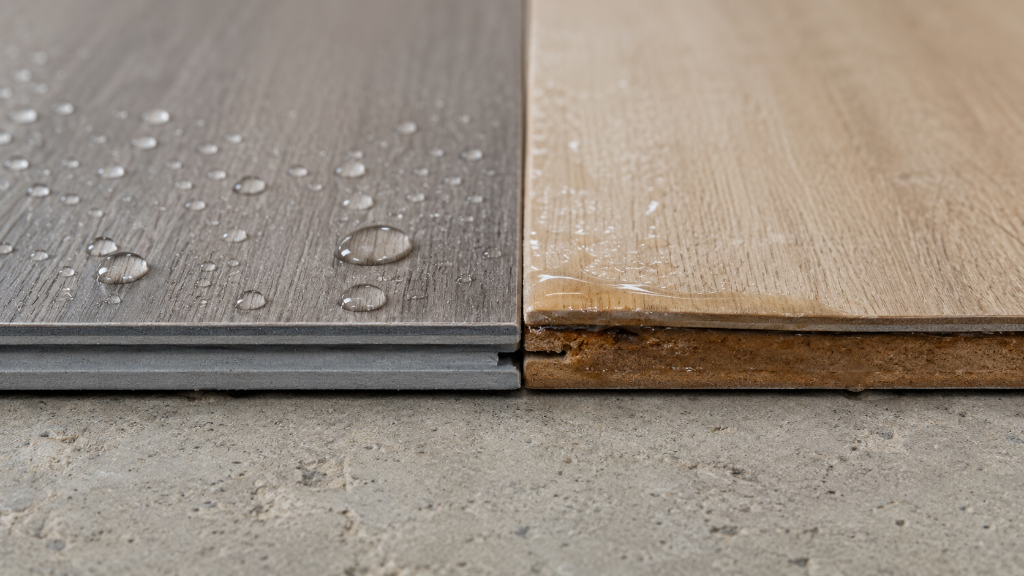
Water-resistant flooring can repel surface moisture for a limited time before water penetrates — the core will eventually absorb moisture if exposure continues or if moisture reaches the edges and seams. Waterproof flooring has a core that cannot be damaged by water regardless of exposure duration or volume. The distinction is not surface behavior — it is core construction. SPC LVP is genuinely waterproof because its stone-polymer composite core cannot absorb water. Most laminate and some WPC LVP is water-resistant at the surface only — the HDF or wood-composite core will swell with sustained moisture. For Northern Virginia homes on concrete slabs, where moisture vapor rises from below continuously, only truly waterproof flooring is the correct specification.
Walk through any Northern Virginia flooring showroom and you will see "waterproof" applied to products that are not waterproof in any meaningful sense — laminates with waterproof surface coatings over HDF cores that swell when moisture reaches the edges, WPC vinyl products with waterproof wear layers over wood-composite cores with real moisture vulnerability. The marketing language has outpaced the actual product performance, and the homeowner paying attention to the label rather than the core construction ends up with the wrong floor for their subfloor.
This distinction is more consequential in Northern Virginia than in most markets. Post-2000 construction in Loudoun, Prince William, and suburban Fairfax counties is predominantly concrete slab — and concrete slabs emit moisture vapor continuously, rising from below, regardless of whether water is ever spilled on the floor surface. A "water-resistant" floor that handles a spilled glass of wine will still fail on a concrete slab if the core cannot tolerate sustained moisture vapor from below. Only a genuinely waterproof core — not just a waterproof surface — is the correct specification for these homes.
The Three Tiers — Waterproof, Water-Resistant, and Neither
How Floors and Beyond categorizes flooring products by their actual moisture tolerance — based on core construction, not marketing language.
These products are waterproof through the full thickness of the plank or tile — not just at the surface. Standing water, moisture vapor from concrete slabs, and sustained humidity cannot penetrate or damage the core material. These are the only products Floors and Beyond specifies for Northern Virginia concrete slab main levels, basements, kitchens, laundry rooms, and any moisture-adjacent installation.
SPC LVP (Stone Polymer Composite): The core is made from stone powder and PVC — a rigid, completely waterproof composite that cannot absorb water. SPC is the correct waterproof specification for most Northern Virginia concrete slab installations. Wear layer thickness (20 mil minimum for residential primary living areas) determines durability; core waterproofness is consistent across all SPC products regardless of price point.
Porcelain tile: Dense, low-porosity (less than 0.5% water absorption), and genuinely waterproof. The correct specification for bathrooms, kitchens, laundry rooms, and entry halls. Requires a stable substrate and professional installation — grout joints must be sealed but the tile body itself is waterproof.
Water-resistant products can handle surface spills cleaned up promptly — they will not be damaged by a spilled drink that is wiped up within minutes. But the core will absorb moisture if water sits on the surface long enough to reach the edges and seams, or if moisture vapor rises from a concrete slab below. Water-resistant is a surface property, not a core property.
WPC LVP (Wood Plastic Composite): WPC has a waterproof vinyl wear layer and surface but a core that includes wood fiber — which has some moisture vulnerability, particularly at the edges where the core is exposed. WPC is softer and warmer underfoot than SPC but is not appropriate for below-grade or concrete slab installations where sustained moisture vapor is a concern. In dry above-grade wood joist applications, WPC performs well.
Engineered Hardwood: The real wood veneer surface and cross-ply core are more moisture-tolerant than solid hardwood, but engineered hardwood is not waterproof. It can handle low moisture vapor conditions on concrete slabs after testing, but cannot withstand standing water or elevated moisture vapor. Water-resistant in controlled conditions; not waterproof.
These products have HDF or wood cores that will swell, warp, or delaminate with sustained moisture exposure — from surface spills, from concrete slab moisture vapor, or from high-humidity environments. Some are marketed with "waterproof surface" language that refers only to the wear layer coating, not the core. The core is not waterproof. Floors and Beyond does not specify these products for Northern Virginia concrete slab installations, basements, kitchens, bathrooms, or laundry rooms.
Laminate (all HDF-core products): The surface aluminum oxide wear layer repels spills temporarily, but the HDF core swells when moisture reaches the edges and seams — or when moisture vapor migrates from a concrete slab below. "Waterproof laminate" is a marketing claim about the surface coating. The product is not waterproof.
Solid Hardwood: Not water-resistant. Wood absorbs moisture, swells, cups, and warps with any sustained moisture exposure. Not appropriate for kitchens, bathrooms, or any below-grade or concrete slab installation.
Product-by-Product Breakdown for Northern Virginia
The complete moisture rating for every common flooring product — and where each is appropriate in Northern Virginia's housing stock.
| Product | Core Material | True Moisture Rating | Concrete Slab OK? | Basement OK? |
|---|---|---|---|---|
| SPC LVP | Stone polymer composite (PVC + limestone) | ✓ Waterproof — core cannot absorb water | ✓ Yes | ✓ Yes |
| Porcelain Tile | Dense fired clay (<0.5% water absorption) | ✓ Waterproof — core is non-porous | ✓ Yes | ✓ Yes |
| Ceramic Tile | Fired clay (3–7% water absorption) | ⚠ Water-resistant — some porosity; dry interior only | ⚠ Dry areas only | ⚠ Dry areas only |
| WPC LVP | Wood-plastic composite core | ⚠ Water-resistant surface; core has wood fiber vulnerability | ✗ Not recommended | ✗ Not recommended |
| Engineered Hardwood | Real wood veneer + plywood or HDF cross-ply | ⚠ Water-resistant in low-moisture conditions only | ⚠ After moisture vapor test only | ✗ Not recommended |
| Laminate | HDF (high-density fiberboard) | ✗ Water-resistant surface only — core swells with moisture | ✗ No | ✗ No |
| Solid Hardwood | Solid wood throughout | ✗ Not water-resistant — absorbs moisture, cups, warps | ✗ No | ✗ No |
Northern Virginia Concrete Slab Note
Most Northern Virginia homes built after 1990 — the colonials, townhomes, and condos in Ashburn, Woodbridge, Herndon, Sterling, Leesburg, and suburban Fairfax — are on concrete slabs. Concrete slabs do not need to flood to damage water-vulnerable flooring. They emit moisture vapor continuously upward. Over months and years, this sustained low-level moisture vapor will swell laminate HDF cores and can affect WPC LVP and engineered hardwood cores even in the absence of any visible water event. SPC LVP is the standard Floors and Beyond specification for Northern Virginia concrete slab main levels because its core cannot be affected by moisture vapor regardless of slab emission level.
Not sure which flooring is genuinely waterproof enough for your Northern Virginia home? Floors and Beyond provides free subfloor assessment and product specification throughout Fairfax, Loudoun, Prince William, and Arlington.
Schedule a Free ConsultationFrequently Asked Questions
What is the difference between water-resistant and waterproof flooring?
Water-resistant flooring repels surface moisture for a limited time before water penetrates the core — typically through edges and seams or via moisture vapor from below. Waterproof flooring has a core that cannot be damaged by water regardless of exposure duration. SPC LVP is genuinely waterproof because the stone-polymer composite core cannot absorb water. Most laminate is water-resistant at the surface only — the HDF core swells with sustained moisture. For Northern Virginia concrete slab homes, where moisture vapor rises from below continuously, only genuinely waterproof flooring (SPC LVP or tile) is the correct specification.
Is laminate flooring waterproof?
No. Laminate flooring is not waterproof — it is water-resistant at the surface only. Laminate has an HDF core that swells and deteriorates when moisture penetrates through the surface seams or migrates from below. Some laminate products use "waterproof" language that refers only to the surface wear layer, not the core. This is why laminate is not appropriate for concrete slab installations in Northern Virginia — concrete slabs emit moisture vapor continuously, and the laminate's HDF core will eventually fail even without any visible water event.
What is the most waterproof flooring for Northern Virginia homes?
SPC LVP is the most waterproof flooring option for Northern Virginia homes — its stone-polymer composite core cannot absorb water, making it appropriate for concrete slab installations, basements, kitchens, and laundry rooms without moisture precautions. Porcelain tile is also genuinely waterproof but requires a stable substrate and professional installation. Floors and Beyond specifies SPC LVP with a 20 mil wear layer as the standard waterproof flooring specification for Northern Virginia concrete slab main levels and any room where moisture is a factor.
Does Floors and Beyond install waterproof flooring in Northern Virginia?
Yes. Floors and Beyond installs SPC LVP and porcelain tile — the two genuinely waterproof flooring specifications — throughout Northern Virginia, including Fairfax, Loudoun, Prince William, and Arlington counties. All installation is by in-house crews only. Free shop-at-home consultations include subfloor assessment, moisture evaluation where concrete is present, product selection guidance, and written estimates at no charge.
// Free Consultation · Northern Virginia
Get the Flooring Specification That's Actually Right for Your Subfloor.
Floors and Beyond assesses your subfloor, identifies the correct moisture specification for your home, and provides a written estimate — at no charge. In-house crews throughout Fairfax, Loudoun, Prince William, and Arlington. Since 1987.
Schedule a Free Consultation