
Vienna Cape Cods:
Matching Original
1948 Oak With
Modern Finishes.
Heritage match without the Disney-fied look. The stain mixing approach that respects what these boards actually are — and what they've been through.
Red Oak Core
Finish
Layers
Stain +
Finish
Target
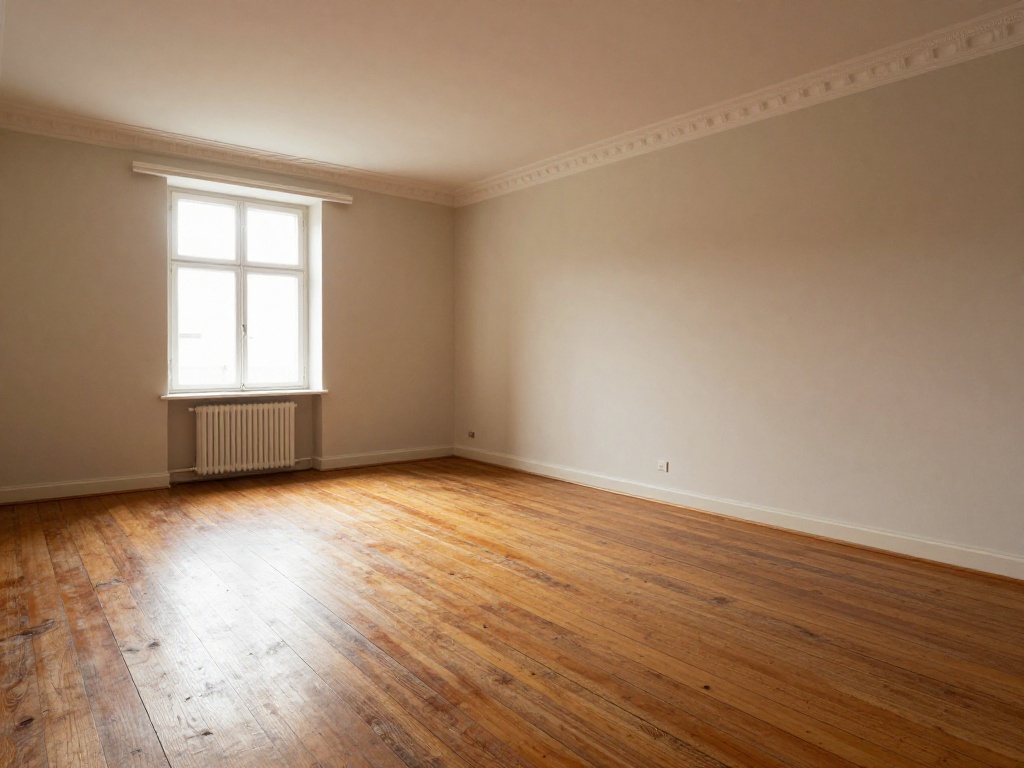
There is a specific look that happens when a contractor applies modern stain straight from the can to a 1948 Vienna Cape Cod floor. Floors and Beyond has a name for it: the Disney-fied floor. It's too even, too bright, too obviously new. The color doesn't sit in the wood — it sits on top of it, like a stain applied to furniture at a big-box store. Every grain line disappears into a uniform wash. The floor looks like it belongs in a new construction showroom, not in a house that predates the Korean War. And then the homeowner looks at it and knows, without being able to articulate exactly why, that something is wrong.
What went wrong is material science. The 1948 red oak under the carpet of a Vienna Cape Cod is not the same material as the red oak at the lumber yard. It was milled from old-growth forest. It has been through 75 winters and 75 summers of Northern Virginia humidity cycles. It has absorbed decades of shellac, varnish, oil-based polyurethane, and the residue of every cleaning product that's ever touched its surface. Applying a modern stain to this wood without understanding these conditions produces the Disney-fied result — because the stain is formulated for fresh wood, not for wood that has lived three-quarters of a century.
Floors and Beyond has been working in Vienna for nearly 40 years. The Cape Cods on Church Street, the houses around Vienna Community Center, the neighborhoods that grew up alongside Maple Avenue in the late 1940s and early 1950s — we know these floors. This guide explains what we know and how we approach them.
What Makes 1948 Vienna Oak Different
The distinction between 1948 old-growth red oak and modern-milled red oak is not subtle — it's fundamental. Understanding it is the prerequisite for any successful work on these floors.
Old-growth red oak grew slowly over 100–200 years before harvest. The tight annual rings produce wood of significantly higher density than modern fast-grown lumber. The grain is closer, the pores are smaller in proportion, and the overall hardness is measurably greater. Decades of site-applied finishes — shellac in the late 1940s, oil-based varnish in the 1950s–60s, early polyurethane in the 1970s–80s — have penetrated the pores and changed how the wood absorbs new material. This is not a problem. It is a characteristic that must be understood and worked with.
Modern-milled red oak grows quickly — 30 to 50 years from sapling to harvest in managed forests. The annual rings are wider, the grain is more open, and the pores accept stain more readily and more evenly. Modern stain products are formulated and calibrated to the absorption characteristics of this faster-grown wood. When applied to the denser, more saturated 1948 oak in a Vienna Cape Cod, the stain behaves differently — it sits on the surface rather than penetrating uniformly, it reads as flat and artificial, and the natural character of the old-growth grain disappears.
The Disney-fied result is not caused by bad products or poor technique applied correctly. It's caused by correct products applied to the wrong material assumption. The contractor who produces a Disney-fied floor on a 1948 Vienna Cape Cod is not incompetent — they're simply working from a modern material assumption on a historic material. The fix is not a better product. It's a different approach.
What the Disney-fied floor looks like in practice: uniform color with no depth variation, grain lines that disappear into the stain color rather than being enhanced by it, a brightness that reads as obviously new against the home's 1948 architectural character, and a finish that says showroom rather than Cape Cod. Every Vienna homeowner who has experienced this knows the specific feeling of disappointment it produces.
The Stain Mixing Approach That Works
The solution to the Disney-fied problem is not a single premium stain product — it's a mixing and layering approach that accounts for the specific absorption characteristics of 1948 old-growth oak and produces color with depth and variation rather than flat uniformity. Here is the Floors and Beyond process for Vienna Cape Cod floors.
No two 1948 Vienna floors are identical. Before any stain decision, Floors and Beyond reads the specific boards: how much material remains, how many previous refinishes have occurred, what the dominant grain character is, and how the existing pore saturation is distributed. A floor that was refinished twice in the 1970s and once in 1995 has different pore saturation than a floor that was last touched in 1962. This assessment happens before any product is selected.
The most important step that most contractors skip: after sanding to bare wood, the floor must be opened to accept stain uniformly. On 1948 old-growth oak with decades of finish history, this means a light wash with a penetrating conditioner that displaces the residual oils and creates a more consistent absorption surface. Without this step, stain absorbs unevenly — darker in the more open areas of the grain, lighter in the denser sections — producing the blotchy, artificial result. With it, the stain has a consistent surface to work with.
On 1948 oak that has been prepared correctly, Floors and Beyond typically applies a very light base coat — often a diluted warm-toned stain at 10–20% of normal concentration — before the primary stain color. This base coat opens the dialogue between the stain and the wood's natural color, preventing the modern-stain-on-old-wood shock that produces the Disney-fied result. It gives the primary stain color something warm and natural to sit on top of, producing depth rather than flatness.
The primary stain color for a 1948 Vienna Cape Cod is almost never a single product straight from the can. Floors and Beyond mixes primary stain colors — typically combining a contemporary color with a warming agent or a lightening medium — to arrive at a color that looks appropriate for the era without being a literal reproduction. A contemporary warm gray mixed with 15% golden oak produces a color that reads as modern and updated but sits in the 1948 oak without fighting it. A dark walnut cut with 20% natural produces a rich tone that enhances the old-growth grain rather than covering it. The ratio is specific to each floor and each target color.
Every stain mix is tested on a section of the actual floor — not on a sample board, not on a similar species — before the project proceeds. Vienna homes have specific light conditions: the mature tree canopy along many Vienna streets filters natural light in ways that affect stain color, and the orientation of a Cape Cod (south-facing kitchen versus north-facing living room) affects how the same color reads in different rooms. Floors and Beyond tests in multiple locations and assesses in both natural and artificial light before the homeowner approves the color and the project proceeds.
The finish coat over a stained 1948 Vienna floor completes the result. Sheen selection is as important as stain color in achieving a heritage-authentic outcome. Water-based polyurethane in matte or satin sheen is the correct specification — it preserves the stain color without adding amber warmth, and the lower sheen level allows the grain character of the old-growth oak to read clearly rather than being obscured by reflective gloss. Oil-based finish, despite its historical use in the 1940s and 50s, is not recommended on stained floors because its amber tone shifts the carefully mixed stain color.
Which Stain Colors Work on 1948 Vienna Oak — and Which Don't
Finish Sheen: The Final Detail That Makes or Breaks It
Sheen selection is the most frequently underestimated decision in a historic floor restoration. The same stain color can look completely different under flat, matte, satin, semi-gloss, or high-gloss finish — and the wrong sheen choice can undo the careful work of stain mixing and grain preparation.
The most historically sympathetic sheen for a 1948 Cape Cod. No reflective quality — pure wood surface. Shows grain depth maximally. Hardest to maintain as it shows every scuff. Appropriate for homeowners prioritizing authenticity over practicality.
Floors and Beyond's primary recommendation for Vienna Cape Cods. Low reflectivity, excellent grain character preservation, and more practical than flat finish. The default specification for heritage-authentic results with real-world maintenance capability.
The midpoint between modern practicality and heritage character. Slightly more reflective than matte — acceptable for Vienna Cape Cods and appropriate when the homeowner wants a more maintained appearance. Still within the range of historically sympathetic.
Begins to read as obviously contemporary on 1948 floors. The reflective quality flattens the grain character that old-growth oak creates. Shows scratches more dramatically. Not appropriate for heritage restoration work.
The fastest path to the Disney-fied result. High gloss makes every floor look like a department store showroom, regardless of how carefully the stain was mixed. Not appropriate for any historic floor restoration. The 1940s and 50s used wax and shellac for sheen — nothing approaching modern high gloss.
Vienna, Virginia: The Specific Context These Floors Live In
Vienna's mature street trees — particularly the canopy along Church Street, Maple Avenue, and the established neighborhoods around the Vienna Community Center — filter natural light in ways that affect stain color. Floors that look warm and appropriate in midday winter light can read differently under dappled summer canopy. Floors and Beyond assesses light conditions in multiple seasons before final color approval.
Vienna's 1948 Cape Cods typically have lower ceiling heights on the main level — 8 feet or slightly below — than contemporary homes. This ceiling-to-floor relationship affects how reflective finishes read. A satin finish that might read appropriately in a room with 9-foot ceilings can feel visually busy in a Cape Cod's proportions. Matte finish is more appropriate at this scale.
Most 1948 Vienna Cape Cods were floored with 2-1/4 inch narrow-strip red oak — the standard of the era. This width creates a specific visual rhythm that contrasts with the wide-plank floors currently fashionable in new construction. Rather than fighting this character, Floors and Beyond works with it — the narrow strip becomes part of the heritage authenticity when finished correctly.
Vienna sits in Fairfax County's most established residential fabric. The real estate market for Vienna Cape Cods rewards authenticity — buyers who seek these homes are often specifically attracted to their historic character. A Disney-fied floor refinish that erases the home's era authenticity is not just aesthetically wrong; it's a market position error. Heritage-sympathetic restoration protects and enhances the property's distinctive character.
From the Field · Vienna
“We've been called into Vienna Cape Cods after other contractors produced the Disney-fied result — to sand it back and start over. The correction costs more than the original job. The homeowners always say the same thing: 'I knew something was wrong the moment I saw it, but I couldn't explain why.' The explanation is material science. The prevention is working with someone who knows these specific floors.”
Floors and Beyond assesses 1948 Vienna oak, mixes stain on your specific boards, and tests in your specific light. Free consultation.
Book a Free AssessmentFrequently Asked Questions
Can I change the stain color on a 1948 Vienna Cape Cod floor significantly — going lighter or darker?
Going darker is straightforward — additional pigment depth covers existing tone reliably. Going lighter on 1948 old-growth oak is more challenging. The wood's natural warmth and the residual oils from decades of historic finishing resist lightening more than modern oak does. Significant lightening — from a medium brown to a near-natural tone — may require wood bleaching after sanding, which is a specific process that Floors and Beyond evaluates case by case. Full whitewash or blonde finishes are not recommended on 1948 Vienna oak for both technical and aesthetic reasons.
How much material remains on a typical 1948 Vienna floor that's been refinished before?
A floor that was site-finished in 1948 and refinished once or twice in subsequent decades typically has significant material remaining — the original 3/4 inch thickness minus 1/16 inch per refinish, minus some from the original site finishing. Most Vienna Cape Cod floors that Floors and Beyond assesses have enough material for one to two more professional refinishes. We measure at floor registers before recommending any approach and will tell you honestly if remaining material is insufficient for a full drum sand — in which case a lighter screen-and-recoat approach extends the floor's life without risking the structural boards.
Should I try to match the original 1948 floor color exactly?
Not necessarily — and exact matching is often not possible. The original 1948 finish was shellac or an early varnish that has long since been refinished over, and the color it produced is no longer accessible through the current wood surface. More productively: aim for a color that is era-sympathetic rather than era-identical. A warm honey or natural tone that reads as appropriate for a 1948 Cape Cod is achievable and aesthetically correct without requiring an impossible exact match to a 78-year-old original finish.
How do I know if my Vienna floor has been stained before versus left natural?
Sand a small section in an inconspicuous area — inside a closet, under a threshold — and examine the bare wood. Natural old-growth oak has a specific warm honey color that is distinctly different from the color of stained wood. If sanding reveals wood that matches the overall floor color, the floor may be natural-finish. If sanding reveals notably lighter, warmer wood than the finished surface shows, a stain was applied at some point. Floors and Beyond makes this assessment during every Vienna Cape Cod consultation — it affects the stain mixing approach and the color target significantly.
// Vienna, Virginia · Heritage Floor Assessment
Let Floors and Beyond Read
Your 1948 Boards
Before Anyone Touches Them.
Free in-home assessment. Stain mixed and tested on your actual floor. No commitment until you approve the color. Serving Vienna and all of Fairfax, Loudoun, Prince William, and Arlington since 1987.
Book a Free Assessment



