
Can You Install LVP
Over Existing Tile,
Hardwood, or Concrete?
A NoVA Subfloor Guide.
The "do I need to rip everything out first?" question, answered by subfloor type — with the NoVA slab and basement moisture caveat most national guides skip.
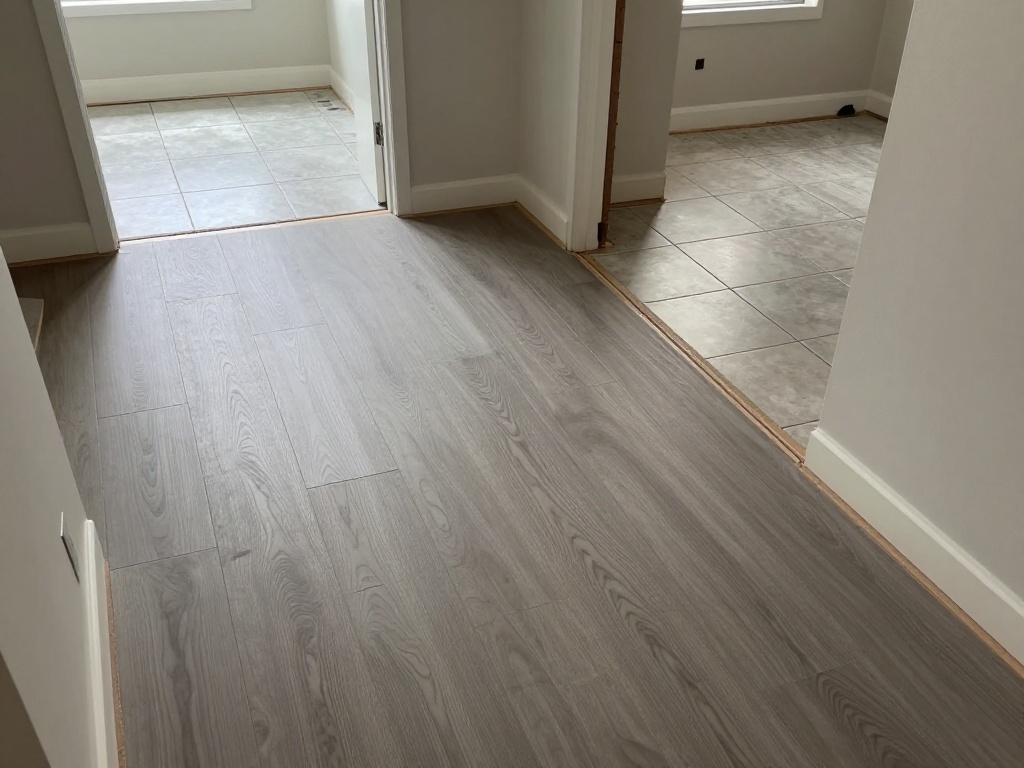
- Existing tile: Usually yes, if it's fully adhered with no hollow spots and the floor is flat within 3/16 inch over 10 feet — no demolition needed in most cases.
- Existing hardwood: Usually yes, with the same flatness standard, plus a check that the hardwood itself isn't actively cupping or showing active moisture issues.
- Concrete slab above grade: Structurally usually fine, but requires a moisture vapor emission test before installation — this is the step most national guides skip and most NoVA homeowners have never heard of.
- Basement concrete: Requires moisture testing every time, no exceptions — Northern Virginia's clay-heavy soil and high water table create elevated below-grade moisture vapor emission rates compared to drier-climate regions most national guides are written for.
- The three tests that matter for any subfloor: Flatness (3/16" in 10 feet maximum), structural soundness (no movement, no hollow spots), and moisture (the one most commonly skipped).
- What happens if you skip moisture testing: Trapped moisture under sealed SPC flooring can lead to mold growth, adhesive failure, and manufacturer warranty voidance — consequences that cost far more than the test itself.
The question Floors and Beyond hears more than almost any other LVP question: "Do I have to tear out my existing floor first?" The honest answer is almost always no for tile and hardwood, and almost always "test first" for concrete — and that second answer is where most national flooring guides stop being useful for a Northern Virginia home specifically. The moisture testing requirement isn't a regional quirk invented for this guide; it's standard manufacturer installation specification that becomes more consequential in this region's soil and water table conditions than in drier parts of the country most generic content is written for.
This guide walks through each common existing subfloor — tile, hardwood, and concrete (both above-grade and basement) — using the same three-factor test, and explains specifically why Northern Virginia homeowners need to take the moisture step seriously even when a national guide or a less careful installer tells them it's optional.
What Three Tests Determine Whether LVP Can Go Over Any Existing Subfloor?
Flatness, structural soundness, and moisture are the three tests that determine LVP overlay suitability regardless of what the existing subfloor material is — and the moisture test is the one most frequently skipped, particularly on concrete subfloors.
Most LVP manufacturers specify a maximum deviation of 3/16 inch over a 10-foot span (some premium rigid-core products allow slightly more). A subfloor with humps, dips, or unevenness beyond this tolerance will cause the LVP's locking joints to flex and eventually fail, or create visible and audible hollow spots underfoot. This is checked with a long straightedge or laser level across the room before any installation decision is finalized.
The existing surface must be fully secured with no movement, no hollow-sounding spots (which indicate disbonded tile or delaminating layers beneath), and no loose boards or fasteners. A tap test across the floor with a hard object identifies hollow spots in tile; a walk-through identifies movement or squeak in hardwood. Any unsound area typically needs localized repair before LVP installation, even if the rest of the floor passes.
Concrete subfloors — especially those in contact with the ground, like slabs and basement floors — continuously emit water vapor from below, even when the surface looks and feels completely dry. Installing a moisture-impermeable LVP product over a slab with excessive vapor emission traps that moisture, leading to adhesive failure, mold growth, or warranty voidance. This is the test almost every national flooring guide mentions briefly and almost every homeowner skips, and it's the test this guide treats as mandatory for any concrete subfloor in Northern Virginia.
Can You Install LVP Directly Over Existing Tile?
Yes, in most cases — existing tile that is fully adhered, free of hollow spots, and flat within tolerance is one of the most LVP-friendly subfloors available, since the rigid tile surface already provides excellent structural stability.
Tile floors are typically excellent LVP overlay candidates. The hard, stable surface already meets the structural soundness requirement in most cases, and tile installations are rarely uneven beyond LVP's flatness tolerance unless there's an underlying subfloor problem.
- Tap test across the full tile surface — any hollow sound indicates disbonded tile that needs repair or removal in that section
- Check for cracked or missing tiles, which can indicate movement beneath that should be addressed first
- Measure existing grout line depth — deep grout lines (more than 1/8") may need a skim coat for a flatter transition surface, especially for rigid-core LVP products
- Confirm the tile is not over a failed or moisture-compromised subfloor — if the tile itself was installed over a problem area, that problem doesn't go away under new LVP
Can You Install LVP Directly Over Existing Hardwood?
Yes, in most cases — existing hardwood that is structurally sound, flat, and not actively experiencing moisture-related movement is a viable LVP subfloor, though the existing finish should be assessed for adhesion if a glue-down LVP product is being considered.
Hardwood floors in good structural condition provide a stable, flat surface for most floating LVP installations. The key consideration specific to hardwood is verifying the wood itself isn't in active moisture distress — installing over actively cupping or gapping hardwood means building on top of an existing problem rather than a stable base.
- Check for active cupping, crowning, or excessive gapping, which indicates the hardwood is currently experiencing moisture movement that should be resolved first
- Confirm no loose boards or squeaking that indicates subfloor fastening issues beneath the hardwood itself
- For floating LVP installations (the most common approach over hardwood), flatness matters more than adhesion — measure across the room with a straightedge
- For glue-down LVP over hardwood, the existing finish must be properly prepped (typically lightly sanded) for adhesive bond, which is a less common approach over existing hardwood than floating installation
Can You Install LVP Over a Concrete Slab — and Why Does Northern Virginia Make This More Complicated?
Structurally, concrete slabs are usually fine for LVP installation, but Northern Virginia's clay-heavy soil and elevated water table mean moisture vapor emission testing is not optional here the way it might be treated as a formality in drier-climate regions — skipping this step carries real consequences in this specific region.
⚠ The NoVA Moisture Caveat Most National Guides Skip
Most national LVP installation guides mention moisture testing as a brief checklist item, almost as an afterthought, because in many parts of the country with sandy or well-drained soil, slab moisture vapor emission rates run low enough that the test frequently passes without issue. Northern Virginia's soil profile is different — clay-heavy soil across Fairfax, Loudoun, Prince William, and Arlington Counties drains more slowly than sandy soil, and combined with the region's naturally higher water table in many areas, slab and basement concrete here often run measurably higher moisture vapor emission rates than the national average the generic guides are written for.
This doesn't mean concrete subfloors in NoVA are unusable for LVP — it means the test is the determining factor, not a formality, and it should never be skipped or assumed based on how dry the slab looks or feels on the surface. A slab can look and feel bone dry while emitting moisture vapor well above safe installation thresholds from below.
| Moisture Test Method | What It Measures | Typical Cost |
|---|---|---|
| Calcium Chloride Test (ASTM F1869) | Moisture vapor emission rate (lbs per 1,000 sq ft per 24 hrs) over a 60-72 hour test period | $75–$150 per test location |
| In-Situ RH Probe Test (ASTM F2170) | Relative humidity within the concrete slab itself, generally considered the more accurate modern standard | $100–$200 per test location |
| Surface Moisture Meter (preliminary only) | Surface-level moisture indication — useful as a quick screening tool but not a substitute for the lab-grade tests above | Often included free in initial assessment |
- Above-grade slabs (main level on slab foundation): Generally lower risk than basement concrete, but still warrant testing in Northern Virginia given regional soil conditions — particularly in homes without a properly functioning vapor barrier beneath the original slab pour
- New slab pours: Concrete continues releasing moisture for months to years after pouring — a slab poured within the last 6-12 months needs testing regardless of how dry it appears, as cure-related moisture emission is often higher than long-term steady-state emission
- SPC LVP with a built-in moisture barrier: Some premium SPC products include an integrated moisture barrier layer that provides additional protection, but manufacturers still specify maximum allowable slab moisture levels even with these products — the built-in barrier reduces risk, it doesn't eliminate the need to test
Can You Install LVP in a Basement on Concrete?
Yes, but moisture testing is mandatory every time — basement concrete sits closest to the water table and soil moisture of any subfloor type in a Northern Virginia home, making it the highest-priority test location in this entire guide.
What Happens If You Skip the Moisture Test in a Basement
Installing moisture-impermeable LVP over a basement slab with excessive vapor emission traps water vapor between the slab and the flooring. Over months, this creates conditions for mold and mildew growth beneath the floor — invisible until the smell or a flooring failure reveals it. Adhesive bonds in glue-down installations can fail, causing the floor to lift or shift. Most LVP manufacturer warranties explicitly require moisture testing documentation as a condition of warranty coverage; skipping the test means any future moisture-related failure is the homeowner's cost to bear, not the manufacturer's or installer's.
The cost of the test itself — typically $75-200 per location — is consistently smaller than the cost of removing failed flooring, addressing mold remediation, and reinstalling once a skipped test results in a real problem.
How Do You Know If Your Contractor Is Actually Testing or Just Saying Yes?
Ask for the specific test method (calcium chloride or RH probe) and request written documentation of the result — a contractor who can't name the test or produce a number is likely skipping it, regardless of verbal reassurance that "it'll be fine."
- Ask directly: "What moisture test will you perform on the concrete, and what's the pass/fail threshold?" A contractor familiar with proper installation practice will name ASTM F1869 or F2170 and a specific number without hesitation
- Request the test result in writing before installation begins — this protects you if a moisture-related issue arises later and becomes a manufacturer warranty question
- Be skeptical of "it looks dry, we don't need to test" as a final answer — visual and tactile dryness checks are not a substitute for the lab-grade tests, and a slab can look completely dry while failing the actual standard
- Understand that a failed moisture test isn't necessarily a dead end — it usually means a moisture mitigation product (an epoxy or polyurethane moisture barrier coating) needs to be applied to the slab before installation, which is a normal and addressable step, not a project-ending problem
Does Installing LVP Over an Existing Floor Change Door Clearances and Transitions?
Yes — overlay installation adds the height of the new LVP plus underlayment on top of the existing surface, which can affect door swing clearance, transition heights to adjacent rooms, and appliance fit, and should be measured before committing to an overlay approach.
For most overlay installations, the added height is modest enough that interior doors continue to clear the floor without trimming, but it's worth checking specifically at exterior doors (where weatherstripping clearance is tighter), at the base of stairs, and at transitions into rooms with a different existing flooring type that won't be touched. Refrigerators and other built-in appliances on rollers occasionally need adjustment after an overlay installation raises the floor height even by a small amount.
From Floors and Beyond
"The overlay question always comes back to the same three things: is it flat enough, is it solid enough, and is it dry enough. Tile and hardwood usually pass the first two without much drama. Concrete is where the third question — moisture — actually matters, and it's the question most homeowners don't know to ask until we bring it up."
Floors and Beyond assesses your existing subfloor — flatness, structure, and moisture testing where needed — before recommending LVP installation.
Book a Free Subfloor AssessmentFrequently Asked Questions About LVP Over Existing Subfloors
Can I install LVP over existing carpet?
No — carpet is not an appropriate subfloor for LVP installation under any circumstances. Carpet's compressibility means it cannot provide the firm, stable base LVP's locking joints require, and the existing carpet and pad should always be fully removed before any hard-surface flooring installation, including LVP. This applies regardless of carpet condition or pad quality.
My basement slab feels completely dry. Do I really still need to test it?
Yes. Concrete slab moisture vapor emission occurs from below the surface and is frequently undetectable by touch or visual inspection — a slab can feel and look bone dry on the surface while emitting moisture vapor well above the threshold LVP manufacturers specify as safe. This is precisely why the test exists as a standard practice rather than a visual judgment call, and it's especially important in Northern Virginia given the region's clay soil and water table characteristics discussed in this guide. Skipping the test based on a dry feel is one of the most common causes of basement LVP failures Floors and Beyond is called in to address.
What happens if my concrete fails the moisture test? Does that mean I can't install LVP?
Not necessarily. A failed moisture test typically means a moisture mitigation step is needed before installation — most commonly an epoxy or polyurethane-based moisture barrier coating applied directly to the slab, which seals the surface against the vapor emission and brings the effective moisture condition within an acceptable range for LVP installation. This adds a step and cost to the project but is a normal and addressable part of many Northern Virginia basement and slab LVP installations rather than a project-ending result.
Is the flatness requirement the same for all types of LVP?
Generally similar across most LVP products — the common standard is 3/16 inch deviation over a 10-foot span — but some premium rigid-core SPC products with thicker, more dimensionally stable cores tolerate slightly more variation than thinner or more flexible products. Always check the specific manufacturer's installation specification for the product being installed rather than assuming a universal number, since exceeding the actual product's tolerance can cause locking joint failure or visible flexing even if the floor seems acceptable by a more general rule of thumb.
How long does subfloor assessment and moisture testing take before installation can start?
The flatness and structural soundness checks are typically completed during the initial in-home assessment, often the same visit. Moisture testing has a built-in waiting period — the calcium chloride test (ASTM F1869) requires a 60-72 hour test window to produce an accurate reading, while RH probe testing (ASTM F2170) also requires a multi-day equilibration period inside the drilled test hole. For any project involving concrete subfloor moisture testing, plan for the test itself to add roughly 3-4 days to the project timeline before installation can begin — this is a worthwhile trade against the cost and disruption of a moisture-related failure after installation.
// Free Subfloor Assessment · Northern Virginia
Find Out If Your Floor
Can Stay Where It Is
Before You Commit to LVP.
Floors and Beyond checks flatness, structure, and moisture — including proper testing on any concrete subfloor — before recommending an installation plan. Serving Fairfax, Loudoun, Prince William, and Arlington since 1987.
Book a Free Subfloor Assessment



