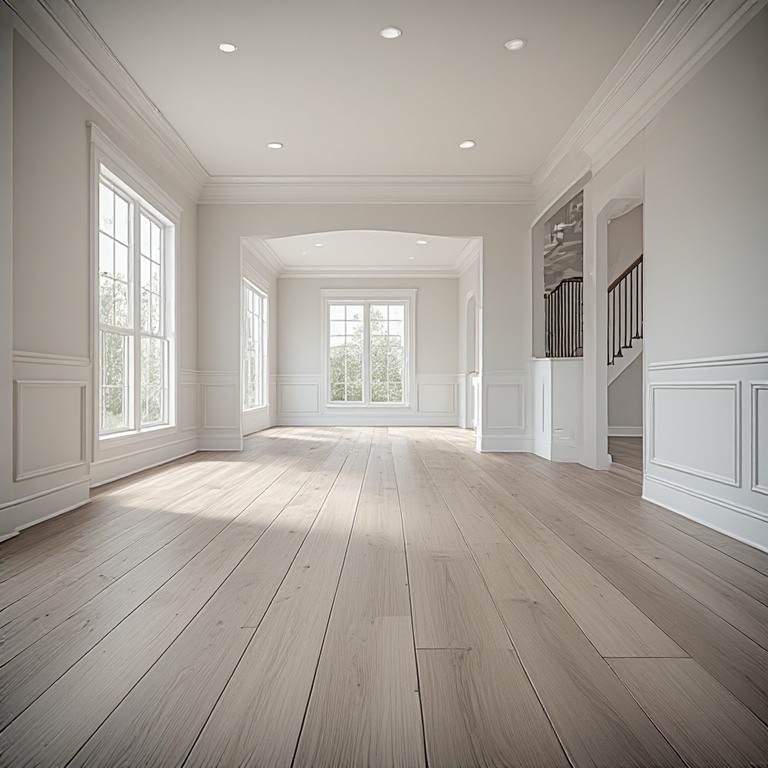

Luxury Vinyl Plank Review · Northern Virginia
Luxury Vinyl Plank Review: A Field-Tested Assessment for Northern Virginia Homes
A review of luxury vinyl plank from a NoVA flooring company that has installed it across hundreds of slab homes in Ashburn, Woodbridge, Herndon, and Sterling — and that does not recommend it for every home. The honest review is shorter than the marketing one.
Luxury vinyl plank (LVP) is a recommended flooring choice for Northern Virginia homes on concrete slabs (post-2000 Ashburn, Woodbridge, Herndon, Sterling) when specified as SPC LVP with a minimum 20-mil wear layer, 5mm total thickness or greater, and a waterproof core. LVP performs well in the NoVA climate because the waterproof core handles the humidity swing and concrete moisture without absorbing moisture. LVP is not recommended for primary living areas on wood joist subfloors (pre-war Del Ray, Old Town Alexandria, Clarendon; post-war Burke, Springfield, Fairfax) where solid hardwood is eligible and outperforms LVP. LVP is also recommended for basements, mudrooms, and below-grade spaces regardless of subfloor type. In-house crews, no subcontractors, since 1987.
The Review Framework
A review of luxury vinyl plank from a Northern Virginia flooring company should be honest about what LVP does well and what it does poorly. The marketing reviews — the ones that rank LVP against hardwood without mentioning the subfloor — are not useful for NoVA homeowners. The honest review starts with the subfloor and works outward to the climate, the use case, and the specification.
Floors and Beyond VA has installed LVP across hundreds of slab homes in Ashburn, Woodbridge, Herndon, and Sterling. The company has also refused to install LVP in pre-war and post-war homes where the original hardwood was restorable. The review framework is subfloor-first: solid hardwood on wood joist subfloors, SPC LVP on concrete slabs. Within each subfloor category, the specification determines whether the LVP performs well or fails.
The honest review conclusion is that LVP is a good product when matched to the right subfloor and specified correctly. It is a poor product when installed on the wrong subfloor or specified carelessly. The product is not the variable — the application is.
Performance on Concrete Slabs
On concrete slabs in post-2000 NoVA homes — Ashburn, Woodbridge, Herndon, Sterling — SPC LVP performs well. The waterproof core handles the concrete moisture vapor transmission without absorbing moisture, which is the structural advantage that makes LVP eligible on slabs where solid hardwood is not. The dimensional stability of the rigid SPC core prevents the floor from cupping or gapping with the NoVA humidity swing. The floating installation means no acclimation period, which makes LVP faster to install than engineered hardwood.
The performance is consistent across the post-2000 NoVA market. Floors and Beyond VA has installed SPC LVP in Ashburn townhouses, Woodbridge single-family homes, Herndon townhomes, and Sterling condos. The product performs well when the specification is correct (20-mil wear layer, 5mm total thickness, SPC core) and the subfloor is properly prepared. The product fails when the specification is wrong (low wear layer, WPC instead of SPC) or the subfloor is not prepared.
The honest review of LVP on slabs is positive. The product does what it is designed to do. The failures Floors and Beyond VA has seen in the field have been the result of poor specification or poor installation, not poor product performance.
Performance on Wood Joist Subfloors
On wood joist subfloors — pre-war Del Ray, Lyon Village, Waverly Hills, Rosemont, Old Town Alexandria, Seminary Hill, Clarendon, and post-war Burke, Springfield, Fairfax — LVP is not recommended for primary living areas. Solid 3/4" white oak is eligible and outperforms LVP over a 30+ year lifespan. Solid white oak can be refinished three to four times, which means a single installation outlasts two or three LVP installations. The lifetime cost calculation, even before considering resale value, typically favors hardwood by a significant margin on wood joist subfloors.
LVP on a wood joist subfloor is technically possible but rarely the right call. The wood joist construction is wasted on a floating product. A pre-war floor that has been covered with LVP has often been devalued, because the LVP hides the asset already in the home. Floors and Beyond VA recommends restoring original hardwood on pre-war subfloors whenever the wear layer supports it.
The honest review of LVP on wood joist subfloors is negative — not because the product is bad, but because the application is wrong. The right product on the wrong subfloor is still the wrong choice.
Performance in Below-Grade Spaces
In below-grade NoVA spaces — basements, mudrooms, laundry rooms — SPC LVP performs well regardless of subfloor type. The waterproof core makes LVP eligible in environments where solid hardwood is not. The humidity differential in below-grade spaces is too severe for solid hardwood — the failure risk is too high. SPC LVP is the practical choice for these spaces.
The performance is consistent across the NoVA market. Basements in pre-war Del Ray homes, post-war Burke homes, and post-2000 Ashburn homes all benefit from SPC LVP installation. The product handles the moisture without absorbing it, and the dimensional stability prevents the floor from telegraphing or separating at the seams.
The honest review of LVP in below-grade spaces is positive. The product is the right choice for these spaces, and the performance justifies the choice.
The Specification Determines Performance
The single most important variable in LVP performance is the specification. A 20-mil wear layer SPC LVP in a primary living area typically lasts 15 to 25 years under family traffic. A 12-mil wear layer LVP in the same room will show wear within 5 to 7 years. A 6-mil wear layer LVP — the builder-grade standard — will show wear within 2 to 3 years. The specification determines the lifespan.
The SPC core is also essential. SPC (stone polymer composite) LVP has a rigid core made from limestone and PVC, which makes it dimensionally stable and waterproof. Regular LVP — WPC (wood polymer composite) or glue-down vinyl — is more flexible and less dimensionally stable. The rigid SPC core handles the NoVA humidity swing and the concrete slab moisture transmission without telegraphing or seam separation. WPC and glue-down LVP do not perform as well in these conditions.
The honest review conclusion is that the specification matters more than the brand. A 20-mil SPC LVP from a mid-tier manufacturer will outperform a 12-mil WPC LVP from a premium manufacturer. Floors and Beyond VA specifies SPC LVP with a 20-mil wear layer and 5mm total thickness or greater for primary living areas, regardless of brand.
The Lifespan and Replacement Cycle
The lifespan calculation for LVP depends on the specification and the traffic. A 20-mil wear layer SPC LVP in a primary living area with moderate family traffic typically lasts 15 to 25 years. The same specification in a high-traffic family room with multiple pets may last 10 to 15 years. The same specification in a low-traffic bedroom may last 25 to 30 years. The lifespan is use-case dependent.
The replacement cycle is the structural disadvantage of LVP compared to solid hardwood. Solid 3/4" white oak can be refinished three to four times over a 30+ year lifespan, with each refinish bringing the floor back to like-new condition. LVP cannot be refinished — when it wears, it must be replaced entirely. The lifetime cost of LVP, factoring in replacement cycles, is higher than the lifetime cost of hardwood on a wood joist subfloor, even before considering the resale value contribution.
The honest review conclusion is that LVP has a finite lifespan that depends on the specification and the traffic. Homeowners should plan for replacement at the end of the lifespan, and should choose the specification based on the expected traffic in the room.
The Resale Value Question
LVP contributes to resale value differently than hardwood. In post-2000 slab neighborhoods like Ashburn, Woodbridge, Herndon, and Sterling, LVP is the baseline — buyers expect it and do not discount for it. LVP is not a value penalty there, but it is not a value contributor either. Engineered hardwood with a thick wear veneer is the value upgrade over LVP in these neighborhoods.
In pre-war and post-war neighborhoods on wood joist subfloors, LVP over original hardwood is a value loss because it hides the asset already in the home. Buyers in Del Ray, Old Town Alexandria, and Clarendon specifically reward original hardwood. Installing LVP over original oak erases that reward. The refinish-first discipline applies: restore the original floor whenever possible.
The honest review conclusion about resale value is that LVP is a reasonable choice where LVP is expected and not a good choice where hardwood is expected. The neighborhood and subfloor determine the answer.
Why In-House Crews
Floors and Beyond VA does not use subcontractors. Every LVP installation, every assessment, every restoration is performed by an in-house employee supervised on-site. This structure matters because LVP requires precision installation, particularly subfloor preparation. An LVP floor installed without proper subfloor preparation will telegraph imperfections and fail at the seams. An LVP floor installed without proper acclimation can buckle or gap at the seams.
An in-house crew answers to the company that sold the job. The company answers to the homeowner. There is no third party to blame when something goes wrong. Floors and Beyond, which leads the field assessments, has roughly forty years of experience on Virginia job sites. That experience is what allows the company to walk into an Ashburn townhouse or a Burke family room and know, within minutes, whether LVP is the right call.
Frequently Asked Questions
Is luxury vinyl plank flooring good for Northern Virginia homes?
Yes, on concrete slabs (post-2000 Ashburn, Woodbridge, Herndon, Sterling) when specified as SPC LVP with a minimum 20-mil wear layer. LVP is also recommended for basements, mudrooms, and below-grade spaces. On wood joist subfloors in primary living areas, LVP is not recommended because solid hardwood is eligible and outperforms LVP over a 30+ year lifespan.
How long does luxury vinyl plank last in NoVA homes?
A 20-mil wear layer SPC LVP in a primary living area typically lasts 15 to 25 years under family traffic. The same specification in a high-traffic family room may last 10 to 15 years. The lifespan depends on the specification and the traffic. LVP cannot be refinished — when it wears, it must be replaced entirely.
What is the best LVP specification for a NoVA home?
SPC (stone polymer composite) LVP with a minimum 20-mil wear layer and 5mm total thickness or greater, with a waterproof core. The 20-mil wear layer is the threshold that separates a floor which will last 15 to 25 years under family traffic from a floor that will show wear within 5 years. The SPC core is essential for dimensional stability.
Should I install LVP over my existing hardwood floor?
Rarely. If the existing hardwood is restorable — wear layer above 1/8" — restoration is almost always the better investment. LVP over an existing hardwood floor wastes the asset already in the home and produces a lower-quality result than a properly restored oak floor. The refinish-first discipline applies.
Floors and Beyond VA — Service Area
Floors and Beyond VA installs SPC LVP across Northern Virginia, including the cities and communities of Ashburn, Woodbridge, Herndon, Sterling, Leesburg, Reston, Springfield, Burke, Fairfax, Alexandria, and Arlington.
Fairfax County · Loudoun County · Prince William County · Arlington County
Schedule an LVP consultation directly with Floors and Beyond VA — in-house crews, no subcontractors, no pricing on the website.