Why Loudoun County
Basements Need
Waterproof LVP,
Not Laminate.
Northern Virginia's clay-heavy soil holds moisture year-round. That moisture migrates through your concrete slab constantly — silently, invisibly, and relentlessly. And it destroys laminate floors in three years or less.
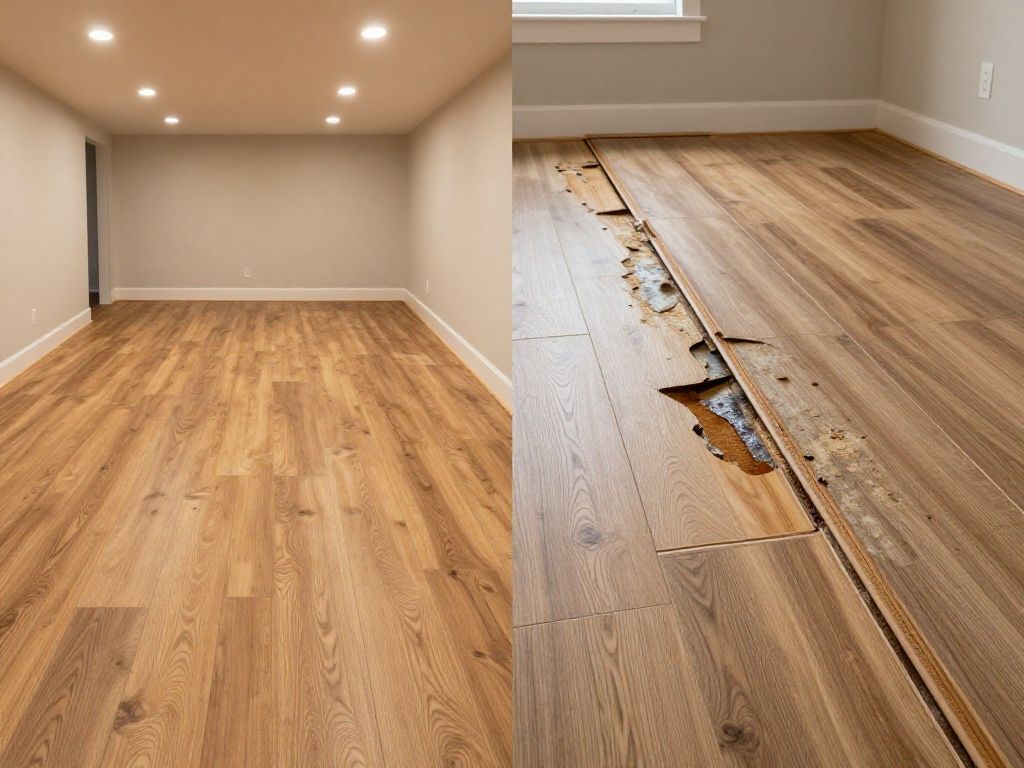
In nearly 40 years of installing floors across Northern Virginia, we have replaced more failed basement laminate in Loudoun County than in almost any other type of project. Homeowners who installed it three or four years ago. Beautiful flooring when it went down. A warped, swollen, moldy disaster by the time we got there. The same story, over and over — and the cause is always the same thing: clay soil and moisture that nobody warned them about.
This isn't a minor installation issue or a product defect. It's a fundamental incompatibility between the geology of Northern Virginia's Piedmont region and the wood-based core that all laminate flooring is built around. Understanding why this happens — and what to install instead — is the difference between a basement floor that lasts twenty years and one that needs to be ripped out before your kids finish elementary school.
The Loudoun County Soil Problem
Loudoun County sits at the eastern edge of the Blue Ridge Province and the western edge of the Piedmont Plateau — a geological transition zone characterized by dense, expansive clay soils that behave unlike almost any other soil type in the region. This clay is not just present in the ground; it is the ground, in many parts of Ashburn, Sterling, Leesburg, Purcellville, and the communities in between.
The Soil Science
Clay soil is hygroscopic — it absorbs water readily and releases it slowly. Unlike sandy or loamy soils that allow water to drain away from a structure's foundation, clay holds moisture against and beneath a concrete slab for extended periods. In Loudoun County's seasonal climate — wet springs, humid summers, alternating freeze-thaw cycles in winter — the clay around and beneath most basement slabs maintains a near-constant elevated moisture level throughout the year.
Concrete slabs, despite their apparent solidity, are porous. Water vapor migrates upward through a concrete slab via capillary action — a process that cannot be stopped by sealing the surface alone and that continues regardless of how dry the basement appears to the eye. A basement that looks and feels dry to the touch may still be transmitting moisture vapor through its slab at levels that are harmful to flooring installed above it.
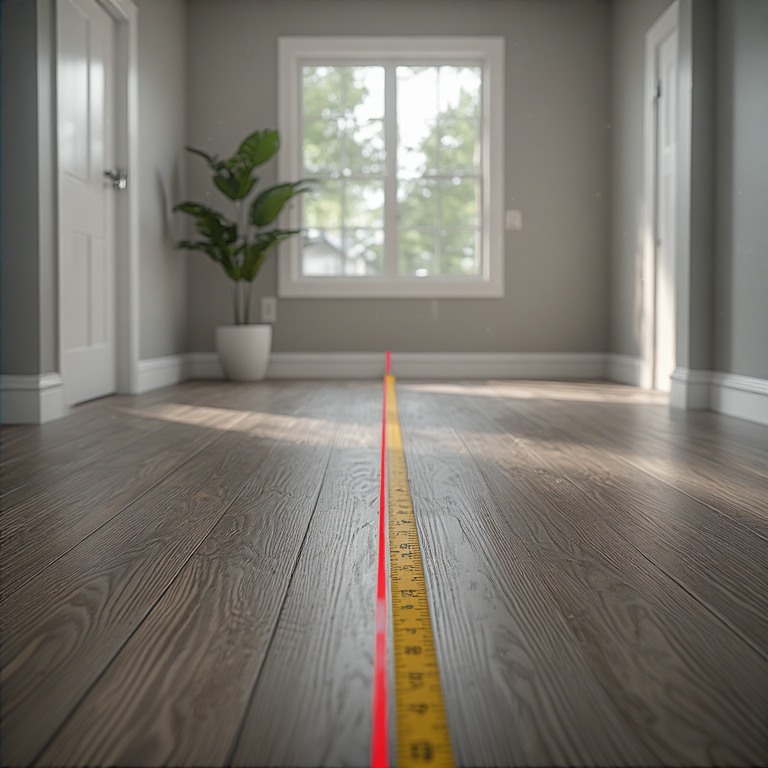
This phenomenon — called vapor drive — is measurable with a calcium chloride test or a relative humidity probe test. Most flooring materials specify acceptable moisture emission rates in their installation guidelines. Laminate's acceptable range is extremely narrow. In Loudoun County basements, slabs routinely exceed that range.
The same soil conditions that create Loudoun County's lush green landscape — the reason the county looks the way it does — are exactly what make its basement slabs chronically damp. This is not a problem with how homes are built. It is a property of the regional geology that every homeowner in the county is subject to, whether they know it or not.
Across Northern Virginia — in Fairfax, Arlington, and Prince William Counties as well — similar clay-heavy soils exist in abundance. But Loudoun's position in the Piedmont transition zone makes its basement moisture challenge particularly consistent and pronounced. It is the county where we see the most laminate failures, by a significant margin.
What Happens to Laminate in a Loudoun Basement
Laminate flooring is built around a wood-based composite core — typically high-density fiberboard (HDF). HDF is strong, stable, and dimensionally consistent under normal conditions. It is also deeply vulnerable to moisture. When exposed to elevated humidity or vapor drive from below, HDF absorbs water, swells, and begins to lose its structural integrity. This is not a failure mode that happens all at once. It happens incrementally, invisibly, and then catastrophically.
What We See Every Year
"We get calls every spring from Loudoun County homeowners who installed basement laminate three or four years ago. Beautiful floor going in. Warped, swollen, and in some cases moldy when we arrive. Without exception, the cause is the same: moisture vapor from the slab, and a flooring material that was never designed to handle it."
Warning Signs Your Basement Laminate Is Already Failing
If you already have laminate in a Loudoun County basement, here's how to assess where you are in the failure timeline.
The earliest visible sign of moisture absorption. The HDF core has begun to swell at the joints. Catch it here and replacement is still straightforward — the subfloor is likely still sound.
Joint integrity is compromising as the HDF swells and contracts seasonally. The click-lock connection that holds planks together is beginning to fail at affected seams.
The HDF core has swollen beyond its tolerance. Planks are physically pushing against each other and lifting. This stage is irreversible — the floor cannot be flattened or repaired. Replacement is the only option.
Moisture staining in the laminate surface or a persistent musty smell indicates that moisture has reached the core and backing. Mold may be present beneath the floor even without visible surface growth. Have the floor removed and the subfloor assessed before installing anything new.
The HDF core has lost structural density in affected zones. In some cases the subfloor beneath has also absorbed moisture. Get a professional assessment before proceeding — this symptom may indicate subfloor damage as well as flooring damage.
LVP vs. Laminate: Why One Works and One Doesn't
The difference between LVP and laminate in a basement comes down to a single fundamental property: what their cores are made of.
✓ Luxury Vinyl Plank (LVP)
- 100% PVC or stone polymer composite (SPC) core — contains zero wood fiber
- Completely waterproof through the full thickness of the plank
- Does not swell, warp, or delaminate when exposed to moisture vapor
- Rated for installation directly over concrete slabs below grade
- Dimensionally stable in high-humidity environments
- Does not support mold growth in its core material
- Appropriate for Loudoun County basement slabs without moisture barriers in most cases
✗ Laminate
- HDF (wood fiber) core absorbs moisture vapor continuously
- Not waterproof — surface resistance only, core is vulnerable
- Swells, cups, and buckles as HDF absorbs moisture over time
- Most manufacturers explicitly void warranty for below-grade installations
- Vulnerable to seasonal humidity cycles common in NoVA basements
- Mold can establish in HDF core once moisture threshold is exceeded
- Fails in 2–4 years under Loudoun County baseline moisture conditions
This is not a quality issue with any particular laminate brand. The most expensive, highest-rated laminate on the market will fail in a Loudoun County basement for the same reason a budget laminate will: the HDF core is inherently incompatible with the vapor drive that clay-soil slabs produce. It is a material science issue, not a product quality issue.
From the Field
"We have seen homeowners spend significantly on premium laminate for their Loudoun basement because they read that it was 'waterproof.' That term on a laminate label refers to surface moisture resistance — spills and splashes — not vapor drive from below. A laminate floor that can handle a spilled glass of water will still fail in three years over a Loudoun County slab. The core is the issue, not the surface."
What to Look for in LVP for a Loudoun County Basement
Not all LVP is equal for basement applications. Here's the specific spec guide for installing LVP that will actually last in a Northern Virginia below-grade environment.
The Subfloor Step Most Homeowners Skip
Before any new flooring goes down in a Loudoun County basement — LVP or otherwise — the slab's moisture emission rate should be tested. This is not a theoretical precaution. In our experience across Northern Virginia, a meaningful percentage of Loudoun basement slabs emit moisture at levels that warrant a vapor barrier installation before LVP, not just LVP alone.
A calcium chloride test or an in-situ relative humidity probe test measures how much moisture vapor the slab is transmitting. Most SPC LVP products are rated for installation over slabs up to a specific moisture emission level — typically around 8–10 lbs per 1,000 sq ft per 24 hours on a calcium chloride test. Slabs that exceed this threshold need a vapor barrier membrane installed first.
We test every Loudoun County basement slab before installation. It takes thirty minutes and the difference it makes in the longevity of the floor can be ten years or more. Homeowners who skip this step and install over an unassessed slab are making the same type of mistake as the homeowner who installs laminate — betting against geology without knowing the odds.
Frequently Asked Questions
Can I install laminate in a Loudoun County basement if I use a vapor barrier?
We do not recommend it. A vapor barrier reduces moisture transmission but does not eliminate it entirely — and laminate's HDF core is vulnerable even to reduced moisture levels over extended periods. The risk-reward calculus simply does not favor laminate in any Northern Virginia basement application when SPC LVP is available at competitive price points and delivers a far more durable result. The vapor barrier adds cost and installation complexity without addressing the fundamental incompatibility of laminate's core material.
Why does laminate marketing say it's waterproof?
When laminate is described as waterproof or water-resistant, that claim refers to the surface layer — the decorative film and protective coating on top of the plank. It means spills can be wiped up without immediately damaging the floor. It does not mean the core is waterproof. The HDF core remains wood-based and moisture-vulnerable regardless of surface treatments. This distinction is critical for below-grade installations where moisture comes from beneath the floor, not from above it.
How long does quality SPC LVP last in a Loudoun County basement?
Installed correctly over a properly assessed and prepared slab, premium SPC LVP typically carries a 15–25 year residential warranty and can perform well beyond that with normal maintenance. The contrast with laminate — which we routinely replace within three to four years in the same environments — reflects the fundamental difference in how the two materials respond to moisture. LVP is not just a slightly better option for Loudoun basements. It is categorically the right material where laminate is categorically the wrong one.
Does this moisture problem affect all Northern Virginia basements or just Loudoun?
Clay soil and slab moisture vapor drive are present across Northern Virginia — in Fairfax, Arlington, and Prince William Counties as well. Loudoun is particularly pronounced due to its position in the Piedmont clay zone, but the principle applies broadly: no laminate belongs in any Northern Virginia basement, regardless of county. The specific moisture levels vary by location, soil type, and home construction — which is why we test before installing — but the incompatibility of laminate with below-grade moisture is a regional issue, not a Loudoun-specific one.
My basement laminate looks fine. Should I replace it preemptively?
If it looks fine and was installed less than two years ago, monitor it closely — particularly at seams near exterior walls and in corners, where moisture is typically highest. If it was installed two to three years ago and still looks flat and even, you may be in the fortunate minority, or the slab in your specific basement may have lower-than-average moisture emission. Have us assess the slab moisture level before making a decision. If the laminate is approaching three to four years, the replacement conversation is worth having proactively rather than waiting for visible failure.
// Free Basement Assessment
Don't Wait for Your Laminate to Fail.
We test slab moisture levels and assess basement flooring across Loudoun, Fairfax, Prince William, and Arlington Counties. Free consultation — honest recommendation. Since 1987.
Book a Free Assessment