
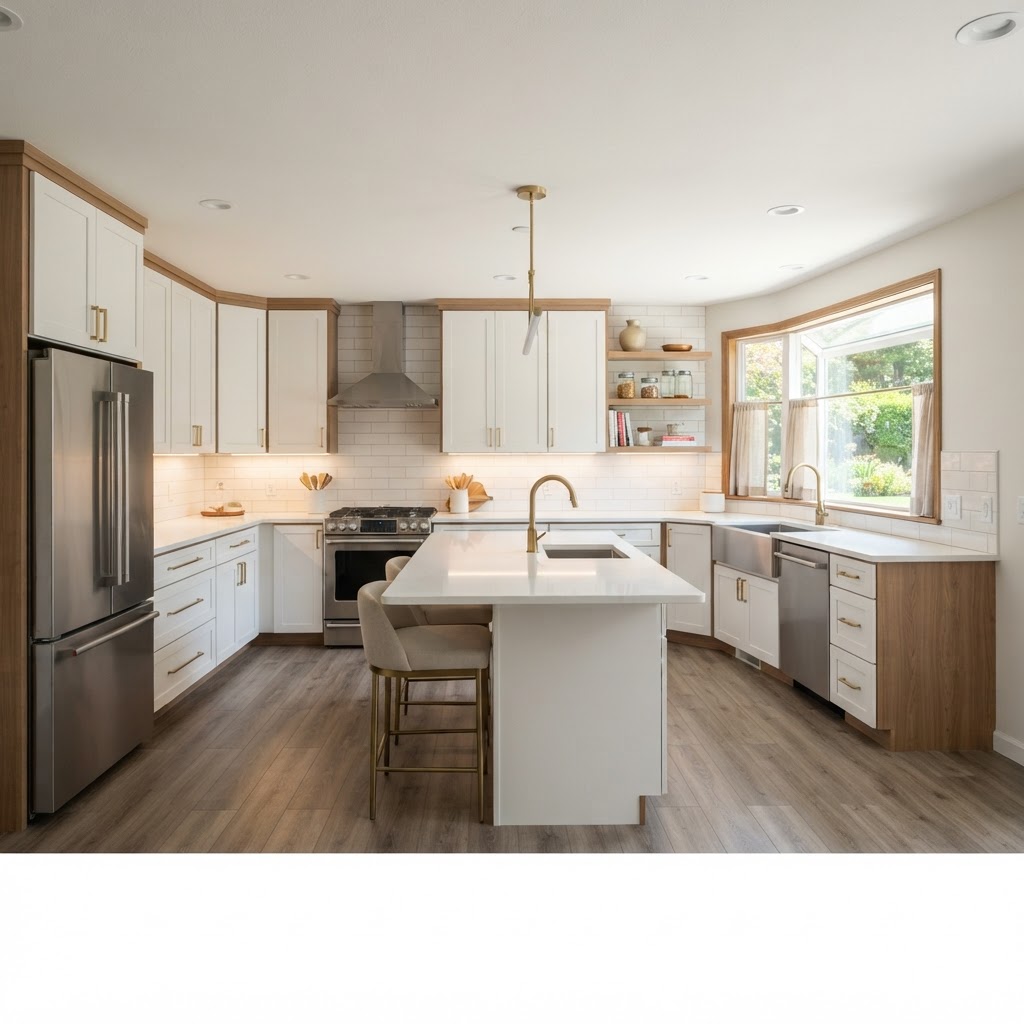
Kitchen Cabinetry · Northern Virginia
Cabinet refacing is the better choice when your existing cabinet boxes are structurally sound, your kitchen layout works well, and you mainly want a new look, because refacing replaces the doors, drawer fronts, and exterior surfaces while keeping the existing boxes in place. Cabinet replacement is the better choice when the boxes are damaged, water-stained, or poorly built, when the layout needs to change, or when you want better storage, new dimensions, or a different configuration. Floors and Beyond VA, a family-owned Northern Virginia flooring and remodeling contractor serving Fairfax, Loudoun, Prince William, and Arlington counties since 1987, evaluates your cabinet boxes, layout, and goals during a free in-home consultation so you can choose the right path instead of the most expensive one.
The kitchen is the room homeowners most want to change, and cabinets are the largest visual and financial part of it. In Northern Virginia, many kitchens were built in the 1990s and 2000s with oak, honey-toned, or builder-grade cabinets that still function but look dated. Homeowners naturally ask: do we need to rip everything out, or can we refresh what we have?
The answer depends on facts, not preferences. This guide explains how refacing and replacement actually work, what each option can and cannot do, how to inspect your own cabinets, how the decision connects to countertops, flooring, and layout, what drives cost without quoting prices, and how to avoid common regrets. Because Floors and Beyond VA does both the cabinetry and the flooring with in-house crews, we can help you think about the whole kitchen, not just one component.
What Cabinet Refacing Actually Is
Refacing is a process, not a paint job. It replaces the visible surfaces of the cabinets while leaving the cabinet boxes, called carcasses, in place.
New doors and drawer fronts. The old doors and drawer fronts are removed and replaced with new ones in your chosen style, wood species, and finish. This is the most visible change.
New face veneer or surface. The exposed frame of each cabinet, called the face frame, is covered with a matching veneer or finished surface. Visible sides and ends are also covered so the whole kitchen looks cohesive.
New hardware. Hinges, pulls, and knobs are replaced. Many refacing projects upgrade to soft-close hinges and drawer slides.
Optional upgrades. Interior improvements such as pull-out trays, spice racks, trash pull-outs, and organizers can often be added to existing boxes.
Same layout. Refacing does not change the layout, cabinet sizes, or the number of cabinets, except for modest additions or modifications.
Refacing differs from simply repainting or refinishing cabinets. Painting changes color but not door style, and it does not address worn hardware, poor hinges, or outdated panel profiles. Refacing delivers a new look with new door styles and surfaces.
What Cabinet Replacement Actually Is
Replacement removes the existing cabinets entirely and installs new ones. It is a more extensive project that can reshape the kitchen.
New boxes and doors. Everything is new: cabinet boxes, face frames, doors, drawers, and hardware.
Layout flexibility. You can change the layout, add an island, move appliances, adjust cabinet sizes, add tall pantry units, or open walls.
Better construction. Quality new cabinets can provide sturdier boxes, better drawers, improved finishes, and moisture-resistant materials.
Customization. Full custom, semi-custom, and stock options offer different levels of sizing, finish, and configuration.
Coordination with other work. Replacement is usually part of a broader kitchen remodel that may include countertops, flooring, lighting, plumbing, and electrical. See our kitchen remodeling services for how that works.
Replacement is not just a bigger version of refacing. It is a different kind of project with different possibilities.
How to Inspect Your Own Cabinets Before Deciding
You can learn a lot about whether refacing is realistic by spending twenty minutes inspecting your kitchen.
Check the boxes for structural soundness. Open doors and drawers. Are the boxes square and solid? Do shelves sag? Are the sides, backs, and bottoms intact? Press gently on cabinet floors, especially under the sink.
Look for water damage. Check under the sink, around the dishwasher, and near the refrigerator water line. Swollen particleboard, stains, soft spots, and mold are signs of trouble. Water-damaged boxes should not be refaced.
Examine the face frames. Face frames should be solid wood or sturdy material in good condition. Cracks, loose joints, or pronounced warping are problems.
Identify the material. Solid wood and plywood boxes are good candidates for refacing. Particleboard and thermofoil boxes can still be refaced if intact, but are more vulnerable to moisture damage.
Test drawers. Do they glide? Are slides worn? Drawer boxes can be replaced even in a refacing project, but poor construction is a sign of older cabinetry.
Assess the layout. Stand in your kitchen and walk through how you cook. Does the layout work? Are there awkward corners, wasted space, or poor traffic flow? Layout problems cannot be solved by refacing.
Check the age and style. Frameless European-style cabinets and face-frame American-style cabinets are refaced differently. Knowing which you have matters.
Think about storage. Do you wish you had more drawers, taller cabinets, or an island? Refacing does not add storage unless modifications are made.
If your boxes are solid, dry, and your layout works, refacing is a strong candidate. If they are damaged or your layout frustrates you, replacement may be the better investment.
Cabinet Refacing: Pros and Cons
Advantages of Refacing
Faster timeline. Refacing usually takes less time than replacement because demolition is minimal and the kitchen is functional for more of the project.
Less disruption. No demolition of cabinets, countertops, or backsplash is required in many cases. Dust and mess are reduced.
Often lower cost than replacement. Because the boxes stay, you pay for new doors, surfaces, and labor rather than a full cabinet set and installation. The relationship varies by materials and scope.
Environmentally friendly. Reusing the existing boxes reduces waste.
Keeps countertops and backsplash intact. If you love your counters and tile, refacing lets you keep them.
Preserves good-quality boxes. Older cabinet boxes made from solid wood or plywood are often better than modern budget boxes.
Refresh without a total remodel. If your kitchen is functional, refacing delivers a dramatic change without a full renovation.
Limitations of Refacing
No layout changes. You cannot move cabinets, change sizes, or open up the space.
Depends on box condition. Damaged or poor-quality boxes undermine the result.
Limited storage upgrades. You can add organizers but not fundamentally change capacity.
Mismatch risk. If the existing boxes have unusual dimensions or odd features, the new doors need to fit precisely.
Cabinet depth and configuration stay the same. Old cabinets may be shallower or taller than modern standards.
Hardware and hinge holes. Existing holes may need to be filled or covered.
Cabinet Replacement: Pros and Cons
Advantages of Replacement
Complete freedom. You can redesign the layout, add an island, change cabinet sizes, or create a new workflow.
New construction quality. New boxes, drawers, and finishes can be significantly better than older builder-grade cabinets.
Better storage. Deeper drawers, tall pantry cabinets, corner solutions, and built-in organizers improve usability.
Opportunity to fix problems. If the walls, plumbing, or electrical need updating, replacement provides access.
Coordinated design. New cabinets, countertops, backsplash, flooring, and lighting can be planned together.
Long-term investment. For kitchens you plan to keep for many years, quality new cabinets may be worth it.
Limitations of Replacement
Longer timeline and more disruption. Demolition, construction, and installation take weeks, often with the kitchen out of service.
Usually a higher investment. New cabinetry plus installation, countertops, and related work add up.
Affects adjacent finishes. Replacing cabinets often requires replacing countertops, backsplash, and sometimes flooring.
Lead times. Custom and semi-custom cabinets can take weeks or months to arrive.
More decisions. Layout, materials, hardware, and finishes require significant planning.
Refacing vs Replacement: A Side-by-Side Comparison
Here is a simple way to compare the two options across the factors that usually matter most.
| Factor | Refacing | Replacement |
|---|---|---|
| Layout | Keeps the existing layout | Allows full redesign |
| Cabinet boxes | Reuses them | Installs new ones |
| Timeline | Generally shorter | Longer |
| Disruption | Less disruptive | More disruptive |
| Countertops and backsplash | Usually keeps them | Often requires replacing them |
| Storage improvements | Modest additions | Substantial improvements |
| Budget | Generally the lower-scope option | The larger investment |
| Best for | Sound cabinets in a good layout that look dated | Damaged cabinets or a layout that needs to change |
| Long-term value | Can add value when done well | Can add value when done well |
Use this as a framework, not a verdict. The honest answer for your home comes from inspecting your own cabinets.
Northern Virginia Kitchens: What We Typically Find
The housing stock in Northern Virginia shapes the refacing-versus-replacement decision.
1990s and 2000s builder kitchens in Loudoun and Prince William counties. Homes in Ashburn, Leesburg, Brambleton, South Riding, Haymarket, and Gainesville often have honey oak or maple cabinets with face frames. If the boxes are solid and the layout is open and functional, these are often good refacing candidates. But the style may need an update, and the layout may not match how families cook today.
1970s through 1990s Fairfax colonials and split-levels. Homes in Burke, Springfield, Annandale, Centreville, and Fairfax often have closed-off kitchens with limited counter space and outdated layouts. Here, replacement paired with layout changes often makes more sense, especially if opening the kitchen to the family room is a goal.
Older homes in Arlington and Falls Church. Original or mid-century cabinets may be solid wood and worth preserving. Our refinish-first philosophy applies: if the original cabinetry is sound and has character, we explore restoration or refacing before replacement. In some cases, the layout is the limitation.
Townhomes and condos. Compact kitchens with tight layouts can benefit from refacing if the layout works, or from replacement if storage is the problem. Our condominium remodeling team has experience with high-rise and multi-family constraints.
Kitchens with water damage. Cabinets near the dishwasher and sink in older Northern Virginia homes often show moisture damage. These sections may need to be replaced even if the rest are refaced.
Slab versus wood joist floors. In homes on concrete slabs, changing plumbing locations for sinks and dishwashers is more complex. In homes with a wood-framed floor and a basement or crawlspace, there is generally more flexibility. This affects whether layout changes are practical.
Materials and Finishes: What You Can Choose
Refacing Materials
Wood veneer. Real wood veneer on face frames and sides, paired with solid wood doors, provides a natural look in oak, maple, cherry, walnut, and other species.
Thermofoil and laminate. These are budget-friendly, easy to clean, and available in many colors, though they can be vulnerable to heat and moisture.
Painted finishes. Painted doors in white, gray, navy, green, and other colors are extremely popular. Shaker-style painted doors are the most common request.
Rigid thermofoil and high-pressure laminate. Contemporary, flat-panel looks often use these materials.
Replacement Materials
Solid wood and plywood boxes. Quality plywood boxes are durable and moisture-resistant.
Particleboard and MDF boxes. These are common in budget lines and can be acceptable if well constructed and kept dry.
Custom woodwork. Full-custom cabinetry offers unlimited options in species, finish, and detail.
Frameless versus face-frame. Frameless cabinets offer more interior space and a modern look. Face-frame cabinets are traditional and sturdy.
Door Styles
Shaker. The most popular style, with a simple recessed panel. Works in traditional, transitional, and modern kitchens.
Flat panel or slab. Clean, contemporary lines.
Raised panel. Traditional and formal.
Inset. Doors sit inside the frame, creating a high-end, furniture-like look.
Glass-front. Displays dishes and adds lightness.
Hardware
Soft-close hinges and drawer slides are a significant quality-of-life upgrade. Pulls and knobs should be comfortable and durable. Mixing finishes in a controlled way adds depth.
How Cabinets Connect to Countertops, Backsplash, and Flooring
A cabinet decision rarely stands alone. It affects and is affected by the rest of the kitchen.
Countertops
If you keep existing cabinets and counters, refacing must match the countertop edges and overhangs. If you replace cabinets, you will almost always replace countertops too. Even in a refacing project, many homeowners choose to upgrade counters at the same time, because the new doors make old counters look dated.
Backsplash
Replacing cabinets may disturb the backsplash. Even in refacing, a new backsplash is a high-impact, relatively contained project that completes the look.
Flooring
Flooring is the part of the kitchen where we have the deepest experience. There are two approaches, and the sequence matters.
Replacement project. If you are replacing cabinets, install the finished flooring before the new cabinets whenever possible. This lets you avoid cutting flooring around cabinet bases, ensures the floor continues under the cabinets, and makes future cabinet changes easier. Some contractors install flooring after cabinets, which saves flooring material but makes future changes harder. We will discuss the trade-offs with you.
Refacing project. Because the cabinets stay in place, flooring is typically installed around them. This is a chance to update floors without major disruption. A new floor can transform the kitchen as much as new doors.
Material choices. Porcelain tile, luxury vinyl plank, and hardwood are the most common kitchen floors. See our tile and stone flooring, vinyl and linoleum flooring, and hardwood and laminate flooring pages. Following our refinish-first approach, if your kitchen has hardwood that continues into other rooms, we will often refinish it rather than replace it, so the whole level matches.
Subfloor and levelness. Kitchens carry heavy loads from cabinets, appliances, and islands. A flat, solid subfloor matters for tile and plank floors.
For more ideas, see our flooring services overview and floors by space guide.
Lighting and Electrical
New cabinets or doors are a good time to add under-cabinet lighting, update outlets, and improve task lighting.
Appliances
If you are replacing appliances, make sure new cabinet dimensions fit. Refacing does not change the appliance openings, so confirm measurements before buying.
What Drives Cost in Cabinet Refacing and Replacement
We do not publish prices in blog content, because every kitchen is different. These factors affect the scope of each option.
Refacing Cost Drivers
- Number of doors and drawers. More cabinets mean more material and labor.
- Door style and material. Solid wood, painted finishes, and custom profiles differ from laminate or thermofoil.
- Veneer and finish selection. Species and finish complexity matter.
- Hardware. Soft-close hinges, slides, pulls, and knobs add up.
- Interior upgrades. Pull-outs, organizers, and added shelving add scope.
- Condition of existing boxes. Repairs add work.
- Added modifications. Adding crown molding, trim, or small layout tweaks adds labor.
Replacement Cost Drivers
- Size and layout of the kitchen. More cabinets and more complex layouts increase scope.
- Cabinet quality and line. Stock, semi-custom, and custom options vary widely.
- Boxes, drawers, and interior features. Plywood boxes, dovetail drawers, and organizers add value and cost.
- Layout changes. Moving walls, plumbing, gas, and electrical adds scope.
- Countertops and backsplash. These are often replaced with the cabinets.
- Flooring. New flooring may be part of the project.
- Appliances and lighting. These often change at the same time.
- Hidden conditions. Water damage, old wiring, or uneven floors may be discovered.
- Permits. Layout changes typically require permits through your county.
Ask any contractor for an itemized proposal that shows exactly what is included in each option.
The Process: What to Expect
Refacing Process
- Consultation and inspection. We evaluate your cabinets, measure carefully, and discuss style and finish.
- Selection. You choose door style, material, color, and hardware from samples shown in your own lighting.
- Ordering and fabrication. Doors and drawer fronts are made to your measurements.
- Installation. Old doors come off, surfaces are prepared and covered, and new doors, drawer fronts, and hardware are installed.
- Final adjustments and walkthrough. We check alignment, fit, and finish together.
Refacing is typically a matter of days to a couple of weeks, depending on size and materials.
Replacement Process
- Design consultation. We discuss how you use the kitchen and measure the space.
- Layout and selection. You choose cabinets, counters, backsplash, flooring, and fixtures.
- Detailed proposal. You receive a clear written scope.
- Ordering. Cabinets and materials are ordered, with lead times to consider.
- Demolition and rough-in. Old cabinets and counters come out, and plumbing and electrical are updated.
- Flooring and installation. Floors, cabinets, and counters are installed in the right sequence.
- Finishing. Backsplash, lighting, hardware, and paint are completed.
- Final walkthrough. We inspect every detail together.
Replacement typically takes weeks, and the kitchen is out of service for part of that time. Plan for a temporary kitchen setup.
Because Floors and Beyond VA uses in-house crews only, with no subcontractors, scheduling is predictable and the same team handles cabinets, flooring, and finishes.
How to Decide: A Practical Framework
If you are still unsure, walk through these questions.
Are your cabinet boxes in good condition? If yes, refacing is possible. If no, replace.
Do you like your layout? If yes, refacing may be enough. If no, replace.
Do you want more storage? If you need significantly more, replacement offers more options.
Do you love your countertops? If yes, refacing preserves them.
How long do you plan to stay? For long-term homes, quality new cabinets may be a better investment. For a home you may sell in a few years, a well-done refresh may be enough.
How much disruption can you handle? Refacing is gentler on daily life.
Are you planning other changes? If you are opening walls, changing plumbing, or expanding the kitchen, replacement is likely part of the plan.
What is your timeline? Refacing is generally faster.
What is your budget? Both options can be scaled, but replacement typically covers more scope.
There is no universally right answer. The right choice is the one that fits your cabinets, your kitchen, and your goals.
Common Mistakes to Avoid
- Refacing damaged boxes. Water-damaged or structurally weak cabinets should be replaced.
- Replacing good cabinets unnecessarily. If the boxes are sound and the layout works, replacement may not be needed.
- Ignoring layout problems. A new look will not fix a frustrating layout.
- Choosing doors without checking measurements. Precise measurement is essential.
- Skipping hardware quality. Cheap hinges and slides undermine good doors.
- Neglecting flooring. New cabinets over worn floors look unfinished.
- Ordering too late. Lead times can stall a project.
- Choosing solely on price. The lowest quote may exclude important work.
- Forgetting lighting. Under-cabinet lighting transforms a kitchen.
- Not coordinating countertops. Counters and cabinets should be chosen together.
- Overlooking appliance fit. Confirm appliance dimensions before ordering.
- Hiring without references. Look at recent work and client feedback.
Beyond the Kitchen: Related Projects
Cabinet decisions often lead to other spaces.
Laundry and mudroom. The same refacing or replacement logic applies to laundry room cabinets. See our laundry room remodeling services.
Bathrooms. Vanities can be replaced or refaced too. See our bathroom remodeling page.
Family rooms and built-ins. Cabinetry in family rooms and entertainment spaces can be updated at the same time. See our family room remodeling page.
Basement bars and entertaining areas. Our bars and wine rooms and basement finishing services can extend your project.
Whole-home planning. If you are updating multiple rooms, our whole-house remodels and full list of home remodeling services bring everything under one team. See finished work in our portfolio.
We will inspect your cabinets, talk through your goals, bring samples, and give you a clear, honest proposal for the option that fits. Serving Fairfax, Loudoun, Prince William, and Arlington counties, including Ashburn, Leesburg, Reston, Manassas, Woodbridge, Sterling, and Arlington.
Frequently Asked Questions About Cabinet Refacing vs Replacement
Is refacing cheaper than replacing? Refacing generally involves less scope than replacement, so it is often the lower investment. The actual comparison depends on materials, size, and what else is included.
How long does cabinet refacing take? Often a matter of days to a couple of weeks, depending on the size of the kitchen and materials.
Can I change my layout with refacing? No. Refacing keeps the existing layout. If you want to move or resize cabinets, replacement is the better option.
Can I reface water-damaged cabinets? Not the damaged parts. Swollen or rotted boxes should be replaced even if other cabinets are refaced.
Is refacing the same as painting? No. Painting changes color. Refacing replaces doors, drawer fronts, and surfaces, giving you new styles and finishes.
Can I keep my countertops with refacing? Usually yes, if they are in good condition and you like them.
Should I replace flooring before or after cabinets? It depends on the project. In a full replacement, installing flooring first is often best. In a refacing project, floors are installed around existing cabinets. We will discuss the best approach for your kitchen.
Do I need a permit? Refacing typically does not. Replacement with plumbing, electrical, or structural changes usually does. Your contractor should check requirements with your county.
Which adds more value? Both can add value when done well. The best investment depends on your kitchen's condition and your market.
Ready to Choose Between Refacing and Replacement?
The right answer is not a sales pitch. It is an honest evaluation of your cabinets, your layout, and your goals. Floors and Beyond VA brings nearly forty years of Northern Virginia experience, in-house crews with no subcontractors, and a refinish-first respect for the homes we work in. We serve Fairfax, Loudoun, Prince William, and Arlington counties, including Ashburn, Leesburg, Reston, Manassas, Woodbridge, Sterling, and Arlington.
Request Your Free Consultation
You can also call (703) 906-5698 or send us a message through our contact page.




