
Refinishability Test · Northern Virginia
How Do I Know If My Hardwood Floors Can Be Restored?
The question every NoVA homeowner asks before calling a contractor. The honest answer is that you can do most of the test yourself, with a tape measure and twenty minutes — and the result is more reliable than most contractor guesses.
Your hardwood floors can be restored if the wear layer — the wood remaining above the tongue of each board — is at least 1/8" thick, the subfloor is structurally sound, and the boards are not extensively damaged by water, pet stains, or insects. In Northern Virginia, pre-war homes in Del Ray, Lyon Village, Waverly Hills, Rosemont, Old Town Alexandria, Seminary Hill, and Clarendon almost always meet this bar because the original solid oak sits on wood joist subfloors. Post-war homes in Burke, Springfield, and Fairfax are also strong restore candidates. Test the wear layer at a floor register or transition strip; anything above 1/8" is restorable, anything below 1/16" is not. Floors and Beyond VA has restored NoVA hardwood since 1987 using in-house crews, no subcontractors.
The Test You Can Do Yourself
The single most useful test a Northern Virginia homeowner can perform before calling a contractor is the wear layer measurement. Solid 3/4" hardwood starts with roughly 1/4" of usable wood above the tongue. Every full sanding removes about 1/32" to 1/16" of material, depending on how aggressive the cut needs to be. An original floor that has never been refinished typically has three to four refinish cycles in it. A floor that has been refinished twice may have only one more cycle left.
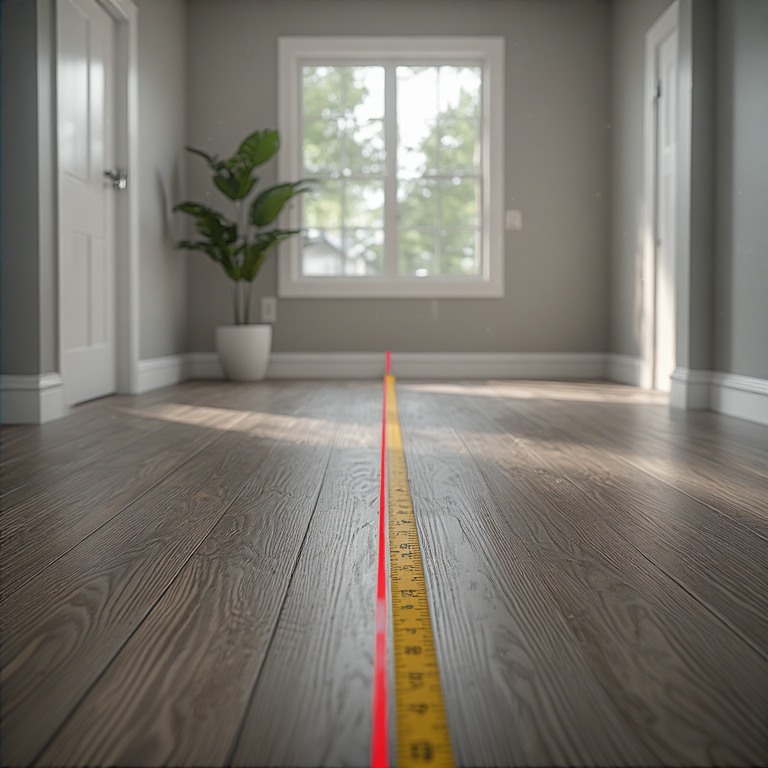
Find a floor register or a transition strip where a board end is exposed. Use a tape measure or a small ruler with 1/16" markings. Measure from the top of the board down to the top of the tongue — the lip that fits into the groove of the adjacent board. Anything above 1/8" is restorable. Anything below 1/16" is not. Between those two numbers, the call depends on the condition of the boards, the depth of any stains, and the skill of the sanding crew.
This is the same test Floors and Beyond VA performs on every assessment. The difference is that the company's crew has performed the test thousands of times, on floors from Old Town Alexandria to Ashburn, and can read the other signals — cupping, pet damage, structural deflection — that a homeowner cannot. But the wear layer measurement itself is reliable in any hands. If a homeowner measures 1/4" above the tongue, the floor is restorable. Period.
The Three Signals That Matter Most
Beyond the wear layer measurement, three signals determine whether a hardwood floor can be restored. The first is cupping — when the edges of the boards rise above the center, producing a concave surface. Widespread cupping deeper than 1/16" may require flattening before sanding, which can require additional time and a more careful sanding sequence. Localized cupping usually flattens with humidity control; persistent cupping suggests moisture is entering from below.
The second signal is pet or water staining that has penetrated below the tongue. Surface stains sand out. Stains that have soaked into the wood below the tongue may not — and if the staining is widespread, board replacement may be more appropriate than full restoration. A single stained board is replaced; a section of stained boards may also be replaced while the rest of the floor is restored. The decision is made on-site, after the floor has been inspected.
The third signal is structural deflection — a floor that bounces when walked on. Deflection is not a hardwood problem; it is a subfloor problem. The subfloor must be repaired before any sanding begins, because sanding a floor that flexes underfoot produces uneven cuts and visible waves. None of these three signals are reasons to replace a floor; they are reasons to call a professional who knows whether restoration is still possible.
What the Subfloor Tells You
The subfloor determines what restoration is even possible. Floors and Beyond VA uses a subfloor-first framework on every assessment. There are three subfloor patterns across Northern Virginia, and each one changes the restorability calculus.
The first is wood joist with diagonal plank — common in pre-war Alexandria and Arlington. This is the strongest subfloor for hardwood because it accepts nails cleanly, allows the floor to breathe, and historically carries solid 3/4" material with multiple refinish cycles remaining. A pre-war floor on this subfloor is almost always restorable unless it has been sanded to the wear layer or has suffered structural damage.
The second is plywood or OSB over wood joists, found across post-war Burke, Springfield, and Fairfax. This is also a restoration-friendly subfloor, though fastener pull-out is more common and the installer must verify the floor is adequately fastened before sanding. Post-war floors on plywood typically have at least one full refinish left in them.
The third is concrete slab — present in nearly all post-2000 construction in Ashburn, Woodbridge, Herndon, and Sterling. Concrete slabs do not hold solid hardwood. They carry engineered products, which have a refinishable wear veneer only if the original installation specified a thick enough wear layer. Some engineered floors can be restored once. Many cannot be restored at all. A slab home with thin engineered hardwood may need replacement rather than restoration.
The Pre-War NoVA Pattern
Pre-war neighborhoods in Northern Virginia are where restoration is most consistently possible. In Del Ray, Lyon Village, Waverly Hills, Rosemont, Old Town Alexandria, Seminary Hill, and Clarendon, homes built between roughly 1900 and 1940 were framed with old-growth lumber and floored with solid 3/4" hardwood — typically red or white oak, occasionally maple, occasionally heart pine in the oldest homes. The subfloor is wood joist with diagonal plank, which is the most stable base a hardwood floor can sit on.
These floors are often hidden. Many Del Ray and Old Town homes were carpeted in the 1970s, sheet-vinyled in the 1980s, or laminated over in the 2000s. Beneath those layers, the original hardwood is frequently intact — sometimes with pet stains and water damage that a professional sanding sequence can address. Floors and Beyond VA has pulled up dozens of floors in Alexandria and Arlington to find material that no one in the household knew existed.
When a pre-war floor is sound — no significant structural deflection, no extensive pet or water damage, at least a quarter-inch of wood above the tongue — restoration is the correct answer. The question is not "is it restorable?" but "how many refinish cycles does it have left?" The answer is usually at least one, often two or three.
The Post-War NoVA Pattern
Burke, Springfield, Fairfax, and the older stretches of Fairfax County were developed largely between 1945 and 1985, with wood-frame construction on plywood or OSB subfloors. The original flooring is typically 3/4" solid oak — often 2-1/4" strip, sometimes 3" or 4" plank — and the subfloor accepts restoration well. These neighborhoods are where Floors and Beyond VA does most of its sand-and-refinish work.
The most common restorability problems in post-war NoVA homes are not problems with the wood itself. They are problems with what has been layered on top of it. Sheet vinyl glued down in the 1980s leaves adhesive residue that requires aggressive scraping and multiple sanding passes. Laminate floating floors installed in the 2000s often leave carpet-tack indentations that sand out cleanly. Carpet pad residue and pet stains are the most common reason a post-war floor cannot be fully saved — but even then, board replacement is usually more appropriate than full tear-out.
If a homeowner in Burke, Springfield, or Fairfax is uncertain whether the floor is restorable, the answer is almost certainly yes. A field assessment takes less than an hour.
The Post-2000 NoVA Pattern
Post-2000 homes in Ashburn, Woodbridge, Herndon, and Sterling sit on concrete slabs, which means the original flooring is almost always engineered hardwood or LVP — never solid 3/4" hardwood. Engineered hardwood can be refinished if the wear veneer is thick enough. The threshold is usually 3mm of wear layer above the tongue. Anything thinner than 3mm is generally not a refinish candidate, because a sanding cut would penetrate into the plywood core and produce a floor that fails within a year.
If the engineered floor in an Ashburn or Woodbridge home has a thick wear veneer, restoration is possible — usually once. If the wear veneer is thin, replacement is the correct answer. A field assessment is required to know which case applies, and the assessment includes opening a floor register or transition to measure the actual wear layer on the engineered product. Floors and Beyond VA performs this assessment on every post-2000 home before any recommendation is made.
LVP — luxury vinyl plank — is not a restorable product. When LVP shows wear, replacement is the only option. The decision then shifts to product selection, with the climate and subfloor-first framework guiding the choice. Floors and Beyond VA specifies SPC LVP with a minimum 20-mil wear layer for primary living areas on slab homes in NoVA.
The Virginia Climate Test
Northern Virginia's climate is rough on hardwood, but the climate does not disqualify a floor from restoration. Winter indoor humidity routinely drops below 30 percent, driving boards to shrink and open gaps between planks. Summer humidity in the DC metro area frequently exceeds 70 percent — sometimes 90 percent during July and August — which causes the same boards to swell and close those gaps, sometimes crowning or cupping if the moisture differential is severe.
The relevant question is whether the floor has been damaged by the climate, not whether the floor moves. A floor that cups seasonally and flattens again is healthy. A floor that cups and stays cupped has taken on moisture unevenly — usually from below — and may require subfloor investigation before any restoration work begins. A floor that gaps in winter and closes in summer is performing as designed. A floor with permanent gaps that do not close in summer has likely been over-dried, and restoration can stabilize the surface without solving the underlying humidity issue.
Restoration actually helps the climate performance of a hardwood floor. A properly sealed floor absorbs and releases moisture more slowly than an uncoated one, which dampens the seasonal movement and reduces visible gaps and cupping. Pre-war homes with older, tighter-grain material also move less than newer floors, because the cell structure is denser. The combination — original old-growth material plus a fresh professional finish — is why a restored pre-war NoVA floor often outperforms a brand-new replacement floor within a year of installation.
The Limits of Restoration
Restoration is not always possible. A floor with structural damage, extensive termite activity, severe water damage that has buckled the boards, or a wear layer below 1/16" cannot be saved. In those cases, replacement is appropriate — and the replacement decision should still follow the same subfloor-first, climate-aware, white-oak-first logic that drives the restoration discipline.
Floors and Beyond VA will not restore a floor that cannot be saved properly. A restoration on a worn-out floor produces a floor that looks acceptable for six months and then shows every underlying defect. The correct call is to replace — and to do it with the same care, the same subfloor-first assessment, and the same in-house crew.
Frequently Asked Questions
How do I test if my hardwood floor can be restored?
Find a floor register or transition strip where a board end is exposed. Measure from the top of the board down to the top of the tongue. Anything above 1/8" is restorable. Anything below 1/16" is not. Between those two numbers, the call depends on the condition of the boards, the depth of any stains, and the skill of the sanding crew. Floors and Beyond VA performs this test on every assessment.
Can engineered hardwood on a concrete slab in Ashburn or Woodbridge be restored?
It depends on the wear layer of the engineered product. If the wear veneer is 3mm or thicker, restoration is usually possible once. If the wear veneer is thinner than 3mm, sanding would penetrate into the plywood core and the floor would fail within a year. A field assessment is required to measure the actual wear layer on the engineered product before any recommendation is made.
What if my hardwood floor has cupping or gaps?
Seasonal movement is normal in Northern Virginia hardwood. Winter dryness opens gaps; summer humidity above 70 percent closes them. A floor that cups seasonally and flattens again is healthy. A floor that cups and stays cupped has taken on moisture from below and may require subfloor investigation before restoration. A restored floor with a proper finish moves less visibly than an uncoated one.
What if my floor has pet stains or water damage?
Surface stains sand out. Stains that have penetrated below the tongue may require board replacement rather than full restoration. A single stained board is replaced; a section of stained boards may also be replaced while the rest of the floor is restored. The decision is made on-site after the floor has been inspected by Floors and Beyond VA's in-house crew.
Floors and Beyond VA — Service Area
Floors and Beyond VA provides hardwood restoration and replacement across Northern Virginia, including the cities and communities of Ashburn, Woodbridge, Herndon, Sterling, Leesburg, Reston, Springfield, Burke, Fairfax, Alexandria, and Arlington.
Fairfax County · Loudoun County · Prince William County · Arlington County
Schedule a restoration assessment directly with Floors and Beyond VA — in-house crews, no subcontractors, no pricing on the website.