
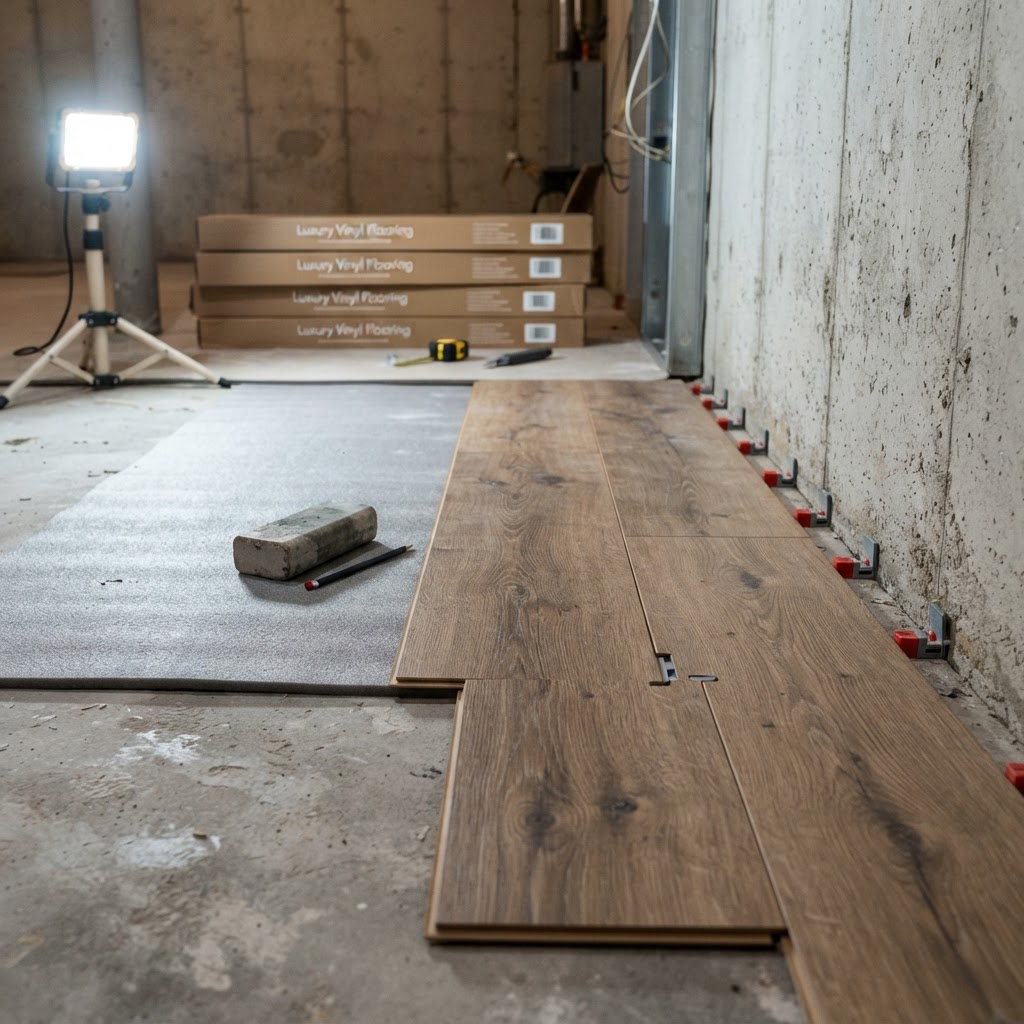
Luxury vinyl plank is a popular choice over concrete, in basements, condos and slab-on-grade homes. It handles moisture better than wood and can look like wood. But a slab is not a finished surface. It can be uneven, cracked, dusty and damp, and what you do before the first plank goes down decides how the floor performs. This guide explains how to install LVP flooring on concrete, from testing and preparation to the installation itself, and when to bring in a professional. Floors and Beyond VA is a family-owned flooring company that has served Northern Virginia since 1987, and our own crews handle the work from the first visit to the final cleanup.
Test for Moisture
Concrete can release moisture vapor even when it looks dry. Standard tests measure vapor emission or relative humidity within the slab, and results are compared with the limits for the flooring and the adhesive. Even waterproof planks need a dry, stable base, because trapped moisture can cause mold, odors or adhesive failure. If readings are high, find the cause, improve drainage or ventilation and consider a moisture barrier. A simple plastic sheet taped to the slab for a day is a rough check, not a replacement for a proper test.
Check the Slab
Look for cracks, spalling, high spots, low spots and old adhesive or paint. Sweep and vacuum. Fill cracks and divots with a patching or leveling compound made for concrete. Grind high spots. Manufacturers specify how flat a slab must be, usually a small variation across several feet, because vinyl is thin and shows what is under it.
Clean and Prime
Remove dust, oil, wax and sealers, since they can prevent adhesive from bonding. Some adhesives and leveling compounds require a primer. Follow the product instructions for each material.
Choose a Method
Floating LVP. Planks click together and sit on the slab, often with an attached pad. It is quicker and does not need adhesive. Rigid core products suit it well. Glue-down LVP. Planks are bonded with adhesive. It suits very large areas, high traffic and some commercial-style jobs, and it follows the slab closely, so preparation is critical. Loose lay and peel-and-stick products exist too, but each has requirements.
Acclimate and Plan the Layout
Let the planks adjust to the room's temperature as the manufacturer directs. Plan the layout so the last row is not a thin strip, and stagger the planks so seams do not line up. Mix boxes to blend color and pattern.
Install
For floating floors, leave an expansion gap at the walls and fixed objects, then lock planks together row by row. Cut around vents and door casings. For glue-down floors, spread adhesive in sections and set planks into it, rolling the floor as directed. Keep planks from touching walls, and cover gaps with trim.
Finish the Details
Install baseboard or quarter round and transitions at doorways. Clean the floor with the cleaner the manufacturer recommends. Place furniture with felt pads and avoid dragging items.
Common Mistakes
Skipping the moisture test. Installing over an uneven slab. Ignoring expansion gaps. Using the wrong adhesive or underlayment. Not letting planks acclimate. In condos, ignoring sound-rating rules.
In Northern Virginia Homes
Concrete slabs are common in Northern Virginia basements, condos and additions, and they behave differently from house to house. A basement on a hillside may be dry for years and damp after a wet spring, while a ground-floor condo may be steady. That is why we test rather than guess. If you live in a condo or an association community, ask about sound and approval requirements before choosing the plank and the underlayment, since they can change what the building will accept.
Frequently Asked Questions
Can you install LVP directly on concrete?
Yes, if the slab is dry, flat and clean, and you follow the manufacturer's instructions.
Do I need underlayment on concrete?
Many planks have an attached pad. Otherwise use one the maker approves.
Is glue-down or floating better on concrete?
Floating is quicker. Glue-down suits large or high-traffic areas.
What if my slab has moisture?
Find the source and consider a barrier, or choose a different approach before installing.
Can I do this myself?
Small rooms with a flat dry slab, yes. Larger areas and basements are often better left to a professional.
Ready When You are
If you are covering a concrete floor with LVP, we can test the slab, tell you what the readings mean and put the plan in writing. Floors and Beyond VA serves Fairfax, Loudoun, Prince William and Arlington counties, Alexandria and the Washington, DC area. Schedule an in-home estimate at floorsandbeyondva.com/Contact or call (703) 906-5698.
LINKS TO ADD (anchor text -> URL) - "luxury vinyl plank flooring" -> /lvp-flooring - "LVP flooring" -> /lvp-flooring - "how thick LVP should be" -> /blog/how-thick-is-lvp-flooring - "SPC vs LVP" -> /blog/spc-vs-lvp-flooring-northern-virginia - "steam mop LVP" -> /blog/can-you-steam-mop-lvp-flooring-northern-virginia - "contact Floors and Beyond VA" -> /contact - "Paired NoVA Guide entry: "How do you install LVP flooring on concrete?"" -> /nova-guide/how-do-you-install-lvp-flooring-on-concrete

