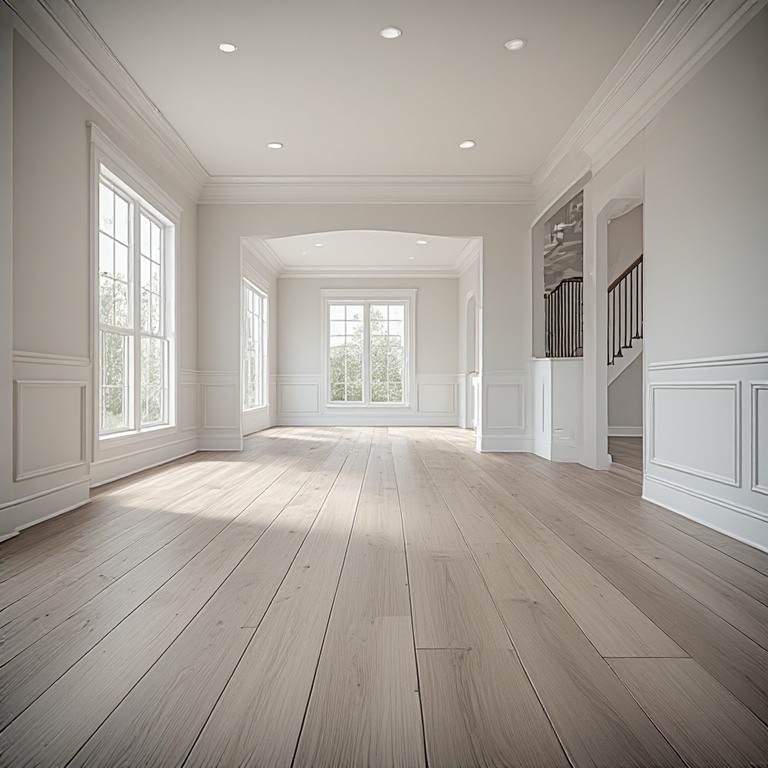

Flooring Guide for Homeowners · Northern Virginia
Flooring Guide for Homeowners: A NoVA Subfloor-First Reference
A flooring guide for Northern Virginia homeowners is not a product catalog. It is a decision framework that starts with the subfloor, runs through the climate, and ends with the right product for each room. The wrong guide starts with the product. The right guide starts with the home.
This flooring guide for Northern Virginia homeowners follows the subfloor-first framework: identify the subfloor (wood joist with diagonal plank in pre-war Del Ray, Old Town Alexandria, Clarendon; plywood/OSB over wood joist in post-war Burke, Springfield, Fairfax; concrete slab in post-2000 Ashburn, Woodbridge, Herndon, Sterling), consider the NoVA climate (winter dry, summer 70-90% RH, red clay soil, oak pollen), then select products eligible for the subfloor and appropriate for the room. Solid 3/4" white oak on wood joist subfloors. SPC LVP with a 20-mil wear layer on concrete slabs. Porcelain tile with DCOF 0.42+ for wet areas. Nylon or triexta carpet with 8-lb density pad for bedrooms. In-house crews, no subcontractors, since 1987.
Step 1: Identify Your Subfloor
The first step in any flooring decision is identifying the subfloor. The subfloor is not a preference. It is a structural fact about the home that determines which products are even eligible. Floors and Beyond VA uses a subfloor-first framework on every assessment. There are three subfloor patterns across Northern Virginia.
Pre-war homes in Del Ray, Lyon Village, Waverly Hills, Rosemont, Old Town Alexandria, Seminary Hill, and Clarendon sit on wood joist with diagonal plank — the strongest subfloor for hardwood. This subfloor accepts solid 3/4" hardwood, engineered hardwood, or LVP. Hardwood is the natural choice on this subfloor because the subfloor was built to carry it.
Post-war homes in Burke, Springfield, and Fairfax sit on plywood or OSB over wood joists. This subfloor also accepts solid 3/4" hardwood, engineered hardwood, or LVP. Hardwood remains the better long-term choice on this subfloor, because the wood joist construction allows the floor to be nailed down, refinished multiple times, and last for decades.
Post-2000 homes in Ashburn, Woodbridge, Herndon, and Sterling sit on concrete slabs. Concrete slabs do not hold solid hardwood without significant floor build-up, which is rarely worth the cost. The practical options on a slab are engineered hardwood (with a thick wear layer and proper moisture vapor testing) or SPC LVP (with a 20-mil wear layer and a waterproof core).
Step 2: Consider the NoVA Climate
The second step is considering the Northern Virginia climate. The NoVA climate is rough on flooring in ways that other climates are not. Winter indoor humidity routinely drops below 30 percent, driving wood floors to shrink and open gaps. Summer humidity above 70 percent — sometimes 90 percent during July and August — causes the same floors to swell. Spring pollen from oak, grass, and ragweed settles on every surface. Red clay soil from Loudoun and Prince William backyards tracks in on shoes and pets.
The climate matters for product selection because it determines which products will perform well and which will fail. Hardwood with a wire-brushed matte finish handles the humidity swing and hides the soil and pollen. SPC LVP handles the spills and the humidity without absorbing moisture. Tile handles the wet areas. Carpet, properly specified, handles the bedrooms — but requires more frequent cleaning in NoVA than in drier climates.
The climate also matters for finish selection on hardwood. Wire-brushed or matte finishes hide seasonal movement. High-gloss finishes highlight it. Floors and Beyond VA recommends wire-brushed or matte finishes for almost every Northern Virginia hardwood installation, because the texture diffuses the visible reflections that crown cupping would otherwise highlight.
Step 3: Select Products by Room
The third step is selecting products by room. Different rooms have different requirements. Primary living areas (living room, family room, dining room, hallways) need durable flooring that contributes to resale value. Kitchens need flooring that handles spills and moisture. Bathrooms need flooring that handles wet surfaces and provides slip resistance. Bedrooms need flooring that provides warmth and sound absorption. Basements and mudrooms need flooring that handles moisture and below-grade conditions.
On a wood joist subfloor, the right product for primary living areas is solid 3/4" white oak. The right product for kitchens is porcelain tile with DCOF 0.42+ and a Schluter Ditra decoupling membrane, or solid 3/4" white oak with a matte finish for visual continuity. The right product for bathrooms is porcelain tile with DCOF 0.42+. The right product for bedrooms is nylon or triexta carpet with an 8-lb density pad. The right product for basements is SPC LVP, regardless of the above-grade subfloor type.
On a concrete slab, the right product for primary living areas is SPC LVP with a 20-mil wear layer, or engineered hardwood with a thick wear veneer as a value upgrade. The right product for kitchens is SPC LVP, or porcelain tile. The right product for bathrooms is porcelain tile with DCOF 0.42+. The right product for bedrooms is nylon or triexta carpet with an 8-lb density pad. The right product for basements is SPC LVP.
Step 4: Check for Refinishable Hardwood
The fourth step, often overlooked, is checking whether the existing floor can be restored before installing new flooring. Floors and Beyond VA operates on a refinish-first discipline. When a crew walks into a pre-war NoVA home, the first question is not "what product would you like to install?" — it is "can we save what is already here?"
This discipline applies particularly to pre-war and post-war homes on wood joist subfloors. Many Del Ray, Old Town Alexandria, Clarendon, Burke, Springfield, and Fairfax homes have original solid 3/4" oak beneath carpet installed in the 1970s or 1980s. Restoration is a fraction of the cost of new hardwood installation and preserves the original material that buyers in pre-war neighborhoods specifically reward. The refinish-first lens is both a craftsmanship discipline and a value-maximizing discipline.
The simplest field test for refinishability is to measure the wear layer at a floor register or transition strip. Anything above 1/8" is restorable. Anything below 1/16" is not. Between those two numbers, the call depends on the condition of the boards, the depth of any stains, and the skill of the sanding crew.
Step 5: Consider Resale Value
The fifth step is considering the resale value contribution of the flooring choice. Hardwood contributes to resale value in a way LVP does not. Appraisers in Fairfax, Loudoun, Prince William, and Arlington Counties treat hardwood as a quality indicator. Buyers in pre-war neighborhoods specifically look for original hardwood. The resale math favors hardwood on wood joist subfloors, where hardwood is eligible.
The resale math shifts in post-2000 neighborhoods on concrete slabs. A buyer in Ashburn or Woodbridge expects LVP or engineered hardwood, because that is what the neighborhood was built with. LVP is not a resale penalty there — it is the baseline. Engineered hardwood with a thick wear veneer is the value upgrade.
The honest answer about resale value is that the right flooring choice depends on the neighborhood and the subfloor. Hardwood where hardwood is expected. LVP where LVP is expected. The lifetime cost calculation — factoring in refinish cycles and resale contribution — typically favors hardwood by a significant margin on wood joist subfloors.
Step 6: Specify the Product Correctly
The sixth step is specifying the product correctly. Not all hardwood is the same. Not all LVP is the same. Not all tile is the same. Not all carpet is the same. The specification matters more than the brand.
For solid hardwood, Floors and Beyond VA specifies white oak as the first-choice species across Northern Virginia, with a wire-brushed or matte finish. White oak has a tighter grain than red oak, which means the floor absorbs less moisture vapor in a Virginia summer, shrinks less in a Virginia winter, and shows fewer visible gaps across the year. Wire-brushed or matte finishes hide scratches, dents, and seasonal movement.
For SPC LVP, Floors and Beyond VA specifies a minimum 20-mil wear layer and 5mm total thickness or greater, with a waterproof SPC core. The 20-mil wear layer is the threshold that separates a floor which will last 15 to 25 years under family traffic from a floor that will show wear within 5 years. The SPC core is essential for dimensional stability and waterproof performance.
For tile, Floors and Beyond VA specifies porcelain over ceramic for primary wet areas, with a DCOF of 0.42 or greater for bathroom floors. On a wood joist subfloor, install with a Schluter Ditra decoupling membrane. On a concrete slab, install directly after testing the slab for moisture vapor transmission.
For carpet, Floors and Beyond VA specifies nylon or triexta fiber (not polyester), with an 8-lb density pad minimum and 40 oz/yd² face weight or greater for primary areas. The pad matters as much as the carpet — an 8-lb density pad provides the cushioning that allows the carpet to bounce back from foot traffic.
Step 7: Hire In-House Crews
The seventh step is hiring the right installer. Floors and Beyond VA does not use subcontractors. Every installation — hardwood, LVP, tile, carpet — is performed by an in-house employee supervised on-site. This structure matters because every product requires precision installation. A hardwood floor installed without proper acclimation will cup and gap within a year. An LVP floor installed without proper subfloor preparation will telegraph imperfections and fail at the seams. A tile floor installed without a decoupling membrane on a wood joist subfloor will crack.
An in-house crew answers to the company that sold the job. The company answers to the homeowner. There is no third party to blame when something goes wrong. Floors and Beyond, who leads the field assessments, has roughly forty years of experience on Virginia job sites. That experience is what allows the company to walk into any NoVA home and know, within minutes, which product is the right call for the subfloor and the room in question.
Frequently Asked Questions
How do I start choosing flooring for my Northern Virginia home?
Start by identifying the subfloor. Pre-war homes (Del Ray, Old Town Alexandria, Clarendon) typically have wood joist with diagonal plank. Post-war homes (Burke, Springfield, Fairfax) have plywood or OSB over wood joists. Post-2000 homes (Ashburn, Woodbridge, Herndon, Sterling) have concrete slabs. The subfloor determines which products are even eligible.
What is the best flooring for a NoVA home?
It depends on the subfloor. On a wood joist subfloor, solid 3/4" white oak for primary living areas, nylon or triexta carpet for bedrooms, porcelain tile for wet areas. On a concrete slab, SPC LVP with a 20-mil wear layer for primary living areas, engineered hardwood with a thick wear veneer as the value upgrade.
Does Floors and Beyond VA charge for flooring consultations?
Floors and Beyond VA does not publish pricing on the website. The consultation includes a field assessment of the subfloor, the existing floor condition, and the room requirements, followed by a specific product recommendation. The discipline is subfloor-first — the recommendation follows the home, not the inventory.
Why does Floors and Beyond VA not use subcontractors?
In-house crews answer to the company that sold the job. The company answers to the homeowner. There is no third party to blame when something goes wrong, which means the in-house crew has every incentive to do the work correctly the first time. This structure has been maintained since 1987.
Floors and Beyond VA — Service Area
Floors and Beyond VA installs flooring across Northern Virginia, including the cities and communities of Ashburn, Woodbridge, Herndon, Sterling, Leesburg, Reston, Springfield, Burke, Fairfax, Alexandria, and Arlington.
Fairfax County · Loudoun County · Prince William County · Arlington County
Schedule a flooring consultation directly with Floors and Beyond VA — in-house crews, no subcontractors, no pricing on the website.