
Looking for a
Hardwood Floor
Showroom?
There's a Better
Way to Choose.
A flooring showroom shows you samples under controlled lighting in an environment that looks nothing like your home. There's a reason the floor you loved in the store sometimes disappoints when it's installed.
⚠ Showroom
Small chips · Fluorescent lighting · No context from your walls, trim, or furniture · Off-site decision
✓ Shop-at-Home
Large samples · Your actual light · Your actual room context · Decision made where the floor will live
- The instinct to see samples before buying is exactly right — the showroom is just the wrong place to see them. The floor needs to be evaluated in the room where it will live, not in a controlled retail environment with different lighting.
- Three variables determine how a floor looks in your home that a showroom cannot replicate: your room's specific lighting, the floor's interaction with your existing trim and wall colors, and how the pattern reads at room scale vs. small-chip scale.
- Shop-at-home solves all three — large samples come to your actual room, evaluated under your actual light, next to your actual furniture and finishes.
- Floors and Beyond provides free shop-at-home consultations across Fairfax, Loudoun, Prince William, and Arlington — including measurements, subfloor assessment, moisture testing on concrete where needed, and a written estimate. No showroom visit required.
- Hardwood is the most light-sensitive flooring category — warm tones cool down significantly under certain artificial light, and cool gray tones can shift dramatically between morning north light and afternoon south light. This is the category where in-room evaluation matters most.
- If you do visit a showroom, the guide below covers exactly how to use what you see there to narrow your options, and what questions to ask so the eventual in-home evaluation is more focused.
You searched for a hardwood floor showroom because you want to see and touch the floor before committing to it. That instinct is completely right — flooring is one of the largest interior surfaces in your home and a decision made from a catalog photo or a two-inch sample chip is a poorly informed one. The showroom exists to serve that instinct. The problem is that it serves it badly.
The lighting in every flooring showroom is designed to make floors look their best. The samples are mounted on walls or laid on display at optimal angles. There is nothing in the showroom that resembles the specific combination of your room's north-facing windows, your cream-colored trim, your medium-brown furniture, and the warm incandescent light over your dining table at 7 PM. Those variables — not the sample chip — determine whether a floor looks the way you hoped once it's installed.
Floors and Beyond has provided free shop-at-home consultations across Northern Virginia since 1987 specifically because the in-home evaluation is the one that actually predicts satisfaction with the finished floor. Here is the honest guide to why showrooms fall short, what to do instead, and how to use both well if you're in the process of choosing.
Why Flooring Showrooms Are the Wrong Place to Make a Final Decision
Showrooms are designed for browsing, not deciding — the controlled environment that makes every floor look appealing is precisely what makes showroom selection unreliable as a predictor of how a specific floor will look in a specific room.
Flooring showrooms use bright, even, color-neutral lighting that makes all floors look clean and consistent. Your home has warm incandescent light in the evening, directional natural light that changes through the day, and specific fixture positions that create shadows and highlights in particular places. A warm amber-toned hardwood that looks rich and balanced under showroom lighting can read as orange under your warm incandescent bulbs. A cool gray LVP that looks sophisticated under showroom fluorescents can shift toward blue or green under morning north light in a room with cool-toned walls. These shifts are not subtle — they are the difference between a floor you love and a floor you wish you'd chosen differently.
A 3-inch sample chip shows you the surface color and approximate texture of a floor. It cannot show you how the floor's natural grain variation distributes across a full room — whether the pattern looks organic and natural at scale or busy and chaotic. It cannot show you how the finish reflects light across a large open area. Wide-plank hardwood (5 inches and wider) in particular looks dramatically different at room scale than it does as a small chip, because the broader plank width changes how the grain pattern and natural color variation read at a distance. A 12-inch or larger sample begins to show this — a 3-inch chip does not.
Floor selection is contextual — the right floor for your room is the one that works with your specific wall color, your trim color, your cabinet finish (if the floor runs into the kitchen), and your primary furniture. A floor that looks perfect next to the showroom's staged display might fight with your cream-painted trim or compete with your dark walnut dining table. The only way to evaluate this is to see the sample in your actual room, next to your actual context. This is what shop-at-home makes possible and what a showroom visit cannot.
The showroom visit is structured as a decision-making event — you're there, the salesperson is there, the samples are there, and the implicit expectation is that the visit ends with a selection. That timeline rarely matches the actual pace at which a good flooring decision is made: see the samples, live with them in the room for a day, evaluate them in morning and evening light, reconsider against the wall color. Shop-at-home leaves the samples with you. The decision gets made at the pace it should be made.
What Is the Shop-at-Home Process — and What Happens During a Floors and Beyond Consultation?
A shop-at-home consultation brings a curated selection of large floor samples to your home — evaluated in your actual room, under your actual light, with your actual room context — along with a subfloor assessment, measurements, and a written estimate, at no charge.
Floors and Beyond's owner Floors and Beyond — with 40 years of Northern Virginia flooring experience — brings a curated selection of samples chosen for your project based on the conversation that precedes the visit: the room size, the existing finishes, the style direction, and the durability requirements. You're not browsing a warehouse; you're evaluating options that have already been filtered for your specific situation.
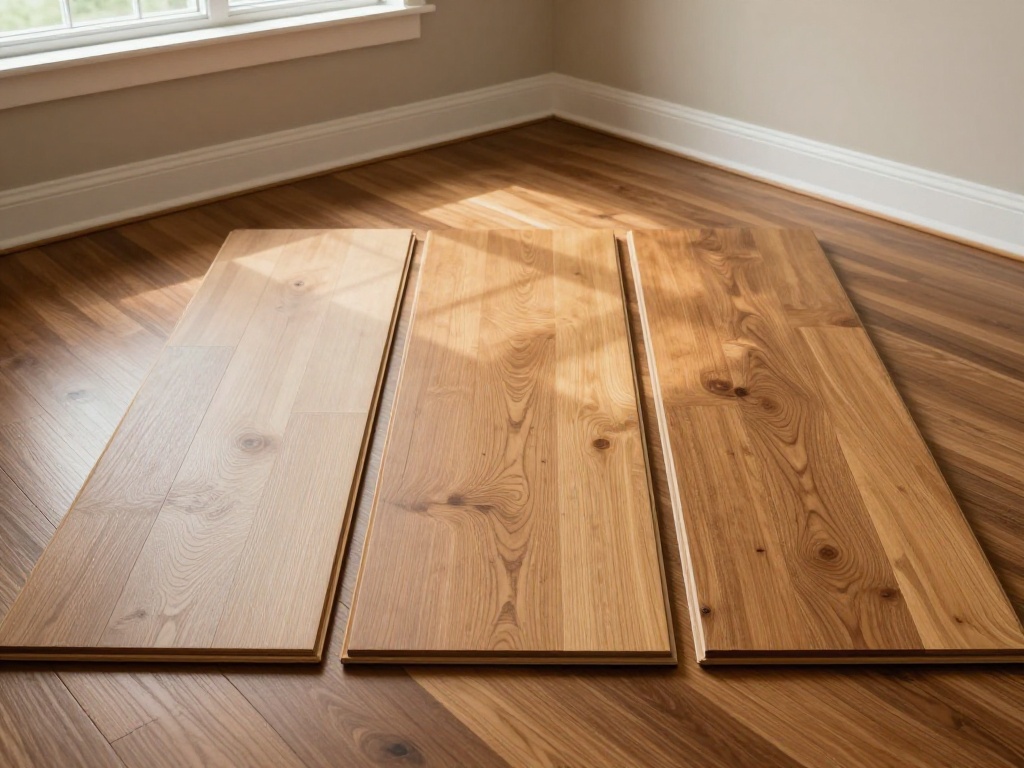
Large samples are laid flat on the floor in the room where the floor will be installed — not held up, not propped against a wall. You walk around them, view them from standing height, from across the room, and from the doorway. You see them next to your trim, your furniture, your walls. You see them in natural morning light and in your evening artificial light.
While the samples are being evaluated, Floors and Beyond assesses the subfloor condition, checks for relevant moisture concerns (particularly for concrete-subfloor rooms and below-grade spaces), and notes any conditions that affect the installation specification. In Northern Virginia's clay-soil market, this step regularly changes the product recommendation — and it's done at the consultation, not after the floor has been ordered.
Rooms are measured precisely, the selected product is confirmed, and a written estimate is provided before the consultation ends. There's no second appointment, no follow-up estimate that arrives days later, and no pressure to commit on the day. The estimate is yours to compare and consider on your timeline.
If you want to live with the samples for a day or two — see them in morning and evening light, show them to a partner or designer — the samples stay. The decision is made when it's right, not when the showroom visit ends.
How to Evaluate a Hardwood Floor Sample in Your Own Home
If you have samples in hand — from Floors and Beyond or from any source — four evaluation techniques consistently produce better floor selection decisions than showroom browsing alone.
Evaluate every sample under three conditions: natural morning light, natural afternoon light, and your primary evening artificial lighting. Warm amber incandescent and LED bulbs shift warm-toned floors orange and cool-toned floors toward green or gray. Daylight color temperature (5000–6500K) is closest to neutral evaluation but rarely matches what your home's evening atmosphere actually looks like at 7 PM. A floor that looks perfect in only one of these conditions is a floor that will read differently at different times of day.
A sample held at waist height under overhead light is showing you almost nothing about how that floor will look. Lay it flat on the existing floor, stand back to your normal standing height, and look at it from across the room. Look at it from the doorway. The angle at which you view a floor in normal use — raking across its surface from a standing position — is completely different from a straight-down view, and hardwood finishes in particular change substantially depending on viewing angle.
Slide the sample up against the baseboard trim, adjacent to a cabinet door, or next to the largest piece of furniture that will sit on the floor. The floor's relationship to adjacent finishes — particularly trim and cabinets — is one of the most underweighted factors in showroom selection and one of the most immediately obvious once a floor is installed. Cool gray floors fight with warm cream trim. Very dark floors disappear next to dark furniture. Very light floors compete with blonde cabinetry. These relationships are invisible in a showroom and obvious the moment a sample is placed in context.
If you are visiting showrooms, ask specifically for 12-inch or larger samples rather than the standard 3–6 inch chips. Most showrooms have larger samples available on request — they're just not the default because they're harder to handle and display. Wide-plank hardwood (5 inches and wider) should ideally be evaluated on a sample that shows at least two full planks side by side, because the grain variation between planks is part of the installed floor's appearance that a single chip cannot represent.
Showroom vs. Shop-at-Home — The Side-by-Side
Both have a legitimate role in the floor selection process — showrooms are useful for narrowing product categories and understanding price ranges, while shop-at-home is where the actual decision should be made.
| Evaluation Factor | Showroom | Shop-at-Home |
|---|---|---|
| Lighting accuracy | Showroom lighting — not your home's lighting | Your actual room's lighting conditions |
| Sample size | 3–6 inch chips (standard) — request larger | 12+ inch samples — room-scale grain visible |
| Room context | Generic showroom staging — not your trim, walls, furniture | Your actual room, your actual finishes |
| Breadth of options | Excellent — see full product range in person | Curated selection — fewer total options |
| Price range clarity | Good — can compare price tiers in person | Written estimate provided at same visit |
| Subfloor assessment | Not possible — you're not at the project site | Done during consultation, informs product spec |
| Decision timeline | Implicit pressure to decide during visit | Samples stay with you — decide on your timeline |
| Best use | Narrowing product categories, understanding price tiers | Making the actual final selection decision |
The Honest Recommendation
"If visiting showrooms helps you narrow from five product categories down to two — that's exactly what showrooms are good for. But the decision between the two finalist options should happen in your room, in your light, next to your trim. Every time we hear 'the floor looked different than I expected,' it comes back to a decision that was made in the showroom rather than in the home."
Floors and Beyond provides free shop-at-home consultations across Fairfax, Loudoun, Prince William, and Arlington — samples, measurements, subfloor assessment, and written estimate at no charge.
Schedule a Free Shop-at-Home VisitQuestions to Ask Any Flooring Contractor or Showroom Salesperson
Whether you're at a showroom or in a shop-at-home consultation, these five questions consistently surface the information that determines whether you're getting the right floor for your specific situation.
- "Can I see a larger sample — at least 12 inches — rather than the standard chip?" If the answer is no, you're making a final decision from insufficient information. Most contractors and showrooms can provide larger samples on request, especially for expensive products.
- "What is the wear layer thickness on this specific product?" For LVP, this is the single most important durability spec. For hardwood, the equivalent question is the sanding depth available for future refinishing. A product's appearance and its durability are two separate specifications.
- "Does this product require moisture testing on my concrete subfloor before installation?" Most quality LVP and all hardwood products require documented subfloor moisture levels within spec before installation. If the answer is "it's fine for concrete" without asking about your specific slab, that's a gap in the consultation.
- "What does the warranty cover in my specific use case — and what voids it?" Product warranties have specific conditions around installation requirements, subfloor preparation, and maintenance protocols. Knowing what voids the warranty before installation is essential, not optional.
- "Who installs — is it your crew or a subcontractor?" The answer matters because warranty accountability, scheduling reliability, and post-installation support all change depending on whether the installer is the same organization as the supplier. Floors and Beyond uses in-house crews only across all projects in Fairfax, Loudoun, Prince William, and Arlington.
Frequently Asked Questions About Shop-at-Home Flooring
What is shop-at-home flooring and how does it work?
Shop-at-home flooring is a service where a flooring specialist brings a curated selection of large floor samples directly to your home for evaluation. Rather than choosing from small chips under showroom lighting, you see full-size samples in your actual room, under your natural light, next to your existing furniture, trim, and wall colors. Floors and Beyond provides free shop-at-home consultations across Fairfax, Loudoun, Prince William, and Arlington counties in Northern Virginia, including measurements, subfloor assessment, moisture testing where relevant, and a written estimate — all at no charge.
Why is a flooring showroom a poor place to make a final decision?
Three factors combine to make showroom floor selection unreliable as a predictor of how a floor will look in your home: showroom lighting is controlled and differs dramatically from your home's natural and artificial lighting; small sample chips cannot show how the floor's grain pattern and color variation behave at room scale; and you cannot evaluate how the floor interacts with your specific wall colors, trim, furniture, and other finishes. These three factors are not minor variables — they're the primary determinants of whether a floor looks the way you hoped once it's installed.
What should I look for when evaluating hardwood floor samples at home?
Evaluate samples in your actual room under three lighting conditions: natural daylight (morning and afternoon if possible), your primary artificial lighting at night, and from multiple angles to see how the grain and finish respond to raking light. Place the sample flat on the floor — not held up — adjacent to your trim, cabinets, or largest furniture piece. View it from standing height and from across the room. Look for how the floor's color shifts across the day and evening, and whether it works with your existing finishes from multiple viewing distances.
Is the Floors and Beyond shop-at-home consultation really free?
Yes. Floors and Beyond's shop-at-home consultation — which includes large samples brought to your home, a subfloor and moisture assessment, room measurements, and a written estimate — is provided at no charge and with no obligation. Floors and Beyond handles all consultations personally. No down payment is required until you decide to proceed with the project, and the estimate is yours to compare on whatever timeline makes sense for your decision.
// Free Shop-at-Home Consultation · Northern Virginia
See the Floor
in Your Room
Before You Decide.
Floors and Beyond brings large samples to your home, assesses your subfloor, measures your rooms, and provides a written estimate — all at no charge. Serving Fairfax, Loudoun, Prince William, and Arlington since 1987.
Schedule a Free Visit



