
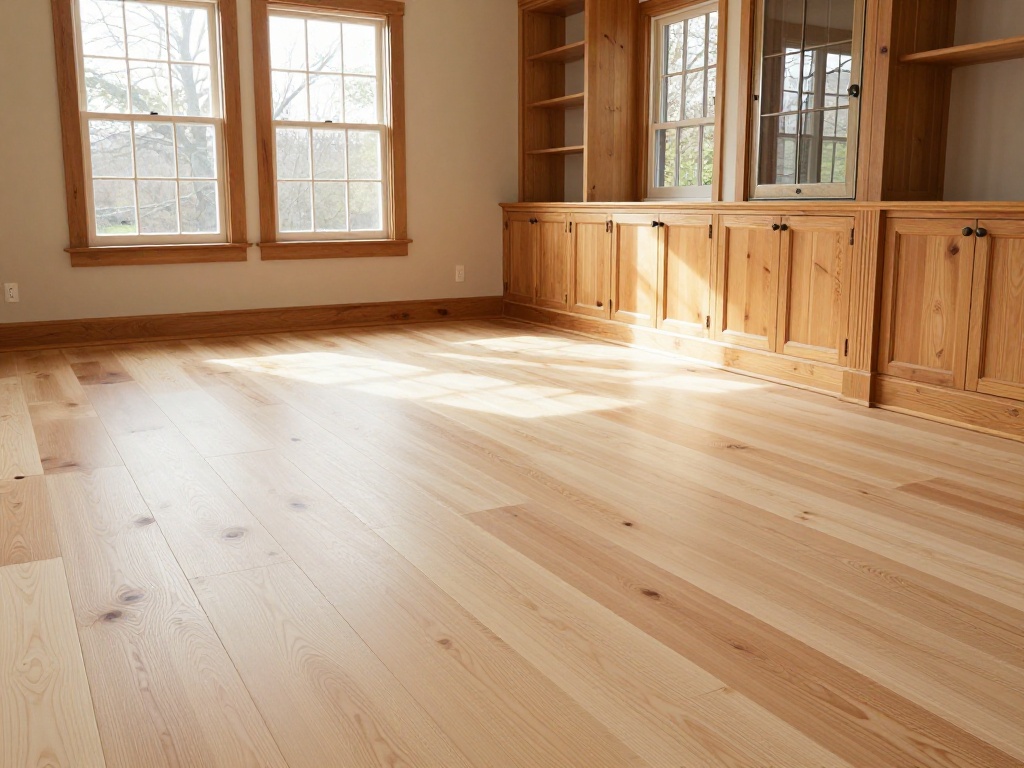
Hardwood Floor
Installation in
Northern Virginia:
Start With
the Subfloor.
Northern Virginia's housing stock spans nearly a century of construction — and each era has different subfloor conditions that determine whether solid hardwood, engineered hardwood, or a hardwood-look alternative is the correct specification. The honest guide starts here.
Plank subfloor, pier-and-beam or basement. Nail-down solid hardwood. Original floors often refinishable.
Plywood or OSB over joists. Nail-down or staple-down solid or engineered hardwood.
Concrete slab prevalent. Engineered hardwood glue-down or LVP — solid hardwood not appropriate.
- The subfloor determines the correct hardwood specification — solid hardwood requires a wood joist subfloor (nail-down); concrete slabs require engineered hardwood (glue-down or float) or LVP; mixed subfloor conditions require room-by-room assessment before any product is ordered.
- Solid hardwood should not be installed on concrete slabs — moisture vapor emission from concrete will cause solid hardwood to cup, swell, and fail regardless of surface sealing. Post-2000 NoVA colonials, townhomes, and condos are frequently on concrete, making engineered hardwood the correct hardwood specification.
- Northern Virginia's pre-war housing stock (Lyon Village, Old Town Alexandria, Cherrydale, Del Ray) has ideal conditions for nail-down solid hardwood — original plank subfloors over pier-and-beam provide excellent fastener holding and original floors are frequently in refinishable condition.
- Acclimation is non-negotiable in Northern Virginia — the region's high summer humidity makes the acclimation step more important than in drier markets; solid hardwood that is not acclimated properly in NoVA conditions will show gapping or cupping within the first year.
- Floors and Beyond installs hardwood throughout Fairfax, Loudoun, Prince William, and Arlington — solid nail-down on wood joist subfloors, engineered hardwood on concrete, and refinishing for existing floors — with free subfloor assessment, moisture testing, and written estimates at no charge.
Hardwood floor installation in Northern Virginia is not one problem — it's three, depending on when the home was built. A 1932 craftsman in Lyon Village, a 1964 ranch in Cherrydale, and a 2005 colonial in Ashburn all have different subfloor conditions that require different products and installation methods. Approaching all three the same way is how hardwood installations fail.
Floors and Beyond has installed hardwood across Northern Virginia's full housing spectrum for nearly four decades. The first thing assessed on every hardwood consultation is the subfloor — not the species, not the stain color, not the plank width. The subfloor determines the correct product. Everything else is secondary. This guide covers that assessment by housing era, and what the right hardwood specification looks like for each.
Northern Virginia's Housing Eras — Subfloor Conditions and What They Mean
The correct hardwood specification in a Northern Virginia home is determined by construction era and foundation type. Here is the honest breakdown by era — and what Floors and Beyond recommends for each.
Northern Virginia's pre-war housing stock — craftsman bungalows and colonial revivals in Arlington's Lyon Village and Waverly Hills, Alexandria's Del Ray and Old Town, and Fairfax County's established older neighborhoods — was built on pier-and-beam or full-basement foundations with diagonal plank subfloors. These are some of the best conditions for nail-down solid hardwood that exist: the plank subfloor provides excellent fastener holding, the pier-and-beam or basement foundation keeps the subfloor at grade rather than on concrete, and the original hardwood floors in many of these homes are still in place and frequently in refinishable condition.
Floors and Beyond's first recommendation for any pre-war Northern Virginia home: assess the existing floors before discussing new product. Original 2.25-inch strip oak in these homes is old-growth timber that is denser and more stable than anything milled today — properly refinished, it outperforms any new hardwood installation at any price point. Where new hardwood is needed (addition, room conversion, matching extension), 3/4-inch solid nail-down in the original species is the correct specification.
Northern Virginia's post-war residential expansion produced a large stock of ranches, split-levels, and colonials in Fairfax, Prince William, and Loudoun that typically have plywood or OSB subfloor over wood joists — sometimes with original strip oak floors still in place, sometimes with carpet or vinyl over the subfloor. These homes are generally good candidates for nail-down solid hardwood installation where new flooring is needed, though the subfloor condition should be assessed before specifying the product. Some post-war homes in this era, particularly first-floor additions and finished basements, were built on concrete slabs — which changes the specification entirely.
The original strip oak floors common to 1950s–1970s post-war Northern Virginia homes are frequently in better condition than homeowners expect — surface wear, dullness, and dated finish are all refinishable conditions, not replacement triggers. Floors and Beyond assesses post-war NoVA floors with the same refinish-first approach as pre-war homes before recommending new hardwood.
The post-1990 residential construction that dominates Northern Virginia's Loudoun County communities (Ashburn, Leesburg, Broadlands, Lansdowne), Prince William County (Woodbridge, Manassas, Dumfries), and Fairfax County's newer subdivisions is predominantly concrete slab construction. Solid hardwood should not be installed on concrete slabs — moisture vapor emission from the slab will cause solid hardwood to cup, swell, and fail. The correct hardwood specification for these homes is engineered hardwood, which has a real wood veneer over a plywood or HDF core that tolerates concrete slab conditions after moisture vapor testing confirms emission is within acceptable limits.
Where engineered hardwood is not appropriate (elevated moisture vapor, budget constraints, or fully below-grade installations), SPC LVP provides a hardwood-look alternative that is 100% waterproof and appropriate for any moisture condition. Floors and Beyond performs calcium chloride or in-situ RH moisture testing before any concrete slab engineered hardwood specification.
Hardwood Installation Methods — Nail-Down, Glue-Down, and Floating
The three installation methods for hardwood flooring — each with specific subfloor requirements and specific product compatibility in Northern Virginia's housing conditions.
The traditional installation method for 3/4-inch solid hardwood. Cleats or staples are driven through the tongue of each plank into the wood joist subfloor below. Requires a wood subfloor of adequate thickness — typically 3/4-inch plywood or diagonal plank — that provides sufficient fastener holding. This is the correct method for pre-war and post-war Northern Virginia homes with wood joist subfloors. Cannot be used on concrete slabs.
Engineered hardwood is adhered directly to a concrete slab using urethane adhesive after moisture vapor testing confirms the slab is within acceptable emission limits. Glue-down provides the most rigid feel underfoot — similar to nail-down solid hardwood — and is the preferred engineered hardwood installation method on concrete in Northern Virginia. Requires careful adhesive selection (urethane adhesive tolerates more moisture vapor than traditional mastic), slab preparation (flatness within 3/16" per 10 feet), and a moisture vapor barrier or moisture-tolerant adhesive in most NoVA slab conditions.
Floating installation connects planks to each other with click-lock joints — nothing is attached to the subfloor. Engineered hardwood can be floated over both concrete and wood subfloors; LVP is almost always installed floating. The advantage: no adhesive, no fasteners, easier installation over existing flooring, and the ability to remove the floor without damaging the substrate. The limitation: slightly more "give" underfoot compared to glue-down or nail-down. For most Northern Virginia engineered hardwood installations on concrete slabs, Floors and Beyond specifies glue-down over floating for the more solid feel underfoot, but both are viable methods.
The Hardwood Installation Process — What to Expect
What a Floors and Beyond hardwood installation in Northern Virginia actually involves — from the initial consultation through the final walkthrough.
The consultation begins with a subfloor assessment — foundation type, subfloor material, flatness measurement, and moisture testing where concrete is present. This determines the correct product specification before any samples are reviewed or product is ordered. For pre-war and post-war homes, we also assess existing floors for refinishing viability before recommending new hardwood.
Once the subfloor assessment determines the correct product (solid vs. engineered, species, width, finish), product is ordered and delivered to the home 3–5 days before installation for solid hardwood acclimation. Planks are stored in the installation rooms at living temperature and humidity to reach equilibrium. This step is non-negotiable in Northern Virginia — skipping or shortening it causes gapping or cupping in the first year. Engineered hardwood requires 24–48 hours of acclimation. LVP requires none.
High spots are sanded flat, low spots are filled with leveling compound, squeaky boards are secured, and any moisture vapor barriers or primers are applied where needed. For concrete slab installations, the slab is cleaned, tested for flatness, and prepared per the adhesive or moisture barrier manufacturer's specification. Proper subfloor prep is what prevents post-installation issues — it's the step that takes longer than expected and the step that should never be rushed.
Nail-down, glue-down, or floating installation per the method specified for the subfloor condition. The installation itself typically takes 1–2 days for a standard-size Northern Virginia home. Transitions, thresholds, and stair nose details are addressed as part of the installation. All work is performed by Floors and Beyond's in-house crews — no subcontractors on any Northern Virginia hardwood installation.
A final walkthrough confirms everything meets specification, transitions are secure, and any installation concerns are addressed before the crew leaves. Floors and Beyond provides written care instructions for the first year — what cleaning products to use, what to avoid, how to manage humidity in NoVA's seasonal climate to protect the investment, and when to schedule the first maintenance coat if applicable.
Species and Finish Selection for Northern Virginia's Humidity
Northern Virginia's high summer humidity (regularly 70–85% RH in Fairfax and Loudoun counties) affects species selection — harder, denser species with lower movement coefficients perform better in NoVA's climate than softer species with high seasonal movement.
| Species | Janka Hardness | Humidity Movement | NoVA Suitability |
|---|---|---|---|
| White Oak | 1360 lbf | Low — tight grain resists seasonal movement | Excellent — first choice for NoVA humidity |
| Red Oak | 1290 lbf | Moderate — slightly more movement than white oak | Very good — the most common NoVA hardwood historically |
| Hard Maple | 1450 lbf | Moderate — can show more seasonal gapping | Good — suitable with proper acclimation and humidity control |
| Hickory | 1820 lbf | Moderate — harder than oak but more movement-prone | Good — excellent durability, manage humidity carefully |
| Brazilian Cherry (Jatoba) | 2350 lbf | High — significant seasonal movement in NoVA humidity | Challenging — requires very careful humidity control year-round |
| Pine | 870–1225 lbf | High — softwood with significant seasonal movement | Not recommended for NoVA primary living areas |
From Floors and Beyond
"White oak is our most frequently specified new hardwood in Northern Virginia right now — not just because it's the contemporary aesthetic choice, but because it's genuinely better suited to the region's humidity than the exotic species that were popular in the 2000s and 2010s. The tight grain structure and lower seasonal movement make it a more stable long-term floor in NoVA's climate. Red oak is equally good and better for homeowners matching existing floors."
Floors and Beyond installs hardwood throughout Fairfax, Loudoun, Prince William, and Arlington — free subfloor assessment, moisture testing, species guidance, and written estimate at no charge.
Schedule a Free Hardwood ConsultationFrequently Asked Questions — Hardwood Installation in Northern Virginia
Can hardwood floors be installed on a concrete slab in Northern Virginia?
Solid hardwood should not be installed directly on a concrete slab — moisture vapor emission from concrete will cause solid hardwood to cup, swell, and fail regardless of surface sealing. For Northern Virginia homes on concrete slabs (common in post-2000 colonials, townhomes, and condos in Ashburn, Woodbridge, and Loudoun County), the correct hardwood specification is engineered hardwood — real wood veneer over a plywood or HDF core that tolerates moisture vapor better than solid wood. Engineered hardwood can be glued down or floated over concrete after moisture vapor testing confirms emission levels are within acceptable limits. Floors and Beyond performs moisture testing before any concrete slab hardwood or engineered hardwood installation.
How long does hardwood floor installation take in Northern Virginia?
Hardwood floor installation typically takes 2–3 days for the active installation work, but the total project timeline includes mandatory acclimation. Solid hardwood requires 3–5 days of on-site acclimation before installation — the planks must be stored in the installation rooms at living temperature and humidity to reach equilibrium with the home's environment. This is especially important in Northern Virginia given the region's high summer humidity. Engineered hardwood requires 24–48 hours of acclimation. LVP requires none. Floors and Beyond includes the acclimation timeline in the written estimate for every hardwood project.
Does Floors and Beyond install hardwood floors in Northern Virginia?
Yes. Floors and Beyond installs hardwood floors throughout Northern Virginia — solid hardwood nail-down on wood joist subfloors, engineered hardwood glue-down or floating on concrete slabs, and hardwood refinishing for existing floors across Fairfax, Loudoun, Prince William, and Arlington counties. All installation is performed by in-house crews only; no subcontractors. Free shop-at-home consultations are available throughout Northern Virginia, including subfloor assessment, moisture testing, species selection guidance, and written estimates at no charge.
What is the best hardwood species for Northern Virginia's climate?
White oak is Floors and Beyond's first-choice recommendation for new hardwood in Northern Virginia — its tight grain structure gives it lower seasonal movement than most other domestic species, making it more stable in NoVA's high summer humidity. Red oak is equally suitable and better for homeowners matching existing floors (the most common hardwood in NoVA's pre-war and post-war homes is red oak). Avoid high-movement exotic species (Brazilian cherry, teak) in Northern Virginia without very careful year-round humidity control. Species with high Janka hardness (hickory at 1820 lbf) are durable but require careful attention to acclimation given their movement characteristics in humid conditions.
// Free Hardwood Consultation · Northern Virginia
New Hardwood Floors
in Northern Virginia
Start With a
Free Assessment.
Floors and Beyond assesses your subfloor, tests moisture where concrete is present, evaluates any existing floors for refinishing viability, and provides a written estimate — at no charge and no obligation. In-house crews throughout Fairfax, Loudoun, Prince William, and Arlington. Since 1987.
Schedule a Free Consultation



