
Flooring in
Ashburn, VA:
The Builder-Floor
Upgrade Guide.
Most Ashburn homes were built with builder-grade flooring on concrete slabs between 1995 and 2020. That construction wave is now hitting the natural upgrade point — and the right floor for an Ashburn slab home is not the same product that was installed when the house was new.
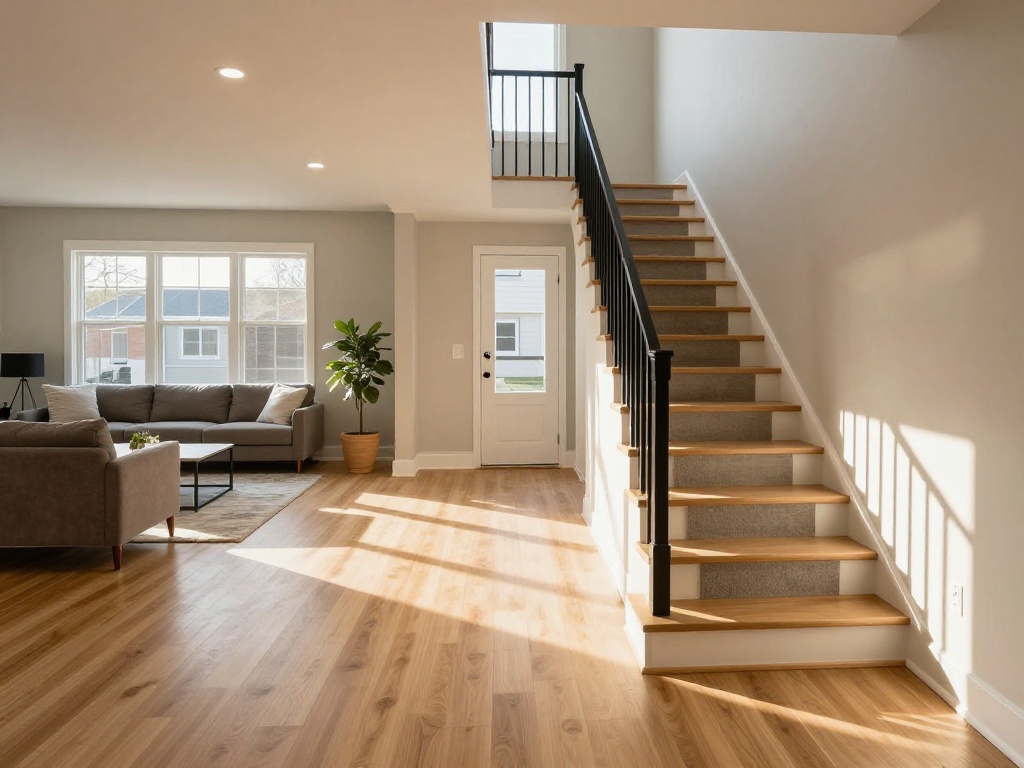
- Most Ashburn homes are on concrete slabs — solid hardwood is not appropriate. The correct primary options are SPC LVP (20 mil+ wear layer) and engineered hardwood after a slab moisture test.
- Builder-grade flooring in Ashburn's 2000–2015 construction wave is now at the natural replacement point — thin-core LVP (6–8 mil wear layer) compresses, builder laminate delaminates near moisture, and both look dated next to renovated kitchens and baths.
- The wear layer is the most important upgrade specification: builder-grade LVP at 6–8 mil wears through in high-traffic areas within 8–12 years; quality replacement LVP at 20+ mil is rated for 15–25 years in residential use.
- Ashburn's clay-heavy Loudoun County soil means slab moisture vapor emission is measurably elevated in this area — concrete moisture testing before installation is not optional, it determines product eligibility and warranty validity.
- Most Ashburn planned communities have HOA flooring guidelines — primarily around acoustic ratings in townhomes and attached homes, and occasionally around finish color restrictions. Floors and Beyond reviews HOA documentation before every Ashburn installation.
- Floors and Beyond serves all Ashburn communities — Brambleton, Broadlands, Lansdowne, Belmont Country Club, One Loudoun, and surrounding Loudoun County neighborhoods — with in-house crews and free shop-at-home consultations.
Ashburn is Northern Virginia's most complete planned-community landscape — Brambleton, Broadlands, Lansdowne, Belmont Country Club, One Loudoun, and dozens of smaller subdivisions built across a 30-year wave of Loudoun County residential development. The homes are well-designed, well-maintained, and almost universally built on concrete slabs with builder-grade flooring that was chosen to a price point, not a quality standard.
That 2000–2018 construction wave is now 8–25 years old. The thin LVP installed in a 2008 Brambleton townhouse and the laminate in a 2003 Broadlands single-family home are both reaching the end of their practical lives — wearing through in traffic paths, delaminating near thresholds, or simply reading as dated next to the kitchen renovation the owners did three years ago. This is the natural upgrade cycle for Ashburn's housing stock, and it's the primary flooring project Floors and Beyond handles across Loudoun County.
Builder-Grade vs. Quality Replacement Flooring: What's Actually Different
Builder-grade flooring is specified to meet a minimum acceptable standard at the lowest cost — quality replacement flooring is specified to the actual performance requirements of the room and the homeowner's timeline. The gap between them is larger than the price difference suggests.
Five Signs Your Ashburn Builder Floors Have Reached the End of Their Life
Builder-grade flooring doesn't fail dramatically — it degrades gradually in ways that become undeniable at a certain point. Here are the five indicators that the replacement threshold has been crossed.
- Visible wear paths in high-traffic areas: The kitchen-to-family-room path, the hallway from the front door to the kitchen, and the top of the stairs are where builder-grade wear layers fail first. When the wear layer is breached, the photographic print layer beneath it scratches and scuffs in ways that cannot be remedied without replacement
- LVP that feels soft or spongy underfoot: WPC-core and thin PVC-core builder LVP compresses under sustained furniture weight and high foot traffic over time. When the floor feels different underfoot in trafficked paths than in low-use areas — softer, slightly spongy — the core has permanently compressed and the structural integrity of the plank is compromised
- Laminate that has swollen or lifted at seams: Builder-grade laminate in Ashburn homes near kitchen thresholds, dishwashers, or bathroom transitions shows moisture damage as edge swelling and joint lifting. This is HDF core failure from moisture — it is not repairable and indicates the floor needs replacement
- Surface scratches through to the print layer: Builder LVP's thin wear layer means cat or dog scratches, furniture legs, and dropped items can penetrate through to the photographic print layer below, creating highly visible marks that cannot be refinished away. Quality replacement LVP's 20+ mil wear layer resists penetration significantly better
- The floor reads as dated next to updated finishes: Ashburn's renovation activity — kitchen and bath updates are extremely common in the 10–15 year post-purchase window — regularly results in a floor that was acceptable when everything else was also builder-grade looking significantly mismatched against new tile backsplash, quartz counters, and painted cabinets
The Right Flooring for Ashburn's Major Communities
Ashburn's planned communities were built across different construction eras, at different price points, and with different subfloor specifications — the right flooring upgrade depends on the community's construction period and the home type within it.
Brambleton is Ashburn's largest planned community and spans 17 years of construction — the earliest townhomes are now over 20 years old and their builder-grade laminate or thin LVP is well past the replacement point. Single-family homes in later Brambleton phases (2012–2020) often have builder LVP that's now showing wear path compression. The uniform concrete slab construction across Brambleton means SPC LVP is the standard replacement specification, with engineered hardwood appropriate for first-floor living areas after a moisture test. Brambleton's townhome sections require acoustic underlayment review for HOA compliance.
Broadlands is one of Ashburn's earliest large planned communities — the oldest homes are nearly 30 years old, and their original flooring is almost entirely past its service life. Builder laminate from the late 1990s and early 2000s in Broadlands homes shows the characteristic HDF moisture failure at thresholds and under sink areas. Single-family home first floors in Broadlands often have hardwood-look laminate that reads authentically dated against any post-2015 kitchen or bath renovation. SPC LVP replacement is the primary Broadlands project for Floors and Beyond.
Lansdowne's longer construction timeline and mix of attached and detached homes means subfloor conditions vary more than in Brambleton or Broadlands. Some Lansdowne single-family homes from the late 1990s have plywood-over-joist subfloors that support nail-down hardwood — a different specification than the concrete slab homes. Floors and Beyond assesses each Lansdowne home individually because the subfloor assessment genuinely changes the product recommendation here more than in any other Ashburn community.
Belmont Country Club's luxury single-family homes represent Ashburn's highest residential price tier — homes where the flooring specification should match the overall quality level of the construction, not default to LVP because the subfloor is concrete. Engineered hardwood in 5-inch and wider planks, properly installed over a moisture-tested concrete slab, is the correct specification for Belmont Country Club's first-floor living areas. Floors and Beyond has installed engineered hardwood in Belmont Country Club for over a decade and specifies based on the specific room, slab moisture condition, and aesthetic direction of each home.
Why Concrete Moisture Testing Is Non-Negotiable in Ashburn
Ashburn sits on Loudoun County's clay-heavy soil — the same geology that creates elevated slab moisture vapor emission throughout Northern Virginia — and any flooring installation on a concrete slab in Ashburn requires moisture testing before product selection, not as a formality but because the test result genuinely determines product eligibility.
| Slab Moisture Result | SPC LVP | Engineered Hardwood | Solid Hardwood |
|---|---|---|---|
| Below 75% RH (ASTM F2170) | Appropriate — with vapor barrier | Appropriate — most products eligible | Never on concrete — regardless of moisture result |
| 75–80% RH | Appropriate — vapor barrier critical | Check product-specific RH tolerance — some eligible, some not | Not appropriate |
| Above 80% RH | Some SPC products eligible — verify warranty | Not appropriate — exceeds most engineered hardwood tolerances | Not appropriate |
| Untested | Not appropriate — voids warranty | Not appropriate — voids warranty | Not appropriate |
From Floors and Beyond
"Ashburn's clay soil is the same geology as the rest of Northern Virginia — it holds moisture and transfers it upward through slabs at rates that vary significantly from slab to slab, even in the same community. We've tested adjacent homes in Brambleton and gotten readings 15 percentage points apart. The test takes 24 hours and it determines everything about the installation. There's no version of this where we skip it."
Floors and Beyond serves all Ashburn communities with free shop-at-home consultations — large samples, concrete moisture testing, measurements, and a written estimate at no charge.
Schedule a Free Ashburn ConsultationFrequently Asked Questions — Flooring in Ashburn, VA
What is the best flooring for Ashburn, VA homes?
Most Ashburn homes were built on concrete slabs between 1995 and 2020, which means solid hardwood is not appropriate as a primary flooring option. The best flooring for most Ashburn homes is SPC (stone polymer composite) LVP at 20 mil or higher wear layer, or engineered hardwood after a concrete moisture test. For Belmont Country Club and other luxury Ashburn communities, wide-plank engineered hardwood on a properly tested slab is appropriate for the aesthetic level the homes require. Floors and Beyond assesses each Ashburn home individually — the correct specification depends on the community, the construction era, and the slab's moisture vapor emission result.
How do I know if my Ashburn builder floors need to be replaced?
Five signs that builder-grade flooring has reached the end of its practical life: visible wear patterns in high-traffic areas where the wear layer has been breached; LVP that feels soft or spongy underfoot, indicating core compression; laminate that has swollen or lifted at seams near kitchens or bathrooms; surface scratches that have penetrated through the wear layer to the print layer; and a floor that looks dated next to renovated kitchens or baths. Most Ashburn homes built between 2000 and 2015 are now at or approaching this point with original builder flooring.
Does Floors and Beyond serve Ashburn, VA?
Yes. Floors and Beyond installs and refinishes flooring across Ashburn and all of Loudoun County — Brambleton, Broadlands, Lansdowne, Belmont Country Club, One Loudoun, and surrounding communities. All work is performed by in-house crews only; no subcontractors are used on any Ashburn project. Free shop-at-home consultations are available throughout Ashburn, including subfloor assessment, concrete moisture testing, room measurements, and written estimates at no charge. Schedule at floorsandbeyondva.com/Contact.
// Free Consultation · Ashburn, VA · Loudoun County
Ready to Replace
the Builder Floors?
Start With the
Right Specification.
Floors and Beyond brings large samples to your Ashburn home, tests your concrete moisture, measures your rooms, and provides a written estimate — at no charge. Serving Loudoun County since 1987.
Schedule a Free Consultation



