
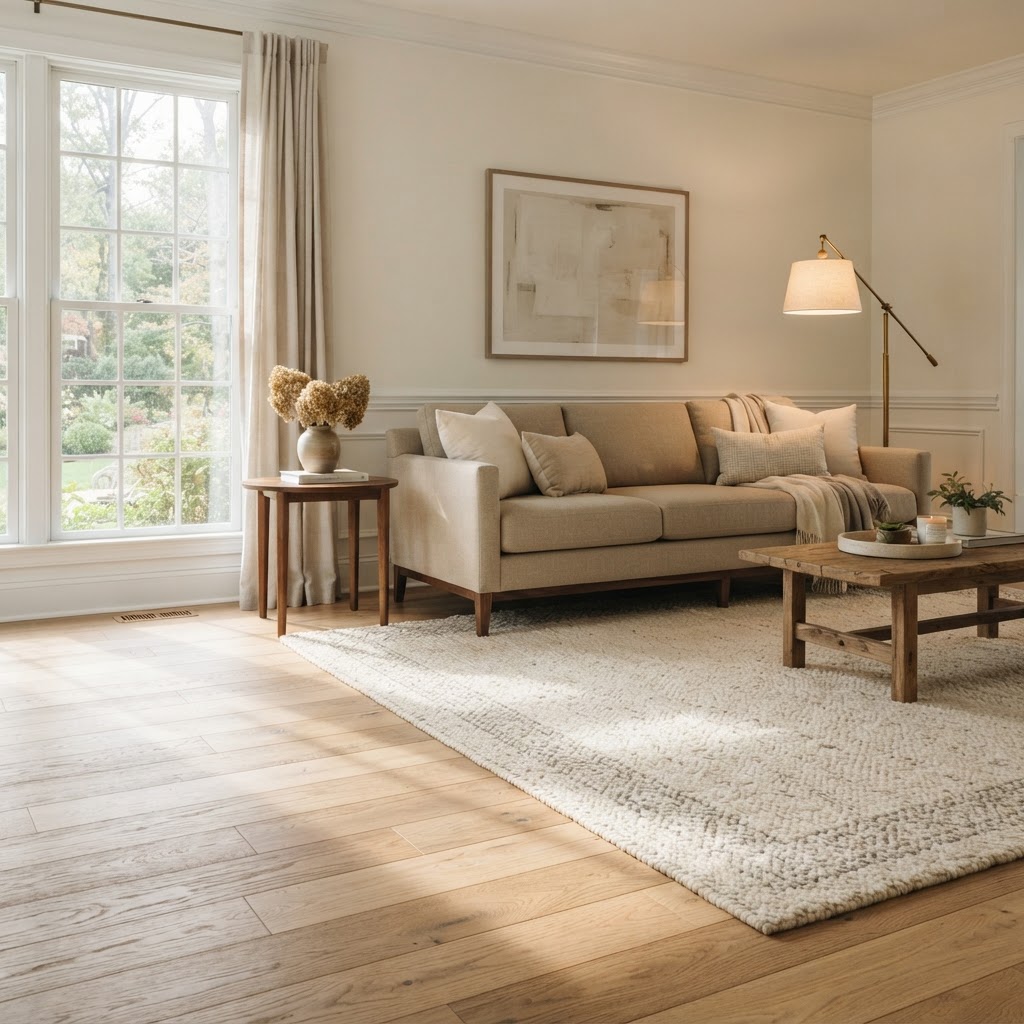
Walk into any room and your eye goes to the same few things within seconds: the light, the furniture, the walls and the floor. Of those, the floor is the largest surface and the one that every other decision has to live with. That is why floor and decor belong in the same conversation. The color of your planks changes how your paint looks. The width of the boards changes how big a room feels. The finish changes how your rugs, sofas and lamps read in the evening. This guide explains how to think about floor decor in a Northern Virginia home, whether you live in a Fairfax colonial, an Arlington condo, a Loudoun townhome or an Alexandria rowhouse. It covers color, tone, pattern, finish, rugs, furniture, walls, lighting and the practical limits that every real house has. Floors and Beyond VA is a family-owned flooring company that has served Northern Virginia since 1987, and we see the same style questions every week while we measure, prepare and install.
Start With the Floor, Not the Accessories
Most people decorate in the wrong order. They choose a sofa, paint the walls and hang art, and then they try to find a floor that agrees with all of it. The better order runs the other way. The floor is the hardest and most disruptive thing to change later, so it deserves to be the anchor. Paint can be redone in a weekend, and a sofa can be replaced when the lease ends or the children grow. A floor stays for a decade or more. When the floor is settled first, every softer decision becomes easier because you have a fixed point to match.
That does not mean the floor has to be the most dramatic element in the room. In many of the best-looking homes, the floor is calm and the decor does the talking. A well-chosen plank in a mid-tone with a natural finish lets rugs, art and furniture stand out. In other homes, the floor is the feature, such as a wide-plank oak with a rich stain in a quiet room. Either approach works. What does not work is a floor that fights with everything around it.
Understand Tone Before Color
Wood and wood-look floors, whether hardwood flooring, an engineered plank or luxury vinyl plank flooring, come in a wide range of colors, but the idea that matters most is tone, meaning whether the floor leans warm or cool. Warm floors have red, orange or yellow undertones, such as honey oak, cherry or amber pine. Cool floors have gray, ashy or neutral undertones, such as weathered oak or driftwood looks. Neither is better, but mixing them carelessly is the most common mistake we see.
The easiest way to check is to hold a sample against the things that will stay in the room. Cabinets, trim, window frames, a fireplace surround and large furniture all have an undertone of their own. If most of them lean warm, a warm floor will feel natural and a cool floor will feel like a mismatch. If the room is already cool, the opposite holds. When the room is mixed, a neutral floor with little visible undertone is the safest bridge.
Light changes tone too. A floor that looks golden at noon can look orange under warm bulbs and gray at dusk. That is why samples should be viewed in your own rooms, in morning light and in evening lamplight, before anything is ordered. At Floors and Beyond VA, we bring samples to your home for exactly this reason.
Light and Dark Floors
Light floors reflect more light and make small rooms feel larger. They suit condos and townhomes with limited windows and they hide dust and pet hair well. Dark floors add contrast and depth and look formal and dramatic, but they show dust, scratches and footprints more readily. Mid-tones are the most forgiving and the most common choice for good reason: they hide wear, work with many colors and look natural in most light.
In Northern Virginia, where many homes have a lot of carpet-to-hard-floor conversions, the shift from a beige carpet to a hard floor can feel dramatic. A mid-tone that is slightly lighter than you think you want often looks right once furniture and rugs are in place, because a room full of objects always looks darker than an empty one.
Plank Width and Length
Board width changes the personality of a room. Narrow strips, around two and a quarter inches, are traditional and suit older homes, colonials and rowhouses where original floors were that size. Mid-width planks of about three to five inches are the most versatile and work in nearly any home. Wide planks of six inches and more feel modern and open and are popular in larger rooms and contemporary kitchens. Longer boards make fewer seams and a calmer surface, which can make a space feel larger.
The home should guide the choice. A narrow strip floor in a new open-plan townhome can feel fussy, while a very wide plank in a small historic rowhouse can feel out of scale. When a floor has to match an existing one, such as in an addition, matching the width matters more than almost anything else.
Pattern and Layout
Most floors run in straight rows, and direction is itself a decor decision. Planks running toward the main window or along the longest wall of a room make it feel longer. Planks running across a narrow room make it feel wider. In open layouts, running the same direction through several rooms ties them together.
Patterns such as herringbone and chevron add movement and a sense of craft. They are especially at home in entries, dining rooms and formal living areas, and they photograph beautifully. They also take more time and skill to install and require careful layout so the pattern is centered and the edges look intentional. Borders and inlays are older traditions that still suit formal homes. For most households, a straight layout in a well-chosen plank gives the best balance between style and practicality.
Finish and Sheen
Finish is the quiet detail that makes the largest difference to how a floor looks day to day. A matte or low-sheen finish looks natural, hides scratches and dust and suits busy households. A satin finish has a soft glow and is the most popular middle ground. A semi-gloss or high-gloss finish is bold, reflective and shows every mark. For a family with pets and children, lower sheen is almost always the wiser decor choice.
On hardwood that is refinished on site, the finish type also changes color. Oil-modified finishes add an amber warmth that deepens with age. Water-based finishes keep the wood lighter and more neutral. On a pre-finished plank, the sheen is set at the factory, so it pays to look at full-size samples in person.
Texture: Smooth, Brushed and Hand-Scraped
Texture is another layer of decor. Smooth floors look clean and modern. Wire-brushed floors have a soft, slightly raised grain that hides wear and feels natural underfoot. Hand-scraped floors have a rustic look with visible tool marks and suit farmhouse or traditional styles. Many luxury vinyl plank products reproduce these textures in a printed and embossed surface, which gives you the look of a textured wood floor with a waterproof core.
Rugs: The Easiest Layer of Floor Decor
A rug is the most flexible part of floor decor because it can change without any construction. A good rug defines a seating area, adds color or pattern, softens sound and warms the feel of a hard floor. A few simple principles work in almost any room.
First, size the rug generously. A rug that is too small looks like a stamp on the floor. In a living room, at least the front legs of the sofa and chairs should sit on the rug. In a dining room, the rug should extend far enough that chairs stay on it when pulled out.
Second, contrast with the floor. A rug with the same tone as the floor blends in and wastes its potential. A lighter or darker rug, or one with a pattern in a different color, makes the floor and the rug both look better.
Third, consider the rug pad. A pad keeps the rug from sliding and protects the floor. Choose one that is safe for your floor type, since some rubber pads can discolor vinyl.
Furniture and Wood Tones
Mixing wood tones in a room is natural and attractive, as long as there is some logic to it. A common approach is to choose furniture that is either clearly lighter or clearly darker than the floor, rather than almost the same. Furniture a shade or two away from the floor can look like a mistake, while furniture a few shades away looks intentional. Repeating one tone across several pieces, such as a coffee table, a console and a picture frame, helps unify the space.
Metal finishes, upholstery and accessories fill in the rest. Black, brass and brushed nickel each suit a different mood, and a floor with a neutral undertone accepts any of them.
Wall Color and Trim
Walls and floors frame each other. Warm neutral walls pair well with warm floors and add a cozy feeling. Cool gray or white walls make cool floors look crisp. A contrast between a light wall and a darker floor gives definition, and a floor and walls in similar tones create a soft, enveloping look. Trim and baseboards matter too: white trim against a mid-tone floor is a classic combination that reads clean in nearly every home.
When floors and walls are both changing, do the floor first when possible, or at least choose them together. Painting is easier to adjust to the floor than the other way around.
Lighting
Lighting reveals or hides everything about a floor. Natural light from large windows highlights grain, and strong sun can fade some finishes over time. Warm bulbs enrich warm floors and can make cool floors look yellow. Cool bulbs make floors look grayer. Recessed lighting creates shadows and highlights at specific points, and glossy floors reflect it. When you test samples, switch on the lights you actually use, and look at the sample during the part of the day you spend most time in the room.
Room by Room
Entry: The entry takes the most abuse and sets the first impression. Durable, scratch-resistant surfaces in a color that hides dirt work best, and a patterned or contrasting floor here can add personality without taking over the house.
Kitchen: Kitchens need water resistance and easy cleaning. Luxury vinyl plank and sealed hardwood are both used, and the floor should coordinate with cabinets and counters. Mixing a different tone from the cabinets often looks better than matching exactly.
Living and dining: These are where floor decor shows the most. A continuous floor through open spaces makes the whole level look larger, and rugs define zones.
Bedrooms: Softer, warmer, quieter surfaces matter here. Hardwood or luxury vinyl plank with a rug beside the bed is a popular combination.
Basements: Moisture-tested luxury vinyl plank is the most common choice, and bright, warm tones help offset the lack of natural light.
Stairs: Stairs should match or deliberately contrast with the adjacent floor. Refinished treads with painted risers are a classic look in older Northern Virginia homes.
Floor Decor in Different Northern Virginia Homes
Colonials in Fairfax and Prince William often have oak floors that can be refinished in a color that fits current taste, from natural to deep brown. Townhomes in Loudoun and Fairfax have open main levels where one continuous floor is the best decor decision. Condos in Arlington, Tysons and Reston need floors that meet building sound rules, and within those rules a lighter plank makes a limited space feel bigger. Older rowhouses in Alexandria and Arlington often have original pine or narrow oak that carries a built-in character, and the best decor choice is usually to refinish and let the age show.
For local project notes, see our flooring company in Fairfax, VA, flooring company in Arlington, VA and flooring company in Alexandria, VA pages.
Practical Limits That Shape Style
Real homes have limits, and good decor respects them. A condo association may require a specific underlayment, which affects floor height and transitions. A basement slab may limit you to moisture-tested products. A household with a large dog should think about scratches before choosing a dark high-gloss finish. A sunlit room may fade some finishes, so shades or UV-resistant finishes help. Good flooring advice starts with these facts and then finds the best-looking choice within them.
A Note on Trends
Trends in floor decor move slowly, which is good news. Wide planks, natural and matte finishes, warm neutral tones and subtle texture have been popular for several years, and they age well. Very gray floors and very glossy finishes have faded as favorites. If a trend appeals to you, choose it in the part of the room that is easiest to change, such as rugs, lighting and accessories, and let the floor lean toward a timeless tone and finish. A floor that suits the architecture of your house will outlast any fashion.
How to Choose Without Second-Guessing
Collect what will stay in the room, such as cabinet doors, a paint chip, a fabric swatch and a photo of your largest furniture. Look at several full-size samples at once in your own space, in different light. Pick the one that still looks right at the end of the day. Resist choosing from small chips alone, since a three-inch square never shows the real effect across a whole room.
If you want the short version of this article, read What are the best floor decor ideas for a Northern Virginia home?.
Working With a Flooring Company on Style
A good flooring company does more than install. It helps you see how a floor will look and live in your home. At Floors and Beyond VA, we start with an in-home visit, bring samples and look at the light, the furniture and the use of each room. Our own crews prepare the subfloor and install, and we plan stairs, transitions and trim so the finished floor looks designed. Schedule an in-home estimate and bring your paint colors, fabric swatches and photos, and we will walk through the options.
Maintaining the Look
Style only lasts if the floor stays in good shape. Use felt pads under furniture, mats at entries and rugs in high-traffic paths. Clean spills promptly and use the cleaner your floor's maker recommends. Keep indoor humidity steady, since wood responds to the seasonal swings of Northern Virginia. For refinished hardwood, a maintenance coat every few years refreshes the finish without a full sanding.
Frequently Asked Questions
What is floor decor?
Floor decor means choosing and styling the floor, including its color, finish, pattern and the rugs and furniture around it, so it works with the rest of the room.
Should the floor match the furniture?
Not exactly. Furniture that is clearly lighter or darker than the floor usually looks better than a near match.
Are light or dark floors better?
Light floors make rooms feel larger and hide dust. Dark floors add drama and show more wear. Mid-tones are the most forgiving.
Does plank width matter?
Yes. Narrow strips suit traditional homes, and wide planks suit open, modern spaces.
Can I change my floor decor without replacing the floor?
Yes. Rugs, furniture, lighting and refinishing in a new color can transform a room.
What sheen is best for a family home?
Matte or satin hides scratches and dust and is the most practical.
Ready to Plan Your Floor and Decor?
If you are choosing a floor and want it to work with the rest of your home, the best first step is to see samples in your own light. Floors and Beyond VA is a family-owned flooring company serving Fairfax, Loudoun, Prince William and Arlington counties, Alexandria and the Washington, DC area since 1987. Schedule an in-home estimate at floorsandbeyondva.com/Contact or call (703) 906-5698.




