
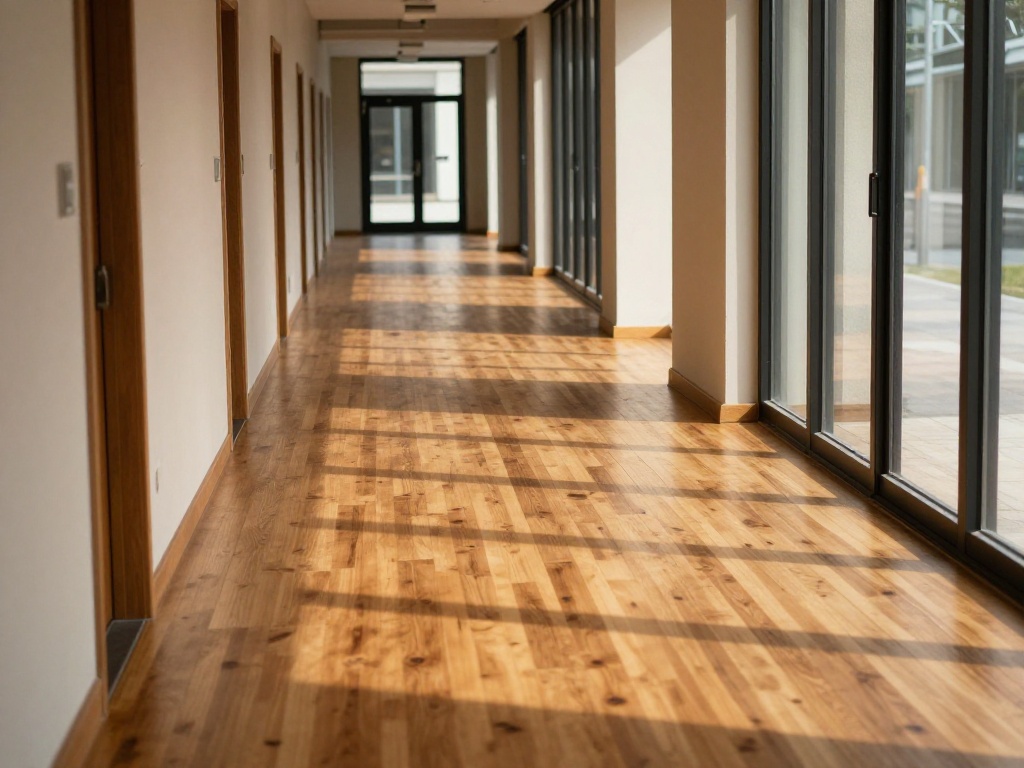
Commercial Flooring
in Northern Virginia:
Not Residential
Flooring Scaled Up.
Wear grades, slip resistance ratings, occupied-space install logistics, and the right product for each space type — the complete specification guide for NoVA businesses and property managers.
- Commercial flooring is a different product category, not a tougher version of residential: wear ratings, slip resistance standards, warranty tiers, and installation logistics all differ — and installing residential-grade product in a commercial space typically voids the warranty and fails ahead of schedule.
- The right product depends on the space type: office suites, retail, food service, fitness, corridors, and lobbies each have different traffic volumes, moisture exposure profiles, and slip resistance requirements that determine the correct specification.
- DCOF (Dynamic Coefficient of Friction) matters in commercial: the 0.42 minimum DCOF requirement for wet areas is a legal compliance threshold in commercial settings — not just a product feature.
- Occupied-space installation is standard for commercial: most Northern Virginia businesses can't close for a floor install — phased scheduling, off-hours work, and section-by-section installation allow most projects to proceed without business interruption.
- In-house crews matter more in commercial than in residential: a subcontracted installation chain on a commercial project creates scheduling risk, accountability gaps, and warranty complications that in-house crews eliminate.
- Northern Virginia commercial flooring has a distinct market context: federal contractor office suites, high-turnover retail, food-service buildouts, fitness studios, religious and educational facilities — each has a specific flooring specification that Floors and Beyond has installed across Fairfax, Loudoun, Prince William, and Arlington.
The most expensive mistake in commercial flooring is straightforward: specifying residential product for a commercial space. It voids the manufacturer warranty on day one. It wears through in months where it should last years. And the replacement cost — now including business disruption and potentially a second full installation — exceeds what the correct commercial specification would have cost at the start.
Floors and Beyond's commercial flooring work spans Northern Virginia's varied business landscape: federal contractor office suites in Fairfax and Arlington, retail buildouts in Loudoun County's growing commercial corridors, restaurant and food service spaces in Prince William, fitness studios and athletic facilities, houses of worship, and institutional settings across all four counties. The guide below covers the specification decisions that determine whether a commercial floor investment lasts or fails.
What Makes Commercial Flooring Different from Residential?
Four specification dimensions separate commercial from residential flooring — wear rating, slip resistance standard, warranty tier, and installation logistics. None of these is simply "more of the same" as the residential equivalent; each operates on a different scale and with different compliance implications.
| Specification Dimension | Residential | Commercial |
|---|---|---|
| Wear rating (LVP) | 6–12 mil wear layer — sufficient for household traffic | 20–28 mil wear layer — required for commercial traffic volumes |
| Wear rating (laminate) | AC3–AC4 — moderate to heavy residential | AC5–AC6 — heavy commercial / public spaces |
| Slip resistance | No legal threshold — manufacturer-specified | DCOF 0.42+ minimum for wet areas — ADA / ANSI A326.3 compliance |
| Warranty coverage | Residential warranty — voids immediately in commercial use | Commercial warranty — covers wear and performance under specified traffic levels |
| Installation logistics | Typically whole-space, unoccupied during install | Often phased — sections installed while business operates in adjacent areas |
| Subfloor requirements | Standard residential flatness tolerance | Tighter flatness tolerance — commercial products reveal subfloor variation more visibly at scale |
| Maintenance protocol | Consumer-grade cleaning products, residential schedule | Commercial maintenance program — pH-neutral cleaners, no-wax protocols, scheduled refinishing for hardwood |
⚠ The Most Common Commercial Flooring Mistake in Northern Virginia
A business owner installs residential LVP — the same product they used in their home, which looks great — in their office suite or retail space because the per-square-foot cost is lower. The residential product has a 12-mil wear layer and a residential warranty. Within 18 months, the wear layer shows visible compression marks at high-traffic paths. The manufacturer warranty doesn't apply — the warranty was voided when the product was installed in a commercial setting. Replacement now costs more than the correct commercial specification would have cost at the start, plus the business disruption of a mid-operation floor replacement.
Floors and Beyond specifies commercial-rated products for every commercial installation. The per-square-foot cost difference between residential and commercial-grade LVP is typically $0.50–$1.50. The cost difference between a 10-year floor and a 2-year floor in a Northern Virginia commercial space is not a rounding error.
The Right Flooring for Each Northern Virginia Commercial Space Type
Each commercial space type in Northern Virginia's business landscape has a different traffic volume, moisture exposure profile, and slip resistance requirement — the specification that's correct for an office suite is wrong for a restaurant, and the specification that's correct for a fitness studio is wrong for a lobbied federal contractor building.
Northern Virginia's concentration of federal contractors, defense agencies, and professional services firms creates a large market for office-suite commercial flooring. Typical requirements: professional appearance, acoustic performance (open-plan offices amplify footstep noise without appropriate flooring), durability in corridors and conference rooms with rolling chair and caster traffic, and the ability to install in phases without closing the office.
Commercial LVP (20+ mil wear layer) handles rolling caster traffic better than carpet tile over the long term and allows for section-by-section replacement of high-wear areas. Carpet tile is appropriate for conference rooms and private offices where acoustic performance outweighs the rolling-caster wear concern.
Retail flooring in Northern Virginia's commercial corridors — Loudoun County's growing Route 7 and Route 28 corridors, Fairfax County's retail centers, Prince William's commercial strips — carries concentrated foot traffic with rolling stock carts, heavy display fixtures, and frequent cleaning with commercial-grade products. The floor is also a visual component of the retail brand environment, which means aesthetic flexibility matters alongside durability.
Porcelain tile rated for heavy commercial traffic and polished or honed concrete are the most durable retail flooring options. Commercial LVP at 22–28 mil wear layer is appropriate for medium-traffic retail with less fixture movement.
Restaurant and food service flooring in Northern Virginia carries the strictest slip resistance requirements of any commercial space type. Wet floors from beverage spills, cleaning, and kitchen moisture create the exact conditions where DCOF compliance is both a legal requirement and a genuine safety issue. The 0.42 DCOF minimum for wet areas is the threshold under ANSI A326.3 — not a guideline, a compliance standard.
Porcelain tile with a structured or textured surface rated at DCOF 0.42+ is the standard specification for restaurant floors. Front-of-house dining areas may use polished porcelain with lower DCOF in dry conditions, but the transition to kitchen and service areas requires the wet-rated threshold without exception.
Northern Virginia's fitness studio and athletic facility market — concentrated in Arlington, Fairfax, and Ashburn — requires flooring that handles impact absorption, moisture from perspiration, and the distinct requirements of different training zones within the same facility. A yoga studio, a free-weight area, and a group fitness floor all have different specifications despite being in the same building.
Sport hardwood (maple or oak flooring on a spring system) is the standard for court sports and group fitness areas requiring impact absorption. Commercial rubber flooring is the correct specification for free-weight and strength areas where dropped equipment creates impact loads wood floors are not designed for. Floors and Beyond installs sport hardwood floors across Arlington and Fairfax fitness facilities.
Houses of worship across Northern Virginia's Fairfax, Prince William, Loudoun, and Arlington communities present a specific commercial flooring challenge: episodic high-volume traffic (services, events, community gatherings) interspersed with low-volume daily use, very long replacement cycle expectations (20–30 years is realistic for a sanctuary or assembly hall), and aesthetic requirements that differ significantly from office or retail environments.
Commercial hardwood at heavy-traffic wear specification is appropriate for sanctuary and assembly hall applications where aesthetics require the warmth of wood and the expected lifespan justifies the investment. Porcelain tile is appropriate for entry lobbies, corridors, and fellowship halls with food service. Installation phasing allows work to proceed during low-use periods without disrupting ongoing services.
How Does Occupied-Space Commercial Installation Work?
Most Northern Virginia businesses cannot close for a floor installation — occupied-space commercial installation uses phased scheduling, off-hours work, and section-by-section sequencing to complete the project while the business continues operating in adjacent areas.
- Phase mapping: Floors and Beyond's commercial project assessment divides the space into installation phases based on the business's operational layout — which areas can be vacated simultaneously, where temporary relocation of furniture or equipment is feasible, and what sequence minimizes operational disruption while maintaining an efficient installation pace
- Off-hours scheduling: Evening and weekend installation is standard practice for commercial projects where daytime operations are essential — Floors and Beyond's in-house crew schedules accommodate off-hours work without the subcontractor coordination complications that make this difficult through a general contractor chain
- Dust and debris containment: Commercial installations in occupied buildings require dust containment barriers between active work areas and occupied zones — particularly relevant for hardwood sanding and refinishing, where fine wood dust is both a respiratory concern and a slip hazard in adjacent corridors
- Directional installation planning: Large commercial spaces require directional planning for floating-floor products (LVP, laminate) to ensure expansion gaps and plank orientation are coordinated across phases — a detail that matters for the finished appearance and structural integrity of the floor at phase joints
Why In-House Crews Matter More in Commercial Flooring
Commercial flooring projects carry more scheduling complexity, higher disruption cost if something goes wrong, and longer accountability relationships than residential projects — all three of which favor the in-house crew model over subcontracted installation.
- Single point of accountability: Floors and Beyond uses in-house crews only — Floors and Beyond's team, no subcontractors. If a phase needs to be adjusted at 6 AM before a business opens, there's one number to call and it goes directly to the crew lead, not through a subcontractor coordination chain
- Warranty clarity: When installation and supply are both from Floors and Beyond, warranty claims are simple — there's no ambiguity about whether a performance issue is a product defect or an installation issue, and no finger-pointing between the flooring contractor and the installation subcontractor
- 40 years of NoVA commercial context: Floors and Beyond has been operating in Northern Virginia's commercial and residential flooring market since 1987 — the institutional knowledge of local building types, common subfloor conditions in NoVA commercial construction, and long-standing supplier relationships that provide scheduling priority are not replicated by a contractor who subs out to whoever's available
- Commercial floor restoration: Existing commercial hardwood floors in Northern Virginia office and institutional spaces — many installed decades ago — can often be restored to commercial-grade specification through professional sanding and refinishing at a fraction of replacement cost. Floors and Beyond assesses commercial hardwood restoration as a first option before recommending replacement
From Floors and Beyond
"Commercial floor restoration is frequently the right answer for Northern Virginia's older office and institutional spaces. A hardwood floor installed 25 years ago in a Fairfax office building, properly refinished with a commercial-grade finish, can perform for another 25 years. That math almost always beats replacement — and it eliminates the 2–3 day installation disruption that a full replacement requires."
Floors and Beyond provides commercial flooring assessments for businesses and property managers across Fairfax, Loudoun, Prince William, and Arlington.
Request a Commercial AssessmentFrequently Asked Questions — Commercial Flooring in Northern Virginia
What is the difference between commercial and residential flooring?
Commercial flooring is specified for sustained high foot traffic and meets different durability, slip resistance, and warranty standards than residential flooring. The key differences: commercial wear ratings (AC5/AC6 for laminate, 20+ mil wear layer for LVP), DCOF slip resistance compliance for wet areas, warranty tiers that actually cover commercial use, and typically different installation requirements for occupied spaces. Installing residential-grade flooring in a commercial space typically voids the warranty and results in accelerated wear requiring early replacement.
What type of flooring is best for commercial spaces in Northern Virginia?
It depends on the space type. Offices: commercial-grade LVP (20+ mil) or carpet tile. Retail: porcelain tile or commercial LVP (22–28 mil). Restaurants and food service: textured porcelain tile rated DCOF 0.42+ for wet conditions. Fitness studios: sport hardwood for courts and group fitness, commercial rubber for weight areas. Houses of worship: commercial hardwood for sanctuaries, porcelain tile for entries and fellowship halls. Floors and Beyond assesses each commercial space individually to specify the correct product, wear grade, and installation method.
Can a commercial floor be installed in an occupied business?
Yes, with proper planning. Occupied-space commercial installation uses phased scheduling (installing in sections while the business operates in adjacent areas), off-hours or weekend work, dust and debris containment between active and occupied zones, and a site-specific logistics plan. Floors and Beyond uses in-house crews only — no subcontractors — which provides the scheduling reliability and direct accountability that occupied-space commercial installation requires.
What is DCOF and why does it matter for commercial flooring?
DCOF stands for Dynamic Coefficient of Friction — a measurement of how much resistance a floor surface provides against a person walking across it in realistic conditions (wet shoes, normal gait). ANSI A326.3 and ADA compliance standards require a minimum DCOF of 0.42 for commercial wet areas such as restaurant floors, building entries, and bathroom corridors. This is a legal compliance threshold in commercial settings, not just a product specification. Floors and Beyond specifies DCOF-rated products for any commercial application where wet conditions are expected and verifies compliance before installation on projects where ADA documentation is required.
Can existing commercial hardwood floors be restored rather than replaced?
Often, yes — and Floors and Beyond evaluates restoration as the first option for existing commercial hardwood before recommending replacement. Northern Virginia office buildings, institutional spaces, and houses of worship with original hardwood floors installed 20–40 years ago are frequently good candidates for professional sanding and refinishing with a commercial-grade finish coat. The cost is typically 40–60% of replacement, the timeline is shorter, and the business disruption is reduced compared to a full pull-and-replace project. Floors and Beyond provides commercial hardwood restoration assessments across Fairfax, Loudoun, Prince William, and Arlington.
// Commercial Assessment · Northern Virginia
Get the Right Spec
for Your Commercial
Space — Before You
Install.
Floors and Beyond provides commercial flooring assessments for businesses and property managers across Northern Virginia. In-house crews only. No subcontractors. Serving Fairfax, Loudoun, Prince William, and Arlington since 1987.
Request a Commercial Assessment



