
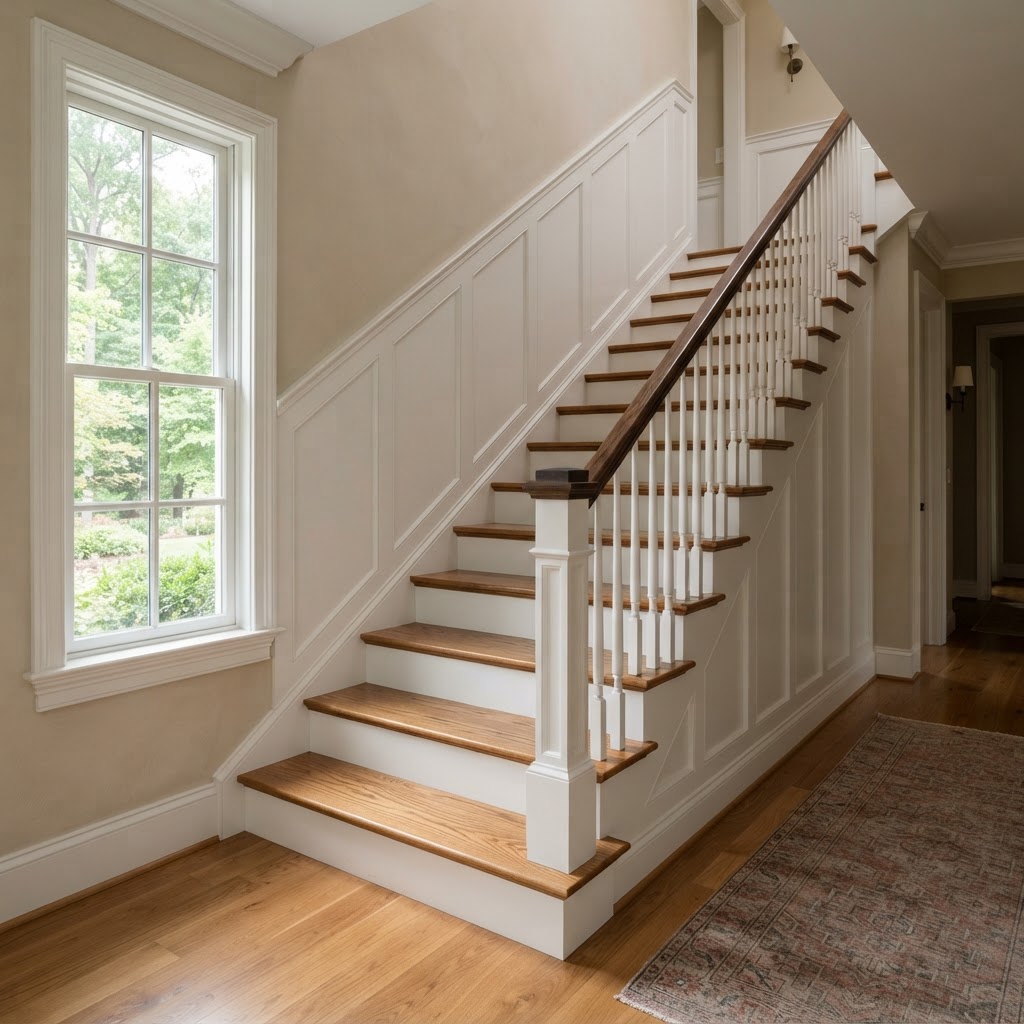
Staircase Remodeling · Northern Virginia
Converting carpeted stairs to hardwood means removing the carpet and padding, evaluating the treads, risers, and stringers underneath, and then either refinishing the existing wood or installing new hardwood treads and risers. The cost depends mainly on what is under the carpet, how many steps and landings you have, whether the staircase is open or closed, and whether you choose new solid treads, stair-part systems, or a refinish of the original wood. Floors and Beyond VA, a family-owned Northern Virginia flooring and remodeling contractor serving Fairfax, Loudoun, Prince William, and Arlington counties since 1987, begins every staircase project by pulling back a corner of the carpet to see what the stairs actually are, because that one look changes the entire plan.
Staircases are the most structural, most visible, and most misunderstood flooring project in a house. A homeowner looking at a carpeted staircase usually imagines a simple swap: carpet out, wood in. In reality, a staircase is a set of precisely cut and framed components, and the work involves carpentry as much as flooring. Done well, a hardwood staircase becomes the architectural centerpiece of a home. Done poorly, it squeaks, shifts, and looks like an afterthought.
This guide covers what is usually hiding under carpeted stairs in Northern Virginia homes, the main ways to convert them, the differences between refinishing and replacing, how to think about wood species and finish, safety and code considerations, what the process looks like day by day, and the mistakes that cause the most regret. Because Floors and Beyond VA uses in-house crews only, with no subcontractors, the people who inspect your stairs are the same people who build and finish them.
Why So Many Northern Virginia Homeowners Are Removing Stair Carpet
Carpeted staircases were the default in builder homes across Fairfax, Loudoun, and Prince William counties for decades. They were quiet, forgiving, and inexpensive to install. Today, many homeowners are moving in the opposite direction for several reasons.
Wear and appearance. Stair carpet takes more abuse than any other carpet in the house. Every step concentrates foot traffic on the same few inches of nosing. Even good carpet develops visible wear lines, matting, and discoloration much faster on stairs than on flat floors.
Allergens and cleaning. Carpet traps dust, pet dander, and pollen. Families with allergies or pets often want a hard surface that can be vacuumed and wiped.
Style and resale. Hardwood stairs are a strong visual signal. Buyers walking into a home in Ashburn, Reston, Burke, or Arlington notice the staircase immediately, and a clean hardwood stair with a good rail reads as quality.
Continuity with the main level. When the main floor is hardwood, a carpeted staircase can look like an interruption. Converting the stairs creates a continuous flow from the foyer upward.
Hidden original hardwood. In many older homes, especially in Arlington and Fairfax neighborhoods built before the 1970s, the original oak treads are still under the carpet. Uncovering them can be one of the most satisfying discoveries in a renovation.
What Is Under Your Carpet: The Question That Decides Everything
Before any design decisions, the most important step is simply looking. There are four common conditions under carpeted stairs in Northern Virginia homes, and each leads to a different project.
Condition One: Finished Hardwood Treads and Risers
In older homes, particularly pre-1970s construction, the original stairs were often finished oak. They may have been carpeted over decades ago for noise or fashion. If the wood is sound, this is the best-case scenario. Following our refinish-first philosophy, we sand, repair, stain, and finish the original wood rather than replacing it. The result keeps the home's character and is usually the most economical path.
Condition Two: Paint-Grade or Builder-Grade Treads
In many newer homes, builders installed stairs knowing they would be carpeted. The treads are often made from softwood, particleboard, or plywood, and the risers are paint-grade material. These parts are not meant to be seen. You cannot refinish them into a showpiece, so the treads and risers must be covered or replaced with finish-grade material.
Condition Three: Damaged or Uneven Stairs
Carpet hides sins. Under it you may find worn treads, cracked nosings, sagging stringers, split risers, or squeaky connections between tread and riser. These conditions need carpentry before any finish material goes on.
Condition Four: Unusual or Custom Framing
Some homes have winders, curved stairs, flared bottom steps, open stringers, or landings with irregular dimensions. These require custom cuts and more labor, and they benefit from experienced hands.
Our free in-home consultation includes this inspection. We lift a corner of the carpet, examine the construction, and tell you honestly which of these four conditions you have. That conversation often saves homeowners from ordering the wrong materials.
Your Main Options for Converting Carpeted Stairs to Hardwood
Once we know what is under the carpet, there are several practical ways to build a hardwood staircase.
Option 1: Refinish the Existing Hardwood Stairs
If the original treads and risers are real hardwood in good condition, refinishing is the most authentic and often least expensive option. The process involves removing the carpet, tack strips, staples, and adhesive residue, repairing damage, sanding, staining or leaving the natural color, and applying a durable finish. Because stairs are high-traffic and slippery when polished, the finish selection matters. Many homeowners choose a satin or matte finish for better traction.
Option 2: New Solid Hardwood Treads With Painted or Stained Risers
This is the classic approach. Solid hardwood treads, typically oak, maple, hickory, or other species, are installed over the existing structure. The risers are either replaced with new finished material or painted white, which creates a crisp, traditional two-tone look. White risers with stained treads are enormously popular in Northern Virginia colonials and traditionals because they are forgiving of scuffs and visually bright.
Option 3: Tread Caps and Riser Panels Over Existing Stairs
Tread caps are thin hardwood pieces fitted over the existing treads, with matching riser panels covering the vertical faces. This approach avoids tearing out the original structure and can be faster and less disruptive. It works best when the existing stairs are structurally sound and level. The trade-off is that the finished stair is slightly taller per step, which has to be handled carefully so the first and last risers still match the others.
Option 4: Full Tread and Riser Replacement
When the existing stairs are too damaged or irregular, the treads and risers are removed and replaced entirely. This produces the cleanest result because every component is new and built to match. It is also the most labor-intensive option.
Option 5: Engineered or Alternative Stair Surfaces
Some homeowners prefer engineered hardwood stair treads, luxury vinyl stair systems, or stair parts that match flooring elsewhere. These can provide good performance in the right situation. For help comparing materials across the house, see our overview of hardwood and laminate flooring and vinyl and linoleum flooring.
Option 6: A Hardwood Runner
Another popular choice is full hardwood stairs with a narrow runner down the center. The runner provides traction and sound dampening while exposing wood on both sides. It combines the comfort of carpet with the look of hardwood and protects the finish where wear is greatest. If you want this look, our carpet flooring services cover runner installation too.
Refinish Versus Replace: How to Decide
| Choose | When it is the right call |
|---|---|
| Refinish | The original treads and risers are solid hardwood, the structure is sound, the wood is not deeply gouged or water damaged, and you like the look of the existing species. |
| Replace | The existing treads are paint-grade or composite, the nosings are badly damaged, the stairs squeak because of structural issues, or you want a different species, color, or profile. |
| A hybrid | Some parts can be saved and others cannot. For example, refinish the risers and stringers while replacing treads, or keep original treads and replace only the damaged ones with matching stock. |
Refinishing preserves original material that is often higher quality than modern replacements. Old-growth oak found in pre-war homes is denser and more stable than much of what is sold today. At Floors and Beyond VA, we will always tell you honestly whether the original wood is worth saving. Our refinish-first approach is not a sales tactic. It reflects a belief that older homes in Northern Virginia, especially in Arlington, Falls Church, Alexandria-adjacent areas, and older Fairfax neighborhoods, deserve to keep what is original and valuable.
What Drives the Cost of a Staircase Remodel
We do not publish prices in blog content, because every staircase is different. What we can do is explain what moves a staircase project from simple to complex so you can evaluate proposals fairly.
- Number of steps. More steps mean more material and labor. A single straight flight is simpler than a two-story home with multiple flights.
- Condition of the existing structure. Squeaks, sagging, and damaged treads add carpentry time.
- Open versus closed stairs. Open stairs expose the sides of the treads, requiring return nosings and finished stringers. Closed stairs have walls on both sides.
- Wood species and grade. Red oak, white oak, maple, hickory, walnut, and exotic species vary widely in price and character.
- Stain, paint, and finish complexity. Custom stains, multi-step finishes, and painted risers add labor.
- Landings and turns. Winders, curved steps, and wide landings need custom cuts.
- Railing and balusters. Replacing a railing, newel posts, or balusters changes both look and budget. Many homeowners pair a stair conversion with a railing update because the combination transforms the entire staircase.
- Moldings and trim. Skirt boards, shoe molding, and wall trim along the stair are part of the finished look.
- Matching existing floors. If the stairs must match hardwood on the main level, species and stain matching require care.
- Access and furniture protection. Tight foyers and finished walls need protection during work.
A written, itemized proposal tells you which of these factors is driving your quote. Be wary of any proposal that does not describe how the stairs will be built, because "hardwood stairs" can mean very different things.
Choosing the Right Wood Species and Finish
Stairs take more punishment than almost any other part of a floor, so material choice matters.
Red oak is the most common stair material in the United States. It is hard, widely available, takes stain well, and has a recognizable grain. It suits traditional homes throughout Northern Virginia.
White oak is slightly harder and has a more refined, linear grain. It has become extremely popular for modern and transitional looks, especially in natural, light, and gray-toned finishes.
Maple is hard and uniform with a smooth, contemporary look. It can show scratches and stain unevenly, so it needs careful finishing.
Hickory is very hard with dramatic grain variation. It suits rustic and casual looks and handles heavy traffic.
Walnut is a rich, dark, luxurious option, softer than oak but stunning in the right home.
Finish choice. On stairs, traction is a safety issue. High-gloss finishes can be slippery in socks. Satin and matte finishes provide better grip. Water-based polyurethane dries quickly and resists yellowing. Oil-based finishes add warmth but take longer to cure and have stronger odors. Hardwax oils offer a natural look and can be spot-repaired.
Stain and color. Natural, honey, gray, espresso, and driftwood tones are all popular. Stair colors should coordinate with your main-level floors, the railing, and the trim. Dark treads show dust and light treads show scuffs, so be realistic about maintenance.
Painted risers. White or off-white risers are practical because kicked scuffs wipe off, and they add brightness to a narrow stairwell. Painted risers also let the tread species be the star.
The Northern Virginia Factor: Housing Stock, Humidity, and Structure
Staircases in Northern Virginia vary with the age and type of home.
Newer Loudoun and Prince William homes. In Ashburn, Brambleton, South Riding, Haymarket, and similar communities, stairs are often builder-installed with paint-grade parts under carpet. The framing is typically modern and square, but the treads and risers are not finish-grade. These homes usually need new treads and risers to become hardwood.
1970s through 1990s Fairfax colonials and split-levels. Homes in Burke, Springfield, Centreville, and Annandale may have stairs that were carpeted from day one or have been re-carpeted several times. The structure is usually solid but may squeak, and nosings may be worn.
Pre-war and mid-century homes in Arlington and nearby neighborhoods. These homes frequently have original hardwood stairs hidden under old carpet. Staircases may be narrow, steep by modern standards, and non-uniform. Preserving character matters, and the work calls for care.
Concrete slab versus wood joist. Staircases that connect a main level to a basement are often built over or against concrete foundation walls and slab floors. The bottom step, where a stair meets a basement slab, often needs special attention for level, moisture, and attachment.
Seasonal humidity. Northern Virginia's humid summers and dry winters cause wood to expand and contract. Quality stair construction accounts for this movement with proper fastening, adhesive, and finish. Squeaks in new stairs often come from poor attachment, not bad wood.
Safety and Code Considerations
Staircases are among the leading places for household falls, so safety is not optional. While specific requirements depend on your jurisdiction and your home's age, these are the principles your contractor should address.
Uniform riser heights and tread depths. Building codes require steps to be consistent. Even small differences between steps can cause trips. When installing tread caps or adding material, the first and last steps need to be adjusted so every step remains the same height.
Nosing and traction. The projecting edge of each tread needs a consistent profile. Finishes and surfaces should provide adequate slip resistance.
Handrails and guards. Handrail height and graspability, baluster spacing, and secure newel posts all matter. If you are upgrading the railing, confirm that the new design meets local requirements.
Lighting. Good stair lighting is a safety feature. Consider switches at both ends, night lights, or low-profile step lights.
Permits. Replacing finish materials generally does not require structural permits, but altering stair dimensions or railings may. Fairfax County, Loudoun County, Prince William County, and Arlington County each have their own requirements, and an experienced local contractor can guide you.
Children, pets, and older adults. If young children, dogs, or older family members use the stairs, traction, handrail comfort, and lighting deserve extra attention. A narrow runner or non-slip tread treatment can be a good compromise.
What to Expect: The Staircase Remodel Process Day by Day
A hardwood stair conversion is a multi-stage project. Here is the typical flow.
Step 1: In-home consultation and inspection. We lift a section of carpet, check the construction, measure each step, and discuss your goals. You choose species, stain, and finish from samples in your own lighting. Everything is included in your free estimate.
Step 2: Demolition. The carpet, padding, tack strips, and staples are removed. This is dusty and loud, so we protect nearby floors and walls.
Step 3: Structural prep. We repair squeaks, reinforce loose treads, fix damaged risers, and ensure each step is level and solid. This step is invisible in the finished stair but determines how long it lasts.
Step 4: Installation or refinishing. New treads and risers are cut, fitted, glued, and fastened. For refinish projects, we sand and repair the existing wood. Landings and nosings are installed with care so every step lines up.
Step 5: Staining and finishing. Stain is applied evenly, followed by multiple coats of finish. Stairs need adequate curing time before regular use.
Step 6: Railing, balusters, and trim. If part of the scope, these are installed or refinished and matched to the stair.
Step 7: Final walkthrough. We inspect every step together, check for squeaks, and complete cleanup.
Timeline expectations. A standard single-flight staircase can often be completed in a few days, but finish cure time matters. Complex, multi-flight, or curved staircases take longer. You may have limited access to the stairs during work and finishing, so plan for temporary arrangements if the stairs connect the only bedrooms to the main level. Because our crews are in-house, scheduling is clear and there are no handoffs between unfamiliar tradespeople.
Mistakes to Avoid When Converting Stairs to Hardwood
- Ordering materials before inspecting the stairs. Never choose material until you know what is under the carpet.
- Ignoring squeaks. Squeaks fixed during conversion stay fixed. Squeaks ignored will return.
- Using the wrong finish. A slick, high-gloss finish on stairs is a fall risk.
- Skipping the first and last step check. Adding material to every tread changes the height of the first and last steps relative to the floors above and below.
- Mismatching species and stain with the main floors. Stairs should coordinate with adjoining hardwood, not fight it.
- Forgetting the railing. A beautiful hardwood stair with a worn railing and dated balusters looks unfinished.
- Underestimating dust and disruption. Plan for cleanup and protect the rest of the house.
- Hiring the lowest bidder without understanding scope. One proposal may include structural repair, new risers, and finishing, while another may only cover treads.
- Walking on the stairs too soon. Finish needs time to cure. Use the stairs only when your contractor says it is safe.
- Choosing trends over traffic. A dark, glossy stair may photograph well but show every footprint and dust speck.
Pairing Your Staircase With the Rest of the House
Staircases rarely exist in isolation. They connect floors, and the best results come from thinking about the whole path.
Foyer and entry. The bottom of the stairs usually meets the front hall. Matching or intentionally contrasting the foyer floor with the stair creates a clear first impression. See our floors by space guide for ideas.
Upper hallway and bedrooms. If the hall upstairs is carpeted, plan the transition at the top step carefully. Some homeowners convert the hallway too, creating a continuous hardwood path.
Basement stairs. Basement staircases often get left behind in a renovation, but they are one of the most-used paths in the house. If you are finishing a lower level, our basement finishing services can integrate the stair into the plan.
Whole-home planning. If you are updating flooring, railings, trim, and paint at once, a coordinated approach is more efficient and produces better results. Our whole-house remodel services bring all the work under one in-house team. You can also explore the full list of remodeling services and our flooring services.
Historic and older homes. If your staircase is part of an older property, our historic home restoration service focuses on preserving what makes the house special while updating what needs it.
Maintaining Hardwood Stairs After the Remodel
A new hardwood staircase will last decades with simple care.
- Vacuum or sweep regularly with a soft brush attachment to remove grit that scratches finish.
- Use felt pads and soft shoes. Avoid walking on stairs in cleats, heels, or shoes with grit.
- Wipe spills promptly. Use a lightly damp, well-wrung cloth and a cleaner recommended for your finish.
- Add a runner if needed. A runner or non-slip treads protect high-traffic areas and improve traction.
- Control humidity. Keeping indoor humidity reasonably stable reduces seasonal gaps and movement.
- Plan periodic recoating. Stairs wear faster than floors. A maintenance coat now and then extends the life of the finish. Our floor care guide covers the basics.
We will lift the carpet, inspect your stairs, bring samples to your home, and give you a clear, honest proposal. Serving Fairfax, Loudoun, Prince William, and Arlington counties, including Ashburn, Leesburg, Reston, Manassas, Woodbridge, Sterling, and Arlington.
Frequently Asked Questions About Converting Carpet Stairs to Hardwood
How long does it take to convert carpeted stairs to hardwood? A typical single-flight staircase takes several days, including time for finish to cure. Complex or multi-flight stairs, or those needing structural repair, take longer.
Can I refinish the stairs under my carpet? If the stairs are solid hardwood in good condition, yes. Many older Northern Virginia homes have original oak stairs under the carpet. If they are paint-grade or composite, they will need to be covered or replaced.
Is it better to refinish or replace stair treads? If the original treads are real hardwood and sound, refinishing is usually better. If they are damaged, composite, or not finish-grade, replacement is better.
Are hardwood stairs slippery? They can be, especially with high-gloss finishes or in socks. Satin finishes, treads with traction treatment, and runners improve safety.
Can I keep the carpet runner and expose the sides? Yes. A hardwood stair with a center runner is a popular compromise. It reduces noise, adds traction, and protects the wood.
Do I need a permit? Replacing surface materials usually does not need a permit, but changing stair geometry or railings may. Your contractor should check requirements for your county.
Can the stairs match my main-level hardwood? Often, yes. Species, stain, and sheen can be matched or intentionally coordinated. Because we do both flooring and stairs, we can plan them together.
Will my stairs squeak? Properly built stairs should not. We address loose connections during structural prep and fasten treads and risers securely.
Ready to Start Your Staircase Remodel?
A staircase is the most-used and most-seen path in your home. Whether you have original hardwood waiting under the carpet or builder-grade stairs that need a full rebuild, the right plan starts with an honest look at what is there. Floors and Beyond VA brings nearly forty years of Northern Virginia experience, in-house crews with no subcontractors, and a refinish-first respect for the homes we work in.
Request Your Free Consultation
You can also call (703) 906-5698 or send us a message through our contact page.




