
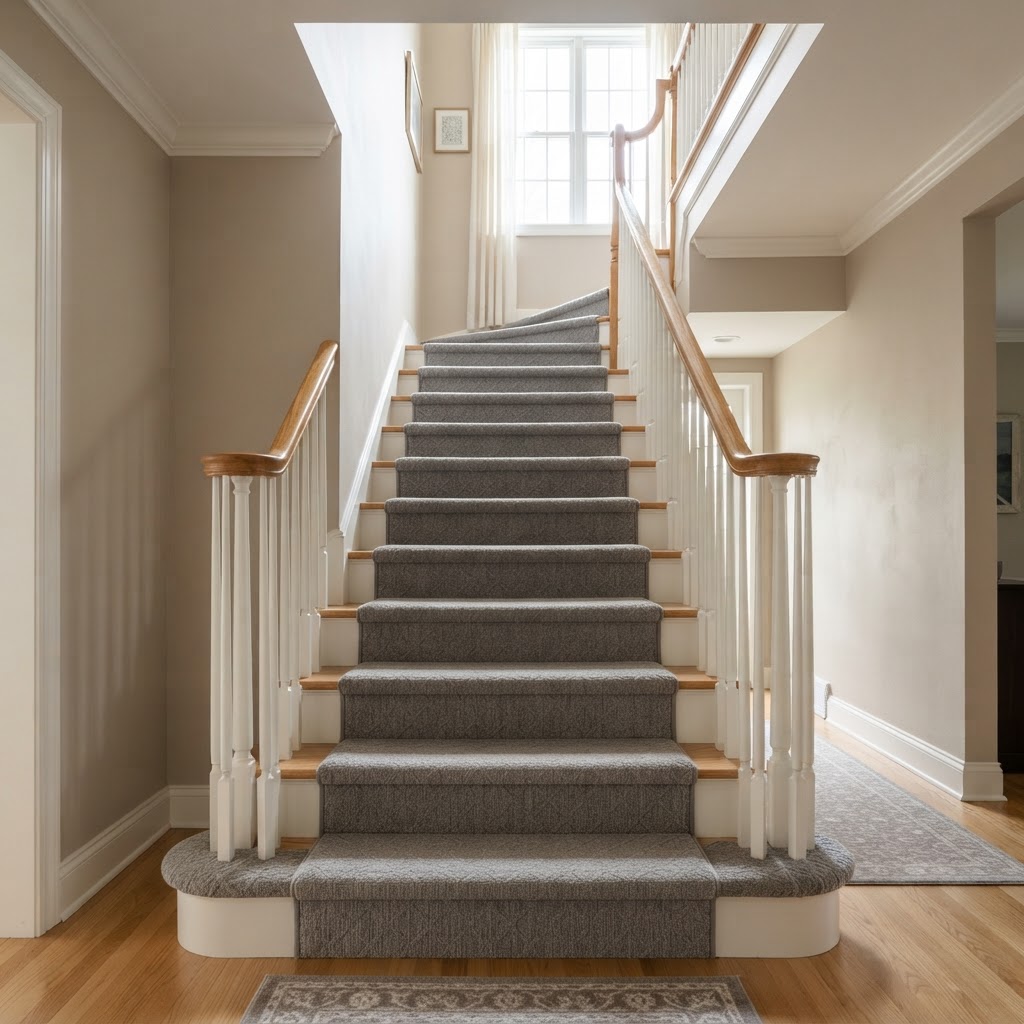
Re-carpet the whole staircase when the existing carpet is worn at the stair edges, loose, stained or flattened across most of the treads, because a full wall-to-wall installation resets the entire surface and secures it properly. Choose a runner when the staircase has attractive hardwood treads and risers you want to show, or when you want a defined, tailored look with a strip of carpet down the center. Replace only the worn sections when wear is limited, though stair carpet is usually installed as one continuous piece, which makes partial replacement uncommon. The right answer depends on the condition of the carpet and padding, the shape of the stairs, the material underneath, and how your household uses the staircase. Floors and Beyond VA, a family-owned Northern Virginia flooring contractor serving Fairfax, Loudoun, Prince William and Arlington counties since 1987, installs carpet with in-house crews and no subcontractors, so the person who measures your stairs is part of the team that installs them.
Stairs are the hardest-working carpeted surface in a home. Every trip up with laundry, every dash down for the school bus, every pet that sprints to the front door lands on a narrow edge called the nosing, and that is where carpet wears first. In Northern Virginia, where colonials, split-levels, townhomes and finished basements often include two or three staircases, stair carpet that looks tired is one of the most visible signs that flooring needs attention. This guide explains how to tell which option fits, how stair shape changes the installation, and what to expect when you ask for a stair carpet replacement estimate. You can also read about the broader process on our carpet page and in our guide to the complete carpet installation process.
How stair carpet wears, and why the edges fail first
Understanding how stair carpet fails helps you decide whether replacement is necessary. On a flat bedroom floor, wear is spread over a large area. On a staircase, almost all of the load concentrates on a narrow band at the front edge of each tread. Feet land there, push off there, and slide across it. The carpet fibers are compressed and abraded again and again, and the backing can begin to show through as a shiny, flattened or frayed strip along every step.
Several other signs usually appear alongside edge wear. The carpet may feel loose or ripple when you step, which suggests it has stretched or lost its grip on the tack strips. You may notice the padding showing through at the nosing, or hear squeaks that were not there before. Stains and soil gather in the corners where tread meets riser, because vacuum nozzles reach them poorly. Color may fade along the sunlit side of a staircase near a window. On carpeted stairs in older homes, you may find several layers of carpet that were installed over each other, which adds bulk and makes the stair edges rounded and slippery.
Loose or badly worn stair carpet is more than cosmetic. A staircase is where falls happen, and carpet that slides or catches a heel is a genuine hazard, particularly for children, older family members and anyone carrying something. If your stair carpet has loosened, treat the repair as a safety item rather than a style decision.
Full wall-to-wall stair carpet: what it is and when it makes sense
Full stair carpeting covers the treads (the part you step on) and the risers (the vertical part) with a continuous piece of carpet, usually running from the top landing down to the bottom. The most common method is often called a waterfall installation, in which the carpet flows over the nosing and down the next riser in one piece, giving a clean, soft look. Another method is called cap-and-band, in which a separate piece covers the tread and wraps over the nosing while another piece covers the riser, which creates a more tailored, defined edge.
Full carpeting makes the most sense in several situations. If the existing stairs are covered with plywood, were never intended to be seen, or have damaged or unattractive wood, carpet hides them and gives you a finished surface. If you want the quietest staircase in the house, full carpet with a quality pad absorbs footfall noise far better than hard surfaces or runners. If the surrounding rooms are carpeted, continuing the same carpet down the stairs creates a continuous look. And if you have small children, older relatives or pets, the grip and cushion of wall-to-wall stair carpet can feel safer than hardwood with a runner.
Full carpet also brings the most visual impact when you are replacing carpet on the upper level and want everything to match. When you plan the staircase together with the hallway and bedrooms, the carpet can run as one cohesive flow, and the installer can plan seams so they fall in the least noticeable places.
Runners: when they work better than full carpet
A stair runner is a strip of carpet, typically running down the center of each step with the wood visible on both sides. It is a classic look in historic Northern Virginia homes, especially in Alexandria, Arlington and Falls Church, where original oak or pine treads are an attractive feature. Runners suit staircases where the wood is in good condition and worth showing.
A runner offers some advantages. It protects the center of each tread, where most of the wear lands, while allowing the wood to remain visible. It can be a design feature in itself, with stripes, borders, patterns or rich colors that frame the stairs. It also allows you to replace the runner in the future without disturbing the stair structure, and the exposed wood margins are easier to clean.
There are trade-offs. A runner requires that the wood on both sides be finished and presentable, and if the treads are rough, painted unevenly or covered with old adhesive, preparation is needed. Runners are typically fastened with rods or tacked in place, and the installation must be precise so the runner sits straight and tight. A runner offers less cushioning and sound absorption than full carpet, and the exposed wood margins can be slippery in socks. Homes with pets and young children may prefer the more complete traction of wall-to-wall carpet.
If your staircase is open on one or both sides, curved or has landings, the design of a runner needs particular care. A good installer will consider how the runner turns at landings and winders, how wide the margins should be, and how the runner aligns with the edges of the treads. If you are unsure, ask to see how a runner will look on your own staircase before you decide.
When worn stair edges mean replacement is the better choice
Many homeowners ask whether they can simply patch a worn nosing. In practice, stair carpet is usually installed as a continuous length, and patching creates visible seams and uneven pile that tend to draw attention. A small repair may be possible in rare cases, but where wear shows along most of the edges, replacement is generally the more satisfying and durable choice.
A few clear signs suggest replacement rather than repair. If the backing is visible at the nosing, the carpet's structure has been compromised, and the wear will only worsen. If the carpet is loose across multiple steps, restretching or refastening may be a temporary fix at best, especially if the pad underneath has collapsed. If stains, odors or pet damage have penetrated the carpet and pad, cleaning will not restore the stairs. If the carpet is outdated in color or style and the rest of the home has changed, replacement lets you update the look at the same time. And if the staircase has had carpet installed over carpet, removing the old layers and starting fresh yields a cleaner, safer surface.
It also helps to think about the carpet's age. Stair carpet that has served for many years has already earned its keep. Rather than trying to extend its life with short-term fixes, many families find it more sensible to replace it with a more resilient construction. If you want to compare what lasts longest in busy households, our guide to the most durable carpet types explains how fiber and construction affect longevity.
How stair shape affects installation
No two staircases are identical, and the shape of yours influences how the carpet is cut, fitted and fastened.
Straight stairs with a uniform width are the simplest. The installer measures the run, plans how the carpet will be laid and secured, and can often complete the job with relatively little waste.
Stairs with a landing divide the carpet into sections. The landing is treated as a small floor area, and the installer decides whether the carpet flows continuously or whether seams fall at the landing. Landings also change how patterns align.
Winders and curved stairs, which have wedge-shaped treads that turn a corner, are more complex. Each wedge-shaped step requires precise cutting, and the carpet pattern or grain needs careful alignment so that the turn looks seamless. These staircases use more material and more labor.
Open-sided stairs, where one or both sides are exposed rather than against a wall, require finished edges. Carpet may need to be wrapped or bound, and the visible side of the tread (called the stringer or skirt) must be considered.
Bullnose or rounded starting steps, often found at the bottom of grand or traditional staircases, are curved and require careful fitting. Not every installer will want to tackle them, so it's worth asking whether the team has experience with them.
Wide stairs may require seams, because carpet comes in fixed roll widths. We discuss this further in our guide to how much flooring you need, but the basic point is that stair width, number of steps and landing layout all influence how much material is required.
The staircase's structure matters too. Treads with loose boards, squeaks or rot need to be repaired before new carpet goes down. Old tack strips and staples must be removed. Risers with damage may need attention. A thoughtful estimate will account for this preparation instead of treating the stairs as a simple copy of the room above.
Padding, density and the stair-specific choices that matter
Padding choice on stairs differs from bedrooms. Thick, soft padding that feels luxurious in a bedroom can be a poor choice on stairs, because excessive cushioning allows the carpet to flex over the nosing, accelerating wear and making steps feel unstable. Stair padding is typically firmer and denser, which supports the carpet at the edge and helps it hold its shape longer. Ask your installer what padding they recommend for stairs, and why.
The carpet construction matters as well. Dense, low-profile constructions tend to wear well on stairs because they resist crushing and show less distortion at the nosing. Loop constructions and tightly twisted cut-pile styles typically hold up better than deep, soft plush on stairs, where footprints and edge wear are more visible. Patterns and heathered colors help camouflage wear. On stairs, the general principle is to choose something dense and resilient rather than lofty.
Fiber also plays a role. Nylon, triexta and wool each bring different strengths to stairs. Nylon is known for resilience, triexta for inherent stain resistance and softness, and wool for natural resilience and a premium feel. Your budget and household will point toward the best fit, and a carpet selection appointment lets you compare samples side by side.
What drives the scope of a stair carpet project
Stair carpet estimates vary more than many homeowners expect, and the variation is not random. Each of the following factors influences the scope of the project, and we describe them here without prices, because the right proposal depends on your staircase.
The number of steps and the staircase width determine the amount of material. The stair shape, including landings, winders, curves and open sides, determines the amount of cutting, fitting and finishing. The carpet grade and construction affect material cost, and dense stair-grade carpets differ from budget products. The padding chosen for the stairs matters. Removal of the old carpet and pad, along with tack strips and staples, adds labor. Subfloor or stair repair, such as fixing squeaks or replacing damaged treads, adds scope. Runner details, such as border treatments, binding, rods and custom widths, differ from wall-to-wall installation. And whether the stairs are being done together with the hall and rooms above can change both the layout and the efficiency of the work.
Floors and Beyond VA provides an honest, all-inclusive estimate, and what we quote is what you pay. Our estimates include old flooring removal, new materials, professional installation, and cleanup, so you can compare proposals on equal footing.
Common mistakes to avoid
The most common mistake is choosing carpet for stairs based on how it looks on a sample board in a bedroom. Stairs are a high-wear environment, and a soft, lofty carpet that feels wonderful in a bedroom may flatten and wear quickly on the nosing.
Another is using the same thick padding as the bedrooms. Stairs need firmer support to keep the carpet stable and prevent premature wear at the edge.
A third is skipping the preparation. Squeaks, loose treads and old staples left in place show up later as problems in the new carpet.
A fourth is adding a runner over unfinished wood. If you want the wood to show, it must be in presentable condition, which may require refinishing before the runner goes in. Our refinish-first philosophy applies here: if the original treads are sound, restoring them often yields a better result than covering them.
A fifth is ignoring safety. Loose stair carpet is a trip hazard, and it should not be left for later.
A sixth is comparing quotes without checking that stairs are included. Some proposals treat stairs as an add-on or price them separately, so it is worth confirming what is in each estimate.
Finally, many homeowners try to save time by delaying the stairs until the rest of the carpet is installed. Stairs are usually best handled together with the upper level, so the carpet matches and the installers can plan seams and transitions as one project.
How Floors and Beyond VA approaches stair carpet replacement
We begin with a free in-home consultation. We walk your staircase with you, look at the condition of the existing carpet, check for loose treads or squeaks, and discuss how your family uses the stairs. Our professionals use precise laser measurements on every room at no charge, and we bring samples so you can compare colors and constructions in your own lighting, which matters because stair lighting can be dim and can change how a color looks.
From there, we provide a clear estimate that includes the work needed, and we explain the differences between full carpet and a runner so you can choose with confidence. Our in-house crews handle the installation, which keeps accountability simple: no subcontractors, one team, one standard of care. We are fully licensed, bonded and insured.
We serve Fairfax, Loudoun, Prince William and Arlington counties, including Alexandria, Reston, Vienna, McLean, Springfield, Burke, Centreville, Ashburn, Leesburg, Manassas and Woodbridge.
Frequently asked questions
How do I know if my stair carpet needs to be replaced?
Look for visible backing at the nosing, looseness, ripples, collapsed padding, persistent odors or stains, and heavy wear on the edges.
Is a runner or full carpet better for stairs?
It depends. A runner shows attractive wood and suits traditional homes, while full carpet offers more cushion, traction and sound absorption.
Can I replace the carpet on only some of the steps?
Stair carpet is usually continuous, so partial replacement tends to be visible. Replacing the whole staircase is typically more satisfying.
What kind of carpet is best for stairs?
Dense, low-profile constructions in resilient fibers tend to hold up best. Heathered or patterned styles help hide wear.
Do curved or winding stairs cost more to carpet?
They require more cutting and labor, which affects the scope of the estimate.
What padding should I use on stairs?
Firmer, denser padding generally works better than thick, soft padding.
Do you remove the old carpet?
Yes. Our estimates include old flooring removal, new materials, professional installation and cleanup.
Can I keep my hardwood stairs and add a runner?
Yes, if the wood is in good condition or can be refinished.
Does Floors and Beyond VA use subcontractors?
No. Our in-house crews handle the work.
Do you serve my area?
We serve Fairfax, Loudoun, Prince William and Arlington counties.
Ready to schedule an estimate for stair carpet replacement?
Your staircase is one of the most visible and most used parts of your home, and the right carpet makes it safer, quieter and more attractive. Floors and Beyond VA offers nearly forty years of Northern Virginia experience, in-house crews with no subcontractors, free in-home consultations with samples, and all-inclusive estimates.
Schedule an estimate for stair carpet replacement: https://floorsandbeyondva.com/Contact
You can also call (703) 906-5698 or send us a message through our contact page.




