
Carpet vs. LVP
in Northern Virginia
Townhomes:
The Honest
Floor-by-Floor
Answer.
Choosing between carpet and LVP for a NoVA townhome is the wrong question. The right question is which product belongs on which level — and the answer is almost always both.
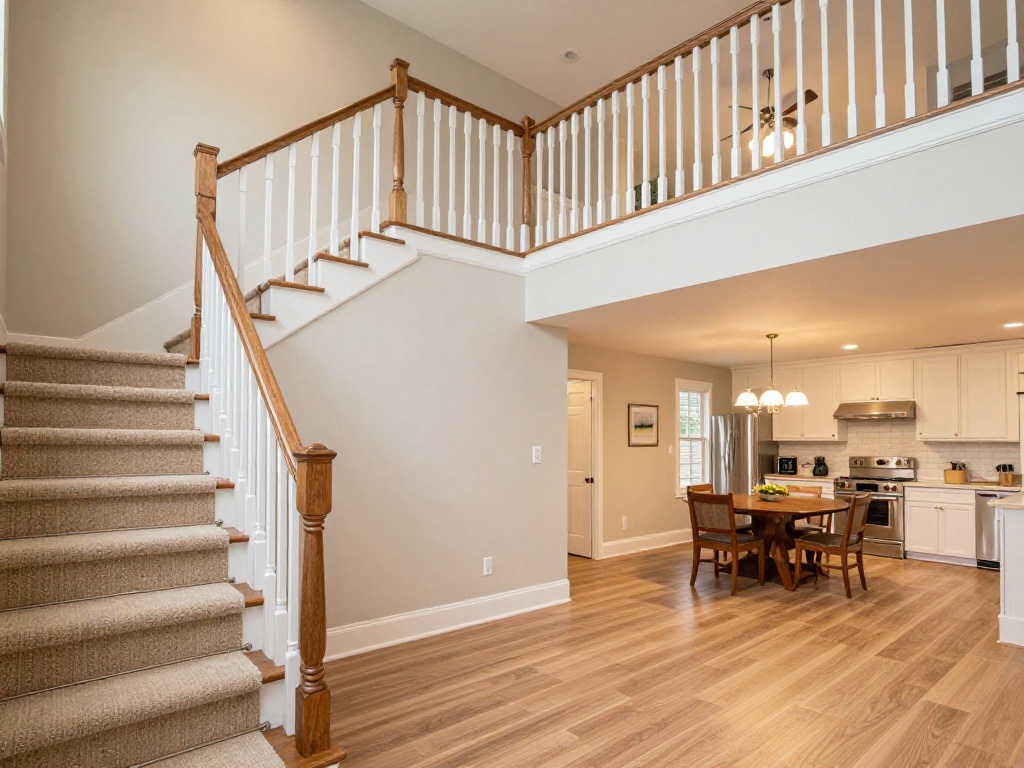
- Most Northern Virginia townhomes should use both products, not one — LVP on the main level where traffic and spills are the primary conditions; carpet on the stairs and bedroom level where noise absorption, thermal comfort, and traction are the primary needs.
- The stair noise argument is the most decisive — carpet on stairs reduces impact noise transmission by 35+ dB compared to hard stair treads, addressing the number one acoustic complaint in Northern Virginia townhomes without any additional acoustic underlayment or structural modification.
- HOA acoustic requirements favor carpet — most Northern Virginia townhome HOAs require minimum IIC 50 for hard floor installations; carpet with a standard pad achieves IIC 70+ automatically, while LVP requires acoustic underlayment to meet the threshold, adding cost and specification complexity.
- The "hard floors increase resale value" assumption is more complicated in townhomes — in a housing type where noise transmission between shared walls is a known buyer concern, carpet on the upper level and stairs is a feature, not a liability.
- Floors and Beyond installs both carpet and LVP in NoVA townhomes as single projects — the mixed approach completed by one in-house crew, with room-by-room recommendations, HOA documentation review, and free written estimates throughout Fairfax, Loudoun, Prince William, and Arlington.
Northern Virginia's townhome stock is one of the densest in the Mid-Atlantic — Ashburn, Woodbridge, Reston, Herndon, Sterling, Leesburg, Manassas, and dozens of other NoVA communities are built around townhome neighborhoods that share walls, stairways, and the acoustic environment of multi-level living. When homeowners in these communities ask "carpet or LVP?" they're usually asking it as a whole-home question. The more useful answer breaks it down by level.
The three-level townhome layout that dominates Northern Virginia — ground floor entry and garage, main living level above, bedrooms on the third floor — creates naturally different product requirements on each level. Treating it as a single specification decision is why so many NoVA townhomes end up with a flooring choice that works well on one level and creates problems on another. Floors and Beyond has installed flooring in Northern Virginia townhomes for decades and this guide covers the honest floor-by-floor breakdown.
The Floor-by-Floor Breakdown for Northern Virginia Townhomes
Each level of a NoVA townhome has different traffic conditions, different acoustic exposure, and different daily use — and the product that performs best in each level reflects those conditions, not a whole-home aesthetic preference.
Northern Virginia townhome ground floors — where the garage, entry, and often a powder room or utility space are located — receive the highest moisture and abrasion exposure of any level. Road salt, rain, snow melt, and muddy outdoor shoes are deposited here first. Carpet in a ground-floor entry degrades rapidly under these conditions: moisture from tracked-in precipitation saturates carpet backing and pad, clay soil from NoVA's characteristic soil composition abrades fibers, and road salt creates crystalline deposits that standard cleaning cannot fully extract.
SPC LVP (solid polymer core) is the correct ground-floor specification — impervious to moisture, cleanable with a damp mop, and durable under the concentrated foot traffic and abrasion of daily entry use. Tile is an equally correct option for ground-level entries and utility areas. Neither carpet nor standard engineered hardwood belongs at this level in a Northern Virginia townhome.
The main living level of a Northern Virginia townhome — kitchen, dining area, and the main living room — is where LVP's practical advantages are most compelling. Cooking spills, tracked-in moisture from the entry below, heavy furniture on casters, and the concentrated traffic of daily household activity all favor a hard floor that can be mopped clean over carpet that retains soil and moisture.
The acoustic case for LVP on the main level is less concerning than on the bedroom level, because the space below the main level is usually the garage or utility ground floor — not an occupied sleeping space. The primary acoustic concern in a NoVA townhome is footstep noise from the bedroom level into the main living area, and from stair use throughout the home — not from the main level downward. This means the acoustic penalty of LVP on the main level is significantly lower than the acoustic penalty of LVP on the bedroom level.
Stairs are where the carpet vs. LVP decision has the largest daily-life impact in a Northern Virginia townhome, and where the case for carpet is most decisive. Hard stair treads — LVP or hardwood — create impact noise with every step that resonates through the home's wood-frame structure. In a three-level townhome where the stairs connect all levels, stair noise from early risers or late arrivals is audible in bedrooms, audible in the main living area, and audible through shared walls in attached homes.
Wall-to-wall stair carpet with a dense rebond pad absorbs that impact at the source — before it enters the framing. The ASTM E492 impact noise reduction of 35+ dB for carpet vs. hard treads translates directly into the difference between stair traffic that wakes sleeping household members and stair traffic that doesn't. This is not a marginal improvement; it's the single most effective and least expensive acoustic intervention available for a Northern Virginia townhome.
The traction case adds to the acoustic argument. Hard stair treads have a coefficient of friction of 0.3–0.4, below the 0.42 safety threshold for stair surfaces. Stair carpet achieves 0.6+. In a household with young children, older adults, or pets using stairs multiple times daily, this traction difference is a safety specification, not a style preference.
The bedroom level of a Northern Virginia townhome sits directly above the main living area — meaning footstep impact from the bedroom level is transmitted into the living space below with every step. LVP on the bedroom level, even with acoustic underlayment, achieves IIC ratings of 50–60. Carpet with a standard pad achieves IIC 70+. This difference is audible: bedroom-level footsteps with LVP overhead are a frequent complaint in townhomes; with carpet overhead they're typically inaudible.
The thermal comfort case complements the acoustic argument. Bedrooms are walked on barefoot — at 6 AM in January in Ashburn or Woodbridge or Leesburg, the difference between stepping onto carpet and stepping onto LVP is approximately 10–12°F of surface temperature. That's a daily quality-of-life difference that accumulates over years of occupancy. And the fall-safety case for carpet in bedrooms — where dark-of-night navigation is the norm — rounds out an argument that clearly favors carpet over hard floors on the bedroom level of any Northern Virginia townhome.
The HOA Acoustic Requirement — What Northern Virginia Townhome Owners Need to Know
Many Northern Virginia townhome and condominium HOAs specify minimum IIC ratings for any hard floor installation — and carpet automatically satisfies these requirements while LVP requires acoustic underlayment to meet them.
Before installing any hard flooring in a Northern Virginia townhome governed by an HOA, the HOA documents should be reviewed to confirm the minimum IIC requirement for hard floor installations on occupied levels. Floors and Beyond reviews HOA documentation as part of every townhome consultation — the acoustic underlayment specification that achieves compliance is part of the recommendation, not an afterthought at installation.
Carpet vs. LVP in Northern Virginia Townhomes — Side-by-Side
The full comparison across the criteria that matter most in a Northern Virginia townhome context — not the generic criteria that apply equally everywhere.
| Criteria | Carpet | LVP | Townhome Verdict |
|---|---|---|---|
| Impact noise (IIC) | IIC 70+ with standard pad — no additional spec needed | IIC 40–60 depending on underlayment — HOA compliance requires underlayment verification | Carpet wins — bedroom level and stairs |
| Stair safety (COF) | 0.6+ — above any safety threshold | 0.3–0.4 — below 0.42 safety standard for stair surfaces | Carpet wins — stairs |
| Spill and moisture resistance | Absorbs moisture — not appropriate for spill-prone areas | 100% waterproof (SPC core) — correct for kitchens, entries | LVP wins — main level and entry |
| Morning comfort / thermal | 10–12°F warmer underfoot — significant in NoVA winters | Feels cold underfoot — area rugs can partially compensate | Carpet wins — bedrooms |
| HOA acoustic compliance | Automatic — carpet exceeds IIC 50 without additional spec | Requires acoustic underlayment documentation and correct product pairing | Carpet simpler for HOA compliance |
| Durability in high traffic | Pile crush in sustained traffic paths — stair carpet should be nylon or triexta | Excellent — 20 mil wear layer handles heavy traffic well | LVP wins — main level traffic paths |
| Lifespan | 10–18 years (nylon/triexta, correctly maintained) | 15–25 years (20 mil+ SPC) | Comparable — LVP slight edge in lifespan |
| Townhome resale | Hard floors valued by some buyers; carpet on bedroom level and stairs valued by noise-sensitive buyers | Hard floors valued broadly; acoustic concerns may offset this in townhome context | Mixed approach — neutral to positive resale |
From Floors and Beyond
"The mixed approach isn't a compromise — it's the correct specification for the townhome layout. LVP on the main level and entry, carpet on the stairs and bedroom level: this is the arrangement that uses each product where its strengths matter and avoids each product where its weaknesses create problems. Floors and Beyond handles mixed townhome projects as a single job with one crew, one estimate, one timeline."
Floors and Beyond installs carpet and LVP in Northern Virginia townhomes throughout Fairfax, Loudoun, Prince William, and Arlington — free consultation including HOA review and room-by-room recommendations.
Schedule a Free Townhome ConsultationFrequently Asked Questions — Carpet vs. LVP in Northern Virginia Townhomes
Should I put carpet or LVP in my Northern Virginia townhome?
Most Northern Virginia townhomes benefit from using both products in the right rooms. LVP is the correct specification for the main level — entry, kitchen, dining, and main living area — because it handles spills, tracked-in moisture, and heavy traffic. Carpet is the correct specification for the bedroom level and stairs, where it provides thermal comfort, impact noise absorption, and stair traction that hard treads cannot match. A mixed approach that uses LVP on the main level and carpet on the upper level and stairs is the specification most Northern Virginia flooring professionals recommend for townhome layouts.
Does carpet reduce noise in a Northern Virginia townhome?
Yes, significantly. Carpet with a quality pad achieves an IIC rating of 70+ — the measure of how much footstep impact noise transmits between floors. LVP without acoustic underlayment achieves IIC 40–50, well below the IIC 50 minimum that most HOAs require for hard floor installations. In a Northern Virginia townhome where bedroom-level footsteps are audible in the main living area below, carpet on the upper level is the single most effective acoustic intervention available. Stair carpet eliminates the impact noise of stair use — the number one acoustic complaint in NoVA townhomes.
Does Floors and Beyond install both carpet and LVP in Northern Virginia townhomes?
Yes. Floors and Beyond installs both carpet and LVP throughout Northern Virginia townhomes in Fairfax, Loudoun, Prince William, and Arlington — frequently completing the mixed approach (LVP on the main level, carpet on the upper level and stairs) as a single project with one in-house crew. Free shop-at-home consultations are available throughout Northern Virginia, including room-by-room product recommendations, HOA acoustic documentation review, and written estimates at no charge.
Does LVP on stairs in a townhome require HOA approval?
It depends on the HOA. Many Northern Virginia townhome and condominium HOAs specify minimum IIC ratings for hard floor installations on occupied levels — and stairs often fall within the scope of that requirement. LVP on stairs without acoustic underlayment typically achieves IIC ratings below the 50 minimum that most HOAs require. Floors and Beyond reviews HOA documentation before any townhome hard floor installation to confirm the acoustic requirements and specify the underlayment product that achieves compliance.
// Free Townhome Consultation · Northern Virginia
Get the Right Floor
on Every Level of
Your Townhome.
Floors and Beyond handles mixed carpet and LVP townhome projects as a single job — one crew, one estimate, HOA documentation reviewed, room-by-room recommendations. Serving Fairfax, Loudoun, Prince William, and Arlington since 1987.
Schedule a Free Consultation



