
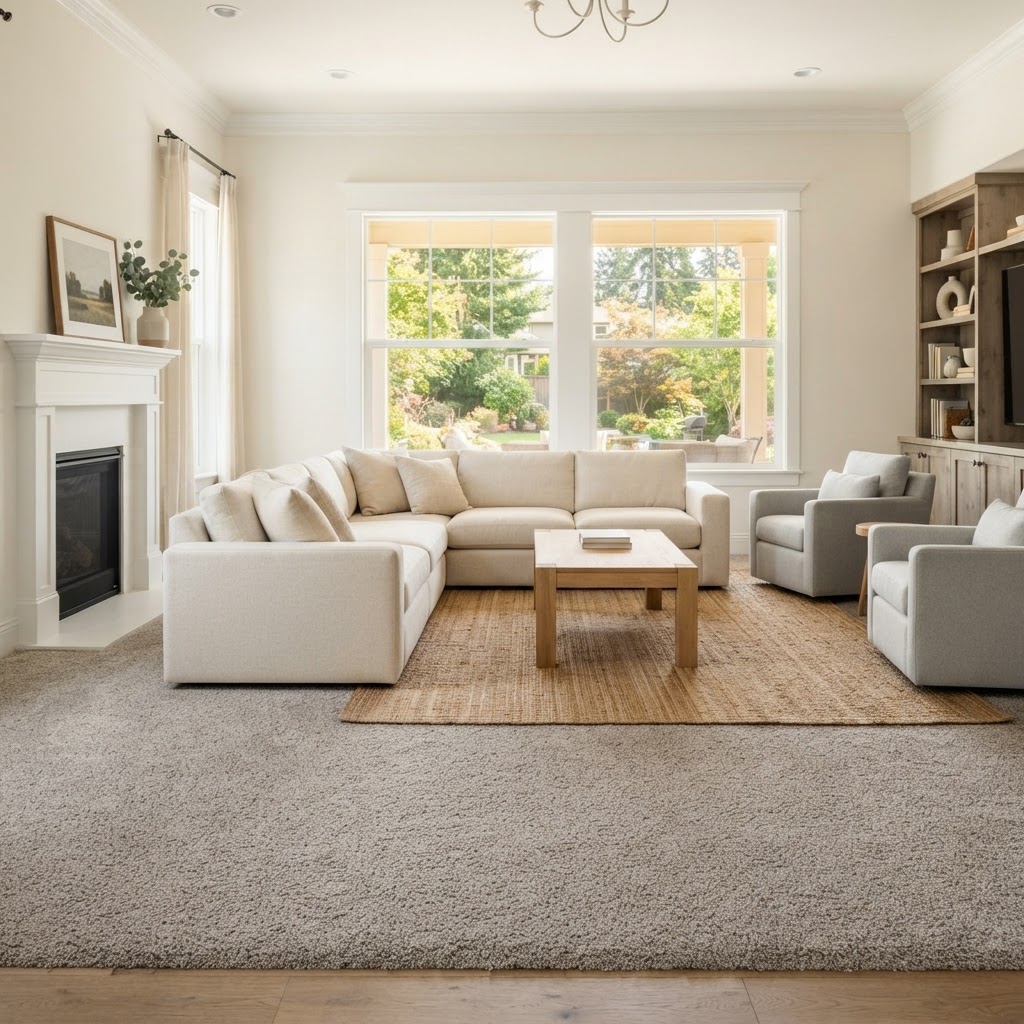
The best carpet color for a household with pets and children is usually a mid-tone, multi-tonal shade, such as a heathered gray-beige, a warm taupe, a flecked oatmeal or a soft brown with visible variation, rather than a pure white, a solid light cream or a solid black. Mid-tones with built-in color variation hide the everyday soil that settles between cleanings: dust, dirt, pet hair, crumbs and the faint shadows that footprints leave. Texture and fiber construction matter nearly as much as the color itself, because a textured or flecked surface scatters light and masks marks that a smooth, solid-color carpet would reveal. Floors and Beyond VA, a family-owned Northern Virginia flooring contractor serving Fairfax, Loudoun, Prince William and Arlington counties since 1987, helps homeowners choose carpet by bringing samples into the actual room during a free in-home consultation, because a color that looks perfect in a showroom can look very different under your own lighting.
This article focuses on how carpet looks between cleanings and how easy it is to keep looking good. It is not a general durability guide, and it does not rank fibers by lifespan. For that, you can read our separate guides on the most durable carpet types and stain-resistant carpet for families. Here, the question is visual: which colors, patterns and textures keep a Northern Virginia home looking clean when real life is happening on the floor. To explore options, visit our carpet page.
Why the color you choose decides how often the carpet "looks dirty"
Every carpet collects soil. What differs is how much of that soil you can see. Visible soil depends on the contrast between the carpet and whatever lands on it. A tan crumb on a white carpet barely registers, but a dark footprint is obvious. A white dog hair stands out on a dark carpet and disappears on a light one. In other words, a carpet looks clean when the things that typically land on it blend in.
Think about what usually lands on your floors. In a Northern Virginia household, it might be fine gray dust, red clay tracked in from a yard in Loudoun or Prince William, pollen in spring, leaf debris in fall, road salt and slush in winter, pet hair, crumbs, and the occasional spilled drink. Most everyday soil is mid-brown or gray. A carpet in a similar mid-tone, with variation in the color, looks clean far longer because that soil blends in. A very light carpet shows brown and gray soil clearly, while a very dark carpet shows lint, pet hair and dust.
This is why we encourage families to start with the soil rather than with the paint chip. Look at what actually builds up in your house and choose a color that disguises it.
Light, dark and mid-tone colors: what each really shows
Light and cream colors make rooms feel airy and bright, and some people love their clean look. However, they show almost every kind of soil: footprints, traffic lanes, dirt along the edges, and spills. Staining is more noticeable on a light, solid surface, even though many modern carpets resist stains better than older ones. A light carpet can still work in a household with children and pets, but it asks for more frequent attention and a willingness to accept some visible traffic patterns over time. If you love the look, choose a light color with visible texture or flecks, rather than a smooth solid.
Dark colors hide stains and dirt well, which seems like an easy answer, but they have their own drawbacks. Dark carpets show lint, dust, pale pet hair, and the vacuum's own tracks. In a room with strong sunlight, dark carpet can show fading, and in a dark room it can feel heavy. Dark solids also show footprints and vacuum marks, particularly in smooth cut-pile styles.
Mid-tones are the workhorses. Colors in the range of greige, taupe, mushroom, warm gray, oatmeal, driftwood and soft brown sit between the extremes of light and dark, so they neither display light soil nor dark lint as aggressively. When the color also has several tones woven through it, the eye reads a blend rather than a single flat shade, and anything that lands on it is camouflaged.
Color variation: the most useful feature in a family carpet
The single most helpful trait in a carpet for a busy home is color variation. A carpet made from yarns that mix two, three or more tones, sometimes with flecks, heathering or subtle patterning, offers the eye many shades to rest on. When a crumb or a bit of dirt lands on it, the speck is lost among the variation.
You will find this variation expressed in several ways. Heathered or tweed colors blend lighter and darker fibers, giving a soft, natural look. Flecked carpets scatter small contrasting dots across a base color. Multi-colored or space-dyed yarns vary along the length of the yarn itself, producing a mottled look. Patterned carpets, whether with a woven pattern or a subtle geometric, add visual complexity that disguises wear and soil.
The more variation a carpet has, the more forgiving it is. This is why a solid, uniform color in any shade, even mid-tone, will usually show marks more readily than a heathered one in the same family.
Pile texture, and why it changes how color reads
Texture changes how light reflects off the carpet, and that changes how color and soil appear. Two carpets in the identical color can look surprisingly different depending on their pile.
A smooth, velvety cut pile, sometimes called plush or saxony, has a uniform surface that reflects light evenly. It looks luxurious and soft, but it also shows footprints, vacuum marks and shading. When you walk across it, the fibers lean in different directions, and the change in light creates visible marks. In a family room with traffic, these marks can make the carpet appear worn or dirty even when it is clean.
A textured cut pile, where yarns are twisted and set so the tips curl, creates a more irregular surface. The tips of the fibers scatter light and break up footprints. It is a popular choice for families because it looks casual and hides marks well.
A frieze, with tightly twisted, curly yarns, is among the most forgiving textures for visible soil because the surface is so irregular that tracks and shading all but disappear.
A loop pile, where the yarn forms loops rather than cut ends, tends to resist showing footprints and has a flat, even look. Berber-style loops often include flecks of color, making them double as a variation carpet. A consultation with real samples is the best way to compare these constructions.
The takeaway is to pair a forgiving color with a forgiving texture. A mid-tone heathered color in a textured cut pile or a loop will look cleaner for longer than the same color in a smooth plush.
Room lighting changes everything
Carpet color is not a fixed property. It shifts with the light in the room, and it can shift dramatically between the showroom, your family room in the afternoon, and the same room under lamps in the evening.
Natural light varies by exposure. A south-facing room in Fairfax or Arlington receives strong, warm light that can wash out pale carpet and make dark carpet look faded over time. A north-facing room gets cool, even light that can make beiges look grayer and warm colors look cooler. East- and west-facing rooms shift through the day.
Artificial light matters just as much. Warm bulbs, around 2700K, bring out yellows and reds in carpet. Cooler bulbs, around 4000K and above, emphasize blues and grays. LED lighting can render colors differently from older incandescent bulbs. A carpet chosen under cool showroom lights may look noticeably warmer or more yellow under your living room lamps.
Light direction also influences the look of pile. Raking light from a window across a carpet emphasizes texture and footprints, while overhead lighting flattens it. If your room has large windows with strong side light, a textured or patterned carpet will hide marks better than a smooth one.
Because of all this, we strongly recommend judging samples in your own space, at different times of day. During a free in-home consultation, Floors and Beyond VA brings samples to your home so you can see how they look in your real light, next to your furniture, walls and trim. Let the samples sit on the floor for a day, and look at them in the morning, afternoon and evening before deciding.
Choosing color for specific households
Homes with dogs and cats. Pet hair is the central issue. Choose a color that is close to your pet's coat color or in a similar mid-tone, and a heathered or textured carpet will help. Black dogs shed on light carpet and white dogs shed on dark carpet, so match to the hair that is actually on your floor. Accidents are easier to manage on a carpet that is stain-resistant, and light solids are the least forgiving. For odors, see our guide to removing pet odors from carpet.
Homes with young children. Spills of juice, markers and food are inevitable. Patterns and flecks help hide small marks. Avoid pale solids in play areas, and consider a color with enough depth to camouflage stains between cleanings.
Homes with teens and frequent guests. Traffic lanes form quickly in hallways and entries. A mid-tone with variation resists showing them.
Busy entries, hallways and family rooms. These areas show soil most because everything passes through them. Choose the most forgiving color and texture here.
Bedrooms. Lower traffic allows more freedom, so you can choose a softer plush or lighter color if you prefer. Keep in mind where beds and furniture will sit, because heavy furniture can leave dents in the pile.
Basements. Light levels are often lower, which changes how color looks, and moisture concerns may influence what is appropriate. Our guide to basement carpet and mold prevention covers that aspect.
Matching carpet to the rest of your home
Color is not chosen in isolation. The carpet should coordinate with wall colors, trim, cabinetry, hardwood in adjoining rooms and furnishings.
Warm undertones, such as beige, tan and warm gray, tend to coordinate with wood floors and traditional trim, which is common in many Northern Virginia homes. Cool undertones, such as blue-gray, can suit modern interiors. Look carefully at the undertones, because a carpet that appears neutral on its own may look pink, green or yellow next to your walls.
Consider also how the carpet meets adjacent floors. If your home has hardwood in the hall and carpet in the bedrooms, the carpet color should complement the wood. Our wood flooring page shows the range of tones we work with.
If you are planning to sell in the next few years, a neutral mid-tone is also the safest choice in terms of broad appeal, though we avoid promising any specific effect on sale price.
Maintenance: keeping the color looking right
Even the most forgiving carpet looks better with regular care. Vacuum frequently, particularly in traffic lanes, using a vacuum with good suction and a clean filter. Place entry mats at doors to catch grit before it reaches the carpet. Treat spills promptly by blotting, rather than rubbing. Schedule periodic professional cleaning according to the carpet manufacturer's recommendations, which also helps maintain any warranty. Keep sunlight in check with window coverings if fading is a concern. Our floor care page offers additional guidance.
Remember that how a carpet looks over time depends on the combination of color, texture, fiber and maintenance. A well-chosen carpet can stay presentable between cleanings much longer than a poorly chosen one, even if both are the same quality.
What drives the scope of a carpet project once you've chosen a color
Color itself does not usually change the cost of carpet, but related choices do, and it is useful to understand them. The fiber and construction you choose to achieve the look you want influence the material scope. The amount of patterned or variegated carpet can affect how much material is needed, since patterns require matching at seams. The padding and removal of old flooring are part of any estimate. The size and layout of the rooms, including stairs and closets, shape the quantity of carpet. We provide honest, all-inclusive estimates, and what we quote is what you pay.
Common mistakes to avoid
The most common mistake is choosing a color from a small sample in a showroom. Small samples under store lighting mislead. Always view larger samples in your own home.
Another is choosing pure white or pale cream because it looks fresh, then discovering how quickly it shows soil in a busy house.
A third is assuming dark is always safer. Dark carpets show lint, dust and pet hair.
A fourth is ignoring texture. A smooth plush shows footprints in any color.
A fifth is forgetting your pets' coats. Pet hair on carpet is one of the biggest visual challenges, and it is easily addressed by matching the color.
A sixth is overlooking undertones. A carpet that clashes with walls and trim looks wrong even if it hides dirt well.
Finally, many homeowners make the decision alone from catalog photos. A conversation with an experienced installer who has seen how colors age in real homes can save years of regret.
How Floors and Beyond VA helps you choose
We start with a free in-home consultation. We bring samples to your home, take precise laser measurements at no charge, and look at your lighting, your furnishings and how your household lives. We talk about pets, children, entertaining and traffic patterns, and we help you narrow choices to a few that suit your priorities. Because our in-house crews handle installation without subcontractors, the people who advise you are accountable for the result.
We serve Fairfax, Loudoun, Prince William and Arlington counties, including Alexandria, Reston, Vienna, McLean, Springfield, Burke, Centreville, Ashburn, Leesburg, Manassas and Woodbridge.
Frequently asked questions
What carpet color hides dirt best?
Mid-tone, multi-tonal colors such as heathered greige, taupe and oatmeal tend to hide everyday soil best.
Is light carpet a bad idea with pets?
It shows more soil, but a light color with flecks or texture can work if you accept more frequent upkeep.
Does dark carpet hide stains?
It hides many stains but shows lint, dust and light-colored pet hair.
Does texture matter as much as color?
Yes. Textured, frieze and loop styles hide footprints and marks better than smooth plush.
Why does carpet look different at home than in the store?
Lighting, wall color and furnishings all change how carpet color appears.
Can I get samples to see in my home?
Yes. We bring samples during our free in-home consultation.
Should I match carpet to my dog's fur?
It can help. Choosing a similar tone makes shed hair less visible.
Will a patterned carpet hide more wear?
Generally yes, because patterns and variation distract the eye from small marks.
Does Floors and Beyond VA use subcontractors?
No. Our in-house crews handle the work.
Do you serve my area?
We serve Fairfax, Loudoun, Prince William and Arlington counties.
Ready for an in-home carpet sample consultation?
The right carpet color should make your home look good on an ordinary Tuesday, not just on installation day. Floors and Beyond VA offers nearly forty years of Northern Virginia experience, in-house crews with no subcontractors, and free in-home consultations with samples.
Book an in-home carpet sample consultation: https://floorsandbeyondva.com/Contact
You can also call (703) 906-5698 or send us a message through our contact page.




