What is the best flooring for a home gym in Arlington?
For most home gyms, Floors and Beyond VA recommends dense rubber flooring — interlocking tiles or rolled rubber — because it protects equipment, the subfloor, and joints. But the right assembly depends on where the gym sits: a ground-floor or basement slab is ideal for heavy lifting, while an upper-floor Arlington condo needs an impact-rated layer to control noise to the unit below. If you already have hardwood, protect it with a removable layer rather than bonding to it.
What is the best material for a home gym floor?
Dense rubber is the default; LVP and protected hardwood work for light, low-impact training.
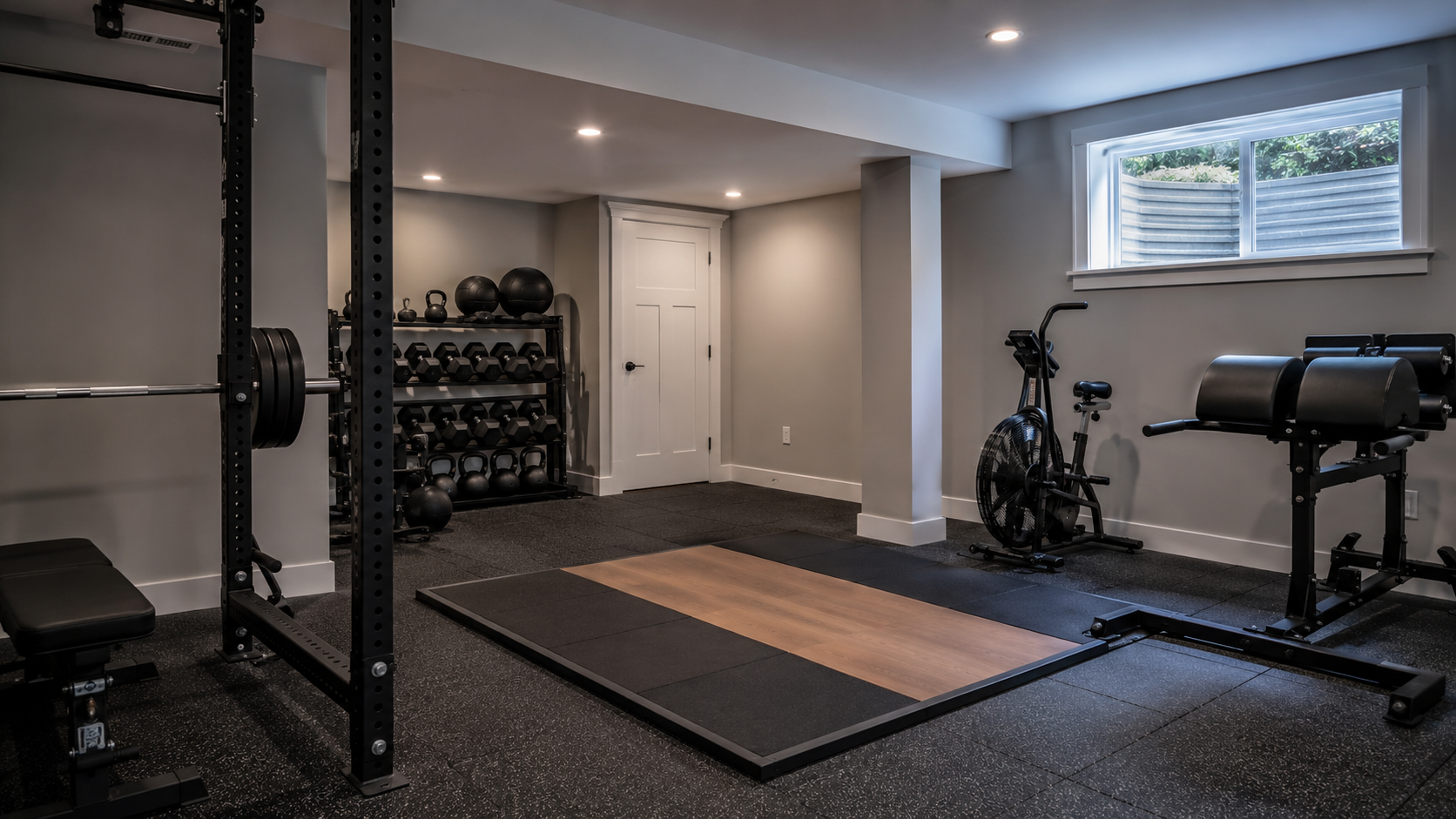
Rubber absorbs impact, grips equipment, and shrugs off dropped weights — which is why it is the standard for serious training. Luxury vinyl plank is a reasonable choice for light cardio, yoga, or a multi-use room, but it dents under heavy plates and racks. Carpet tile suits stretching and bodyweight work only. The best answer is rarely one material for the whole room — it is a rubber lifting zone paired with a more comfortable surface for the rest.
| Use | Best material | Why |
|---|---|---|
| Free weights / lifting | 3/8–3/4 in. rubber | Protects structure and equipment from drops |
| Cardio machines | 8mm rubber or LVP | Stable, easy to clean, absorbs vibration |
| Yoga / stretching | Rubber or carpet tile | Comfort and grip matter more than density |
| Multi-use room | LVP with a rubber zone | Looks finished, protects the lifting area |
Slab basement or upper-floor condo? The subfloor decides.
Where the gym sits changes the whole assembly before the top layer is even chosen.
Over a concrete slab
The ideal home-gym location. A slab handles heavy loads and drops without deflection. The main concern is moisture, so a waterproof rubber or a moisture barrier under the surface keeps a below-grade Arlington rec room dry and stable.
Over a wood-framed floor
Wood-framed floors flex and transmit impact noise to the space below. A layered assembly — acoustic underlayment plus rubber — reduces sound transfer and protects the structure. Heavy deadlifting is best avoided above another living space.
Many Arlington and Ballston condo buildings set minimum sound-isolation requirements (measured as IIC for impact noise and STC for airborne sound) for any flooring change. A home gym on an upper floor magnifies impact noise to the unit below, so Floors and Beyond VA builds a layered assembly that meets the building’s rating before installing — the same acoustic thinking used for hardwood and LVP in Old Town Alexandria condos.
Can you put a home gym over existing hardwood?
Yes — but protect the hardwood, don’t bond anything to it.
If a room already has sound hardwood, the goal is to shield it, not sacrifice it. A removable floating layer of rubber over a protective barrier guards against dents and moisture while keeping the option to return the room to finished wood later. Permanently gluing gym flooring onto a good hardwood floor destroys value that is hard to recover. In keeping with a refinish-first approach, Floors and Beyond VA assesses whether the existing floor is worth preserving before anything goes over it — and if the hardwood is already worn, refinishing it first and adding removable mats is often the smarter sequence.
How thick should home gym rubber be?
Match thickness to impact: thicker under weights, thinner under cardio.
Thickness is about the forces the floor absorbs, not a single blanket number. For general training over a firm subfloor, 8mm is a sensible minimum. Dedicated lifting and deadlift zones move to 3/8 inch, 1/2 inch, or 3/4 inch rubber, and are often doubled under a lifting platform. Over an upper-floor assembly, added thickness also helps dampen impact noise. The heavier and higher the drops, the more rubber belongs underneath — which is why Floors and Beyond VA specs the lifting zone and the rest of the room separately.
Frequently asked questions
What flooring holds up to dropped weights in a home gym?
Dense rubber. For general training, 8mm over a firm subfloor is a reasonable minimum, and dedicated lifting zones benefit from 3/8 inch to 3/4 inch rubber, often doubled under a platform. The goal is protecting both the equipment and the structure beneath, so Floors and Beyond VA specs thickness to the actual use.
Can you put a home gym floor over hardwood?
Yes, but protect the hardwood rather than bonding to it. A removable floating rubber layer over a protective barrier shields the wood from dents and moisture while keeping the option to return the room to finished hardwood. Floors and Beyond VA assesses whether the existing floor is worth preserving first.
Will a home gym on an upper floor disturb the unit below?
It can. In Arlington condos and upper-floor rooms, impact noise travels downward, and many buildings set minimum sound-isolation requirements. A layered assembly of acoustic underlayment plus rubber reduces transfer and helps meet building rules. For serious lifting, a ground-floor or basement slab is always quieter and safer.
Building a home gym? Start with the floor assessment.
Floors and Beyond VA will check your subfloor, sound requirements, and any existing hardwood, then spec the right assembly — free, before any work begins.
Schedule Your Free Assessment