
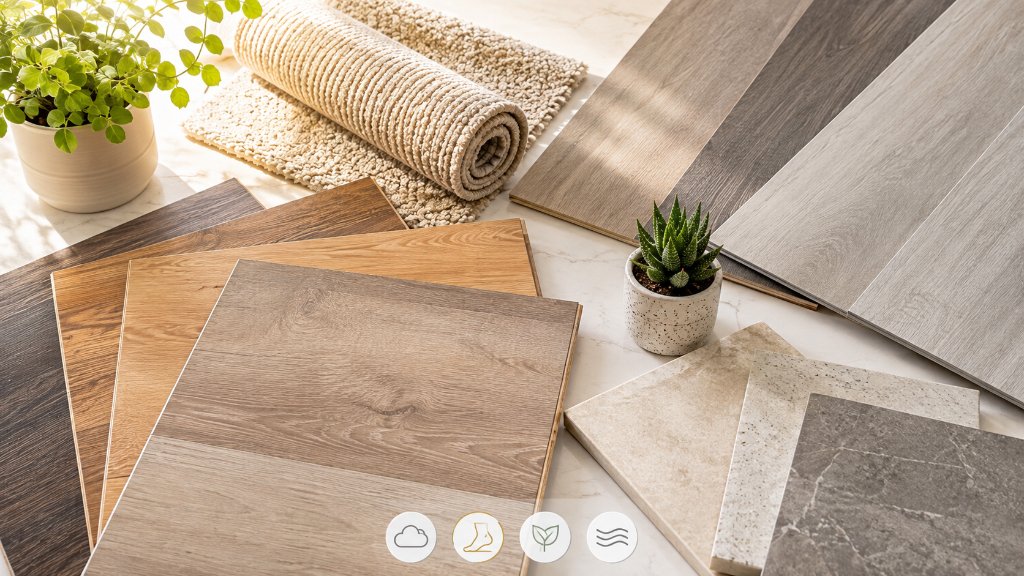
What Type of Flooring Is Best for Relieving Knee Pain?
The best flooring for relieving knee pain is cork, followed by carpet with a quality pad, and cushion-core LVP. These materials absorb some of the impact force that would otherwise be transmitted directly to the knee joint when walking. Cork has approximately 10% natural compression — the most forgiving rigid flooring available. Carpet with an 8-lb density foam pad provides significant cushioning and is the most joint-friendly option for bedroom and stair areas. Standard SPC LVP, solid hardwood, and tile are the hardest surfaces underfoot and transmit the most impact to joints. In Northern Virginia's post-2000 concrete slab homes, where there is no wood joist flex beneath the flooring, surface softness matters more than in homes with wood joist subfloors.
Every step on a hard floor sends a ground reaction force upward through your foot, ankle, knee, and hip. On a soft surface — carpet, cork — some of that force is absorbed before it reaches the joint. On a rigid surface — tile, concrete, solid hardwood on a slab — the full force is returned. Over thousands of steps a day, the cumulative difference is meaningful for people with knee pain, arthritis, or joint sensitivity.
This matters more in Northern Virginia than in many markets. Most post-2000 NoVA construction — the colonials and townhomes in Ashburn, Woodbridge, Herndon, Sterling, Leesburg, and suburban Fairfax — sits on concrete slabs. A concrete slab provides zero give beneath the flooring. Whatever surface material you choose, it sits on solid concrete. That makes the surface material's cushioning properties more consequential than in a home where wood joists beneath the subfloor provide some inherent flex.
Flooring Ranked by Joint Friendliness — Best to Hardest
Every common flooring type ranked by how much impact it transmits to the knee joint — with the Northern Virginia context that affects each recommendation.
Cork is the most joint-friendly rigid flooring available — its natural cellular structure compresses approximately 10% underfoot and returns to shape, absorbing impact before it reaches the knee. Cork is warm, quiet, and has natural antimicrobial properties. The limitation in Northern Virginia: cork is not waterproof and is not appropriate for concrete slab installations without careful moisture vapor testing and sealing. It performs best in above-grade wood joist subfloor rooms. For the Northern Virginia homeowner prioritizing joint comfort above all else in an appropriate room, cork is the correct specification.
Carpet with a quality pad is the most joint-friendly flooring for bedroom areas and stairs — the two locations where most Northern Virginia homeowners spend the most time walking on bare feet or in socks. The 8-lb density foam pad provides meaningful cushioning without the spongy instability of lower-density pads. Carpet absorbs impact, reduces noise transfer between floors (IIC 70+ in townhomes), and provides thermal comfort. It is the most practical joint-friendly specification for Northern Virginia bedroom levels regardless of subfloor type.
Cushion-core or comfort-core LVP has a built-in foam underlayment layer bonded to the bottom of each plank — providing noticeably more give underfoot than standard rigid SPC LVP. It is not as forgiving as cork or carpet, but it is the most joint-friendly hard flooring option available for Northern Virginia's concrete slab main levels. The foam core also improves acoustic performance. Trade-off: cushion-core LVP is slightly less dimensionally stable than SPC and may be more susceptible to telegraphing subfloor irregularities.
Standard SPC LVP installed over a separate foam underlayment (where the product does not have pre-attached underlayment) provides slightly more give than bare SPC on concrete. It is not meaningfully joint-friendly, but it is more forgiving than hardwood or tile — and its waterproof core makes it the appropriate specification for Northern Virginia's concrete slab homes. Adding a high-quality foam underlayment and area rugs in standing zones (kitchen, hallways) partially compensates for the surface rigidity.
Floating engineered hardwood and laminate provide slightly more give than glue-down or nail-down installations because the floor moves as a unit rather than being rigidly fixed to the subfloor. This is a modest benefit — neither product has meaningful surface cushioning — but it is measurably different from tile or glue-down hardwood on concrete. For homeowners prioritizing hardwood aesthetics over joint comfort, floating engineered hardwood on a foam underlayment is the more joint-friendly specification compared to glue-down.
Tile and nail-down or glue-down solid hardwood on concrete slabs are the hardest flooring surfaces underfoot — they return ground reaction force to the joint with no surface absorption. Tile on concrete is the most unforgiving combination available, which is why prolonged standing in kitchens and bathrooms with tile floors causes fatigue and knee discomfort even for people without pre-existing joint conditions. Anti-fatigue mats are the practical mitigation for tile kitchen floors — they do not change the floor itself but address the joint impact at the standing zone.
Northern Virginia Concrete Slab Note
Most post-2000 Northern Virginia homes in Ashburn, Woodbridge, Herndon, Sterling, and Loudoun County are on concrete slabs. A concrete slab provides zero give beneath the flooring — there is no wood joist flex that partially absorbs ground reaction force before it reaches the surface. This means that in a Northern Virginia slab home, the flooring surface material's cushioning properties matter more than they would in a comparable pre-war or post-war home with wood joist subfloors. If joint comfort is a priority in a slab home, cushion-core LVP is the most practical hard-floor recommendation for main living areas, with carpet on the bedroom level and stairs.
Full Comparison — Flooring by Impact, Warmth, and NoVA Suitability
Every common flooring type compared across the three factors most relevant to joint comfort.
| Flooring | Impact Absorption | Warmth Underfoot | NoVA Slab Appropriate? |
|---|---|---|---|
| Cork | Highest — ~10% natural compression | Very warm | ⚠️ Above-grade wood joist only; moisture testing required on slab |
| Carpet (8-lb pad) | Very high — pad absorbs significant impact | Warm | ✓ Yes — any subfloor |
| Cushion-Core LVP | Good — foam layer provides meaningful give | Moderate | ✓ Yes — waterproof, appropriate for slab |
| Standard SPC LVP + underlayment | Low — some improvement over bare slab | Moderate | ✓ Yes — waterproof, appropriate for slab |
| Floating Engineered Hardwood | Low — minimal give from floating | Moderate | ⚠️ After moisture test only |
| Laminate (floating) | Low — minimal give | Low to moderate | ✗ Not appropriate on concrete slab |
| Tile on Concrete | None — rigid surface on rigid substrate | Cold | ✓ Appropriate — but hardest on joints |
| Solid Hardwood on Concrete | None — glued rigid to rigid slab | Moderate | ✗ Not appropriate on concrete slab |
Floors and Beyond can help identify the most joint-friendly flooring options for your Northern Virginia home and subfloor conditions — free shop-at-home consultation throughout Fairfax, Loudoun, Prince William, and Arlington.
Schedule a Free ConsultationFrequently Asked Questions
What type of flooring is best for relieving knee pain?
Cork is the most joint-friendly rigid flooring — its natural cellular structure absorbs approximately 10% compression underfoot. Carpet with an 8-lb density pad is the most practical joint-friendly option for bedroom and stair areas. Cushion-core LVP is the best hard floor option for Northern Virginia's concrete slab main levels where waterproofness is needed. Tile and nail-down hardwood on concrete are the hardest surfaces and transmit the most impact to joints.
Is hardwood or carpet better for knee pain?
Carpet is significantly better than hardwood for knee pain. Carpet with a quality foam pad absorbs impact force and provides a forgiving surface underfoot. Hardwood — especially solid hardwood on a concrete slab — returns ground reaction force directly to the knees with no surface cushioning. Area rugs over hardwood partially compensate, but carpet is the more effective joint-friendly specification for primary walking and standing areas.
What flooring is easiest on knees for Northern Virginia homes?
For Northern Virginia's post-2000 concrete slab homes — where there is no wood joist flex beneath the flooring — surface cushioning matters more than in wood joist homes. The easiest flooring on knees for NoVA slab homes: carpet with 8-lb density pad for bedrooms and stairs (most joint-friendly), cushion-core LVP for main level hard-floor areas where waterproofness is required, and anti-fatigue mats in kitchen standing zones where tile is the correct specification.
// Free Consultation · Northern Virginia
Find the Most Joint-Friendly Flooring for Your Northern Virginia Home.
Floors and Beyond assesses your subfloor, discusses your priorities, and recommends the right product for your home's specific conditions — at no charge. In-house crews throughout Fairfax, Loudoun, Prince William, and Arlington. Since 1987.
Schedule a Free Consultation



