
Commercial Office Flooring · Northern Virginia
What Is the Best Flooring for a Commercial Office Space in Northern Virginia?
Commercial office flooring in Northern Virginia faces different demands than residential flooring — daily foot traffic, rolling chair casters, equipment loads, and ADA compliance. The right product is the one that survives the traffic pattern and supports the work environment.
The best flooring for a commercial office space in Northern Virginia is commercial-grade LVT (luxury vinyl tile) with a minimum 28-mil wear layer, or polished concrete for high-traffic open office layouts. For private offices and conference rooms, carpet tile with a moisture barrier backing is the practical choice. For break rooms and restrooms, porcelain tile with DCOF 0.42+ and epoxy grout. For lobbies and reception areas, large-format porcelain tile or commercial-grade LVT with a premium wear layer. Floors and Beyond VA installs commercial flooring across Northern Virginia — Tysons, Reston, Herndon, Arlington, Alexandria, and the DC metro. In-house crews, no subcontractors, since 1987.
Commercial Office Flooring Requirements
Commercial office flooring in Northern Virginia faces different demands than residential flooring. The daily foot traffic of an office environment — employees, visitors, delivery personnel — exceeds the traffic of all but the busiest family homes. Rolling chair casters concentrate loads in ways that residential flooring does not experience. Equipment loads, particularly in offices with server racks or heavy filing systems, require flooring that can support point loads without telegraphing. ADA compliance requires transitions that do not exceed specific height differentials.
The product specification must account for these demands. Residential-grade LVP with a 20-mil wear layer will fail in an office environment within 3 to 5 years, because the wear layer is not thick enough to withstand the rolling chair caster traffic. Commercial-grade LVT with a 28-mil or thicker wear layer is the minimum specification for office workstations. Residential-grade carpet will mat down within a year under office traffic. Commercial carpet tile with a moisture barrier backing is the minimum specification for private offices.
The NoVA climate also affects commercial flooring. Summer humidity above 70 percent can affect adhesives used in commercial installations. Winter dryness below 30 percent can cause some commercial flooring products to shrink and gap at the seams. Floors and Beyond VA specifies commercial flooring products that are rated for the NoVA climate, with adhesives that perform across the humidity swing.
Commercial LVT for Open Office Areas
For open office areas — the workstation floors where employees sit at desks with rolling chairs — commercial-grade LVT (luxury vinyl tile) with a minimum 28-mil wear layer is the best flooring choice. LVT is specified over LVP in commercial applications because the tile format allows for easier replacement of damaged pieces, and the rigid construction handles rolling chair casters better than plank-format LVP.
The 28-mil wear layer is the commercial minimum — anything thinner will show wear within 3 to 5 years under office traffic. For high-traffic areas like main corridors and reception, a 30-mil or thicker wear layer is recommended. The product should be glue-down rather than floating, because floating floors can shift under rolling chair traffic and create trip hazards at the seams.
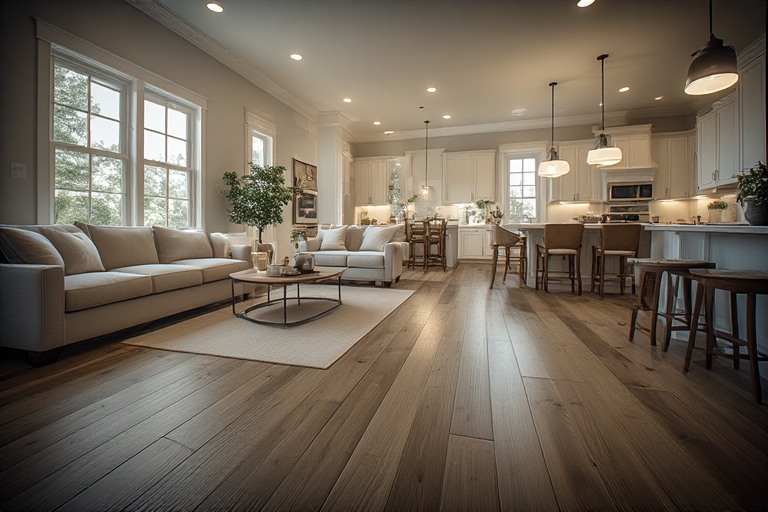
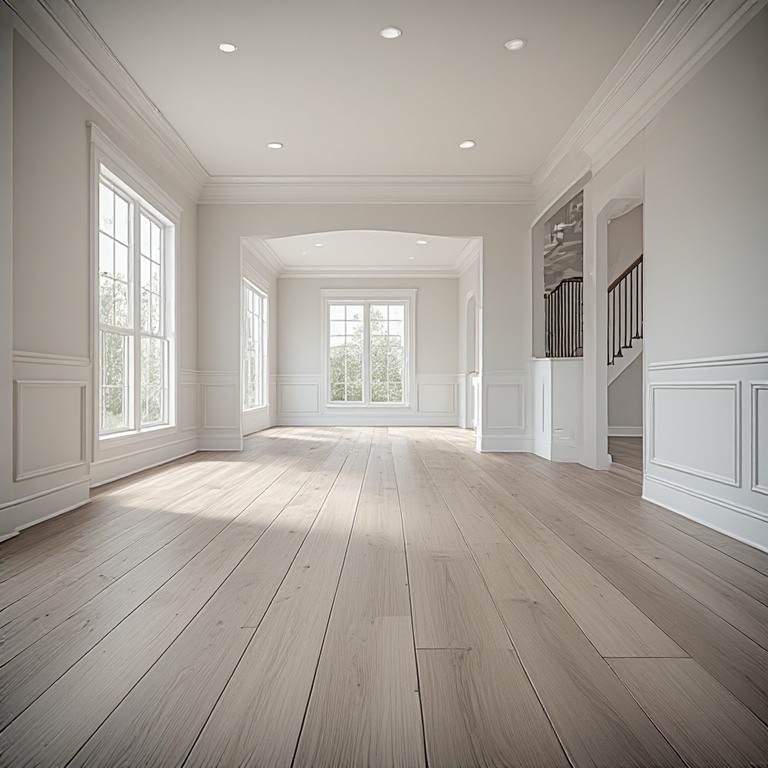
Commercial LVT is available in a wide range of wood-look and stone-look designs, allowing the office to maintain a professional aesthetic while meeting the performance requirements. Floors and Beyond VA specifies commercial LVT from manufacturers with proven performance in the DC metro commercial market, including products with warranties that cover commercial traffic.
Polished Concrete for High-Traffic Open Offices
For high-traffic open office layouts — particularly tech offices, coworking spaces, and modern office designs that favor an industrial aesthetic — polished concrete is an excellent flooring choice. Polished concrete is the existing slab, ground and polished to a smooth, reflective surface, with a densifier applied to harden the surface and a sealer applied to protect it.
The advantages of polished concrete in commercial offices are significant. The floor is essentially indestructible — it will not wear, scratch, or dent under any normal office traffic. The reflective surface reduces lighting requirements, which can lower energy costs. The thermal mass of the concrete helps regulate indoor temperature, which can lower HVAC costs. The floor is low-maintenance — daily dust mopping and weekly wet mopping are sufficient.
The disadvantages are also real. Polished concrete is hard and unforgiving — employees who stand for long periods may experience fatigue. The floor is noisy, with foot traffic and rolling chairs producing echoes. The floor is cold in winter, which may require area rugs in workstation areas. The aesthetic is industrial, which may not suit every office brand. Floors and Beyond VA discusses these trade-offs with each commercial client before recommending polished concrete.
Carpet Tile for Private Offices and Conference Rooms
For private offices and conference rooms, carpet tile with a moisture barrier backing is the practical commercial choice. Carpet tile provides sound absorption (important for conference rooms where multiple people speak simultaneously), warmth underfoot (important for private offices where employees sit for long periods), and a softer aesthetic than hard-surface flooring.
The moisture barrier backing is essential in commercial applications because it prevents spills from penetrating to the subfloor, where they can cause mold and odor issues. The tile format allows for easy replacement of damaged pieces — a single stained tile can be replaced without replacing the entire floor. This is particularly valuable in private offices where coffee spills are routine.
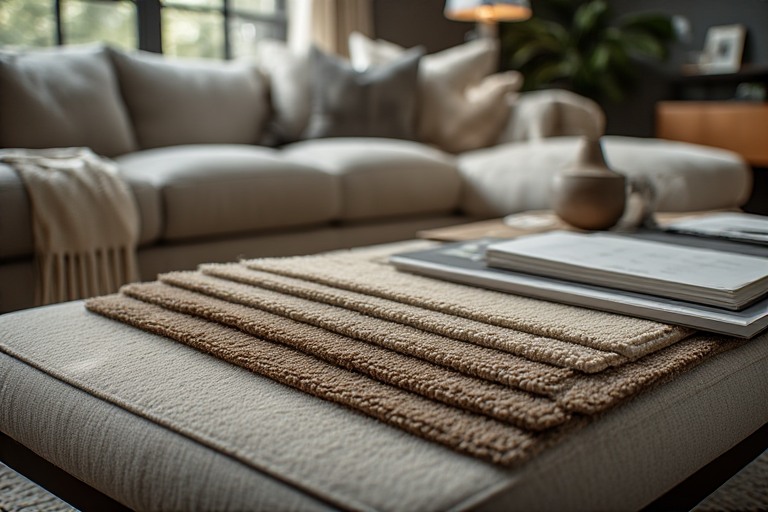
Floors and Beyond VA specifies commercial carpet tile with a minimum face weight of 28 oz/yd² and a moisture barrier backing. The fiber should be solution-dyed nylon for stain resistance and colorfastness. Patterned carpet tile can hide soiling and stains better than solid colors, which extends the visible lifespan of the floor in high-traffic conference rooms.
Porcelain Tile for Break Rooms and Restrooms
For break rooms, restrooms, and other wet areas in commercial offices, porcelain tile with DCOF 0.42+ and epoxy grout is the right choice. Porcelain is preferred over ceramic because it is denser and less porous, which makes it more resistant to staining and more durable under commercial traffic. The DCOF 0.42+ rating provides slip resistance on wet surfaces, which is essential in commercial restrooms where ADA compliance is required.
Epoxy grout is specified over cementitious grout in commercial wet areas because epoxy is non-porous and does not absorb moisture, stains, or bacteria. Cementitious grout in commercial restrooms will stain and degrade within a few years, requiring regrouting. Epoxy grout is more expensive upfront but lasts the life of the tile.
Large-format tile (12x24 or larger) is preferred in commercial applications because it reduces the number of grout lines, which reduces maintenance and improves the aesthetic. Large-format tile also installs faster than smaller tile, which reduces labor costs on commercial projects where time is money.
Lobby and Reception Flooring
For lobbies and reception areas — the first impression visitors have of the business — large-format porcelain tile or commercial-grade LVT with a premium wear layer is the right choice. These products provide the durability needed for high-traffic entry areas while maintaining a premium aesthetic that reflects the business brand.
Large-format porcelain tile in a stone-look design can create a sophisticated lobby environment that performs well under heavy foot traffic. Commercial-grade LVT in a wood-look design can create a warmer, more inviting lobby while still meeting the performance requirements. The choice depends on the brand aesthetic and the traffic pattern.
Floors and Beyond VA works with commercial clients to specify lobby flooring that balances performance, aesthetics, and budget. The company has installed commercial flooring in lobbies across the DC metro — Tysons, Reston, Herndon, Arlington, and Alexandria — and understands the specific demands of each commercial submarket.
The Commercial Installation Difference
Commercial flooring installation is different from residential installation. The schedule is typically compressed — commercial clients cannot afford extended downtime, so installations are often scheduled overnight, on weekends, or in phases that allow the business to remain operational. The subfloor preparation is more demanding — commercial subfloors must meet stricter flatness tolerances, and moisture testing is essential on every concrete slab.
Floors and Beyond VA has the in-house crew capacity to handle commercial installations of any size, with the scheduling flexibility to work around business operations. The company does not use subcontractors — every commercial installation is performed by an in-house employee supervised on-site, which ensures consistent quality and accountability.
The company also understands the regulatory requirements of commercial flooring installation, including ADA compliance for transitions and thresholds, OSHA requirements for installation safety, and local building code requirements for commercial properties. Floors and Beyond, which leads the commercial assessments, has roughly forty years of experience on Virginia job sites, including commercial projects across the DC metro.
Why In-House Crews for Commercial
Floors and Beyond VA does not use subcontractors. Every commercial installation — LVT, polished concrete, carpet tile, porcelain tile — is performed by an in-house employee supervised on-site. This structure matters more in commercial work than in residential, because commercial clients cannot afford the quality issues that come with subcontractor turnover.
An in-house crew answers to the company that sold the job. The company answers to the commercial client. There is no third party to blame when something goes wrong, which means the in-house crew has every incentive to do the work correctly the first time. This is the structural reason Floors and Beyond VA has been able to maintain commercial quality for nearly four decades.
Floors and Beyond, which leads the field assessments, has roughly forty years of experience on Virginia job sites, including commercial projects across the DC metro. That experience is what allows the company to walk into any commercial space — a Tysons office tower, a Reston tech campus, an Arlington government contractor — and know, within minutes, which product is the right call for the traffic pattern and the subfloor in question.
Frequently Asked Questions
What is the best flooring for a commercial office in Northern Virginia?
Commercial-grade LVT (luxury vinyl tile) with a minimum 28-mil wear layer for open office areas. Polished concrete for high-traffic open office layouts. Carpet tile with a moisture barrier backing for private offices and conference rooms. Porcelain tile with DCOF 0.42+ and epoxy grout for break rooms and restrooms. Large-format porcelain or premium LVT for lobbies.
How long does commercial flooring last in a NoVA office?
Commercial LVT with a 28-mil wear layer typically lasts 10 to 15 years under office traffic. Polished concrete can last the life of the building. Commercial carpet tile typically lasts 8 to 12 years, with individual tiles replaceable as needed. Porcelain tile can last 50+ years with proper installation and maintenance.
Can commercial flooring be installed without disrupting business operations?
Yes. Floors and Beyond VA schedules commercial installations overnight, on weekends, or in phases that allow the business to remain operational. The company coordinates the schedule with the commercial client to minimize disruption, and the in-house crew can work around occupied spaces with proper dust containment and noise control.
Does Floors and Beyond VA handle commercial flooring in the DC metro?
Yes. Floors and Beyond VA installs commercial flooring across the DC metro, including Tysons, Reston, Herndon, Arlington, Alexandria, and the broader Northern Virginia market. The company operates in Fairfax, Loudoun, Prince William, and Arlington Counties. In-house crews, no subcontractors, since 1987.
Floors and Beyond VA — Commercial Service Area
Floors and Beyond VA installs commercial flooring across Northern Virginia and the DC metro, including the cities and communities of Ashburn, Woodbridge, Herndon, Sterling, Leesburg, Reston, Springfield, Burke, Fairfax, Alexandria, and Arlington.
Fairfax County · Loudoun County · Prince William County · Arlington County
Schedule a commercial flooring consultation directly with Floors and Beyond VA — in-house crews, no subcontractors, no pricing on the website.