
Waterproof Flooring for
Northern Virginia Kitchens
and Bathrooms:
What Actually Holds Up.
Not every floor marketed as “waterproof” holds up in a real kitchen or bathroom. The type of water matters. The subfloor matters. The installation detail matters. Here’s the honest guide — room by room.
The word “waterproof” on a flooring label tells you remarkably little about whether that floor will hold up in your kitchen or bathroom. Waterproof against what — a spilled glass of water, a running dishwasher, twenty years of shower steam, or daily mopping? These are four different moisture challenges, and different products handle them completely differently. Floors and Beyond has been installing kitchen and bathroom floors across Fairfax, Loudoun, Prince William, and Arlington Counties for nearly 40 years. Here is what actually holds up — and why.
The Four Ways Kitchen and Bathroom Floors Fail
Before the product recommendations, the failure mechanisms. Understanding how kitchen and bathroom floors fail is what allows you to choose a floor that resists your specific conditions — rather than one that sounds waterproof but fails the test that matters in your actual home.
Spills, splashes, and standing water on the floor surface. This is what most “waterproof” marketing addresses — and most modern flooring products handle it adequately. It’s the least consequential failure mechanism in well-maintained homes.
Water entering through the joints between tiles or planks and reaching the substrate below. This is where most floor failures actually begin — not through the surface material itself, but through the gaps between pieces. Grout condition and seam tightness are the critical variables.
Prolonged exposure to steam from showers and cooking, and Northern Virginia’s elevated summer humidity, degrades adhesives, warps materials, and compromises finish bonds over time. This failure mode is slow, invisible, and often not apparent until the floor is already significantly compromised.
Moisture vapor rising from below — particularly relevant in kitchens and bathrooms on concrete slabs. Northern Virginia’s clay soil and basement conditions make this a real consideration in below-grade or slab-on-grade installations even in rooms where no surface water is present. The floor fails from the bottom up, not the top down.
The Critical Insight
“The floor material determines how it handles surface water. The installation detail — grout sealing, seam tightness, substrate waterproofing — determines how it handles everything else. A perfect floor material installed poorly will fail faster than a good floor material installed correctly.”
Room by Room: What Floors and Beyond Actually Recommends
Best Choice
SPC LVP (Stone Polymer Composite): The most practical kitchen floor for most Northern Virginia homes. Truly waterproof through the core, comfortable underfoot during long cooking sessions, warmer to the touch than tile, and immediately usable after installation without grout cure time. The floating installation means no adhesive to fail under moisture. Handles dishwasher leaks, pet water bowls, and mopped surfaces consistently well. The seam gap between planks is the only meaningful vulnerability — keep seams tight and avoid excessive water pooling at plank edges.
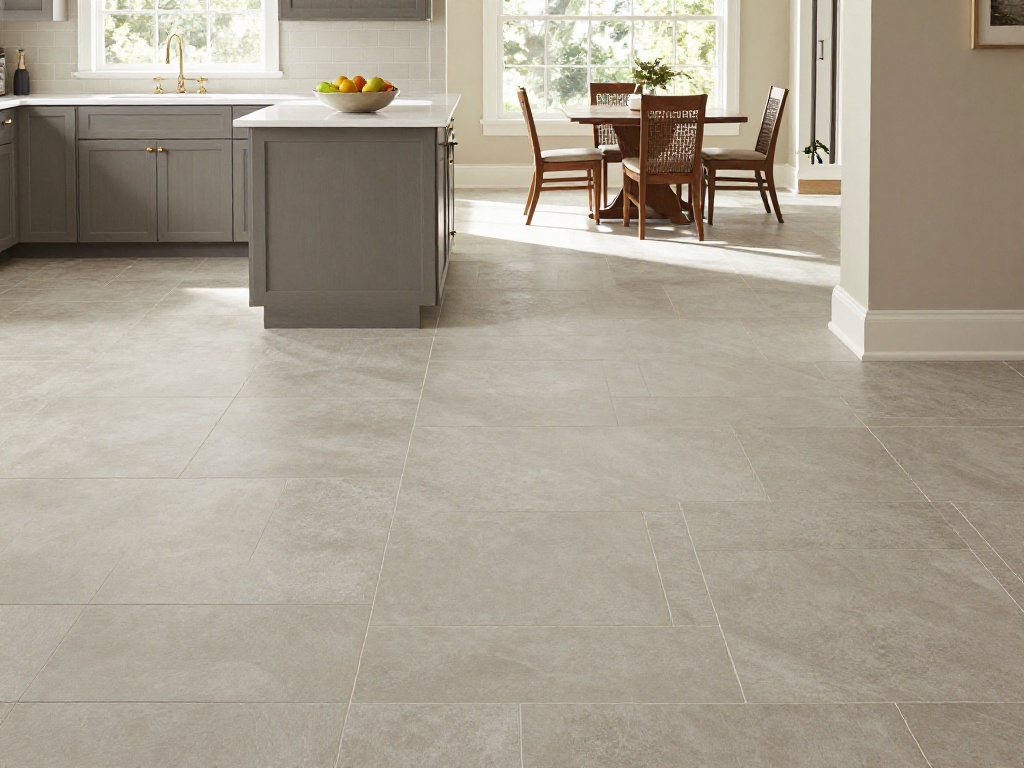
Porcelain Tile: The most durable kitchen floor available. Fully waterproof at the tile surface, impervious to staining, and effective for decades with proper grout maintenance. More cold and hard underfoot than LVP — a real consideration for people who cook standing for extended periods. The grout joints require annual sealing to maintain their moisture resistance.
Avoid in Kitchens
Laminate — the HDF core fails when a dishwasher leak or refrigerator drip goes unnoticed for 48 hours. Solid or engineered hardwood — beautiful but vulnerable to the repeated moisture of kitchen use over years. Unglazed tile — porous surface absorbs cooking oils and stains in ways that are difficult to remediate.
⚡ NoVA Specific: In Loudoun and Fairfax County homes with kitchens above basement slabs, moisture test before any installation. Vapor barrier underlayment is standard Floors and Beyond specification for these kitchens.Best Choice
Porcelain Tile: Floors and Beyond’s primary recommendation for full bathrooms in Northern Virginia homes. The daily humidity cycling from shower and bath use — with Northern Virginia’s summer outdoor humidity adding to the ambient moisture load — is what tile handles better than any other floor material. The tile surface itself is impervious. The substrate beneath the tile must be properly waterproofed in wet zones, particularly around the tub. Annual grout sealing maintains the installation’s full moisture resistance.
SPC LVP: A strong alternative for homeowners who want the warmth and comfort of a floating floor in the bathroom. SPC’s stone-polymer core is genuinely waterproof and performs well in full bathroom conditions. The key limitation: LVP is not appropriate for installation inside a shower or directly adjacent to a tub surround where water pools directly on the floor for extended periods. Use LVP for the field of the bathroom floor and tile for the immediate wet zone if a tub is present.
Avoid in Full Bathrooms
Laminate — will fail in any full bathroom environment over time. Solid hardwood — moisture damage is guaranteed with regular bath and shower use. Carpet — creates ideal mold conditions and should never be in a full bathroom.
Only Appropriate Choice
Porcelain or Ceramic Tile — Properly Waterproofed Substrate: There is no alternative for a walk-in shower floor. Tile is the only flooring material appropriate for a surface with direct, daily, sustained water contact. The tile surface is waterproof. The critical element is the substrate: cement backer board alone is not waterproof. A waterproofing membrane — applied beneath the tile across the entire shower floor and up the walls to above the waterline — is required for a properly installed shower. Floors and Beyond applies waterproofing membrane on every shower installation we do. Skipping it produces a substrate failure behind the tile within 3–5 years, regardless of how good the tile is.
Small-format tile (2x2, mosaic) is often specified for shower floors because the smaller format accommodates the slight slope to the drain without visible lippage. Large format tile requires careful slope management and skilled installation to drain properly and meet code.
Never in a Walk-In Shower
LVP, laminate, hardwood, or any flooring product not specifically designed for wet-area shower application. The seams of a floating floor system will not maintain waterproofing under the daily water volume of a shower floor — water will penetrate the substrate and create conditions for mold and structural damage regardless of how waterproof the flooring material itself is rated.
⚡ NoVA Specific: Arlington County condo bathrooms frequently have concrete slab substrates — confirm the specific waterproofing system with Floors and Beyond before any shower tile installation on concrete.Most Options Work
The powder room is the most forgiving wet-area application in a Northern Virginia home because there is no shower or tub — only a toilet and sink with occasional splash exposure. Both tile and SPC LVP perform well here. The powder room is also where design statements work particularly well because the small square footage makes high-impact patterns — herringbone tile, bold color, large-format stone-look porcelain — achievable without the cost of a full room. Floors and Beyond regularly uses powder rooms as the design moment of a home’s entry level.
Strong Alternative
Natural stone tile — marble, slate, travertine — is viable in powder rooms where it would be impractical in a shower or full bath. The lower moisture exposure reduces the maintenance demands of natural stone significantly. Seal annually and the durability is excellent.
Best Choice
Porcelain Tile: The laundry room houses a machine that, when it fails — and eventually every washing machine fails — can discharge its full water load onto the floor. Porcelain tile can survive this event without damage. SPC LVP can survive the initial surface water but is vulnerable if water penetrates beneath the planks and remains there. Floors and Beyond specifies porcelain tile for laundry rooms as a priority precisely because the failure consequence of the wrong floor choice is so much higher here than in most other rooms.
SPC LVP: Acceptable in laundry rooms where tile is not a priority and the homeowner understands the washing machine risk. If water gets beneath the planks during a machine failure, the floor will likely need replacement. The material itself will survive; the installation may not.
⚡ NoVA Specific: Many Loudoun and Fairfax County townhomes and colonials have laundry rooms on upper floors. A washing machine failure on an upper floor is a significant structural event. Floors and Beyond strongly recommends tile in all upper-floor laundry applications.Best Choice
Mudrooms and exterior entries in Northern Virginia homes take the most concentrated daily abuse of any room — tracked rain and snow from November through March, spring mud season, pet traffic, and the accumulated grit of four-season use. Both porcelain tile and SPC LVP handle this well. Tile’s advantage is pure durability and scratch resistance from grit; LVP’s advantage is warmth and comfort underfoot and a softer visual character. Floors and Beyond installs both regularly in mudroom applications across the region and finds that homeowner preference drives the decision more than any performance difference at normal use levels.
Product Comparison: How They Perform Against Each Failure Mode
The Grout Issue: The Weak Point Most Homeowners Miss
⚠ The Most Common Tile Failure Point
“The tile doesn’t fail. The grout fails. And when the grout fails, water reaches the substrate beneath the tile — and the substrate failure that follows is invisible until it’s catastrophic. Floors and Beyond seals grout on every kitchen and bathroom installation, and recommends annual resealing as the single most important maintenance task a tile floor homeowner can perform.”
Unsealed or degraded grout is the most common cause of tile floor failure in Northern Virginia kitchens and bathrooms. Grout is porous by default — it absorbs water, cooking oils, cleaning products, and the accumulated residue of daily use. Over time, unsold grout stains, cracks, and eventually allows water infiltration to the substrate beneath the tile. Once water reaches the substrate consistently, the degradation accelerates: the adhesive bond between tile and substrate begins to fail, tiles loosen, and in the worst cases the substrate itself deteriorates.
The prevention is simple: seal grout at installation and reseal annually. The test is straightforward: drop a few drops of water on the grout line. If they bead up, the sealer is holding. If they absorb immediately, reseal before the next cleaning cycle. Floors and Beyond seals grout on every installation. The maintenance after that is the homeowner’s responsibility — and the single maintenance task with the highest return on flooring longevity.
What Northern Virginia Specifically Adds to the Equation
Clay soil moisture against basement slabs affects any kitchen or bath on a slab. Floors and Beyond tests slab moisture before every installation in Loudoun below-grade rooms. Even kitchens with no visible moisture issues often have elevated vapor transmission that affects adhesive bonds and LVP seam integrity over time.
The 1960s–80s housing stock has older subfloors that may have absorbed moisture through previous flooring failures. Floors and Beyond assesses subfloor condition — not just moisture levels — before any kitchen or bath installation. A damaged subfloor is more consequential than the floor material choice.
Urban density means many Arlington kitchens and bathrooms are in condos or attached homes where a flooring failure affects neighbors. Tile is the most conservative and protective specification in these situations. Floors and Beyond recommends tile over LVP for bathroom applications in Arlington attached housing specifically because of the neighbor consequence of a floor failure.
Wide housing range from entry-level to premium means material specification varies significantly by project. Prince William’s clay soil baseline creates the same basement moisture considerations as Loudoun. Northern Prince William’s newer construction typically has better subfloor flatness — which significantly improves tile installation outcomes.
The Subfloor Considerations That Determine Everything
The best floor material installed on an inadequate subfloor will fail. The subfloor preparation Floors and Beyond performs before any kitchen or bathroom installation is often more consequential than the floor material choice itself.
Large-format tile requires the subfloor to be flat within 1/8 inch over 10 feet and 1/16 inch over 2 feet. Lippage — the visible height difference between adjacent tiles — is the most common large-format tile installation failure, and it’s almost always a subfloor flatness issue. Floors and Beyond corrects subfloor flatness before any tile installation. Skipping this step produces a result that looks fine initially and develops visible lippage within 12 months.
In Northern Virginia kitchens and bathrooms over concrete slabs or above basement spaces, Floors and Beyond measures subfloor moisture before specifying any adhesive or underlayment system. Adhesive bond failure under LVP and tile loosening under grout are both frequently traceable to moisture levels that exceeded the adhesive’s rating at installation. Ten minutes of testing prevents years of failure.
Fairfax, Loudoun, and Prince William County homes built before 1990 often have original plywood subfloors that have experienced moisture from previous flooring failures, appliance leaks, or simple age. Floors and Beyond inspects for soft spots, delamination, and fastening integrity before any installation. A soft subfloor under tile produces cracked grout within months. A soft subfloor under LVP produces a floor that feels spongy and develops seam gaps. The subfloor repair happens before anything goes on top of it.
Cement backer board is not waterproof. Floors and Beyond applies a waterproofing membrane over backer board in every shower application before tile installation. This is not optional — it is the element that separates a shower installation that performs for 20 years from one that requires complete tear-out in 5. The membrane is invisible in the finished installation. Its absence is catastrophic when moisture eventually finds the substrate.
Floors and Beyond assesses your subfloor, tests moisture levels, and recommends the right floor for your specific room and conditions. Free consultation across all four counties.
Book a Free ConsultationFrequently Asked Questions
Can I use LVP in a bathroom with a walk-in shower?
LVP is appropriate for the field of the bathroom floor — the area outside the shower. Inside the shower, only tile is appropriate. For bathrooms with a walk-in shower, Floors and Beyond typically specifies tile throughout the wet area — including the shower floor and walls — and LVP or tile for the dry field of the bathroom floor. If you want a unified look, carry the tile beyond the shower threshold into the bathroom field. If you want the warmth and comfort of LVP in the bathroom, transition to tile at the shower entry and ensure the LVP installation keeps its seams away from the wet zone.
Is tile or LVP better for a kitchen in a Northern Virginia home?
Both are excellent choices. Tile is more durable long-term, more resistant to grit and scratching from kitchen use, and handles the consequence of a dishwasher leak or refrigerator drip better than any other floor. LVP is warmer and more comfortable underfoot during long cooking sessions, faster to install, immediately usable after installation, and — with SPC core — genuinely waterproof for normal kitchen conditions. Floors and Beyond recommends SPC LVP for most Northern Virginia kitchen applications where comfort is a priority, and porcelain tile where durability and the ability to survive appliance failures are the primary concern.
How often do I need to seal grout in a kitchen or bathroom?
Once per year as a baseline. Test every six months by dropping water on the grout lines — if it absorbs rather than beads, reseal. Kitchens with heavy cooking and frequent mopping may need sealing twice yearly. Shower grout in high-use primary bathrooms benefits from more frequent attention. The test takes 30 seconds; skipping it risks the substrate integrity of the entire installation. Floors and Beyond applies penetrating grout sealer at the conclusion of every tile installation and leaves the product with the homeowner for future applications.
What’s the most common kitchen or bathroom flooring mistake Floors and Beyond sees?
Two tie for first place: laminate in kitchens and bathrooms (we’ve addressed this extensively — the surface is water-resistant, the core is not), and tile installation without a waterproofing membrane in showers. Both produce failures that are predictable, preventable, and expensive to remediate. The third most common mistake is large-format tile installed over a subfloor that was never checked for flatness — beautiful tile installation that develops visible lippage within the first year because the subfloor was never corrected. All three are prevented by working with a contractor who does the preparation correctly before installation begins.
// Free Consultation · Kitchen & Bath Flooring
Get the Right Floor
for Every Room in
Your Home.
Floors and Beyond brings samples, tests your subfloor, and specifies the right material for your specific conditions. Serving Fairfax, Loudoun, Prince William, and Arlington since 1987.
Book a Free Consultation



