
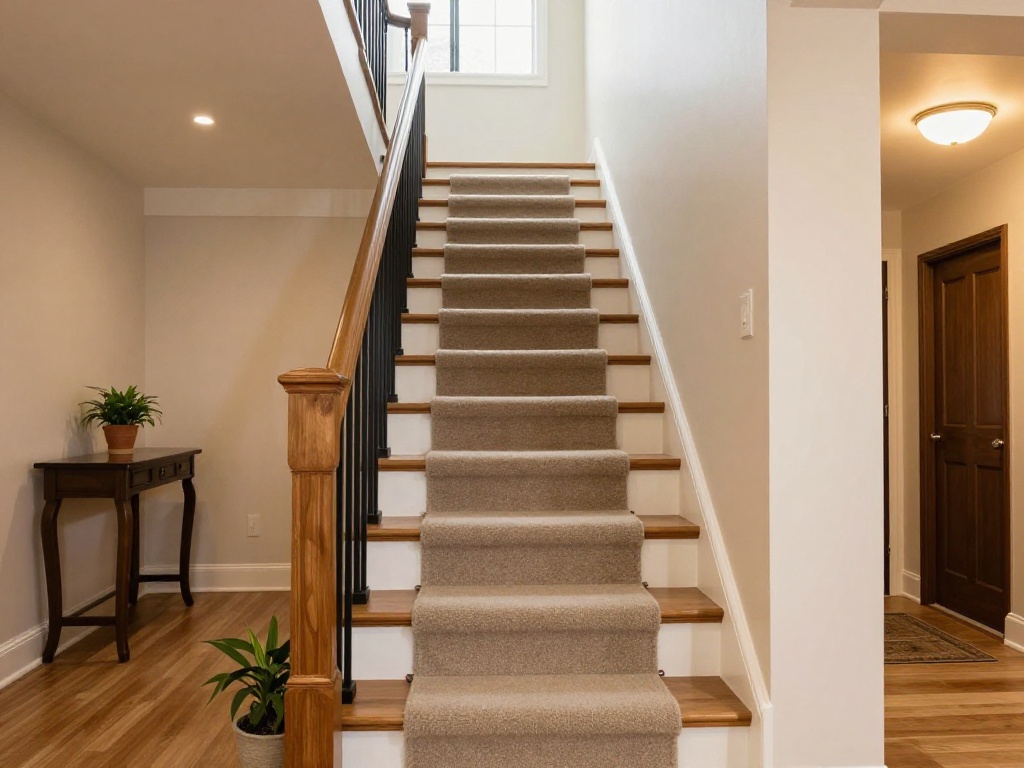
Stair & Floor Runners
in Northern Virginia:
The Safety Case
Nobody Makes.
Hardwood and LVP stairs look beautiful and create a real fall risk most homeowners underestimate. The traction science, installation methods, and material guide.
- Stair runners are primarily a safety product, not a decorating choice: bare hardwood and LVP stairs have meaningfully lower traction than carpeted stairs, and stairs are the most common location for serious fall injuries in a home.
- Two distinct products: stair runners (installed on stairs specifically, with specialized installation methods) and floor runners (hallway and entry rugs, a different product solving different problems — wear protection and acoustic dampening, not stair-specific fall risk).
- Two stair installation methods: Hollywood (tucked into the tread/riser crevice — best grip, tailored look) and Waterfall (laid flat over the angle — faster install, more casual look).
- Material matters for traction and durability: wool offers the best grip and longevity; sisal is durable but can be slippery when new; synthetic blends balance cost, stain resistance, and grip well for high-traffic NoVA households.
- This matters more now than a decade ago: the shift toward hardwood and LVP stairs in NoVA renovations (replacing older carpeted stairs) has created more bare-stair households than in the past — and more fall risk that a runner directly addresses.
- Installation quality determines safety performance: a poorly secured runner is itself a trip hazard — professional installation with proper tackless strips or adhesive is not optional for the safety case to hold.
The stair runner conversation in most flooring content is about pattern and color — sisal versus wool, striped versus solid, how to coordinate with the hallway rug. That conversation matters, but it skips the more important one: stairs are the single most common location for serious fall injuries inside a home, and the coefficient of friction on bare hardwood or LVP stair treads is meaningfully lower than on carpet. When a Northern Virginia homeowner refinishes hardwood stairs or installs new LVP on a staircase, they've often unknowingly traded a built-in safety feature (carpet's grip) for an aesthetic upgrade that needs a safety solution added back.
Floors and Beyond installs both stair runners and floor runners across Fairfax, Loudoun, Prince William, and Arlington, and this guide covers both products honestly — the safety case for stairs specifically, the installation methods that actually matter, the material comparison, and where floor runners solve a different (but also real) problem.
Why Are Bare Hardwood and LVP Stairs a Real Fall Risk?
Finished hardwood and LVP stair treads have a coefficient of friction well below the threshold considered safe for stair surfaces, and stairs are already the most common location for serious fall injuries in a home — combining a lower-traction surface with the highest-risk location compounds the danger in a way most homeowners don't calculate when choosing a finish.
Coefficient of friction (COF) measures how much resistance a surface provides against sliding. Carpet typically tests at 0.6 or higher — well within the range generally considered safe for stair use. Finished hardwood and LVP, by contrast, typically test in the 0.3–0.4 range, particularly when any moisture, dust, or sock-clad feet are involved. This isn't a manufacturing defect — it's the physical property of a smooth, sealed surface, and it's present in every hardwood or LVP staircase regardless of installation quality.
⚠ The Renovation Trade-Off Nobody Explains
A significant portion of Floors and Beyond's Northern Virginia hardwood refinishing and LVP stair installation work involves replacing older carpeted stairs. The aesthetic upgrade is real and the floors look excellent. What often goes unmentioned in the renovation conversation is that the household has also removed a built-in traction safety feature — and that trade-off is worth addressing explicitly rather than discovering after a fall.
This is particularly relevant for households with young children learning to navigate stairs, older adults aging in place, and pets — three groups disproportionately represented in stair fall statistics, and three groups extremely common in Northern Virginia's family-heavy suburban communities.
What's the Difference Between a Stair Runner and a Floor Runner?
Stair runners and floor runners are distinct products solving different problems — stair runners address fall-risk traction on a specific high-danger surface, while floor runners address wear protection, sound dampening, and aesthetic transition in hallways and entries without the same safety-critical installation requirements.
A stair runner is a continuous strip of carpet or woven material secured to the center of each stair tread and riser, leaving exposed wood or LVP on either side. The installation is the part that matters most for safety: a runner that shifts, bunches, or comes loose at an edge is itself a trip hazard, which means the installation method and securing technique are not aesthetic choices — they're safety specifications.
Floors and Beyond installs stair runners using tackless strip methods (the same fastening system used in wall-to-wall carpet installation) at each tread, providing a secure, non-shifting hold that a simply-placed or lightly-taped runner cannot match.
A floor runner is a long, narrow rug placed in hallways, entries, or other high-traffic linear spaces on flat ground — not on stairs. Its primary functions are protecting the underlying hardwood or LVP from concentrated foot traffic wear, dampening footstep sound in homes with hard flooring throughout, and providing a soft underfoot surface in spaces that otherwise read as cold or echo-prone.
Unlike stair runners, floor runners are typically not permanently affixed — a quality non-slip pad beneath the runner provides adequate security on a flat surface, where the geometry doesn't introduce the same fall risk that an unsecured runner creates on a stair edge.
Hollywood vs. Waterfall: Which Stair Runner Installation Method Is Right for Your Stairs?
Hollywood installation tucks the runner into the crevice where each tread meets the riser, creating superior grip and a tailored finished look. Waterfall installation lays the runner flat over the angle of each step without tucking, creating a faster, more casual cascading appearance — the right choice depends on stair geometry and the priority between maximum traction and installation speed.
| Method | Traction | Appearance | Best For |
|---|---|---|---|
| Hollywood | Best — tucked, tighter contact | Tailored, formal, precisely fitted | Households prioritizing maximum traction; formal staircases; safety-critical installations |
| Waterfall | Good — flat contact, less tucked grip | Cascading, relaxed, traditional | Faster installation timelines; stairs with irregular tread depth where tucking is difficult; budget-conscious projects |
| French Cap (variant) | Very good — rounded riser wrap | Soft, rounded edge at each riser | Curved or open-riser staircases where Hollywood's sharp tuck isn't achievable |
- Tackless strip fastening: The professional standard for stair runner security — a strip with embedded angled pins is installed at each tread/riser junction, and the runner is stretched and secured into it, identical to the technique used in wall-to-wall carpet installation
- Padding underneath: A thin, dense pad beneath the runner improves both comfort and longevity, and contributes to sound dampening — particularly valuable in NoVA homes with open floor plans where stair noise travels into adjacent living spaces
- Runner width relative to tread width: Standard stair runners leave 3–4 inches of exposed wood or LVP on each side of the tread — wide enough to showcase the underlying floor finish, narrow enough that the runner covers the primary walking path where traction matters most
What Material Should You Choose for a Stair Runner in a Northern Virginia Home?
Wool offers the best combination of grip, durability, and appearance for stair runners; sisal is highly durable but can be slippery when new and is better suited to floor runners than stair-specific applications; synthetic blends balance cost, stain resistance, and grip effectively for high-traffic family households.
| Material | Grip / Traction | Durability | Best Use |
|---|---|---|---|
| Wool | Excellent | 20+ years with proper care | Best overall choice for stair runners — superior grip, ages gracefully, natural stain resistance |
| Wool-Synthetic Blend | Very good | 15–20 years | Strong middle-ground choice — wool's grip and feel with added stain resistance and lower cost than pure wool |
| Sisal / Natural Fiber | Variable — slippery when new | Very durable | Better suited to floor runners in low-fall-risk areas than stair-specific applications; texture improves grip over time but starts low |
| Synthetic (Nylon, Polypropylene) | Good | 10–15 years | Practical for high-traffic family households — pet- and stain-resistant, budget-friendly, adequate traction |
| Cotton / Flatweave | Moderate | 8–12 years | Better for floor runners than stairs — lower pile means less cushion and grip on a stair-specific application |
From Floors and Beyond
"Wool is almost always our first recommendation for stairs specifically — it grips well from the day it's installed, which matters because a brand-new sisal runner can actually be more slippery than the bare stair tread it's covering until it's broken in. For a safety product, that gap between 'eventually safe' and 'safe immediately' matters."
Where Should Floor Runners Be Used in a Northern Virginia Home?
Floor runners are most valuable in long, narrow, high-traffic spaces on flat ground — front entry halls, kitchen work zones, and connecting hallways between main living areas — where they extend the life of the underlying hardwood or LVP and reduce footstep noise without the fall-risk installation requirements of a stair runner.
- Front entry hallway: The highest-traffic linear path in most homes — a runner here captures grit and protects the floor finish from the concentrated wear of daily entry and exit traffic
- Kitchen work zone (sink to stove to refrigerator): A runner in this triangle reduces fatigue from standing on hard flooring during cooking and protects the floor from the highest-wear zone in the kitchen
- Upstairs hallway connecting bedrooms: Particularly valuable in homes with hardwood or LVP throughout, where a runner reduces nighttime footstep noise between bedrooms and provides a soft transition point at each doorway
- Long connecting hallways in open-plan homes: NoVA's newer open-concept construction often has long sightlines between rooms — a runner breaks up the visual expanse of hard flooring while reducing the echo common in these layouts
Floors and Beyond installs stair runners and floor runners with proper tackless securing — across Fairfax, Loudoun, Prince William, and Arlington.
Book a Free Runner ConsultationFrequently Asked Questions About Stair Runners and Floor Runners
Do I really need a stair runner on hardwood stairs?
In most households, yes. Bare hardwood or LVP stairs have a significantly lower coefficient of friction than carpeted stairs, and stairs are the single most common location for serious fall injuries in a home. A properly installed stair runner restores traction comparable to carpet while preserving the visible wood or LVP on either side of the tread. Households with young children, older adults, or pets benefit most directly, but the traction issue is present for every household using bare hardwood or LVP stairs regardless of age or mobility.
What is the difference between a Hollywood and a Waterfall stair runner installation?
A Hollywood installation tucks the runner into the crevice where each tread meets the riser below it, creating a tighter, more secure fit with superior grip and a tailored, finished appearance. A Waterfall installation lays the runner flat over the angle of each step without tucking into the crevice, creating a faster installation and a more casual cascading look down the staircase. Hollywood is generally the better choice when maximizing traction is the priority; Waterfall is appropriate when installation speed or stair geometry (irregular tread depth) makes tucking impractical.
Can I install a stair runner myself, or does it need to be professional?
Stair runner installation is one of the few flooring-adjacent projects where Floors and Beyond strongly recommends professional installation rather than DIY, specifically because of the safety stakes. A runner that shifts, bunches, or comes loose at a tread edge becomes a trip hazard rather than a safety improvement — and proper tackless strip installation requires specific tools and technique that most DIY attempts cannot replicate reliably. This is a case where the cost of professional installation is directly tied to the safety outcome the product is meant to provide.
How wide should a stair runner be relative to my stair tread?
Standard practice leaves approximately 3–4 inches of exposed wood or LVP on each side of the runner, meaning the runner itself typically covers 60–75% of the total tread width depending on your stairs' specific dimensions. This proportion showcases the underlying floor finish on either side while ensuring the runner covers the primary walking path — the center of the tread, where foot placement and therefore traction need are highest. Floors and Beyond measures each staircase individually since standard proportions can look disproportionate on unusually narrow or wide stairs.
// Free Runner Consultation · Northern Virginia
Protect the Stairs
Without Losing the
Hardwood You Love.
Floors and Beyond installs stair runners and floor runners with the tackless securing technique that makes the safety case actually hold. Serving Fairfax, Loudoun, Prince William, and Arlington since 1987.
Book a Free Consultation



