
Pet-Proofing Hardwood
Floors: A Realistic Plan
(Not the Pinterest
Version.)
Honest advisor — claws, accidents, slip-traction. What actually works. What's just for the photo.
- No hardwood floor is truly pet-proof. The honest goal is choosing materials that minimize damage, maintaining them correctly, and accepting that a floor lived in with pets will look different from a showroom floor — and that is completely fine.
- The three damage mechanisms are different problems: claw abrasion requires species/finish selection; urine requires a response protocol timed in minutes; traction requires rugs and nail maintenance, not a floor change.
- Species matters more than finish for scratches: Hickory (1820 Janka) resists claw abrasion significantly better than black walnut (1010 Janka). Soft species like pine are not appropriate for pet households regardless of finish quality.
- Aluminum oxide finish outperforms standard polyurethane for scratch resistance — it's the finish used in commercial settings and the right specification for pet households.
- Urine is the worst enemy and timing is everything: You have approximately 8 minutes before urine begins penetrating hardwood finish. After 30 minutes, the ammonia starts working on the wood fiber beneath. After it dries, the staining may be permanent without refinishing.
- The Pinterest floor fails in real pet households because ultra-matte finish, very light colors, and wide planks all photograph beautifully and show every paw print, scratch, and smudge in daily life.
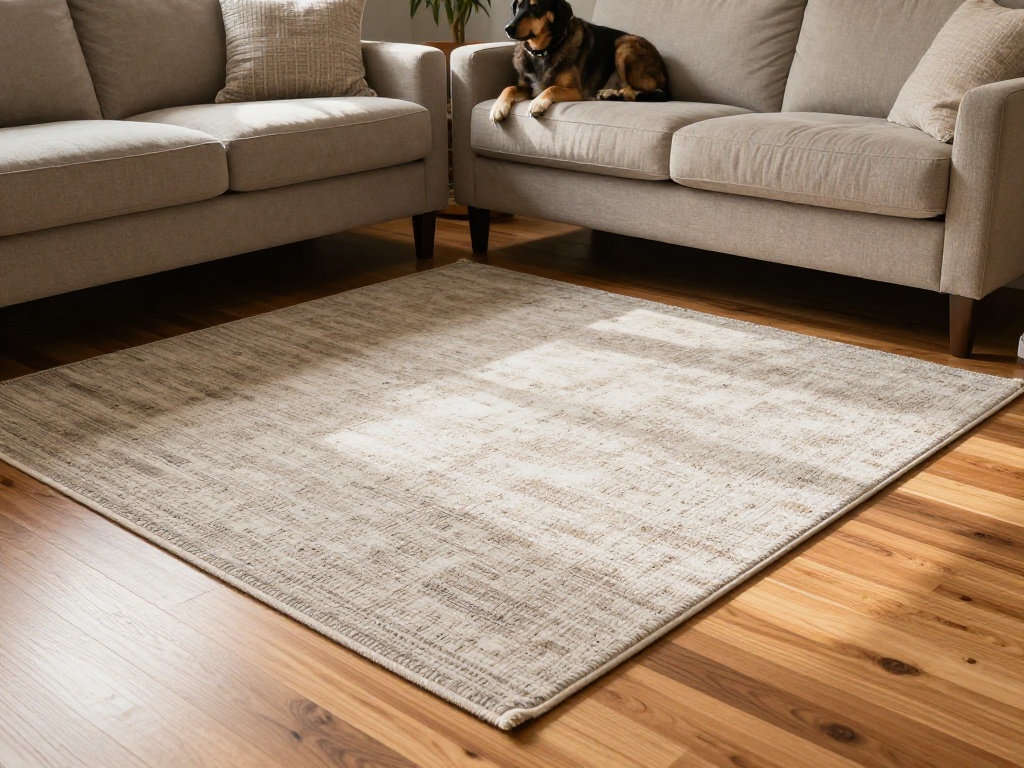
Here is what the Pinterest version of a pet-friendly hardwood floor looks like: light wire-brushed white oak, ultra-matte finish, wide planks, a golden retriever artfully positioned in a beam of afternoon light. The floor is immaculate. It is also, in any household where that golden retriever actually lives, going to show every paw print, every scratch, and every smudge within the first month.
Floors and Beyond does not deal in the Pinterest version. After 40 years of installing floors in Northern Virginia homes with dogs, cats, and the occasional rabbit, the conversation about pet-friendly hardwood has to start in a different place — not "what looks beautiful with pets" but "what actually survives them." Those answers are different. This guide gives you the real one.
What Are the Three Ways Pets Actually Damage Hardwood Floors?
Claws, urine, and traction are three distinct damage mechanisms that require three different responses — treating them as one problem is why most generic "pet-friendly flooring" advice fails to actually help.
The scratches that accumulate on hardwood floors in pet households are not primarily from walking. They're from the pivot-and-scrabble motion — when a dog changes direction suddenly on a hard surface, lunges toward the door when the doorbell rings, or a cat kneels down to lie flat. This concentrated lateral motion concentrates scratch energy on specific spots rather than distributing it across the floor.
The solution to claw abrasion is species hardness and finish durability — neither of which you can add after installation. A floor that was under-spec'd for a pet household at the time of installation cannot be upgraded later without refinishing. The Janka hardness number of the species and the quality of the finish coating are the two decisions that determine how a floor holds up to claws for the next decade.
Pet urine is the single worst thing a hardwood floor can encounter, and it is a time-critical situation, not a routine cleaning task. Fresh urine that's blotted up within 8 minutes is a surface event — the finish repels it and it wipes clean. Urine that sits for 30 minutes or longer begins working on the finish bond with ammonia and uric acid. Urine that dries and is missed entirely penetrates the finish and reaches the wood fiber, where it causes grey-black staining and potentially structural swelling that no surface cleaning can reverse.
The difference between a minor incident and a refinishing project is almost entirely a matter of how quickly the accident was found and addressed. In pet households, this means establishing a daily visual check of floors in pet activity zones — not because accidents are frequent, but because a missed accident found the next morning has already done significant damage.
Dogs — particularly large breeds, senior dogs, and dogs with hip dysplasia or arthritis — struggle with traction on smooth hardwood surfaces. This isn't about the dog being clumsy. Smooth hardwood requires constant muscular compensation from a dog navigating it, which concentrates stress on hip and knee joints. Veterinarians treating joint conditions in dogs routinely identify home flooring as a contributing factor in households where dogs live primarily on hard, slick surfaces.
The traction solution is not a different floor — it's area rugs in dog activity zones and nail maintenance. A dog with properly trimmed, rounded nails has meaningfully better traction on hardwood than a dog with long nails that splay out with every step, creating the slipping motion that causes both the dog's joint strain and the floor's scratch pattern simultaneously.
Which Hardwood Species Actually Hold Up to Claws — and Which Don't?
Species Janka hardness is the most reliable predictor of scratch resistance in pet households — a harder wood absorbs claw impact without surface marking, while a softer species like pine or walnut shows claw marks from normal walking within months.
| Species | Janka Hardness | Pet Household Rating | Notes |
|---|---|---|---|
| Hickory | 1,820 | Excellent | The hardest common hardwood; best resistance to claw abrasion in any pet household |
| Brazilian Cherry (Jatoba) | 2,350 | Excellent | Extremely hard; color deepens significantly over time — not for everyone aesthetically |
| White Oak | 1,360 | Good | The most popular flooring species — adequate hardness for most pet households with proper finish |
| Red Oak | 1,290 | Good — with caveats | The classic Northern Virginia species — acceptable with aluminum oxide finish; shows scratches more than white oak over time |
| Maple | 1,450 | Good | Hard and durable; light color shows dark pet hair and smudges more than medium tones |
| Black Walnut | 1,010 | Poor — Avoid With Active Dogs | Beautiful but soft; claw marks appear within months in active dog households regardless of finish quality |
| Heart Pine / Douglas Fir | 870–1,225 | Not Appropriate | Soft species used in historic homes; claw damage from even small dogs is rapid and irreversible |
Does Finish Type Actually Matter for Pet Scratch Resistance?
Yes — significantly. Aluminum oxide finish resists claw abrasion measurably better than standard oil-based or water-based polyurethane, and it's the finish specification Floors and Beyond recommends for any household with active dogs.
| Finish Type | Scratch Resistance | Pet Household Suitability | Notes |
|---|---|---|---|
| Aluminum oxide (factory finish) | Highest available | Best for pet households | Applied under UV curing at the factory; harder than any site-applied finish; used in commercial settings |
| Water-based polyurethane (site-applied) | Good | Adequate with hard species | Floors and Beyond's site-applied spec for pet households; clear, preserves wood tone, 3-coat application |
| Oil-based polyurethane (site-applied) | Good — slightly softer | Acceptable | Longer dry time; adds amber warmth; slightly more susceptible to scratch than water-based at equivalent coat count |
| Hardwax oil (site-applied) | Lower — penetrating finish | Not ideal for pet households | Beautiful matte look; penetrates wood rather than forming a surface barrier; urine and moisture can reach wood fiber more readily |
| Ultra-matte / dead flat finish | Varies — looks great in photos | Read before specifying | Ultra-matte finishes hide sheen wear but show smudges, paw prints, and nose prints more than satin sheens in daily life |
What Does the Pinterest Version Get Wrong — and What Should You Choose Instead?
The choices that photograph beautifully for hardwood floor content are frequently the worst choices for actual pet households — light colors, ultra-matte finish, and wide planks all look stunning in staged photos and perform poorly with daily pet life.
Photographs beautifully in morning light with a well-positioned dog. In real daily life: shows every dark paw print after outdoor walks, shows every smudge and nose print on the matte surface, and displays every scratch in high contrast against the light background. The ultra-matte finish also tends to hold onto grime in pet households because the flat surface has nowhere for dirt to "slide off" the way a satin sheen does.
A medium warm-gray or warm honey tone conceals dark paw prints and light pet hair simultaneously — the two most common daily appearances in a pet household. Satin finish (not ultra-matte, not high-gloss) wipes cleanly and doesn't show smudges at normal viewing distance. Narrower planks hide individual scratch marks better than wide planks because the eye reads the floor as a pattern rather than focusing on individual boards.
Walnut's rich chocolate tones and pine's historic warmth are genuinely beautiful. In any household with a medium or large dog that walks on the floor daily, claw marks appear within months on walnut and within weeks on pine — regardless of finish quality. The Janka hardness number is a physical property of the wood that no finish product can meaningfully override.
Wire-brushed white oak or hickory achieves the textural character that draws people to softer species, while the hard species underneath resists claw damage. The brushed texture has an additional functional advantage: it hides minor claw marks within the existing surface texture, making normal wear nearly invisible. This is the specification Floors and Beyond recommends when a pet household also wants a floor with aesthetic character.
What Is the Correct Protocol When a Pet Has an Accident on Hardwood?
Urine damage on hardwood is almost entirely a function of response time — the 8-minute window between an accident happening and the urine beginning to penetrate finish determines whether the outcome is a cleanup or a refinishing project.
⚠ The Timeline Most Pet Owners Don't Know
Fresh urine on intact hardwood finish: blot immediately, wipe with pH-neutral cleaner — typically no permanent damage. Urine sitting 30+ minutes: ammonia begins attacking the finish bond from below; white haze or dull spot may develop that cannot be cleaned away. Urine dried and missed: uric acid crystals and ammonia have reached the wood fiber; grey-black staining develops that requires sanding through the color layer to remediate. The damage escalates in a predictable, time-dependent way that makes response speed the entire equation.
Stack 3–4 paper towels or a thick cloth directly on the accident. Press down firmly and let it absorb — don't rub or spread. Rubbing pushes urine laterally across more floor surface.
Apply a pet-specific enzymatic cleaner to the area — not vinegar (which damages finish), not all-purpose cleaner, not bleach. Enzymatic cleaners break down uric acid crystals rather than masking them. Let sit 2–3 minutes per product instructions.
Wipe with a clean damp cloth, then immediately dry with a dry cloth. No moisture should remain on the surface. Inspect the finish under raking light — if the finish appears intact and the area looks clean, the incident was addressed in time.
A dried, missed accident that has produced grey-black staining or finish haze requires professional assessment. The fix depends on depth: sometimes a spot refinish of the affected boards is sufficient; sometimes the staining has penetrated deeply enough to require full board replacement before refinishing.
Is Hardwood Safe for Senior Dogs and Large Breeds With Joint Problems?
Smooth hardwood floors require continuous muscular compensation from dogs navigating them, which veterinarians increasingly identify as a contributing factor in hip and knee joint strain — particularly in large breeds and senior dogs. The solution is rugs and nail maintenance, not a floor change.
A dog walking on a smooth, hard surface cannot grip effectively with its paws the way it would on carpet, grass, or textured flooring. To compensate, the dog splays its legs slightly with each step and engages stabilizing muscles continuously to prevent slipping. For a young, healthy dog this is minor. For a large breed (Lab, German Shepherd, Golden Retriever), a senior dog over 7 years old, or any dog with existing hip dysplasia or arthritis, this continuous compensation accelerates joint wear and amplifies existing joint pain.
- Area rugs in dog traffic zones — entry to kitchen, couch to door, bottom and top of stairs — provide grip without changing the floor. The rug placement in a pet household should map to the dog's actual movement paths, not interior design preference
- Non-slip rug pads under every rug — a rug that slides on hardwood provides no traction benefit and creates a tripping hazard for both dogs and people
- Nail trimming every 3–4 weeks — long nails that click on hardwood are nails that splay under the dog's weight with every step, creating both the scratch pattern on the floor and the traction problem for the dog simultaneously. Rounded, trimmed nails provide dramatically better grip
- Pet booties or toe grips — for senior dogs or dogs with significant joint conditions, veterinary-recommended rubber toe grips (ToeGrips, Pawz boots) applied to the nails provide traction on hard surfaces without requiring structural floor changes
From Floors and Beyond
"The traction conversation is the one that surprises most pet owners. They chose hardwood, their dog slips, and their first instinct is that the floor is wrong. The floor is fine. The nail length and the rug placement are the variables. We've never recommended that a pet-household client replace their hardwood floors because of traction — we've recommended nail trims and rug placement every time."
How Do You Assess Existing Hardwood Damage in a Pet Household?
The type of damage on an existing floor determines whether the fix is a professional cleaning, a screen-and-recoat, a spot refinish, or a full refinish — and most pet-household floors that look damaged are better candidates for refinishing than homeowners assume.
- Surface scratches that haven't penetrated the finish: A scratch that doesn't catch your fingernail is a surface-level mark in the finish, not a wood gouge. This level of accumulation is addressed by a screen-and-recoat — a fresh finish coat fills and levels minor surface scratches and restores the floor's appearance without sanding through the stain
- Scratches that catch a fingernail but no bare wood visible: Deeper finish scratches that haven't reached bare wood may be candidates for a targeted spot treatment or, if widespread, a full screen-and-recoat with light sanding. Floors and Beyond assesses whether wood exposure is present before recommending scope
- Grey-black staining from urine: This is the damage that most often requires a full refinish. The stain has penetrated the finish and is in the wood fiber itself. Light sanding removes it in minor cases; full sand-to-bare-wood is required when the staining is deep or widespread. In extreme cases where the wood structure is compromised, board replacement before refinishing is necessary
- White haze or cloudy areas: A white haze in the finish surface is typically moisture damage from standing water or urine that was not cleaned promptly. This is often resolvable with a spot refinish rather than a full floor refinish, depending on extent
Floors and Beyond assesses pet-household hardwood damage across Fairfax, Loudoun, Prince William, and Arlington. Free assessment — honest scope recommendation.
Book a Free AssessmentFrequently Asked Questions About Hardwood Floors and Pets
Should I refinish my hardwood floors before or after getting a dog?
Before, if the floors need it — with the understanding that the finish will need maintenance again within a few years of active dog life. Fresh finish on pre-dog floors gives you the strongest possible starting point; the aluminum oxide or high-quality water-based poly has its full thickness available to resist claw abrasion from day one. If you're getting a puppy, note that puppies have accidents more frequently than adult dogs — the urine protocol in this guide is more important in the first year than any floor specification decision. If you're adopting an adult dog, have the floors professionally cleaned and assessed before adoption and note any existing issues for your records.
My cat scratches the floor when sharpening its claws on the furniture — is that a hardwood problem?
No — cat scratch posts and pads are the correct intervention for a cat that scratches vertical surfaces. Cats do not scratch floors as a behavioral pattern; they scratch floors incidentally while playing or kneeling. The claw abrasion from a cat is meaningfully less severe than from a medium or large dog simply because of weight — a 10-pound cat exerts far less pressure through its claws than a 60-pound dog. Cat households with hard species and proper finish rarely experience significant claw-related floor damage.
Is LVP better than hardwood for pet households?
SPC LVP's waterproof core and 20-mil wear layer make it more forgiving than hardwood in pet households for two specific situations: households with dogs that have frequent accidents (where the urine penetration problem is eliminated) and households where the floor is being installed for the first time and the primary concern is daily maintenance rather than aesthetic depth. However, hardwood with the right species, finish, and maintenance protocol performs well in most pet households and offers the genuine wood character and refinishability that LVP cannot provide. The choice is honest-preference, not a clear winner — which is why Floors and Beyond assesses each household's specific pet situation and flooring goals before recommending one over the other.
What's the best way to clean hardwood floors in a pet household daily?
Dry microfiber mop daily — it captures pet hair and fine grit before they become abrasives under foot traffic. Damp microfiber mop with pH-neutral hardwood cleaner (Bona or equivalent) weekly — never wet mop, never steam mop, never vinegar. Spot-clean pet hair concentrations as they appear, especially in corners and under furniture where static electricity accumulates pet hair on hardwood surfaces. Keep enzymatic pet cleaner accessible for accident response — the 8-minute window makes response speed the most important variable in any pet household floor maintenance plan.
// Free Floor Assessment · Northern Virginia
Get the Honest Assessment
for Your Pet Household.
Floors and Beyond looks at your actual floors, your actual pets, and tells you exactly what the right species, finish, and maintenance plan is — without the Pinterest filter. Serving Fairfax, Loudoun, Prince William, and Arlington since 1987.
Book a Free Assessment



