
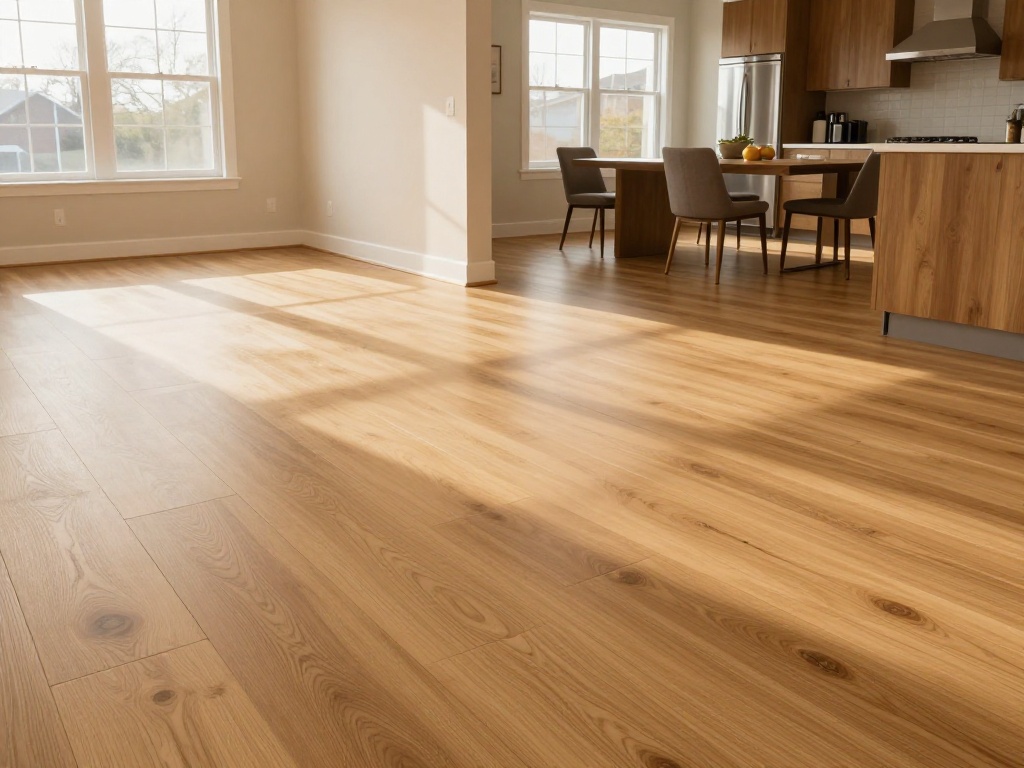
Luxury Vinyl Plank
Flooring in
Northern Virginia:
The Complete
LVP Installation
Guide.
LVP is the fastest-growing flooring choice in Northern Virginia — and for reasons that are specific to NoVA's housing stock. Concrete slabs, finished basements, condo HOA requirements, and humid summers all make LVP's particular properties more relevant here than in drier, lower-density markets.
- LVP (Luxury Vinyl Plank) is 100% waterproof in SPC construction — not water-resistant, not water-tolerant, but fully impervious to moisture — making it the correct specification for Northern Virginia's finished basements, concrete slab main levels, and any room with plumbing exposure.
- Wear layer thickness is the most important specification decision — 20 mil is the residential standard for NoVA main living areas; anything below 12 mil is builder-grade and not appropriate for primary rooms in active households.
- SPC core vs. WPC core matters for Northern Virginia's climate — SPC (Solid Polymer Core) is denser and more dimensionally stable across humidity swings than WPC (Wood Plastic Composite), making it better suited to NoVA's high summer humidity and temperature cycling.
- NoVA's concrete slab prevalence makes LVP the natural specification — solid hardwood cannot be installed on concrete; engineered hardwood requires careful moisture testing; LVP floats over concrete with no moisture barrier needed in most conditions.
- HOA acoustic requirements in NoVA condos and townhomes require acoustic underlayment — LVP without underlayment achieves IIC 40–50; most NoVA HOAs require IIC 50 minimum; the underlayment product must be verified to achieve the combined IIC rating together with the LVP.
- Floors and Beyond installs LVP throughout Fairfax, Loudoun, Prince William, and Arlington with in-house crews, free subfloor assessment, HOA documentation review, and written estimates at no charge.
Luxury vinyl plank has gone from a niche renovation product to the dominant flooring choice in Northern Virginia in under a decade — and the reasons are specific to how NoVA homes are built and how NoVA households live in them. The region's high summer humidity, its prevalence of concrete slab construction in post-2000 colonials and townhomes, its density of condo and townhome communities with HOA acoustic requirements, and its finished-basement culture all create conditions where LVP's particular combination of waterproof core, dimensional stability, and floating installation addresses real problems that hardwood and laminate cannot.
Floors and Beyond has installed LVP across Northern Virginia since the product became commercially viable in its current SPC form — and this guide covers what actually matters in a NoVA LVP installation: core type, wear layer specification, subfloor requirements by housing type, and HOA acoustic compliance for the condo and townhome installations that make up a significant portion of the region's housing stock.
What Is LVP Flooring — and What Makes It Different
LVP (Luxury Vinyl Plank) is a multi-layer synthetic flooring product manufactured to replicate hardwood appearance while being 100% waterproof — a property no real wood product can match, and the primary reason for its growth in Northern Virginia's humidity-affected housing stock.
Understanding LVP's layer structure explains both its advantages and its limitations — and why the specification decisions (core type, wear layer, underlayment) matter more than the appearance decisions (color, width, surface texture).
Wear Layer Specification — The Decision That Determines LVP Lifespan
Wear layer thickness is the single most important LVP specification decision. Every other characteristic — core type, plank width, surface texture, color — affects the floor's appearance. Wear layer thickness determines how long it keeps that appearance under traffic.
The wear layer found in most builder-installed LVP in new construction. Adequate for very low-traffic areas (guest bedrooms, storage rooms) but will show visible wear within 3–5 years in any primary living area with normal household traffic. Floors and Beyond does not specify 6–8 mil wear layer for any Northern Virginia main living area, kitchen, or hallway.
Appropriate for bedrooms, home offices, and lower-traffic secondary rooms where pet nails and furniture drag are not primary concerns. In Northern Virginia households with dogs or cats, 12 mil may show pet nail marks within 5–8 years in medium-traffic areas. Floors and Beyond recommends 12 mil as the minimum for any room where it is specified, but recommends 20 mil for any room with pet or child activity.
The specification Floors and Beyond recommends for all main living areas, kitchens, hallways, and stair applications in Northern Virginia homes. 20 mil wear layer handles pet nails, furniture leg drag, rolling chair use, and normal family traffic without visible degradation across a 15–20 year product lifespan. This is the correct specification for the majority of Northern Virginia LVP installations.
The appropriate specification for Northern Virginia entry halls that receive heavy tracked-in abrasion from road salt and outdoor shoes, rental properties where accelerated wear is a budget concern, home gyms, and any commercial or semi-commercial application. At 28–40 mil, the wear layer is essentially immune to any residential traffic pattern. Costs more per square foot but delivers a product lifespan that justifies the premium in high-wear contexts.
NoVA Subfloor Conditions — What LVP Requires by Housing Type
Northern Virginia's housing stock includes three primary subfloor conditions — each with different LVP installation requirements. The subfloor assessment is the first step of every Floors and Beyond NoVA LVP installation.
The most common subfloor condition in Northern Virginia's newer housing stock. Concrete slab construction dominates townhomes built from the 1980s onward and many post-2000 single-family colonials in Ashburn, Woodbridge, and Loudoun County communities. LVP is the ideal product for concrete slabs — it floats without adhesive (eliminating the adhesion failure risk that affects glue-down products), tolerates the residual moisture vapor emission that most NoVA slabs produce, and can be installed in one day for a standard-size main level.
The one requirement for concrete slab LVP installation: the slab must be flat within 3/16 inch over 10 feet. Floors and Beyond measures flatness during the subfloor assessment and performs self-leveling compound application where needed before installation.
Older Northern Virginia single-family homes — pre-1990 construction in Fairfax, Arlington, Alexandria, and the established parts of Loudoun and Prince William — typically have plywood or OSB subfloor over joists. LVP installs equally well over wood subfloor, though squeaky or springy boards should be secured before installation and any high spots sanded flat. The floating click-lock installation system is the same as on concrete — no adhesive, no acclimation.
Northern Virginia renovation projects frequently involve installing LVP over existing flooring. LVP can be installed over most existing hard flooring — tile, hardwood, old LVP — if the existing surface is flat, securely adhered, and the combined floor height doesn't create threshold or door clearance issues. This saves the cost and labor of subfloor demo and is a common scenario in kitchen renovations and main-level updates. Floors and Beyond assesses existing flooring condition during the consultation to confirm it qualifies as a suitable LVP substrate.
LVP vs. Other Flooring Options for Northern Virginia Homes
How LVP compares to hardwood, engineered hardwood, and laminate across the criteria that matter most in Northern Virginia's housing and climate context.
| Criteria | LVP (SPC) | Solid Hardwood | Engineered Hardwood | Laminate |
|---|---|---|---|---|
| Waterproof | ✓ 100% waterproof core | ✗ Moisture causes swelling and cupping | Surface resistant; not waterproof through | ✗ HDF core absorbs moisture — swells and delaminates |
| Concrete slab installation | ✓ Ideal — floating install, no moisture concern | ✗ Not appropriate — moisture vapor causes failure | Possible with moisture barrier and testing | ✗ HDF core moisture risk on concrete |
| NoVA summer humidity | ✓ Dimensionally stable — SPC doesn't expand | ✗ Expands and contracts — seasonal gapping | More stable than solid; still some movement | ✗ HDF expands with humidity — joint failure |
| Finished basement | ✓ First-choice specification | ✗ Never appropriate below grade | Possible with careful moisture control | ✗ Not appropriate below grade |
| Refinishing / longevity | Cannot be refinished — replaced when worn | ✓ Can be refinished 3–5× — 50+ year lifespan | 1 light sanding possible; 20–30 yr lifespan | ✗ Cannot be refinished — replaced when worn |
| Resale value perception | Increasingly valued; buyer preference varies | ✓ Premium perception; appraiser value recognition | ✓ High perceived value | Budget perception; modest resale premium |
| Installation timeline | ✓ 1–2 days — no acclimation required | 2–3 days — 3–5 day acclimation required first | 2–3 days — acclimation required | ✓ 1–2 days — acclimation helpful but brief |
From Floors and Beyond
"LVP is the right choice for a lot of Northern Virginia projects — but not all of them. A pre-war single-family home in Lyon Village with original hardwood that's still in refinishable condition is a hardwood refinishing project, not an LVP installation. A finished basement in Woodbridge on a concrete slab is an LVP project. The consultation determines which situation each homeowner is actually in."
Floors and Beyond installs LVP throughout Fairfax, Loudoun, Prince William, and Arlington — free subfloor assessment, HOA review, wear layer recommendation, and written estimate at no charge.
Schedule a Free LVP ConsultationFrequently Asked Questions — LVP Flooring in Northern Virginia
What is luxury vinyl plank (LVP) flooring?
Luxury vinyl plank (LVP) is a multi-layer synthetic flooring product that replicates hardwood appearance through a high-resolution photographic print layer protected by a transparent wear layer. Unlike solid hardwood, LVP is 100% waterproof in SPC (Solid Polymer Core) construction, dimensionally stable across humidity changes, and suitable for installation on concrete slabs without a moisture barrier in most conditions. In Northern Virginia, LVP is commonly specified for finished basements, concrete slab main levels, condo and townhome installations with HOA acoustic requirements, and kitchen and dining area renovations.
What wear layer thickness should I choose for LVP in a Northern Virginia home?
Wear layer thickness is the most important LVP specification decision. 6–8 mil is builder-grade and not recommended for primary living areas. 12 mil is appropriate for bedrooms and lower-traffic secondary rooms. 20 mil is the standard specification Floors and Beyond recommends for all main living areas, kitchens, hallways, and stair applications in Northern Virginia homes — it handles pet nails, furniture drag, and normal daily traffic without visible degradation across a 15–20 year product lifespan. 28–40 mil is appropriate for entryways, rental properties, and commercial applications where maximum durability is the priority.
Does Floors and Beyond install LVP flooring in Northern Virginia?
Yes. Floors and Beyond installs LVP flooring throughout Northern Virginia — Fairfax, Loudoun, Prince William, and Arlington counties — including finished basements, main living levels, condos and townhomes with HOA acoustic requirements, and whole-home LVP installations. All installation is performed by in-house crews only; no subcontractors. Free shop-at-home consultations are available throughout Northern Virginia, including subfloor assessment, wear layer specification, HOA documentation review, and written estimates at no charge.
Can LVP be installed in a finished basement in Northern Virginia?
Yes — LVP in SPC construction is the first-choice specification for Northern Virginia finished basements on concrete slabs. Solid hardwood cannot be installed below grade due to moisture vapor. Engineered hardwood requires careful moisture testing and is not appropriate if vapor emission levels are elevated. SPC LVP tolerates the residual moisture vapor emission that most Northern Virginia slabs produce, installs without adhesive, and provides the waterproof core that makes below-grade moisture incidents manageable rather than catastrophic. Floors and Beyond performs a subfloor flatness check during the consultation and specifies any leveling compound needed before installation.
// Free LVP Consultation · Northern Virginia
Find Out If LVP Is
Right for Your
Northern Virginia
Home.
Floors and Beyond assesses your subfloor, reviews HOA documentation where needed, recommends the right wear layer for your specific rooms, and provides a written estimate — at no charge. In-house crews throughout Fairfax, Loudoun, Prince William, and Arlington. Since 1987.
Schedule a Free Consultation



